A Prayer of Confession and Contrition (Nehemiah 9:16-25)

But they—our own ancestors—acted arrogantly.
They became stubborn and wouldn’t obey your commands.
They refused to listen.
They forgot the miracles you performed for them.
They became stubborn and appointed a leader
to take them back to slavery in Egypt.
But you are a forgiving God,
one who is compassionate, merciful, patient,
and always ready to forgive.
You never abandoned them,
even when they made a metal statue of a calf for themselves
and said, ‘This is your god who took you out of Egypt.’
They committed outrageous sins.
But because of your endless compassion,
you didn’t abandon them in the desert.
The column of smoke didn’t leave them during the day,
but it led them on their way.
The column of fire didn’t leave them during the night,
but it gave them light to see the way they should go.
You gave them your good Spirit to teach them.
You didn’t keep your manna to yourself.
You gave them water to quench their thirst.
You provided for them in the desert for 40 years,
and they had everything they needed.
Their clothes didn’t wear out, and their feet didn’t swell.

You gave kingdoms and nations to the Israelites
and assigned them their boundaries.
So they took possession of the land of Sihon,
the land of the king of Heshbon,
and the land of King Og of Bashan.
You made their children as numerous as the stars in the sky.
You brought them into the land you told their parents to enter and possess.
Their children took possession of the land.
You defeated for them the Canaanites, who lived in the land.
You handed the Canaanite kings and their people over to them
to do whatever they wanted with the Canaanites.
The Israelites captured fortified cities and a rich land.
They took possession of houses filled with all sorts of good things,
cisterns, vineyards, olive trees,
and plenty of fruit trees.
So they ate and were satisfied and grew fat.
They enjoyed the vast supply of good things you gave them. (God’s Word Translation)

The Jewish people had experienced the Babylonian Captivity. The walls of Jerusalem had been torn down, and the Temple was ransacked and destroyed.

Years later, the Persians overthrew the Babylonians, and many of the Jewish captives were allowed to return to Judea. One of the returning groups was led by Nehemiah, who was a cupbearer to the king.

Nehemiah engaged in an ambitious project of rebuilding Jerusalem’s wall and securing the city. It was a large undertaking. Yet, even more daunting was restoring the Jewish people’s worship of Yahweh, and following the Torah, God’s law.

Today’s Old Testament lesson takes place in the fifth century B.C.E. Nehemiah, along with the religious leader Ezra the scribe, organized a public assembly. The people listened to the Torah being read, and were fasting, confessing, and repenting of the ways they had neglected God’s law.

A group of Levites (the priests) stood up and said a long prayer of confession. Our verses for today are a part of that extended time of confession of sin and profession of faith. The people’s past history was very much a part of their present circumstances.

The Levities emphasized that it is God’s nature to be full of faithfulness and steadfast love. So, the Lord preserved the Israelites and rescued them out of Egyptian slavery through a series of miraculous wonders.

While their ancestors were out in a desert sojourn, anticipating entry into the Promised Land, God was faithful to provide for the Israelites both physical and spiritual food – Torah and manna.

And yet, despite the incredible rescue from Egypt, and miraculously escaping through the Red Sea, the people were rebellious. Their disobedience to God in the golden calf experience prevented that generation from entering into the promised rest. (Hebrews 3:16-19)

Every generation has its “sinners,” those who seem to have a bent toward selfish behavior, and refuse to see the needs of the entire group. They only serve God if it serves their own self-centered purposes. And they stubbornly refuse to bend to anyone’s wishes, including God’s.

Unfortunately, that sin of pride and arrogance gets passed down to the next generations. It’s not only, in some ways, taught; this sort of stubbornness also appears to have a genetic component, as well. Whenever our minds and hearts are rewired with injustice toward others and disobedience toward God, that wacky wiring gets passed down to the next generations.

It is quite likely that past trauma has a lot to do with skewed minds and hearts.

Epigenetics is a scientific field which investigates how environment influences our genes. Trauma does not alter our actual DNA sequence; but it does impact how that sequence is read and utilized in our body.

When an individual experiences trauma, their body may adapt by adjusting gene expression, and some of these changes can be passed on to their children. It’s like passing on genetic notes to our progeny – which means that these notes can be rewritten (and rewired) by our own life experiences and actions.

I am not a genetic scientist, yet this may be something akin to the divine warning about generational sin, arising from a generation’s trauma experience, after being enslaved and mistreated for 400 years in Egypt. In giving the Law to Moses, God then said:

“The Lord, the Lord, the compassionate and gracious God, slow to anger, abounding in love and faithfulness, maintaining love to thousands, and forgiving wickedness, rebellion and sin. Yet he does not leave the guilty unpunished; he punishes the children and their children for the sin of the parents to the third and fourth generation.” (Exodus 34:6-7, NIV)

Whether any of us knows anything about genetics and epigenetics, or not, there yet remains the need for a prayer of confession. It is necessary to acknowledge our own sins, as well as the sins of our ancestors.

In their prayer of confession, the Levites in Nehemiah’s time acknowledged and confessed their own guilt, and the guilt of their ancestors, of being the following:

  1. Obstinate. They stubbornly presumed God would be with them, then obstinately did whatever the heck they wanted.
  2. Stubborn. They were “stiff-necked” and refused to obey God when they didn’t want to.
  3. Forgetful. Not an accidental forgetting, but a purposeful neglect to remember what God had done for the people.
  4. Idolatrous. It was the people’s impatience with waiting for Moses on Mount Sinai that led to the golden calf idol disaster. Failing to accept God’s timetable will always lead to a bevy of bad behavior.
  5. Disobedient. The most sinister form of this is obeying halfway, and believing that you have completely done your duty for God, i.e. the sin of one person, Achan, affecting the entire community. (Joshua 7:1, 10-12, 20-26)
  6. Complaining. Murmuring and grumbling is the dissatisfying attitude and speech of ingrates. When directed at God, it is a failure of faith, replaced with a belief that God is mean and/or capricious.

Confession and repentance are the remedies to both individual and communal guilt. And that is exactly what Ezra and Nehemiah organized the post-exilic Israelites to do, publicly.

Not only did they offer a prayer of confession and repentance, but they also acknowledged and believed God’s faithfulness and mercy to forgive, renew, and restore.

Indeed, God’s grace is greater than all of our sin.

The Levites were not simply offering a mechanical liturgical formula for corporate confession. They were crying out with heartfelt confession to the God they believed was listening and would respond.

As the Levites led the people in confession and repentance, they pointed to the following attributes and activities of God which they put all of their trust in:

God forgives.

He made known his ways to Moses,
    his deeds to the people of Israel:
The Lord is compassionate and gracious,
    slow to anger, abounding in love.
He will not always accuse,
    nor will he harbor his anger forever;
he does not treat us as our sins deserve
    or repay us according to our iniquities.
For as high as the heavens are above the earth,
    so great is his love for those who fear him;
as far as the east is from the west,
    so far has he removed our transgressions from us. (Psalm 103:7-12, NIV)

God guides.

He guides me along the right paths
    for his name’s sake. (Psalm 23:3, NIV)

God provides.

He has caused his wonders to be remembered;
    the Lord is gracious and compassionate.
He provides food for those who fear him;
    he remembers his covenant forever. (Psalm 111:4-5, NIV)

God sustains.

I lie down and sleep;
    I wake again, because the Lord sustains me. (Psalm 3:5, NIV)

When all is said and done, the centrality of God is humanity’s ballast. As we orient all of life around the Lord, this is what makes all the difference in coming to grips with our past, present, and future.

May it be so, to the glory of God.

Celebration and Lament (Matthew 2:13-18)

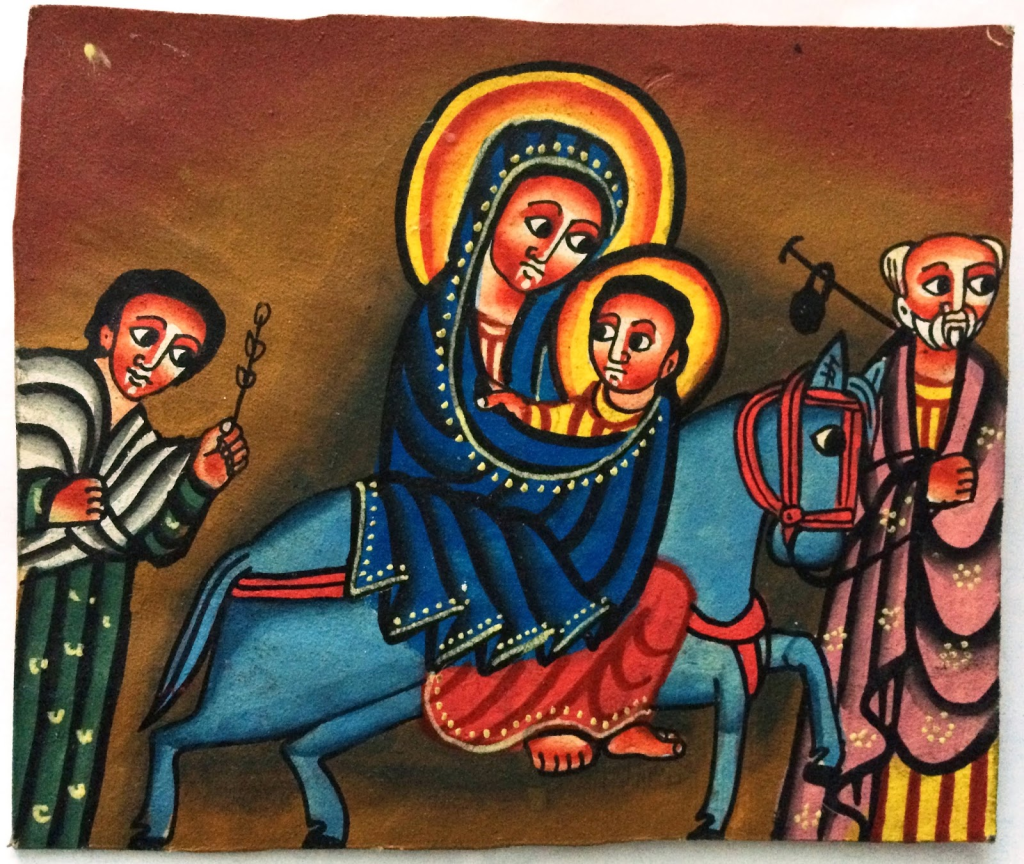
Coptic Church depiction of the holy family in Egypt

Now after they had left, an angel of the Lord appeared to Joseph in a dream and said, “Get up, take the child and his mother, and flee to Egypt, and remain there until I tell you, for Herod is about to search for the child, to destroy him.” Then Joseph got up, took the child and his mother by night, and went to Egypt and remained there until the death of Herod. This was to fulfill what had been spoken by the Lord through the prophet, “Out of Egypt I have called my son.”

When Herod saw that he had been tricked by the magi, he was infuriated, and he sent and killed all the children in and around Bethlehem who were two years old or under, according to the time that he had learned from the magi.Then what had been spoken through the prophet Jeremiah was fulfilled:

“A voice was heard in Ramah,
    wailing and loud lamentation,
Rachel weeping for her children;
    she refused to be consoled, because they are no more.” (New Revised Standard Version)

Smack in the middle of the great celebration of Christ’s birth is a great lament. That’s because not everyone views the birth of Jesus with joy; there are others who see it as a threat and want to stamp it out.

We are humans, with two ears, two eyes, two hands, two feet, two lungs, and two kidneys. Our paired organs exist because we need the two of them in order to function properly. Joy and sadness, celebration and lament, are emotionally paired so that our soul may serve us as it is intended to. We hold them both together – at the same time, all the time – in order to have a well-rounded and healthy way of life.

In this time of year, it can be easy to gravitate towards either one or the other. We might become engrossed in all the shiny things of the season; or we may get lost by all the sorrows which the season stirs up for us.

I invite you to approach the mundane and simple manger. Although it might seem dull and unattractive – the last place you may find wholeness and peace – it is truly the place where we find God. It is here that both our joys and our sorrows meet, because among the stinky animals and the lower class life we shall actually discover the real longing of our hearts.

The gracious and almighty God preserved and protected the child Jesus. Christ’s early life retraced the life of ancient Israel. Like the Jewish patriarchs, Jesus went down to Egypt (and would eventually go down and face hell for us in his crucifixion); and, like the ancient Israelites, Jesus was brought up out of Egypt (and would rise from the dead bringing freedom from sin and death once for all) in a New Exodus.

It is as if the disciple Matthew means to connect the two Testaments as a unified whole by saying, “Look, here is the Messiah, the coming King, the promised One of Israel and of all the nations. Jesus is our salvation, the fulfillment of all that we have hoped for.”

Jesus is the New Exodus

In the second of three dreams, Joseph is told to take Jesus to Egypt. Joseph obeyed the Lord and took responsibility for the role of protecting Jesus, as contrasted with Herod’s role in attempting to murder Jesus.

Yet, there is more to this story than Christ’s protection; this is the fulfillment of a biblical pattern, an identification of Jesus with the people of God. Matthew pulled forward the prophet Hosea to say that just as God brought the Israelites out of Egypt through a great deliverance, God brought up Jesus, the Great Deliverer, out of Egypt as the unique Son of God.

Ethiopian Orthodox icon of the holy family fleeing to Egypt

When we hold the pair of Testaments together in both hands, we feel the weight of Jesus as God’s divine Son; so therefore, Christ is the rightful Ruler in God’s kingdom.

Just as God preserved Israel from Pharaoh’s wrath, the Lord protected Jesus from Herod’s wrath. God’s kindness and loyalty extends to us as covenant people and preserves us from the wrath of the devil who seeks to keep as many people as possible in the realm of darkness.

Our hope is in the Lord Jesus, who conquered the devil by establishing a beachhead on this earth through an incarnation as the Son of God.

Jesus Brought Us Out of Exile

The scoundrel King Herod massacred innocent toddlers to ensure the destruction of Jesus. Behind his atrocity was the devil himself, who knew Jesus was the coming king who would one day bring salvation. Reflecting on a vision of Christ’s birth, the Apostle John identified the sinister plan and the divine deliverance:

The dragon stood in front of the woman who was about to give birth so that when she gave birth, he might devour her child. She gave birth to a son, a male child who is to rule all the nations with an iron rod. Her child was snatched up to God and his throne. (Revelation 12:4-5, CEB)

Satan wars against God’s Son and God’s people, whose roots go all the way back to the first prophecy of Christ after the Fall of humanity. God declared to Satan:

“And I will cause hostility between you and the woman,
    and between your offspring and her offspring.
He will strike your head,
    and you will strike his heel.” (Genesis 3:15, NLT)

There has been continual enmity ever since, between the serpent and the seed of the woman. It manifests itself with the Israelites constantly being threatened with extermination and tempted to conform to pagan ways.

King Herod was just another in a long line of demonically animated persons trying to perpetuate the kingdom of darkness. We must take this threat seriously because the devil knows that his time is short. A second Advent is coming which will be the final judgment.

Satan’s most powerful weapon, death, has lost its sting because of Jesus. Christmas is a hard time of year for many people, filled with depression instead of joy, grieving over lost loved ones for whom we will not spend another Christmas with.

Yet there is a reunion coming, the hope of a bodily resurrection in which we will be with Jesus and God’s people forever. Be encouraged to understand that there is no time in heaven; it will be only a moment and the people who have gone before us will turn around and see us; we will one day join them.

Matthew also used the prophet Jeremiah to communicate hope. Jeremiah’s prophecy dealt with children who were lost in war to the invading Babylonians. The prophecy is a lament with the hope that captivity will not be forever.

The disciple Matthew wanted us to see that the exile is over for us; Jesus has arrived, and the tears which were shed will shortly dry up. There may be a time of suffering we must endure, but there will be glory. Jesus is the Great Deliverer who brings us out of sin’s captivity and into the promises of God. He is our hope.

Jesus is the promised One who will deliver us from the tyranny of the devil. Christ is the hope of the nations, the Savior of the world. So, let us come back to the first Christmas which was the beginning of the end for evil on the earth.

Believers in Jesus are part of God’s victory, and they overcome the evil one by the blood of the lamb, acknowledging that Christ’s incarnation was essential for us. 

Just as Jesus made a radical break with his former life in heaven through the incarnation, we, too, must break with our old way of life.

God will save the people through this child Jesus. The greatest gift we can give in this season and throughout the coming year is the gift of grace, the presentation of the Christ child.

Loving God, help us remember the birth of Jesus so that we may share in the song of the angels, the gladness of the shepherds, and the wisdom of the wise men.

Close the door of hate and open the door of love across the world.

Let kindness come with every gift and good desires with every greeting.

Deliver us from evil through the blessing of the Christ child.

Teach us to be happy with pure hearts.

Grant us grateful thoughts, devoted hearts, and gracious hands, through Jesus our Savior in the might of the Holy Spirit. Amen.

God Is Good, Idols Are Bad (2 Kings 17:7-20)

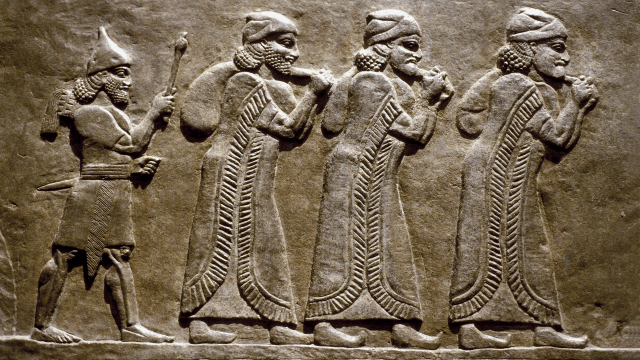
 An Assyrian solider deporting people from their land (From the Southwest Palace of Tiglath-Pileser III at Nimrud, ca. 730-727 B.C.E.; British Museum.)

The Israelites sinned against the Lord their God, who brought them out of Egypt and rescued them from the power of Pharaoh (the king of Egypt). They worshiped other gods and lived by the customs of the nations that the Lord had forced out of the Israelites’ way. They also did what their kings wanted them to do.The Israelites secretly did things against the Lord their God that weren’t right:

They built for themselves illegal places of worship in all of their cities, from the smallest watchtower to the largest fortified city.

They set up sacred stones and poles dedicated to the goddess Asherah on every high hill and under every large tree.

At all the illegal places of worship, they sacrificed in the same way as the nations that the Lord had removed from the land ahead of them.

They did evil things and made the Lord furious.

They served idols, although the Lord had said, “Never do this.”

The Lord had warned Israel and Judah through every kind of prophet and seer, “Turn from your evil ways, and obey my commands and decrees as I commanded your ancestors in all my teachings, the commands I sent to you through my servants the prophets.” But they refused to listen. They became as impossible to deal with as their ancestors who refused to trust the Lord their God. They rejected his decrees, the promise he made to their ancestors, and the warnings he had given them. They went after worthless idols and became as worthless as the idols. They behaved like the nations around them, although the Lord had commanded them not to do that. They abandoned all the commands of the Lord their God:

They made two calves out of cast metal.

They made a pole dedicated to the goddess Asherah.

They prayed to the entire army of heaven.

They worshiped Baal.

They sacrificed their sons and daughters by burning them alive.

They practiced black magic and cast evil spells.

They sold themselves by doing what the Lord considered evil, and they made him furious.

The Lord became so angry with Israel that he removed them from his sight. Only the tribe of Judah was left. Even Judah didn’t obey the commands of the Lord their God but lived according to Israel’s customs. So the Lord rejected all of Israel’s descendants, made them suffer, handed them over to those who looted their property, and finally turned away from Israel. (God’s Word Translation)

The Flight of the Prisoners, by James Tissot, 1898, depicting the Babylonian exile from Jerusalem

The prophets had warned the northern kingdom of Israel; but they did not listen, nor did they heed the prophetic utterance. Israel then stood as an example and a warning to the southern kingdom of Judah; yet they, too, refused to learn from their brother’s downfall.

And even before the kingdom was split between Israel in the north and Judah in the south, the ancient Israelites had a troubling tendency to buck the Lord’s instructions and find other more and creative ways of expressing themselves spiritually.

Every generation of people are responsible for their own spirituality and their own actions in life. We, in our contemporary time and place, need to learn the lessons of the past – for we also are not an exception in history, as if we can do whatever we want without attending to the common good of all persons and worshiping in any sort of way we want.

The trouble with the ancient worshipers of Yahweh is that they decided to pick and choose whatever commands they wanted to follow, or not. They went through continual times of idolatry and forgot about God and God’s Word to them.

To respect and revere the Lord is to obey God’s instructions. To worship Yahweh is to have an undivided allegiance to God and God’s commands. The failure to obey is really a failure of faith.

The prophets Amos, Hosea, Micah, and Isaiah specifically called out the sinful practices of the people and their negligence in upholding basic social and economic justice for everyone. They condemned violence and oppression of the poor; and expressed the divine displeasure with taking advantage of the disadvantaged.

How to treat people and live well were explicitly spelled out in the entirety of God’s Law. Yet, the leaders and the people, as a whole, decided to go another way. They kept introducing idolatrous and unhealthy forms of worship and living. And it led to their ruin.

The ancient people were continually offered grace if they would only accept it. They could return to the Lord and come back to the true worship and obedience of the God who had rescued them from trouble again and again. Turning from their unholy practices, and turning back to Yahweh, would reverse God’s impending judgment. Yet, tragically, the people did not listen.

Idolatry is a failure to trust God, and to rely instead on something else which is not able to sustain a life. Unfortunately, those who create a god according to their own liking end up becoming like the thing they worship, that is, worthless.

The tragedy of the Israelites is that they were to be God’s people, the Lord’s treasured possession, a kingdom of priests, and a holy nation which brings blessing to the earth. Instead, they traded their meaning and purpose in life to imitate everyone else around them.

Sadly, people have felt throughout history, and even we ourselves today, that there is something else, other than God, that we need in order to be happy – something more important to your heart than the Lord – whether it is human acceptance and approval, social reputation, political power and control, or financial advantage and privilege.

Idolatry creates an ignoring of the divine in our life. We might even have the chutzpah to think we can challenge God, like some small yippee pup who growls and takes on the big dog, who knows that with an effortless paw across the body, could toss the prideful pup away.

Like a mother bird who scours the land for food to sustain the babies, and brings it back to their gaping mouths, God longs to provide us with a good and beautiful life – if we will but only receive it.

Listen, my people, I’m warning you!
    If only you would listen to me, Israel.
There must be no foreign god among you.
    You must not bow down to any strange deity.
I am the Lord your God,
    who brought you up from Egypt’s land.
    Open your mouth wide—I will fill it up! (Psalm 81:8-10, CEB)

O Lord, as you gave us the greatest commandment, to love you with all our heart, soul, strength and mind, help us to love you above all else, putting you above the potential idols in our lives, including success, fame and wealth. May your benevolent kingdom come, and your moral and ethical will be done, here on this earth for this time, as it is always done in your heaven. Amen.