Good News Is for Everyone (Isaiah 56:1, 6-8)

This is what the Lord says:

“Maintain justice
    and do what is right,
for my salvation is close at hand
    and my righteousness will soon be revealed….

And foreigners who bind themselves to the Lord
    to minister to him,
to love the name of the Lord,
    and to be his servants,
all who keep the Sabbath without desecrating it
    and who hold fast to my covenant—
these I will bring to my holy mountain
    and give them joy in my house of prayer.
Their burnt offerings and sacrifices
    will be accepted on my altar;
for my house will be called
    a house of prayer for all nations.”
The Sovereign Lord declares—
    he who gathers the exiles of Israel:
“I will gather still others to them
    besides those already gathered.” (New International Version)

Issues of identity

Ever since the Jewish people existed – for the past 4,000 years – there have been other people and other nations who have conquered them, displaced them, and have even tried to annihilate them altogether, several times throughout history.

A seminal experience for ancient Israel was when God’s temple was destroyed and the people taken into exile in Babylon. Generations later, many faithful Jews returned to Jerusalem to rebuild and reform under Nehemiah and Ezra.

Undergoing defeat, occupation, and oppression can and will do a great deal of psychological, emotional, and spiritual harm. And when it happens repeatedly, it’s easy to understand how any group of people might wonder: “Are we still God’s people? Have so many years of being in other places made us different? Who are we right now?”

These are questions of identity. For many Jews, since God allowed them to be conquered, because they did not obey the covenant, then now is the time to double-down on following the rules and proving they are truly God’s chosen people. So much so, that some (not all) insisted that their identity can only be maintained by radically separating themselves from everyone and everything foreign that is not Jewish. 

We can understand how a vulnerable people who have been attacked and conquered would be suspicious about welcoming outsiders. In fact, any sort of hospitality could be seen as a betrayal of their own struggle, and a deviation from their sense of community, identity, and integrity. 

Diversity and inclusion isn’t warm and fuzzy

So, when God comes along and shares a plan of bringing foreigners to the holy mountain, it’s scandalous. The people don’t see this as a wonderful moment of everybody getting to together, singing kumbaya, and letting bygones be bygones. Nobody in Israel is saying, “Lord, please let us gather together with a bunch of foreigners, strangers, aliens, and gentiles!”

Quite the opposite. Instead, they start circling the wagons to survive and maintain and preserve their Jewish identity. Isaiah’s message challenged the people to their core. It was not a popular idea – even coming from God – of including the other. Such change was a threat.

Welcoming strangers can be upsetting

Whenever I walk through neighborhoods in major cities and see banners in yards that say, “All Are Welcome!” and churches that emblazon that message on their signage, I wonder if they really understand what they’re saying. There are many folks who expect welcoming the stranger to feel good, to be rewarding and connect us to one another. There may be romantic notions of connecting with others with idyllic visions of new people folding seamlessly into who we already are.

The reality is typically much different than that. We are surprised and disheartened when others don’t think or act like we do, and having them around feels awkward. They’re upsetting the status quo and making the group into something I don’t like. It might be something like your crazy uncle who shows up on holidays and makes everything weird. 

The thing we must face and contend with is this: Strangers, foreigners, immigrants, and anyone different from ourselves, often bring God’s own message to us, coming in amongst us to disrupt and transform. Strangers bring strange practices; foreigners bring foreign worldviews; and different people bring different practices and ideas we aren’t familiar with. But why in the world would we ever be surprised that strangers are strange!? 

What in God’s name is going on?

On God’s holy mountain, people are gathered around values, ethics, and obedience. Community and being together with the Lord is defined by faith, and not by simply signing off on a list of approved beliefs and doctrinal statements. God makes it clear that faithfulness, even of foreigners, will determine who is brought into the house of prayer for all people. Deliverance is offered to those who walk the walk and don’t just talk the talk.

What’s more, deliverance does not involve revenge, nor assurances that bad things will never happen again. Instead, salvation means freedom to pray and be connected to God. This is what God wants. And so, the Lord will bring and gather faithful people from all over – both Jew and Gentile. They will all dwell together in God’s house with much joy.

An invitation for belonging

We find words in today’s text having to do with a sense of belonging: house, accepting, prayer, gather. Isaiah puts forth a compelling vision of life with God, where we belong and have community. At the heart of God is a hospitality which invites all kinds of people to come and enjoy the divine presence and being with one another.

At the time of Christ’s incarnation, the angels showed up and announced good news of great joy to all people. And yet, far too many persons, perhaps out of sense to guard against outsiders hurting them, turn this gracious message on it’s head by announcing bad news of great judgment to all people that aren’t like me and don’t think like me.

Christ’s Church has struggled through its history to invite and include the other, and to uphold this basic message of gracious good news for everyone.

From the Council of Jerusalem that met to decide whether one ought to become a Jew first in order to be a Christian (Acts 15), to withholding membership to African Americans in certain churches in the 20th century, to the just plain ignoring of the poor and marginalized in many places, we must be intentional and deliberate about reaching and ministering to all people.

The joy of salvation is that I do not need to jump through certain spiritual hoops to enter into Christianity, nor be a certain kind of person. The church is not an exclusive club of one particular sort of people based in race, gender, ethnicity, class, spiritual pedigree, or even certain preferences on issues. Through repentance and faith in Jesus, all may come to God.

All people have intrinsic worth as individuals created in the image of God, and therefore need the attention of Christians in bringing the gospel to them. It is much too easy to ignore people we do not understand and who are different from us, or to look down on those who do not agree with me on disputable matters.

When it comes to the good news of Jesus, having people out of sight does not mean we keep them out of mind. Too many people are often off the radar of many churches for a variety of reasons, not the least of which is because the poor and needy have to compete with the wealthy and powerful for attention. To intentionally reach and minister to a different class or generation or race requires much love and many resources.

How big is your inner space?

Jesus had a big enough inner space to accommodate prostitutes, drunks, tax collectors, and a whole variety of sinners. Do you and I have a big enough space to allow people in our lives who are not like us, without feeling threatened or insecure? The Pharisees feared being contaminated if having table fellowship with such people; the Sadducees were afraid of losing their religious power if the status quo was changed to focus on others; and the Zealots feared continued Roman domination if Jesus kept up spending his time in graciousness to all kinds of sinners. So, all the religious people killed him.

The gospel of Jesus is good news of great joy for everyone. We are to work together to propagate this message by having the shared purpose of evangelism to everyone without discrimination. When we engage in this critical endeavor together, there is tremendous joy. We are meant to gather on God’s holy mountain and share with all sorts of people.

Blessed Lord God, through your Son you commanded us to go into all the world and proclaim good news to every creature. Increase our faith and zeal, that we may more earnestly desire the salvation of all people.

We confess that our hearts are often indifferent and dull to your cry of mission. Forgive our callousness and judgmentalism toward others, and by your Holy Spirit fill us with a burning zeal to bring light into darkness. Give us loving hearts, sincerity of speech, and holiness of life.

Knowing that this world, as it is now, will not last forever, drawing to a close, may we by your Spirit’s prompting, support the mission of this church with our personal witness, our earnest prayers, and our sacrificial gifts. Grant that through us many may be included on your holy mountain, through Jesus Christ, your Son, our Lord, who with you and the Holy Spirit reign as one God, now and forever. Amen.


Good News for All (Acts 8:26-40)

11th century Byzantine depiction of Philip and the Ethiopian eunuch

An angel from the Lord said to Philip, “Get up, and take the desert road that goes south from Jerusalem to Gaza.” So Philip went.

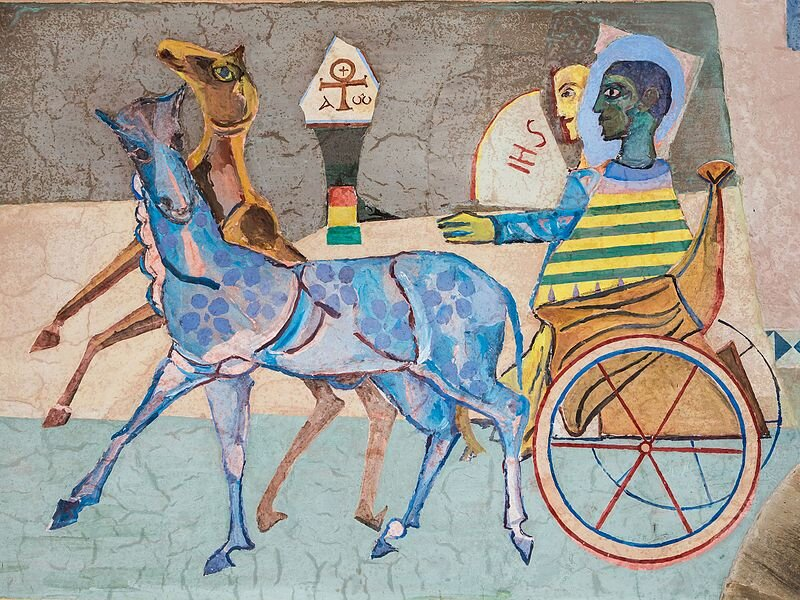
An Ethiopian man who had come to Jerusalem to worship was on his way home. The man was a eunuch, a high-ranking official in charge of all the treasures of Queen Candace of Ethiopia. As the official rode along in his carriage, he was reading the prophet Isaiah out loud.

The Spirit said to Philip, “Go to that carriage, and stay close to it.”

Philip ran to the carriage and could hear the official reading the prophet Isaiah out loud. Philip asked him, “Do you understand what you’re reading?”

The official answered, “How can I understand unless someone guides me?” So he invited Philip to sit with him in his carriage.

This was the part of the Scriptures that the official was reading:

“He was led like a lamb to the slaughter.
He was like a sheep that is silent
when its wool is cut off.
He didn’t open his mouth.
When he humbled himself,
he was not judged fairly.
Who from his generation
will talk about his life on earth being cut short?”

The official said to Philip, “I would like to know who the prophet is talking about. Is he talking about himself or someone else?” Then Philip spoke. Starting with that passage, Philip told the official the Good News about Jesus.

As they were going along the road, they came to some water. The official said to Philip, “Look, there’s some water. What can keep me from being baptized?”  The official ordered the carriage to stop. He and Philip stepped into the water, and Philip baptized him. When they had stepped out of the water, the Spirit of the Lord suddenly took Philip away. The official joyfully continued on his way and didn’t see Philip again.

Philip found himself in the city of Azotus. He traveled through all the cities and spread the Good News until he came to the city of Caesarea. (God’s Word Translation)

We are in the Christian season of Epiphany – a time of celebrating that the light of the Lord has been given not only to Jews but to Gentiles, as well. The good news of mercy, forgiveness, salvation, and peace in Jesus Christ is for everyone, and not just some.

So, we have a very appropriate story in today’s New Testament lesson illustrating God’s grace for those who have been typically the “outsiders” when it comes to the worship of God.

God’s grace is really a merciful divine intervention into another’s life, providing something a person or group needs, yet cannot obtain on their own.

Philip, one of the original twelve disciples of Jesus, received instructions from the angel of the Lord. Take a certain road. That’s it. No other explanation. The command is, however, full of grace. Most of us don’t do all that well with multiple instructions given at once. We do much better with a single imperative at a time.

And so, the next piece of guidance came as Philip was taking the road from Jerusalem south to Gaza. Go hang out around a certain carriage. Philip needed no more direction after that; he took to what was happening.

Philip and the Ethiopian Eunuch by Herbert Boeckl

Maybe reading the story from our contemporary perspective hinders us from seeing just how scandalous and unthinkable the story was for people in the first century. Jews and Gentiles didn’t hang out with each other; and, if they did, there were all sorts of rules regulating how the interaction would go.

We really don’t have any of this with Philip. He simply emulates his Lord and ignores societal and cultural mores to meet the need of someone very different than himself.

An Ethiopian man was in Jerusalem and heading back home. He was an official in the Queen of Ethiopia’s court, and a eunuch (a castrated official). He was a person of color with a mutilated body and could have very well been of a different gender than Philip was used to. In other words, he was about as foreign from Philip as one can get.

Yet, what better way to communicate that the gospel is for everyone? Philip had learned from Jesus not to adopt the divisions of race, religion, and gender that others did. See, instead, with spiritual eyes to the heart of a person.

And this Ethiopian eunuch had a heart curious about God, a mind trying to understand God’s words, and a gut that told him this guy approaching me for whom I don’t know and isn’t from my country is perhaps God’s messenger to me.

That’s what I call a divine appointment.

Those divine encounters always result in changed lives. I believe both the Ethiopian and Philip were changed that day. The only way that any of us truly changes is through the interaction with others different from ourselves.

The good news of Jesus is for all. If, however, we remain in a closed system which is not open to others of differing cultures and communities, then we harden into believing the gospel is for us, and not them.

Christianity is not, therefore, an exclusive club made up of insiders who demonize outsiders as not looking, acting, or thinking like we do. We already have plenty of that insidious junk in the world. At its inception, Christianity was different. And, I believe, it needs to keep that edge of reaching out to all persons with a life-giving message of salvation and peace – not a death-dealing sermon of Christian cultural hegemony.

Good news for all people everywhere means that proclamation of the gospel of Jesus Christ needs to occur for all nations and ethnic peoples. It’s a message of grace, not judgment; of mercy, not threats; of open love, not closed hate.

Philip and the Ethiopian show us the way through their sensitivity to the divine, their open dialogue with one another, and their shared commitment to doing what is right and serving the Lord. Philip was a guide, not a conqueror. And the Ethiopian became a follower of Jesus, not Philip.

Let’s make sure to keep it straight; and to keep reaching out.

Lord God, thank you that in love and mercy, you reached out to us – and that when we were dead in our sins, you sent Jesus to make us alive. Thank you that you have a heart that seeks the lost. Thank you for saving us.

Give us hearts that care for the people who are in darkness and need the light of Christ. Teach us to care for them as you do. Grow us to care for the common good of all humanity. 

Help your Church everywhere to know and love you; and to invite others into your divine dance. May our conversations with others be seasoned with salt and full of grace; may our relationships show people the love of Jesus. May our hearts reflect your own heart, through Jesus Christ our Lord, in the strength of the Holy Spirit. Amen.

What’s On Your Wish List? (Acts 26:24-29)

Before Paul finished defending himself, Festus shouted, “Paul, you’re crazy! Too much learning has driven you out of your mind.”

But Paul replied, “Honorable Festus, I am not crazy. What I am saying is true, and it makes sense. None of these things happened off in a corner somewhere. I am sure that King Agrippa knows what I am talking about. That’s why I can speak so plainly to him.”

Then Paul said to Agrippa, “Do you believe what the prophets said? I know you do.”

Agrippa asked Paul, “In such a short time do you think you can talk me into being a Christian?”

Paul answered, “Whether it takes a short time or a long time, I wish you and everyone else who hears me today would become just like me! Except, of course, for these chains.” (Contemporary English Version)

The Apostle Paul was quite the guy – a zealous, indefatigable, intense, Type-A dude. Yet it wasn’t those characteristics that Paul wanted others to see in him. He simply desired others to see Christ in him. 

Having been arrested for preaching the good news of forgiveness and new life in Jesus Christ, Paul found himself before King Agrippa, engaging in a DTR (define the relationship) talk; and making a strong apologetic for the Christian faith. 

Agrippa asked Paul, “In such a short time do you think you can talk me into being a Christian?” Paul answered with confidence and conviction, “Whether it takes a short time or a long time, I wish you and everyone else who hears me today would become just like me!” 

“Trial of the Apostle Paul” by Nikolai Bodarevsky, 1875

I wonder how many of us could boldly say the same thing as Paul. 

Are we the sort of Christians that others could emulate? 

Has our faith journey led us to the place of being a solid model of what a follower of Christ should look like? 

Do we expect others to change while avoiding change ourselves? 

Do we deeply desire and work toward others coming to know Jesus? 

So, what is on your wish list?

  • I wish each Christian everywhere would spend their relational and emotional energy making this world a better place by living into the words and ways of Jesus Christ.
  • I wish every person I encounter would have the privilege of knowing Christ as I have.
  • I wish all my parishioners and patients would become what I am, except, of course, for my self-made chains.

Perhaps we all must look in the mirror and examine our true desires. It’s easy to put our energy into good yet lesser wishes in life. Yet, if Christians are to become like their ancient forefather in the faith, the Apostle Paul, we will begin focusing our energies into things such as the following:

  • Making outreach a priority. We do what is most important to us. That’s probably self-evident. But churches and believers that do not make outreach a primary priority are really making it no priority, at all.

Paul said, “Do the work of telling the Good News. Do all the duties of a servant of God.” (2 Timothy 4:5, ERV)

  • Mentoring others into the words and ways of Jesus. Many church laypersons believe that training other Christians is what we pay the clergy to do.But this is really the responsibility of every believer.

Paul said, “You have often heard me teach. Now I want you to tell these same things to followers who can be trusted to tell others.” (2 Timothy 2:2, CEV)

  • Taking responsibility for spreading the good news. Blaming and shaming gets us nowhere. Pastors complain about churches. Churches bellyache about Pastors. And both attack the culture, the denomination, or some other external scapegoat. It’s time for all of us to own what needs to be said and done.

Paul said, “Be ready to spread the word whether or not the time is right. Point out errors, warn people, and encourage them. Be very patient when you teach.” (2 Timothy 4:2, GW)

  • Connecting prayer with telling the message of Christ. It doesn’t take a lot of energy to pray for Aunt Mable’s bunions to go away. It’s altogether another thing to pray sustained, focused, and passionate prayers for the people in my life to know Christ and him crucified, risen, ascended, and coming again.

Paul said, “Don’t forget to pray for us, that God will open doors for telling the mystery of Christ… Pray that every time I open my mouth I’ll be able to make Christ plain as day to them.” (Colossians 4:3-4, MSG)

  • Being compassionate and kind, like Christ, to others. There not only needs to be a clear articulation of the gospel, but also a clear demonstration of basic human kindness. Many Christians never get the opportunity to share the gospel because they’re just downright obnoxious.

Set Christ apart as Lord in your hearts and always be ready to give an answer to anyone who asks about the hope you possess. Yet do it with courtesy and respect, keeping a good conscience. (1 Peter 3:15-16, NET)

  • Establishing every Christian ministry as an opportunity to share the gospel. Intentional effort and energy toward proclaiming the gospel in both word and deed needs to go into everything we do.

Paul said, “So take special care how you conduct yourselves. Don’t be unwise but be wise. Make use of any opportunity you have because these are wicked times we live in.” (Ephesians 5:15-16, NTE)

  • Caring, not at all, that new Christians will change our lives or our church too much. I’m serious. I’ve heard the line many times by church folk in my years of pastoral ministry that new believers come in and change things we like. Come on, man. Get over it. Change is built into the Christian experience. God said:

I am about to do a new thing; now it springs forth; do you not perceive it? I will make a way in the wilderness and rivers in the desert. (Isaiah 43:19, NRSV)

You don’t need a personality like the Apostle Paul to live into your calling as a Christian. You and I only need to put our will and energy into things that matter most to God.

Risen and ascended Lord, you are the king of all creation. May your rule and reign take over my life to such a degree that everything that comes out of my mouth, and every action I take would be worthy of emulation in your way of love. Amen.

What Will It Take to Reach Others? (1 Corinthians 9:19-23)

Even though I am free of the demands and expectations of everyone, I have voluntarily become a servant to any and all in order to reach a wide range of people: religious, nonreligious, meticulous moralists, loose-living immoralists, the defeated, the demoralized—whoever. I didn’t take on their way of life. I kept my bearings in Christ—but I entered their world and tried to experience things from their point of view. I’ve become just about every sort of servant there is in my attempts to lead those I meet into a God-saved life. I did all this because of the Message. I didn’t just want to talk about it; I wanted to be in on it! (The Message)

What will it take? 

What will it take to impact the world with the gospel of grace? 

What will it take to reach your neighbor with the love of God in Christ? 

What will it take to positively influence your relative, co-worker, or friend in grace and truth? 

The answer? It will take becoming a servant to them all. 

Reaching others with the glorious and incredible good news of forgiveness and new life in Jesus requires us to relinquish our rights and freedoms in order to have a ministry of presence. 

Somehow, far too many Churches and Christians have adopted the wrongheaded notion that they can reach people without interacting with them. They wing-it with a few tepid prayers, wishing that people will magically show up their church or event in order to experience their friendliness.

But it takes going to where people are and engaging in real human relationship to reach another person. It ought to be obvious, yet it isn’t for a lot of folks:

We have to be around other people in order to reach them. 

That’s why reaching the party-crowd takes going to the bar. 

It’s why reaching young moms takes sitting with them at the park while the kids play. 

It’s why reaching kids requires getting on the floor with them and playing what they want to play.

This is why it takes being present among the various people, businesses, and institutions in the community in order to reach them.

The goal is not to get other people to show up on our turf and become just like us. The goal is not for us to remain in comfortable surroundings while we expect others to get over their uncomfortableness to be with us.

Rather, the goal is to show up on their turf and relate to them, to become like them.

If it weren’t in the Bible we might think it blasphemous to say such a thing. But there it is, and we must wrestle with its implications for our lives. So, what needs to change?

My wife and I have a lot of experience working with dementia and Alzheimer’s patients – which means we also end up working a lot with their adult children and grandchildren. It’s difficult watching a person who raised you becoming a different person, living in a different world.

Many relatives try their darndest to get mom or dad back into “reality,” to return to their original selves and their surroundings. So, they correct, cajole, and criticize, in order to reach them and pull them back from their supposed mental abyss.

And it doesn’t work. More than that, it’s not only unhelpful, but it’s also often hurtful.

Instead of expecting a dementia patient to come into my world, I must go into their world.

Just the other day, my wife was talking with a self-described “Ninja Priestess.” And this dear woman was refusing to wear her socks on a hospital floor – which cannot happen in a healthcare setting. She didn’t want to wear them because “it diminishes my power and my connection to the ground.”

If we insist on remaining in our world, this immediately becomes a fight. Ultimatums are issued. Policies are pronounced. Security is called because everything escalates out of control.

Yet, if we enter the dear woman’s world, we choose to see things from her perspective and not ours.

My wife’s response? “It’s okay. The socks are cotton. All natural. They won’t hinder your power, at all.” And off they went together down the hall without incident and the patient feeling cared for and empowered.

When it comes to reaching people – anyone, no matter who they are – we must be willing to enter their world and be a part of it, seeing things as they see it, understanding where they’re coming from, without judgment and with plenty of empathy and compassion.

But if we insist on colonizing others in order to harvest their souls for our own spiritual benefit, then we have failed to understand the spirit and intent of the Apostle Paul’s teaching to us.

Being a servant means exactly that – serving others by listening, washing their feet, giving them time, and making compassionate connections.

God has cut us into the action of divine purposes in this world. This is privileged work. So, let’s do it with all the care and concern given us by the Spirit.

Merciful God, help us, your people, to live wisely among those who don’t yet know you, so that they can see the light of Christ in us, hear the words of Christ from us, and experience the salvation of Christ which is in us. Amen.