Encourage One Another (1 Thessalonians 3:1-5)

So when we could stand it no longer, we thought it best to be left by ourselves in Athens. We sent Timothy, who is our brother and co-worker in God’s service in spreading the gospel of Christ, to strengthen and encourage you in your faith, so that no one would be unsettled by these trials. For you know quite well that we are destined for them. In fact, when we were with you, we kept telling you that we would be persecuted. And it turned out that way, as you well know. For this reason, when I could stand it no longer, I sent to find out about your faith. I was afraid that in some way the tempter had tempted you and that our labors might have been in vain. (New International Version)

If life were always a bowl of cherries, we would not continually need to be encouraged. But, as you well know, we all need encouragement in order to keep going, be patient, and persevere through the hard slogs of this life.

The Apostle Paul, although sometimes coming across as a driven Type A sort of personality in Scripture, was nonetheless sensitive and attentive to the spiritual and emotional needs of the churches in his care. And because of that concern, he sent his young protégé, Timothy, to encourage the believers in Thessalonica and support them in their efforts to live a faithful life.

Encouragement is a vital practice for all people; it isn’t optional. To need encouragement is not a sign of weakness, any more than needing food is. Ideally, encouragement happens daily, just as much as we need three square meals a day. (Hebrews 3:12-14)

The church is to be a community of mutual support for one another. The world can be a tough, unfriendly, and lonely place. It’s easy to get hurt.

The word “encourage” is a beautiful word (Greek: παρακαλέω and English transliteration: parakaleo). It is actually two words smashed together (compound word) to communicate a wonderful truth. “Para” means to come alongside. It’s a word found in many of our English words (i.e., parachute, paramedic, etc.). The other half of the word, kaleo, means “to call out,” that is, to exhort someone to do something. 

When we put those two words together, parakaleo means to exhort someone to do something by coming alongside them and helping them to do it. Therefore, we do the dual work of saying helpful words and backing it up with helpful actions.

We are to do the patient work of building up and strengthening the faith of each other. Not everything goes according to plan in life; there are unforeseen delays and issues and problems which causes us to find creative work arounds. At other times, we just have to submit to the wait and not become upset or discouraged about it.

When it comes to faith, we are not to give up when things don’t go as we think they should, or as planned. In stressful situations, we must avoid tearing down one another. And we are not to look at other people as objects to be “fixed” when they don’t perform, or do, or say, what we want them to. 

Everyone needs a continual stream of encouragement to keep going so that we do not lose heart or lose hope. If we are in the habit of only pointing out things to others we don’t like, or consistently feel the need to correct people, then we really must say at least five encouraging things for every single complaint. 

“Do you see how everywhere Paul puts the health of the community into the hands of each individual?  Encourage one another and build each other up. Do not then cast all of the burden on your teachers, and do not cast everything on those who have authority over you. You are able to edify one another…. If you are willing, you will have more success with one another than we (pastors) can have. You have been with one another a longer time and know more about one another’s affairs. You are not ignorant of one another’s failings and have more freedom of speech, love, and intimacy. You have more ability than we do to reprove and exhort. I am only one person. You are many. You will be able to be teachers to one another.”

Saint John Chrysostom, 4th century Bishop of Constantinople

We encourage and edify one another with Christ – who is both our example and our substitute. Jesus is our example of leaving the comfort of heaven and coming alongside us in our human condition; he lived the holy life we could not live, and so, is our substitute. 

Jesus came alongside us and taught us how to live by showing the way of love and taking care of the sin issue once for all. After rising from the dead and ascending to heaven, we now have the hope that Christ will return.  Then we will no longer have to deal with the world, the flesh, and the devil dogging us at every turn, seeking to discourage us. 

The three indispensable elements of the Christian life are faith, hope, and love. We need all three in order to be encouraged and strengthened in faith.

For faith to be strong, it needs exercise through continual repetitions of handling hard and challenging circumstances.   

For hope to flourish, we need the confident expectation that God will make good on all divine promises.

For love to abound, it needs to become the very air we breathe. Love is to be so common and routine for us that we put it on every day just as we put on our clothes. We love one another by encouraging each other through meeting needs. We love each other enough to say what needs to be said, and back it up with help so that they will not become discouraged but will persevere and keep going.

The Holy Spirit of God is referred to by Jesus as the Paraclete – the noun form of the word for encouragement.  The Spirit is the one who comes alongside us and teaches us all things by helping us. The Spirit’s work is to sanctify us and make us holy. 

God does not shout commands from heaven; the Lord comes alongside us by means of the Spirit to help us live the Christian life. And that is how believers are to function – pointing one another to Christ, exhorting and helping and edifying each other until the Lord Jesus comes again. 

Almighty God, by your Word you laid the foundations of the earth, set the boundaries of the sea, and still the wind and waves. Surround us with your grace and peace, and preserve us through all the vicissitudes of this life. By your Spirit, lift up those who have fallen, strengthen those who work to rescue or rebuild, and fill us with the hope of your new creation; through Jesus Christ our Lord. Amen.

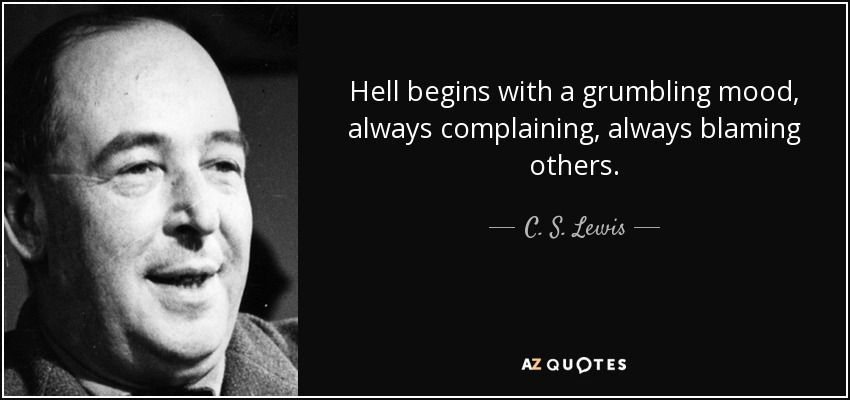
Get Rid of Grumbling (Numbers 16:41-50)

Grumbling broke out the next day in the community of Israel, grumbling against Moses and Aaron: “You have killed God’s people!”

But it so happened that when the community got together against Moses and Aaron, they looked over at the Tent of Meeting and there was the Cloud—the Glory of God for all to see.

Moses and Aaron stood at the front of the Tent of Meeting. God spoke to Moses: “Back away from this congregation so that I can do away with them this very minute.”

They threw themselves face down on the ground.

Moses said to Aaron, “Take your censer and fill it with incense, along with fire from the Altar. Get to the congregation as fast as you can: make atonement for them. Anger is pouring out from God—the plague has started!”

Aaron grabbed the censer, as directed by Moses, and ran into the midst of the congregation. The plague had already begun. He put burning incense into the censer and atoned for the people. He stood there between the living and the dead and stopped the plague.

Fourteen thousand seven hundred people died from the plague, not counting those who died in the affair of Korah. Aaron then went back to join Moses at the entrance to the Tent of Meeting. The plague was stopped. (The Message)

grum-bled, grum-bling, grum-ble:

  • to murmur or mutter in discontent; complain sullenly
  • an expression of discontent; complaint; unhappy murmur; growl.

Out of all the bad things in this old world, grumbling and murmuring aren’t typically at the top of our list of heinous sins. Yet, they’re bad. The reason grumbling needs squelching is because complaining is like a gateway drug – start using it and it will surely lead to worse things, unless stopped.

A surefire way to divide a community of people is by grumbling and complaining. This was the deliberate tool of Korah – a Levite who was angling for more power and authority amongst the Israelites in their sojourn in the desert. His stirring up rebellion through constant complaints was a high-handed sin, meant to undercut Moses as the leader.

The revolt he incited resulted in a dramatic intervention of God in causing the earth to open up and swallow Korah and the rebels. The Lord has a zero tolerance policy toward satanic plans of upending godly leadership and replacing it with a lust for power.

The Punishment of Korah, Holman Illustrated Bible, 1890

Unfortunately, this was not the end of the story. Aftershocks of grumbling erupted around the community. And it was dealt with by God with the same sort of wrath that Korah experienced. A plague broke out and many more died.

So, why all the death? This was far more than a bunch of malcontents who were griping about how things were going. It was an assault against the Lord – in the same way Lucifer once brought rebellion to heaven. In both cases, swift action was taken.

Please keep in mind that we need a nuanced understanding of complaining, grumbling, and arguing. A great deal of complaining is an expression of grief, of pushing back against the hurt. There’s also the grumbling that comes because everybody else is doing it. But then there is the sort of grumbling that is intended to topple God as the authority and place oneself in that position. That’s the nasty sort which will get one in a heap of trouble.

I once had a parishioner, several years back, who continually complained about me. More than that, he seemed to be always trying to get others to join him in his constant grumbling. I certainly tried to be as meek as Moses. Whether that happened, or not, I’m not sure.

It got bad enough that one Sunday, the grumbler invited me to come outside after church and settle things “like men,” which meant with fisticuffs. Oy.

About a month later, the man was standing in his driveway, then fell straight over. He was dead before he even hit the pavement. I’ll leave it to you for an interpretation. I’ll also say that, obviously, the grumbling and rebellion stopped.

The people’s grumbling and revolt against Moses was tantamount to rebelling against God.

Grumbling is not okay. Whenever folks dig in and complain in order to overturn something or someone which the Lord has established, their plans for destruction get turned in on themselves. In other words, what happens to themselves is what they were planning all along for another.

The New Testament author of Hebrews picked up this tone of grumbling from the ancient Israelites, and offered a warning to his own contemporary audience:

“Today, if you hear his voice,
    do not harden your hearts
as you did in the rebellion,
    during the time of testing in the wilderness,
where your ancestors tested and tried me,
    though for forty years they saw what I did.
That is why I was angry with that generation;
    I said, ‘Their hearts are always going astray,
    and they have not known my ways.’
So I declared on oath in my anger,
    ‘They shall never enter my rest.’ ”

See to it, brothers and sisters, that none of you has a sinful, unbelieving heart that turns away from the living God. (Hebrews 3:8-12, NIV)

The author also provided some simple yet profound exhortation for keeping grumbling and murmuring at bay:

But encourage one another daily, as long as it is called “Today,” so that none of you may be hardened by sin’s deceitfulness. (Hebrews 3:13, NIV)

Encouragement is the daily practice which prevents a hard heart and soul rot – the very things which lead a person to begin complaining and rebelling.

If there is no encouragement, complaints will take root. And if complaints take root, bitterness begins to grow. And if bitterness begins to grow, it will feed itself on grudge-bearing. And if grudge-bearing persists, it will have very unpleasant results.

See to it that no one falls short of the grace of God and that no bitter root grows up to cause trouble and defile many. (Hebrews 12:15, NIV)

So, let us cultivate the fruit of the Spirit, and put aside the shameful deeds of darkness. Let us look for ways to encourage one another, rather than tearing down each other. Let us:

Fix our eyes on Jesus, the pioneer and perfecter of faith. For the joy set before him he endured the cross, scorning its shame, and sat down at the right hand of the throne of God. Consider him who endured such opposition from sinners, so that you will not grow weary and lose heart. (Hebrews 12:2-3, NIV)

Holy God, you work in us to will and to act in order to fulfill your good purpose. Help us to do everything without grumbling or arguing, so that we may become blameless and pure, without fault in a warped and crooked generation, through Jesus Christ our Lord, in the power of the Holy Spirit. Amen.

New Rules for a New Society (Ephesians 4:25-32)

We are part of the same body. Stop lying and start telling each other the truth. Don’t get so angry that you sin. Don’t go to bed angry and don’t give the devil a chance.

If you are a thief, quit stealing. Be honest and work hard, so you will have something to give to people in need.

Stop all your dirty talk. Say the right thing at the right time and help others by what you say.

Don’t make God’s Spirit sad. The Spirit makes you sure that someday you will be free from your sins.

Stop being bitter and angry and mad at others. Don’t yell at one another or curse each other or ever be rude. Instead, be kind and merciful, and forgive others, just as God forgave you because of Christ. (Contemporary English Version)

New life means being a part of a new society; and a new society means new rules to live by which benefit and uplift the entire community. Old destructive practices must be replaced with new encouraging and supportive ways of being together. Stop taking the broad easy road to destruction and start walking the hard path to life and contentment.

Stop Lying and Start Telling the Truth

Lying exists because people believe that being truthful and transparent is too traumatic. Many people don’t think that being open, honest, real, vulnerable, and genuine is worth the risk. They have believed the lie that they won’t be accepted, that they’ll lose face with others, or that people will just gossip about me if they really knew about me. So, we hide from others and avoid the truth.

In truth, we are responsible for one another – to make and keep promises to each other because that is what God does with us. Churches that love truth will make a safe place for the awkwardness of confession, forgiveness, and healing.

Truthful communities are places of hospitality where we are safe to be real. No one ought to ever suffer in silence, cry alone, or wonder whether others will forsake them. We belong to one another. Therefore, to have union with Christ is to have union with one another; you can’t have one without the other.

Stop Stealing and Start Giving

Theft comes in many forms, especially in our contemporary age. Embezzlement, shoplifting, fraud, plagiarism, and robbery are just a few examples of the ways in which we humans steal from one another.

Embezzlement is the theft of assets (money or property) by a person who has been trusted to keep those assets safe. Instead of embezzling funds, we are to steward those assets well, distributing them with care and a conscience – using them for the benefit of others, not simply ourselves.

Shoplifting involves stealing goods from retail establishments. Some people steal because they are in dire need. Many more steal because they can and want to. We must stop taking things we want, and learn to be satisfied with what we have. And we will only do this by using our own money to buy things for others who are in need.

Fraud is stealing that involves convincing the victim to surrender their money or property under false pretenses. This is nothing more than manipulating someone to get what you want. Work hard to defend the defenseless and ensure their justice, rather than commit a gross injustice against them.

Plagiarism is the practice of taking someone else’s work or ideas and passing them off as one’s own. It’s cheap. It’s easy. And don’t do it, period. Someone else worked very hard to create what you may nonchalantly use for your quick benefit. Take the pains to credit someone else’s work and document the sources you use.

Robbery is a theft that involves using violence, intimidation, or threats to obtain property. Put the threats, guns, and false confidence away. In it’s place, do whatever it takes to do things right, hold a job, and give something back to society.

Stop All the Unhelpful Talk and Start Encouraging

Corrupt or dirty talk is totally unnecessary. It’s unwholesome and benefits nobody. Rather, make it your aim to use your words for good by encouraging others.

Encouragement involves strongly urging someone to do something with an equal commitment to lovingly come alongside and help. This requires both verbal exhortations and tangible assistance. Encouragement is the glue which holds a people together. Without it, a society degenerates into watching-out-for-number-one, and destructive personal survival tactics which will say anything to get what one wants.

Stop the Bitterness and Start Forgiving

Forgiveness is choosing not to hold another’s persons offensive words or actions over their head. It is:

  • Specific to an event, action, or words.
  • A process: it takes time to truly forgive.
  • Something anybody can do, regardless of race, creed, religion, etc.
  • Hard.
  • Freeing.
  • Ongoing.
  • Gracious.

“To forgive is to set a prisoner free and discover that the prisoner was you.”

Lewis Smedes, Forgive and Forget: Healing the Hurts We Don’t Deserve

Bitterness, however, wants to hold onto a grudge and seeks to punish the one who has offended them. That’s the way of Satan, not God. Even if the person has set themselves up as your enemy, we have clear exhortations from Jesus to love our enemies and do good to them, not harm. (Matthew 5:43-48)

The world revolves on the axis of mercy, not judgment. The sooner we get in the groove of how things actually operate for us to live a good life, the better that our relationships and society will be.

Good and gracious God, we ask that you make our life journey safe as we choose integrity, not disintegration. Shed light on those who follow crooked paths. May their dishonesty be exposed so that corrections can be made before further damage occurs. Help our nations, neighborhoods, and faith communities choose a path of mercy and goodness, rather than the crooked way of lies, theft, vitriol, and grudge-bearing. May we see a new wave of integrity sweeping over our world, through Jesus Christ our Lord, by the power of your Holy Spirit. Amen.

Stop the Bad, Start the Good (Ephesians 4:25-5:2)

We are part of the same body. Stop lying and start telling each other the truth. Don’t get so angry that you sin. Don’t go to bed angry and don’t give the devil a chance.

If you are a thief, quit stealing. Be honest and work hard, so you will have something to give to people in need.

Stop all your dirty talk. Say the right thing at the right time and help others by what you say.

Don’t make God’s Spirit sad. The Spirit makes you sure that someday you will be free from your sins.

Stop being bitter and angry and mad at others. Don’t yell at one another or curse each other or ever be rude. Instead, be kind and merciful, and forgive others, just as God forgave you because of Christ.

Do as God does. After all, you are his dear children. Let love be your guide. Christ loved us and offered his life for us as a sacrifice that pleases God. (Contemporary English Version)

All of us have a hard time breaking bad habits, even and especially destructive habits which damage us and/or others. Why, despite knowing better, is it so doggone hard to change? And why, even though having the best of intentions, does that person in my life never change because I tell them to?

Probably because our approach to change dooms us from the beginning. Here are a few approaches which, frankly, do not work:

  • Telling ourselves (or others) to stop. Barking commands may alter speech or behavior for a while but it won’t stick. That’s because people need affirmation, encouragement, and love in order to change – and not by mandated rules. Judgmentalism or shaming others never effects any sort of positive change. Neither our brains nor our souls operate that way.
  • Relying on willpower. This is really an over-reliance on thinking. Yes, it’s necessary to change our thinking. It isn’t, however, enough. That’s because we are not brains-on-a-stick. We also have a body, emotions, and a spirit which needs activation, as well. What’s more, our thinking doesn’t change by sheer force of the will. Our brains are literally not wired that way.
  • Believing in positive thinking. “I think I can, I think I can, I think I can….” “Dream it and do it.” “I believe in myself.” “Nothing is impossible.” I am not suggesting we indulge negative thinking or let a bad attitude take root. I’m saying that positive thinking has its limits. It’s helpful but is not the true agent of behavioral change.
  • Pursuing self-help. Yes, we must all help ourselves. After all, we are responsible for our own behavior. However, self-help alone doesn’t bring lasting change. By only going it alone, individuals come up with hackneyed homebrewed prescriptions that will not get the job done. That’s because we are hard-wired for community and any sort of effective change of habit happens with others.

To stop doing or saying something is only half the equation. We also need to start doing and saying something else altogether.

Change always involves both putting off and putting on, laying down and picking up, removing and replacing, starting and stopping.

The Christian tradition holds that Jesus is the way, the truth, and the life. Life together is to be shaped around the person and work of Christ. Since Christians share a common confession of Jesus together, we are to share a common life together.

Therefore, we will stop non-Christian ways of relating to each other and start a Christian way of relating to each other – because we belong to one another and are inextricably connected as the community of the redeemed.

Stop lying and start speaking the truth

Too often, we put up a plastic false front. Pretending we are okay, when we are not, or even acting like life is hard, when it isn’t, is an untruthful presentation – it’s a lie. Secrecy and deception are tools of Satan, not God. Therefore, we must put off the bad habit of pretention, and put on the good habit of speaking truthfully to each other. 

Buying into the devil’s snake oil salesmanship leads one to believe we cannot be open, honest, real, vulnerable, and genuine; it’s not worth the risk. We worry about being rejected, losing face, or becoming a victim of gossip. Shame then takes the steering wheel of one’s life, instead of speaking truthfully.

We speak the truth in love because we are responsible to one another – not hiding in the shadows or avoiding the dark places of the heart – but stepping into the light and forsaking all fakery for the benefit of everyone’s needs. The only thing lying does is undermine and erode true community.

Stop stealing and start being generous

Thievery takes many forms: petty theft, identity theft, stealing intellectual property (copywrites, patents, trade secrets, etc.), fraud, plagiarism, robbery, burglary, embezzlement, shoplifting, and more. Gossip, slander, and defamation robs another person of their dignity and reputation. Likely the most insidious theft of all is the stealing and kidnapping other human beings.

Stealing will always be a way of life unless it is replaced wholesale with generosity. Learning to give back is the surest path to real change. And there a lot of ways of doing it.

We can give back to the community through donating our time, participating in charity events, volunteering at a school, hospital, or senior center, and even recycling or planting a tree, or giving blood.

Whatever it is you choose to do, connect it with the penchant toward stealing you may have. For example the one prone to gossip might replace it with gratitude; or the one who chronically steals another’s time might join an altruism group.

Stop the dirty useless talk and start encouraging others

Locker room talk and dirty jokes aren’t helpful. There’s also a lot of speech that’s just downright useless, such as: a preacher who pads the sermon with lots of unnecessary words; a relative who is vague and not specific with their words; a boss who always points out, with many words, what is wrong but barely says one word of affirmation to an employee.

Instead of tearing down others with words, replace those words with encouragement. Going out of your way to write an encouraging card or note to someone, bending down to look a child in the eye to say, “hi,” expressing sincere condolences to someone who lost a loved one, or just having a kind word for the harried cashier behind the counter or the waitress at the restaurant, are simple ways of embracing encouragement as a lifestyle.

Stop being so bitter and angry and start forgiving people

Many people either cannot or will not forgive because they want to hold onto their anger and bitterness. Somehow, in their twisted and darkened thinking, they believe that, unless they maintain their grudge-bearing, the offending person or group will get off the hook.

Please, lay down that crushing load of mental vengeance; and pick up the light backpack of grace and forgiveness.

Chances are, if you’ve been in the habit of being angry for a long time, you have a cardiologist you see on a regular basis. Do yourself a favor by changing yourself and saving your health, instead of expecting others to change and blaming them for your issues.

If you are not the person you want to be, then take a lesson from the Apostle Paul: don’t just try and stop something you don’t like but also start doing just the opposite of it, in helpful ways that are a blessing to others.

And if ever in doubt, love is always the best choice.

May the God of peace make you pure and faultless, belonging only to what is right, just and good. And may your whole self—spirit, soul, mind, body, and emotions—be kept safe and be blameless when our Lord Jesus Christ comes. Amen.