“Oh, That My Words Were Recorded” (Job 19:23-27a)

“Oh, that my words were recorded,
    that they were written on a scroll,
that they were inscribed with an iron tool on lead,
    or engraved in rock forever!
I know that my redeemer lives,
    and that in the end he will stand on the earth.
And after my skin has been destroyed,
    yet in my flesh I will see God;
I myself will see him
    with my own eyes—I, and not another. (New International Version)

The biblical character Job expressed a feeling that all of us, at one time or another, have likely felt: Longing for someone to actually hear our voice, our words of grief, listen to them, and not let them fall into oblivion as if we were alone on this earth.

Job was hurting like no one before or after him. His grief was palpable. His pain was deep and intense. Not knowing what the heck was going on, he had zero understanding of why complete calamity came upon him.

Job’s family was killed, all but his wife. He lost all his earthly possessions to either theft or disaster. And his body was wracked with painful sores that covered his entire body. He was as miserable as one person could be. It was grief stacked upon grief.

In that misery and pain, after losing everything, Job didn’t want his words to be lost. He wanted them to be heard and remembered. Job needed to know that his voice was real, that he was not just speaking into the air.

This gets to the heart of what every grieving person likely wants: For someone to listen to their story of loss – for that story to be heard, listened to, and taken seriously.

I know the feeling. And I know it a bit more intimately than I would like to.

In this past year I was diagnosed with a health disorder that prevented me from continuing to work in a job I absolutely loved. This precipitated a move to another state to be near family. And there are many more losses and griefs to go along with all the changes in my life.

Going through circumstances that we neither asked for nor wanted is hard, especially when it involves significant losses. Without facing our grief, like Job did, we may end up losing ourselves and becoming lost or stuck in that grief.

Rather than me blithering on about the need for vulnerability, I myself will be vulnerable. One of the ways I accept, cope, and transcend hard stuff is through journaling. Here is a portion of my journal from today, unedited:

“I can feel myself sinking down toward the abyss. The darkness is beginning to overwhelm me. Everything – the changes, the transitions, the grief, the state of all things – is too much.

“Lord, have mercy.

“And so, I write, in the hope that my grief and big feelings of loss and of lostness will somehow fade into the background – not the foreground – of my life. Yes, it’s all a part of me. A very important part. And I never want to disavow it. Yet, it is only a part, and not the whole of me.

“Maybe that’s the thing I need to know and remember this day – that grief is not all of me; doesn’t define me as a person; and need not rule my life. There is some sort of ‘sweet spot’ in all this, in which I vulnerably and forthrightly acknowledge and talk about my grief without stuffing it away into an internal junk closet. But also, I do not necessarily focus on it as if grief is all that I am.

“Rather, I’m (like all other people) a complicated soul made up of many moving spiritual and emotional parts.

“It is ironic that a guy who once talked to grieving people on a daily basis is now grieving the loss of no longer talking to grieving people on a daily basis. Yet, here I am.

“One of the reasons I derived so much fulfillment from doing grief work with others is that it is so very much needed! I live in a society where everyone wants you to be okay, likely because they themselves are so very uncomfortable with grief and don’t know what to do with it. So, many people simply want everyone to be ‘normal,’ whatever the heck that actually means.

“Loss is painful, and no one (including me) wants to hurt. But the pain won’t go away magically. I (and everyone) must face the hurt, walk into and through the pain in order to feel better.

“To open-up to the unique pain of loss is the only way to realize emotional healing. In order to move on, we’ve got to stop trying to move on. Instead, let it out.

“In writing this I’m reminding myself what I’ve told hundreds of patients and parishioners who were going through their own unique circumstances of painful loss. Strength is found in embracing weakness, and not by trying to soldier on as if loss doesn’t bother me. It’s okay to grieve. And it’s okay to grieve any sort of loss. It’s more than okay; it’s absolutely needed.”

Eternally righteous God, merciful judge of all the living: In your love you called us to share the glory of Christ. Strengthen our hearts in every good work and word, so that we may be steadfast in your ways and always believe your truth. Amen.


Spiritually and Emotionally Overwhelmed

Gethsemane – His Will, by Lucy Dickens

I lift up my eyes to the hills—
    from where will my help come?
My help comes from the Lord,
    who made heaven and earth. (Psalm 121:1-2, NRSV)

“You can’t calm the storm, so stop trying. What you can do is calm yourself. The storm will pass.” – Timber Hawkeye

Even Jesus got overwhelmed.

He took Peter and the two sons of Zebedee along with him, and he began to be sorrowful and troubled. Then he said to them, “My soul is overwhelmed with sorrow to the point of death. Stay here and keep watch with me.”

Going a little farther, he fell with his face to the ground and prayed, “My Father, if it is possible, may this cup be taken from me. Yet not as I will, but as you will.” (Matthew 26:37-39, New International Version)

Jesus was so spiritually and emotionally overwhelmed, he felt so bad, that depression and grief were a powerful part of his experience in the garden as he anticipated facing his horrendous death.

Yes, Jesus became grieved and depressed. Not only did he express such emotions in prayer, but he also told his feelings to his disciples. I personally don’t know of any leader – either in the world or in the church – that would ever admit such a thing to his/her parishioners, employees, or constituents.

Christ confessed that his very soul was encircled with grief-stricken depression. The weight of the emotion was so heavy that Jesus felt as though he was being crushed to death.

“It is one thing for Jesus to feel this way; but should a leader tell his followers he feels this way? Isn’t a part of effective leadership keeping fears from followers? But if Jesus having depression has already taught us it is acceptable, at times, to be depressed, then Jesus talking about his depression teaches that it is acceptable, at times, for leaders to tell followers the bad state of their souls.” – Frederick Dale Bruner, The Church Book: Matthew 13-28

If Jesus needed human companionship and the ability to bear his soul, then how much more do his followers need to do so? And especially the clerics who are ordained to his ministry?

Becoming overwhelmed is a universal human experience:

May my prayer come before you;
    turn your ear to my cry.

I am overwhelmed with troubles
    and my life draws near to death.
I am counted among those who go down to the pit;
    I am like one without strength. (Psalm 88:2-4, New International Version)

We may become overwhelmed by being devastated or feeling overpowered by a confluence of circumstances all at once. To be overwhelmed is to experience several big emotions all at once – including an awful feeling of estrangement from God and/or others.

Whenever complicated grief, relational distance, traumatic experiences, and too many responsibilities come together, they create a perfect storm which can leave us stuck, lonely, and chronically tired.

There are times when it seems as if every time we turn around, there’s another big shoe that drops. We might end up dealing with so many large circumstances and important situations happening at the same time, that we become spiritually and emotionally overwhelmed with it all.

Although it’s easy to become overwhelmed, it’s hard to get over those big, troubled feelings. Yet, we can do it. We can initially calm ourselves enough to function.

Yet, we also need to understand that the emotional array surrounding our difficult circumstances will take more than a few minutes and a few breathing exercises to overcome; it could take weeks, months, even longer.

What’s more, going forward, there will always be a need to listen to our bodies, be attentive to our feelings, and remain in touch with our gut instincts.

We could use some helpful habits to serve us well, whenever we sense the tug toward that sinking feeling of becoming spiritually and emotionally overwhelmed:

  • Sit with your emotions, especially the grief. That is, acknowledge your feelings, and actually let yourself feel them, and express them in positive ways that don’t damage others or their property.
  • Identify and list your current stressors. Then, prioritize them as to which you will work on first. Avoid multi-tasking. Breaking down your life into manageable pieces, done over time with patience, is a healthy way of approaching the behemoth in front of you.
  • Write out your experiences. Keep a daily journal. Focus on expressing both your emotions and your gratitude. The act of writing in and of itself is a powerful means of bringing health, wholeness, and some sort of sense to your situations.
  • Create art. Learn a musical instrument, write your own poetry, sculpt, or paint. Let any anger and frustration come out through your art, rather than coming out sideways onto others through verbal violence.
  • Discover new or alternative spiritual practices, i.e. mindfulness, meditation, Reiki, aromatherapy, breath prayers, etc. Crazy new circumstances you’ve never experienced before may require some seemingly new or strange practices you’ve never tried before.
  • Change the story you are telling yourself. Look for parts of your experience within your control. Learn from the past. Consider what you might do differently in the future in similar situations. In other words, let your story not be one big nasty carbuncle on your soul; allow it to be a companion that teaches you.
  • Consider having a comfort animal. Caring for a pet fosters emotional healing. This one addition to your life could change it immeasurably for good.
  • Engage your inner critic. Face the judgment you may be giving yourself and replace it with grace. Work on dropping the ego and becoming your true self. And there is perhaps no better way of this happening than facing your inner critic.
  • Exercise. Pay attention to where you carry stress in your body. Find an enjoyable way of moving your body.
  • Connect with others. Join a group of like-minded people, such as a faith community or a volunteer organization. Tell your story to another trusted person, such as a friend, therapist, or pastor.
  • Find your identity. Most spiritual traditions take a high view of humanity as having intrinsic worth. As for me, I know to whom I belong: God. Having my identity firmly in Christ – and not in my abilities, or the lack of them – makes all the difference.

Our limitations, screw-ups, diseases, disorders, and disasters need not define our lives. There is no shame in admitting when we are full of sorrow, in the throes of grief, experiencing depression, or living in an awful situation.

Taking Jesus as an example, we have the courage to face stressful adversity and become the people we were always meant to become.

May the places of darkness within you be turned towards the light. And may you know divine shelter and healing blessing when you are called to stand in the place of pain. Amen.

Pay Attention to Grief (Genesis 49:29-50:14)

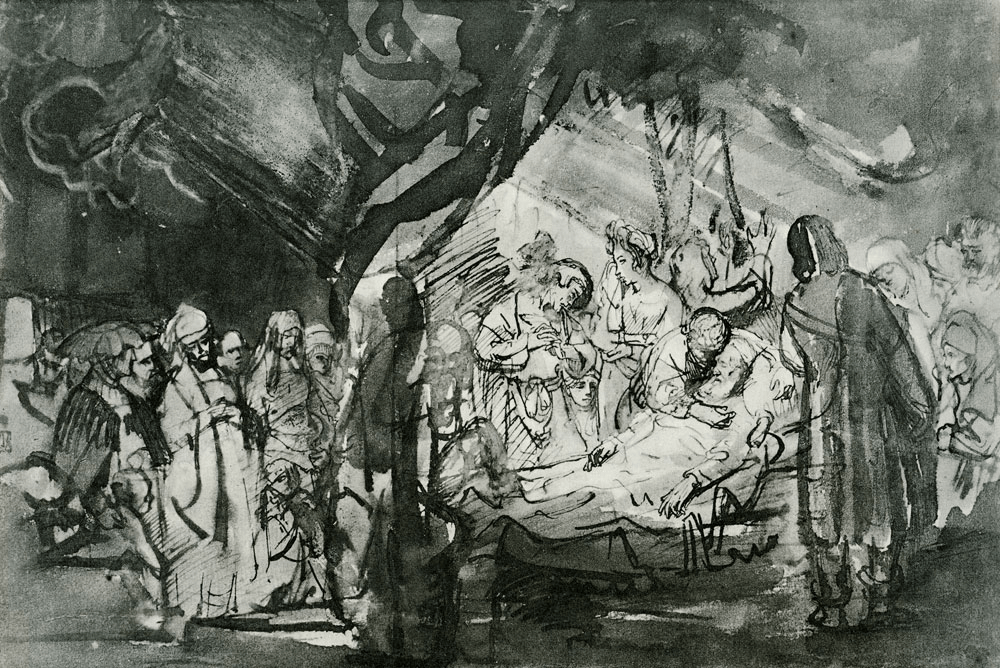
The Death of Jacob, by Rembrandt, c.1640

Jacob told his sons:

Soon I will die, and I want you to bury me in Machpelah Cave. Abraham bought this cave as a burial place from Ephron the Hittite, and it is near the town of Mamre in Canaan. Abraham and Sarah are buried there, and so are Isaac and Rebekah. I buried Leah there too. Both the cave and the land that goes with it were bought from the Hittites.

When Jacob had finished giving these instructions to his sons, he lay down on his bed and died. Joseph started crying, then leaned over to hug and kiss his father.

Joseph gave orders for Jacob’s body to be embalmed, and it took the usual 40 days.

The Egyptians mourned 70 days for Jacob. When the time of mourning was over, Joseph said to the Egyptian leaders, “If you consider me your friend, please speak to the king for me. Just before my father died, he made me promise to bury him in his burial cave in Canaan. If the king will give me permission to go, I will come back here.”

The king answered, “Go to Canaan and keep your promise to your father.”

When Joseph left Goshen with his brothers, his relatives, and his father’s relatives to bury Jacob, many of the king’s highest officials and even his military chariots and cavalry went along. The Israelites left behind only their children, their cattle, and their sheep and goats.

After crossing the Jordan River, Joseph stopped at Atad’s threshing place, where they all mourned and wept seven days for Jacob. The Canaanites saw this and said, “The Egyptians are in great sorrow.” Then they named the place “Egypt in Sorrow.”

So Jacob’s sons did just as their father had instructed. They took him to Mamre in Canaan and buried him in Machpelah Cave, the burial place Abraham had bought from Ephron the Hittite.

After the funeral, Joseph, his brothers, and everyone else returned to Egypt. (Contemporary English Version)

117 days. That’s how long Jacob’s family, along with the people of Egypt, mourned for him after his death. Yes, he was a patriarch. And yes, Joseph was the administrator of an entire nation. Yet this was not unusual behavior; it was normal.

When my mother-in-law was tragically and suddenly killed in a car accident, 30 years ago, I could not take any bereavement time off, because according to company policy, it was not my mother. So, since she lived a thousand miles from us, I had to use vacation time and take a week away. Then, when I returned to work, I was expected to pick up where I left off, as if nothing had happened.

Although I work under better conditions today, and workplaces are getting better at acknowledging the importance of tragic events in the life of employees, we still have a long way to go in dealing with grief, bereavement, mourning, and lament.

The modern funeral industry is a rather recent phenomenon in history. Beginning with, and then following, the American Civil War, death was a prominent specter, affecting every community and nearly every home. People like my second great grandfather became part of a growing business of handling the dead and providing services for grieving families. He became a coffin maker and a chief supplier for the burgeoning funeral parlor (which later morphed into a furniture business which lasted a hundred years).

Even though families needed help after a devastating war, over time, the unintended effect is that we became detached from death. Others could handle bodies and arrangements. We could choose to see or not see the dead. Folks began losing the ability to grieve and mourn their changes in life.

Grief doesn’t just go away with time. If it isn’t acknowledged, faced, accepted, and dealt with, it slowly begins to sit in the soul and rot. Eventually, it becomes spiritual gangrene; the person becomes bitter, without joy and stuck in unwanted emotions.

The point of all this is that grief and bereavement strikes us all; none of us gets off planet earth without having to deal with the loss of significant people in our lives. And when it happens, it’s imperative that individuals and societal structures allow for the time and space to mourn.

The ancients were on to something which we need to recover. They discerned the importance of allowing grief to run it’s course, instead of us trying to master grief, get over it, and move on. Grief will be dealt with when it is dealt with. Trying to tame it is like attempting to bench press 700 pounds; it’s only going to crush you if you try controlling it.

I’m not agitating for a 117 span of days for everyone’s mourning. But I am insisting that we have conversations about grief and confront it, rather than ignore it. Because grieving doesn’t mean you’re imperfect; it means you’re human.

The way we move through our grief is by telling our story – which requires someone to listen. That only happens if we have created the space for it to occur. Expectations of moving-on will leave grief where it is, poisoning us from the inside-out.

The only way to the mountain is through the valley. The only way to make the pain go away is to move through it – not by avoiding it, pretending it’s not there, or trying to go around it. Pain and suffering are inevitable; misery is optional. And letting bereavement and grief have it’s way for a while is the path away from the misery.

You will heal and you will rebuild yourself around the loss you have suffered. You will be whole again, but you will never be the same. And that’s a good thing. It gives us the ability and empathy to extend blessing to others who will eventually face their own terrible loss. They will need someone to listen. And you will be there for them.

Lord, do not abandon us in our desolation. Keep us safe in the midst of trouble, and complete your purpose for us through your steadfast love and faithfulness, in Jesus Christ our Savior. Amen.

Dealing with Hate (Genesis 37:5-11)

One night Joseph had a dream, and when he told his brothers about it, they hated him more than ever. “Listen to this dream,” he said. “We were out in the field, tying up bundles of grain. Suddenly my bundle stood up, and your bundles all gathered around and bowed low before mine!”

His brothers responded, “So you think you will be our king, do you? Do you actually think you will reign over us?” And they hated him all the more because of his dreams and the way he talked about them.

Soon Joseph had another dream, and again he told his brothers about it. “Listen, I have had another dream,” he said. “The sun, moon, and eleven stars bowed low before me!”

This time he told the dream to his father as well as to his brothers, but his father scolded him. “What kind of dream is that?” he asked. “Will your mother and I and your brothers actually come and bow to the ground before you?” But while his brothers were jealous of Joseph, his father wondered what the dreams meant. (New Living Translation)

We need to talk about hate, and it’s wicked stepsisters jealousy and disrespect.

In the ancient world, the oldest son was usually the one favored by parents. The eldest child would typically grow up to lead the family and inherit the largest share of the family resources. Joseph and Benjamin were two sons born to Jacob and Jacob’s favored wife, Rachel (Genesis 30:22-24). They were the youngest of Jacob’s twelve sons.

Jacob loved Joseph more than any other of his children (Genesis 37:3). To make things even more complicated, Jacob made his affection for the seventeen-year-old Joseph very public by giving Joseph a special long multi-colored robe. Not surprisingly, the other brothers hated him. 

“Joseph’s Dreams” by Susan Govatos

From the brothers’ perspective, Joseph added insult to injury by sharing a dream of his, implying that all of them would one day bow down to him. Dreams were significant in the ancient world; they were understood to be one way the divine realm could communicate with humans. But all this only made Joseph’s brothers hate him more than they already did.

Unfortunately, as the story unfolds further into Genesis, Joseph’s brothers take their sibling rivalry to a diabolical level. And it’s all fueled by their hatred and jealousy.

We all can relate to feelings of hatred and jealousy toward another. They can overwhelm us. So, what do we do when these big emotions come upon us?

  1. Consider your thoughts. If you find that you’ve been engaging in an all-or-nothing thought or a generalization, consider what a more balanced thought might be. Instead of saying, “He’s a total jerk,” consider instead, “I don’t like what he did to me” as an alternative. This approach typically makes the difference between health and sickness. A peaceful heart leads to a healthy body; jealousy is like cancer in the bones. (Proverbs 14:30, NLT)
  2. Pause for a moment and be curious about whether what you’re telling yourself about the other person or group is accurate. Crowds came from the villages around Jerusalem, bringing their sick and those possessed by evil spirits, and they were all healed. The high priest and his officials, who were Sadducees, were filled with jealousy. They arrested the apostles and put them in the public jail. (Acts 5:15-18, NLT)
  3. Lead with empathy and compassion if you feel hatred toward a person or group. Empathy is the ability to understand and share the feelings of another. Compassion is engaging in an act of kindness. If you come upon your enemy’s ox or donkey that has strayed away, take it back to its owner. If you see that the donkey of someone who hates you has collapsed under its load, do not walk by. Instead, stop and help. (Exodus 23:4-5, NLT) “But to you who are willing to listen, I say, love your enemies! Do good to those who hate you. Bless those who curse you. Pray for those who hurt you.” (Luke 6:27-28, NLT)
  4. Talk to God instead of bottling up your feelings. Many people believe that ignoring their emotions will make them disappear, but in reality, it’s quite the opposite. Rather than going away, unaddressed emotions build up and intensify over time. Praying to the Lord and crying out to God are therapeutic. Rescue me from the mud; don’t let me sink any deeper! Save me from those who hate me, and pull me from these deep waters. (Psalm 69:14, NLT)
  5. Receive God’s love and kindness. We cannot give that which we have not first received. Once we, too, were foolish and disobedient. We were misled and became slaves to many lusts and pleasures. Our lives were full of evil and envy, and we hated each other. But when God our Savior revealed his kindness and love, he saved us, not because of the righteous things we had done, but because of his mercy. He washed away our sins, giving us a new birth and new life through the Holy Spirit. (Titus 3:3-5, NLT)

If we spend a disproportionate amount of time hating someone in our heart, have difficulty focusing on other things because of jealousy, or consider disrespecting another to the point of violence, then we need help; we cannot handle this alone.

Seeking help to resolve hatred doesn’t mean that there’s mental illness going on. Everyone experiences hatred at some point in their lives. Allowing God and others to help is a rational, responsible, and courageous act.

Almighty God, from whom all thoughts of truth and peace proceed: kindle, we pray, in the hearts of all, the true love of peace and guide us with your pure and peaceable wisdom, so that your kingdom may go forward on this earth, filled with the knowledge of your love; through Jesus Christ your Son our Lord, who is alive and reigns with you, in the unity of the Holy Spirit, one God, now and forever. Amen.