In that day five cities in Egypt will speak the language of Canaan and swear allegiance to the Lord Almighty. One of them will be called the City of the Sun.
In that day there will be an altar to the Lord in the heart of Egypt, and a monument to the Lord at its border. It will be a sign and witness to the Lord Almighty in the land of Egypt. When they cry out to the Lord because of their oppressors, he will send them a savior and defender, and he will rescue them.
So the Lord will make himself known to the Egyptians, and in that day they will acknowledge the Lord. They will worship with sacrifices and grain offerings; they will make vows to the Lord and keep them. The Lord will strike Egypt with a plague; he will strike them and heal them. They will turn to the Lord, and he will respond to their pleas and heal them.
In that day there will be a highway from Egypt to Assyria. The Assyrians will go to Egypt and the Egyptians to Assyria. The Egyptians and Assyrians will worship together. In that day Israel will be the third, along with Egypt and Assyria, a blessing on the earth. The Lord Almighty will bless them, saying, “Blessed be Egypt my people, Assyria my handiwork, and Israel my inheritance.” (New International Version)
Yahweh is so much more than an ancient local Israelite deity. This is the Lord God almighty, creator of heaven and earth. God is the Lord of the universe, and Israel is not just a sliver of land in the Middle East.
As such, all peoples belong to God. And God is concerned for all the nations. In the ancient world, the Lord was even concerned for places like Egypt and Assyria – two nations which historically treated Israel with contempt and oppression.
The Lord God, Yahweh, as the prophet Isaiah stated, will be revealed to the Egyptians, so that they, too, will worship the Lord with sacrifices and offerings. They will revere God with a monument to Yahweh’s saving power.
The Egyptians will make religious vows and fulfill them. And there will also be relations with Assyria. Israel will exist alongside – and literally geographically in the middle – the powers of Egypt and Assyria. And Israel will serve as a blessing between them.
In other words, God will choose to bless, bringing both religious and political balance and peace. It is rather extraordinary that the Lord speaks of Egypt as “my people” and Assyria as “my handiwork.” God’s vision is always much larger than our own puny human sight or imagination.
In a biblical book filled with sad visions of judgment and God’s wrath, today’s Old Testament lesson is a beautiful vision of hope and peace. This, my friends, is what can be! It doesn’t have to be a pipe dream that various peoples who are historical enemies of one another can walk together in the peace and wholeness of God’s blessing. This is no impossible, although it appears highly improbable.
It takes little effort to hold onto hate and enmity; but it takes a great deal of energy to work on peacemaking, and loving those who have harmed others so terribly.
The fact of the matter is that Yahweh responds to every people who cry out in their oppression – even those who were once oppressors themselves.
That is called “grace,” and it is why grace is so scandalous, because a lot of folks don’t want to see grace extended to those they dislike, hate, and even want dead.
God will do for other nations what God did for Israel, in delivering them from their harsh slavery. The Lord’s ears hear everyone on the earth, and not just some people.
All of the hard-hearted resistance of the past, personified so stubbornly in the Pharaoh who would not let go of Israel, is remarkably overcome and reversed.
This is how it always seems to operate throughout history, including today. People cry out and are delivered, then worship the God who granted them grace and freedom. We very often come to believe because we were in some sort of awful trouble, which caused us to cry out and acknowledge the God who saves.
God both strikes and heals, attacks and helps. God moves people from rancorous relationships to robust reconciliation.
People, however, are not passive in any of this process. Those who are already blessed and enjoy God must relinquish any sort of exclusive thoughts or practices and be willing to share their identity and privilege with others who were once enemies.
Unity, harmony, wholeness, and a true ecumenical spirit and vision will bring people together. The benefits are wonderful, yet let it also be acknowledged that reconciliation and relationships require giving up any sense of being better than the other, or holding on to primacy of positions and power.
Stated positively, it means that we embrace a diversity of people, including them in every way possible, because we discern them as being equals, and not so different from me.
God has other chosen people besides me and you. Can you accept that?
“Egypt comes home to its true self only as Israel opens its sense of privilege to its adversaries.”
Walter Brueggemann
The Lord opposes the arrogant and proud, but gives grace to the humble. God will gladly deliver and welcome all peoples.
If we have the spiritual eyes to see, we will notice and observe that the world is God’s chosen people.
O God, hear our humble prayer, so that we may serve you in holiness and faith, giving voice to your divine presence among us until the coming of your Son, Jesus Christ, who lives and reigns forever and ever. Amen.
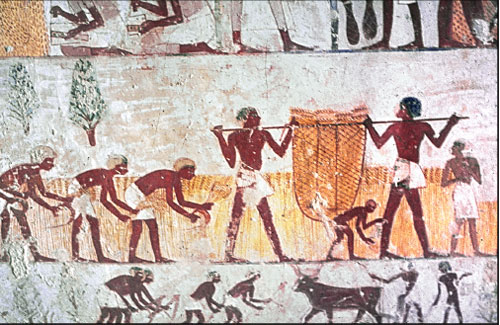
Egyptian workers harvesting grain. From the tomb of Mena in Thebes, c.1420 B.C.E.
Give thanks to the Lord and proclaim his greatness.
Let the whole world know what he has done.
Sing to him; yes, sing his praises.
Tell everyone about his wonderful deeds.
Exult in his holy name;
rejoice, you who worship the Lord.
Search for the Lord and for his strength;
continually seek him.
Remember the wonders he has performed,
his miracles, and the rulings he has given,
you children of his servant Abraham,
you descendants of Jacob, his chosen ones….
He called for a famine on the land of Canaan,
cutting off its food supply.
Then he sent someone to Egypt ahead of them—
Joseph, who was sold as a slave.
They bruised his feet with fetters
and placed his neck in an iron collar.
Until the time came to fulfill his dreams,
the Lord tested Joseph’s character.
Then Pharaoh sent for him and set him free;
the ruler of the nation opened his prison door.
Joseph was put in charge of all the king’s household;
he became ruler over all the king’s possessions.
He could instruct the king’s aides as he pleased
and teach the king’s advisers….
All this happened so they would follow his decrees
and obey his instructions.
Praise the Lord! (NLT)
Our spiritual and emotional vision can sometimes be myopic. It is precisely in those times when we have tunnel vision and neither look back to a past in which God acted with justice nor see ahead to a future with hope that we must remember God is supreme over everything, including time.
God’s providence and blessing is the animating force behind all events. The biblical character of Joseph is Exhibit A of God’s sovereign backstage orchestration of personal and world forces. Joseph’s story of brotherly betrayal, bondage, imprisonment, and rise to power include some lessons for us (Genesis 37-41):
Joseph is portrayed as a model of wisdom for us to follow.
Respect and obey the Lord! This is the beginning of knowledge. Only a fool rejects wisdom and good advice (Proverbs 1:7, CEV).
Do not letmercy and truth leave you. Fasten them around your neck. Write them on the tablet of your heart. Then you will find favor and much success in the sight of God and humanity (Proverbs 3:3-4, GW).
Joseph did not know the end of the story while he was in the middle of it, languishing in prison. Little did he know that God was testing his character, training him to listen well, and preparing him for his eventual leadership in Egypt – all to save many lives from hunger and starvation.
Now faith is the assurance of things hoped for, the conviction of things not seen. (Hebrews 11:1, NRSV)
Joseph successfully negotiated and navigated a world which was vastly different from his own religion and ethics. He was determined not to give in to the seductions of women and power around him; and, he did not become bitter against his brothers, nor against the Egyptians.
Don’t love the world’s ways. Don’t love the world’s goods. Love of the world squeezes out love for the Father. Practically everything that goes on in the world—wanting your own way, wanting everything for yourself, wanting to appear important—has nothing to do with the Father. It just isolates you from him. The world and all its wanting, wanting, wanting is on the way out—but whoever does what God wants is set for eternity. (1 John 2:15-17, MSG)
Four-hundred years later, Moses also had to navigate the situation of being an Israelite in the world of Egypt, and walked in the footsteps of his forebear, Joseph:
By faith Moses, when he had grown up, refused to be known as the son of Pharaoh’s daughter. He chose to be mistreated along with the people of God rather than to enjoy the pleasures of sin for a short time. He regarded disgrace for the sake of Christ as of greater value than the treasures of Egypt because he was looking ahead to his reward. (Hebrews 11:24-26, NIV)
We understand, knowing the end of the story, that Joseph was in Egypt (in the world) to be a blessing and that God had him there for a purpose. This is no less true for the people of God. We do not exist merely for ourselves but to be a blessing to the world. God, as he did for Joseph, shows us mercy while we are smack in the middle of hardship and not by taking us out of our worldly predicament. Life must sometimes be lived at great risk amid the world and not apart from it.
Seen from a strictly worldly perspective, Joseph’s time in slavery and prison was an unnecessary injustice. However, from God’s vantage point, Joseph was learning to be mindful of God despite his circumstances. For the Lord is much more concerned about the process we undergo in spiritual formation, rather than simply producing a product at the end of the line. Most of life is lived in the mundane, and Joseph was faithful in all the workaday decisions and demands of life. This made him able to handle all the vicissitudes of others in their fickle and feckless ways and see God’s providential working.
Lord God, you hold both heaven and earth in a single peace. Let the design of your great love shine on the waste of our anger and sorrow, and give peace to your Church, peace among nations, peace in our homes, and peace in our hearts through Jesus Christ our Lord who with you and the Holy Spirit benevolently reign as one God, now and forever. Amen.
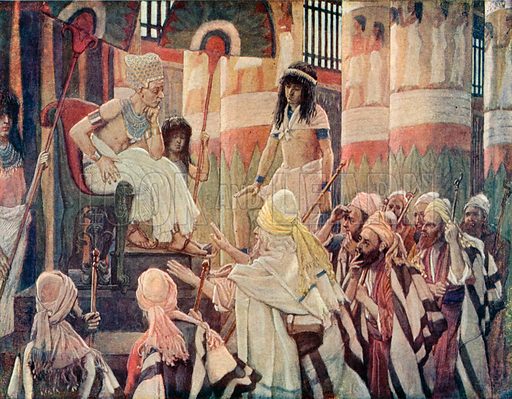
Joseph presents Jacob and his brothers to Pharaoh by French artist James Jacques Joseph Tissot (1836-1902)
And God spoke to Israel in a vision at night and said, “Jacob! Jacob!”
“Here I am,” he replied.
“I am God, the God of your father,” he said. “Do not be afraid to go down to Egypt, for I will make you into a great nation there. I will go down to Egypt with you, and I will surely bring you back again. And Joseph’s own hand will close your eyes.”
Then Jacob left Beersheba, and Israel’s sons took their father Jacob and their children and their wives in the carts that Pharaoh had sent to transport him. So, Jacob and all his offspring went to Egypt, taking with them their livestock and the possessions they had acquired in Canaan. Jacob brought with him to Egypt his sons and grandsons and his daughters and granddaughters—all his offspring.
These are the names of the sons of Israel (Jacob and his descendants) who went to Egypt:
Reuben the firstborn of Jacob. The sons of Reuben: Hanok, Pallu, Hezron and Karmi.
The sons of Simeon: Jemuel, Jamin, Ohad, Jakin, Zohar and Shaul the son of a Canaanite woman.
The sons of Levi: Gershon, Kohath and Merari.
The sons of Judah: Er, Onan, Shelah, Perez and Zerah (but Er and Onan had died in the land of Canaan).
The sons of Perez: Hezron and Hamul.
The sons of Issachar: Tola, Puah, Jashub and Shimron.
The sons of Zebulun: Sered, Elon and Jahleel.
These were the sons Leah bore to Jacob in Paddan Aram, besides his daughter Dinah. These sons and daughters of his were thirty-three in all.
The sons of Gad: Zephon, Haggi, Shuni, Ezbon, Eri, Arodi and Areli.
The sons of Asher: Imnah, Ishvah, Ishvi and Beriah. Their sister was Serah. The sons of Beriah: Heber and Malkiel.
These were the children born to Jacob by Zilpah, whom Laban had given to his daughter Leah—sixteen in all.
The sons of Jacob’s wife Rachel:
Joseph and Benjamin. In Egypt, Manasseh and Ephraim were born to Joseph by Asenath daughter of Potiphera, priest of On.
The sons of Benjamin: Bela, Beker, Ashbel, Gera, Naaman, Ehi, Rosh, Muppim, Huppim and Ard.
These were the sons of Rachel who were born to Jacob—fourteen in all.
The son of Dan: Hushim.
The sons of Naphtali: Jahziel, Guni, Jezer and Shillem.
These were the sons born to Jacob by Bilhah, whom Laban had given to his daughter Rachel—seven in all.
All those who went to Egypt with Jacob—those who were his direct descendants, not counting his sons’ wives—numbered sixty-six persons. With the two sons who had been born to Joseph in Egypt, the members of Jacob’s family, which went to Egypt, were seventy in all.
Now Jacob sent Judah ahead of him to Joseph to get directions to Goshen. When they arrived in the region of Goshen, Joseph had his chariot made ready and went to Goshen to meet his father Israel. As soon as Joseph appeared before him, he threw his arms around his father and wept for a long time.
Israel said to Joseph, “Now I am ready to die, since I have seen for myself that you are still alive.”
Then Joseph said to his brothers and to his father’s household, “I will go up and speak to Pharaoh and will say to him, ‘My brothers and my father’s household, who were living in the land of Canaan, have come to me. The men are shepherds; they tend livestock, and they have brought along their flocks and herds and everything they own.’ When Pharaoh calls you in and asks, ‘What is your occupation?’ you should answer, ‘Your servants have tended livestock from our boyhood on, just as our fathers did.’ Then you will be allowed to settle in the region of Goshen, for all shepherds are detestable to the Egyptians.”
Joseph went and told Pharaoh, “My father and brothers, with their flocks and herds and everything they own, have come from the land of Canaan and are now in Goshen.” He chose five of his brothers and presented them before Pharaoh.
Pharaoh asked the brothers, “What is your occupation?”
“Your servants are shepherds,” they replied to Pharaoh, “just as our fathers were.” They also said to him, “We have come to live here for a while, because the famine is severe in Canaan and your servants’ flocks have no pasture. So now, please let your servants settle in Goshen.”
Pharaoh said to Joseph, “Your father and your brothers have come to you, and the land of Egypt is before you; settle your father and your brothers in the best part of the land. Let them live in Goshen. And if you know of any among them with special ability, put them in charge of my own livestock.”
Then Joseph brought his father Jacob in and presented him before Pharaoh. After Jacob blessed Pharaoh, Pharaoh asked him, “How old are you?”
And Jacob said to Pharaoh, “The years of my pilgrimage are a hundred and thirty. My years have been few and difficult, and they do not equal the years of the pilgrimage of my fathers.” Then Jacob blessed Pharaoh and went out from his presence.
So, Joseph settled his father and his brothers in Egypt and gave them property in the best part of the land, the district of Rameses, as Pharaoh directed. Joseph also provided his father and his brothers and all his father’s household with food, according to the number of their children. (NIV)
Jacob Blesses Pharaoh by Welsh artist Owen Jones, 1869
God likes fulfilling his promises to us – even and especially when we are in Egypt – in the world. Sometimes we work too hard at avoiding the world and creating heaven on earth right now. God knew what the Israelites would face: four-hundred years of slavery in Egypt. Yet, God sent them anyway. Often, the people of God grow more in times of trial and hardship, than in times of plenty and peace.
The trip to Egypt included everyone in Israel. There is a genealogical list of those who made the journey because God fulfills his promises through people. These are the folks who would carry on accomplishing the will of God. Joseph and Jacob, the son, and the father, are reunited. Joseph diplomatically planned where the gang would live and work because Egyptians looked down on shepherds. Much like the ancient Israelites, we must navigate a world that is okay with us being in it yet not okay with us in the middle of things.
In the Old Testament, Egypt represents the world. It is interesting God sent his people to live there. God seeks to create a people for his Name who are distinct from Egypt, yet, live among the people of the world. There is a continual tension for God’s people to be holy and unique, not assimilating into the world’s mold; and, yet, at the same time, God wants them to have a constant engagement and interaction with the world. Therefore, two extremes are to be avoided: to focus solely on being a holy people through complete severance from the world as much as possible; and, to seek relevance in the culture through wholesale jettison of distinctiveness so that the sacred and the secular are connected.
God safeguards a distinct people so that they will be a preservative in the world. Godly people are neither to live in a vacuum, cut off from the world altogether, nor to be wed to the world so that the two are indistinguishable. We live in a fundamentally broken world in need of the peace and grace of spiritual people within it. The Church has had to struggle with how to live in the world for two-thousand years. We have the advantage of drawing from a rich Christian history. For there is nothing we face now which has not been faced by the church before.
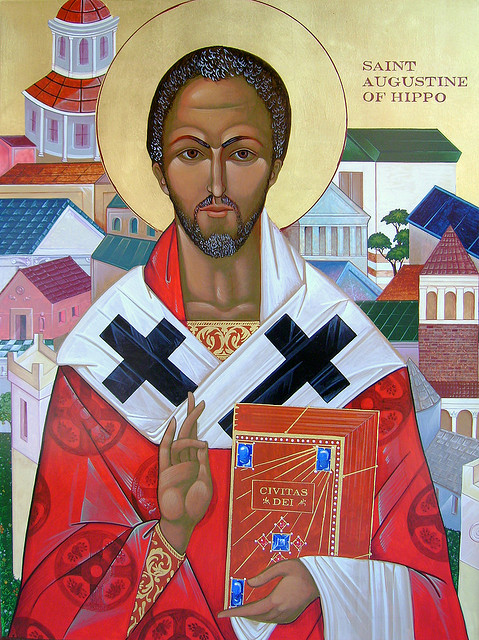
Saint Augustine wrote his seminal work, City of God, in about 413 C.E. The Roman empire had fallen, and pagans were blaming the Church because Christianity had become wed to the state. The people of God were unsure how to proceed. So, Augustine sought to help Christians think about how to live in a post-Christian society.
Augustine’s work is lengthy and quite in-depth, so, the following is a brief distilling of his main arguments. For Augustine, there are four essential institutions: two visible institutions; and, two invisible institutions:
The Church – is a divinely established institution, designed to lead people to God.
The State – is a political institution, adhering to political virtues to establish the peace.
The City of Heaven – is made up of those predestined for salvation.
The City of the World – is made up of those destined for eternal damnation.
We must pursue the City of Heaven, which for Augustine, is the pursuit of justice and righteousness. Augustine gave a clarion call for people to choose which city they will pursue, especially because many tended to blur the distinctions between the visible institutions of church and state.
Augustine’s conclusion is that the purpose of history is to show the unfolding of God’s plan. This involves fostering the City of Heaven and filling it with worthy citizens. Therefore, the fall of Rome, a visible city so important to the people of Augustine’s day, was not near as important to the invisible God.
Maintaining an eternal perspective can help us today. The collapse of jobs, the scourge of a racialized society, the loss of life due to COVID-19, and injustice are significant events and circumstances – important enough to consider deeply how those issues will be handled. Augustine called out the people of his day for ignoring invisible spiritual solutions for the great problems among them.
Returning to the book of Genesis, a question arises: Will the Israelites become a nation through assimilation with Egypt and its institutions, or will they maintain their distinction as God’s people by relying on God’s covenant promises? There are no easy answers to living in the world. However, it is important we struggle with how to get along in it.
God is the principal actor in the created world. God chooses to use his people as instruments of blessing to it. Joseph’s wisdom and diplomacy, given by God, turned potentially catastrophic situations into times of prosperity. God, too, will use us as dispensers of wisdom – applying truth to concrete situations for the betterment of all involved.
Joseph handled the delicate situation of his brothers being shepherds while all shepherds were detestable to Egyptians. Joseph brought the two worlds together through artful negotiation between the interests of both Pharaoh and the Israelites. He created a win/win scenario by setting up his brothers to help Pharaoh with his own needs in caring for livestock. In the end, all parties were satisfied because Joseph maintained a focus on needs instead of only advocating one side.
Rather than getting bogged down in promotion of methods and means, a sage approach is to maintain a focus on needs – which requires careful listening and a stance of empathy. Then, we can work toward prosperity for all instead of hardening into reified positions. A lot of problems in the church, work, society, and family can be turned to blessing if we seek the wisdom that comes from God.
May the Lord bless you and keep you; and, make his face shine on you and be gracious to you. May the Lord turn his face toward you and give you peace. Amen.








 Rev. Tim Ehrhardt