The Tower of Babel (Genesis 11:1-9)

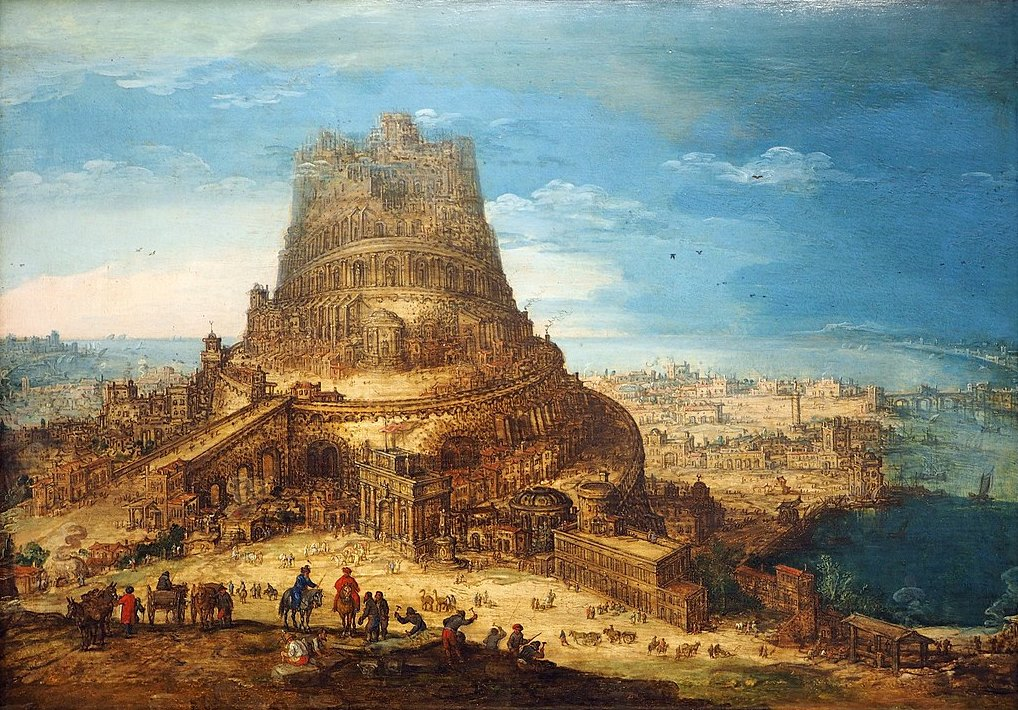
The Tower of Babel, by Hendrick van Cleve III (1525–1589)

At one time, the whole Earth spoke the same language. It so happened that as they moved out of the east, they came upon a plain in the land of Shinar and settled down.

They said to one another, “Come, let’s make bricks and fire them well.” They used brick for stone and tar for mortar.

Then they said, “Come, let’s build ourselves a city and a tower that reaches Heaven. Let’s make ourselves famous so we won’t be scattered here and there across the Earth.”

God came down to look over the city and the tower those people had built.

God took one look and said, “One people, one language; why, this is only a first step. No telling what they’ll come up with next—they’ll stop at nothing! Come, we’ll go down and garble their speech so they won’t understand each other.” Then God scattered them from there all over the world. And they had to quit building the city. That’s how it came to be called Babel, because there God turned their language into “babble.” From there God scattered them all over the world. (The Message)

At first glance, the Bible reader may wonder what the big deal is about people coming together to build a tower.

A mere cursory look at the text might seem as if God is having some sort of divine anal-retentive moment of control. After all, the people are just trying to get some work done; it’s not like they’re going to somehow invade God’s privacy with a very tall tower.

But that’s not what was going on, way back there several millennia ago. Something more subversive was afoot, and the Lord was completely savvy to what was happening.

The previous chapter (Genesis 10) presents a rather orderly spread of the burgeoning humanity across the earth – which is consistent with God’s original blessing and mandate at the creation of people:

“Prosper! Reproduce! Fill Earth! Take charge!
Be responsible for fish in the sea and birds in the air,
    for every living thing that moves on the face of Earth.” (Genesis 1:28, MSG)

Yet, here in Genesis 11, people have intentionally stopped discovering the earth. It appears they are more curious about heaven. So, they amassed themselves together and decided to move vertically rather than horizontally across the world.

There seems to have been a great deal of human ambition that was eyeing an assault and takeover of the divine realm, instead of busying themselves with their God-given human realm. Another way of putting it is that they were irresponsible – not caring for creation – but more concerned about having some leverage on God.

Ambition, in and of itself, is neither good nor bad; it’s where that ambition is aimed. And the early people were directing their sights up rather than out – trusting in their human ingenuity and technological abilities to achieve autonomy for themselves.

Because God created humans in the divine image and likeness, people were (and still are!) amazing creatures who can accomplish incredible feats of achievement in whatever they set their minds and hearts to do. Yet, in the case of constructing a tower (or ziggurat) humanity was ignoring their mandate to care about the earth and its inhabitants. Instead, they were working their own will to build a name for themselves, apart from God.

So, the Lord stepped in by confusing their common language so that they would have difficulty communicating with one another. On the surface, it might seem that God was being capricious. But examining just a bit deeper, we can observe what would happen if people threw off their responsibility to the planet and all of its creatures.

The entire world could be subject to terrible inattention. Much like a backyard garden that becomes overrun with weeds due to neglect, the whole earth was in jeopardy of falling into a system of evil that would care nothing for its abundant life and intricate ecosystems. In short, the earth could be ruined.

If this sounds eerily like what we humans are doing today, its probably because that is precisely what we are doing – putting a collective stiff-arm to God and doing whatever the heck we want in exploiting the earth for our own human purposes.

Never mind that entire species of fish and animals, along with flora and fauna and forests and wetlands and grasslands are being harmed and destroyed by so called human ingenuity and technological advance.

It is our own arrogant pride and hubris of abject selfishness, in setting up ourselves as masters of the universe, that brings us to the edge of an environmental holocaust – not to mention fighting amongst ourselves about who will be in charge and in control of it all. We’ll engage in wars and atrocities if that’s what it will take.

Therefore, the Tower of Babel is a symbol of all that is wrong – not right – with humanity. Until we can unlearn our ancient ways of arrogance and injustice, ignorance and lack of awareness, and recover even older ways of caring for one another and the earth, then we will find ourselves being broken by the divine gravity of judgment which exists whenever people choose to defy the order of the world.

In many ways, primeval history remains alive in our daily current events. Yet, it can change. But it will take a heavy dose of humility and confession of guilt to begin undoing the harm we have imposed on others and on our world. And it will take a return to Eden, to the responsibility of creation care, and of healthy relational connections with both other people and God.

Every one of us is culpable – whether we have been directly involved in systemic evil, or not. We all have participated in and benefited from our privilege as human beings living on this planet – sometimes to the extent of turning a blind eye to the great needs of the earth and its inhabitants.

So, what will you do about it? Who will you turn to? Where does your ultimate trust rest? Are you willing to work for good, to be merciful, just, kind, and loving in a pursuit of right relationships with God, others, and the earth?

Sovereign Lord and Creator, renew our spirits and cleanse our hearts. Renew our minds and transform our lives. Renew our cities and rebuild our ruins. Renew our world, in your name we pray, Amen.

The Finite and the Infinite (Psalm 65)

God of Zion, to you even silence is praise.
    Promises made to you are kept—
    you listen to prayer—
    and all living things come to you.
When wrongdoings become too much for me,
    you forgive our sins.
How happy is the one you choose to bring close,
    the one who lives in your courtyards!
We are filled full by the goodness of your house,
    by the holiness of your temple.

In righteousness you answer us,
    by your awesome deeds,
    God of our salvation—
    you, who are the security
        of all the far edges of the earth,
        even the distant seas.
    You establish the mountains by your strength;
    you are dressed in raw power.
    You calm the roaring seas;
        calm the roaring waves,
        calm the noise of the nations.
Those who dwell on the far edges
        stand in awe of your acts.
    You make the gateways
        of morning and evening sing for joy.
You visit the earth and make it abundant,
    enriching it greatly
        by God’s stream, full of water.
You provide people with grain
    because that is what you’ve decided.
Drenching the earth’s furrows,
        leveling its ridges,
    you soften it with rain showers;
        you bless its growth.
You crown the year with your goodness;
    your paths overflow with rich food.
Even the desert pastures drip with it,
    and the hills are dressed in pure joy.
The meadowlands are covered with flocks,
    the valleys decked out in grain—
        they shout for joy;
        they break out in song! (Common English Bible)

The biblical psalms present God as sovereign over all creation. Today’s psalm extols the Lord of the universe as God of both temple and terra, of people and the earth.

God of the temple

Praise is the appropriate offering to God – because it is the Lord who listens, forgives, and chooses to fill persons with the holiness and goodness of God’s presence, exemplified in the temple.

Infinite righteousness cannot be fulfilled by finite beings. In other words, we need God.

The nineteenth century philosopher and theologian, Søren Kierkegaard (1813-1855) insisted that the humans did not established themselves; therefore, no one can simply exercise their will toward better and brighter circumstances.

Kierkegaard argued that humanity, at its core, is a synthesis of the infinite and the finite, the temporal and the eternal. A finite human is not a self; only when connected and aware of the infinite is someone a self. (The Sickness Unto Death)

Creatures can never lift themselves above anxiety, worry, distress, or hardship with only finite resources; we need infinite supplies and divine capital, to tap into the image of God within us, to realize that our true identity is inextricably dependent upon our Creator.

“Prayers” by Yoram Raanan

We are more than bodies and brain synapses; we are also souls. And as souls, we shall never realize our true selves through the temporary means of possessions, prestige, and power. A person cannot construct a self, by themselves, to bear the weight of who we really are. That’s because our real identity is hidden with Christ in God. (Colossians 3:3)

Just as the temple in Jerusalem was much more than a physical structure, so we, as the people of God, are so much more than tangible beings.

Do you not know that you are God’s temple and that God’s Spirit dwells in you? (1 Corinthians 3:16, NRSV)

Praise, prayer, and worship are practices designed to connect with the infinite God. Indeed, the kingdom of God is much nearer than we know.

Jesus said, “The kingdom of God is not coming with things that can be observed, nor will they say, ‘Look, here it is!’ or ‘There it is!’ For, in fact, the kingdom of God is among you.” (Luke 17:20-21, NRSV)

God of terra

We walk upon and inhabit this present terra firma, this earth. The earth, and all that is in it, belongs to the Lord. God is something of a cosmic farmer, taking care of the earth, watching over it, tending to its needs.

All that takes place on this celestial ball we live upon is under the gracious and loving eye of God. It is the Lord who brings the seasons and the rains, calming the storms of the seas, as well as the storms of our lives.

One of the reasons we find ourselves in such an impending climate debacle on this earth, is that we continue to utilize all the finite resources we can muster and fail to acknowledge and become aware of the grand infinite wherewithal we have with our Creator and Sustainer.

“I am the Lord, your savior;
I am the one who created you.
I am the Lord, the Creator of all things.
    I alone stretched out the heavens;
    when I made the earth, no one helped me. (Isaiah 44:24, GNT)

The earth is beautiful. Yet, in our insistence upon merely using the temporal and physical, ugliness has come upon the earth, obscuring the true nature of God’s good creation. Distancing ourselves from the Creator only builds bigger obstacles to solving the earth’s most significant issues.

Self-imposed and ensconced impediments need to be cleared away. The weeds have overtaken the garden; we can no longer see the good plants that are supposed to grow and produce a harvest. And yet, as any farmer or gardener knows, you cannot simply yank such weeds from the ground without also pulling up what you are trying to preserve.

The Lord will provide – but if we keep to our stubborn independence from God, the process of weeding the garden will take much longer to accomplish. Yet, God is patient, not wanting any to perish but all to come around to the infinite. (2 Peter 3:9)

Conclusion

Let us come to God in our neediness and failure. We must see ourselves as infinite souls with finite solutions who can cry out to the God who hears and forgives. We need to connect with the Lord who hears our prayers. It is imperative that we rely upon the infinite Creator who is concerned to cultivate justice and righteousness upon an earth which is full of plenty for everyone.

Praise, pray, give thanks, and be connected to the infinite One whom we need for life and godliness in this present, evil, and finite age.

Stay joined to me and I will stay joined to you. No branch can produce fruit alone. It must stay connected to the vine. It is the same with you. You cannot produce fruit alone. You must stay joined to me. (John 15:4, ERV)

Blessed God and Father of all, yours is the kingdom, the power, and the glory forever. To you belongs the heavens and the earth. It is you who made all that is – sun, moon, stars, rivers, forests, minerals, birds, animals, fish, and us – and pronounced it all “good.” We seek your divine mercy and help so that our work and our worship may curb the sin that so easily entangles and bring your intended shalom to the earth. Amen.

Psalm 48 – Our Place Matters

Great is the Lord and greatly to be praised
    in the city of our God.
His holy mountain, beautiful in elevation,
    is the joy of all the earth,
Mount Zion, in the far north,
    the city of the great King.
Within its citadels God
    has shown himself a sure defense.

Then the kings assembled,
    they came on together.
As soon as they saw it, they were astounded;
    they were in panic, they took to flight;
trembling took hold of them there,
    pains as of a woman in labor,
as when an east wind shatters
    the ships of Tarshish.
As we have heard, so have we seen
    in the city of the Lord of hosts,
in the city of our God,
    which God establishes forever.

We ponder your steadfast love, O God,
    in the midst of your temple.
Your name, O God, like your praise,
    reaches to the ends of the earth.
Your right hand is filled with victory.
    Let Mount Zion be glad,
let the towns of Judah rejoice
    because of your judgments.

Walk about Zion, go all around it,
    count its towers,
consider well its ramparts;
    go through its citadels,
that you may tell the next generation
    that this is God,
our God forever and ever.
    He will be our guide forever. (New Revised Standard Version)

In college, I was a geography minor. One of the interesting things I discovered in looking at old maps from around the world, is that each country, nation, or people group tends to place themselves at the center of the world.

In the 1956 movie, The King and I, the King of Siam (played by Yul Brynner) displays a map with an oversized Siam (present day Thailand) smack in the middle, making sure to impress upon his children’s English schoolteacher, Anna (Deborah Kerr), that the British Empire is not the center of the world.

Our place matters. Being grounded and rooted to a geographical spot helps us establish long term relationships, consistent patterns of living, and attentive service to the community.

I happen to think there is something healthy about having pride of place. It enables us to take some ownership and responsibility of an area. Ideally, as we learn to care for our surrounds, we discover proper stewardship of all creation and the necessity of paying attention to the world that we all inhabit together.

Yet, we know that doesn’t always happen. The pride of place can give way to the wrongheaded belief that we are better than others, that our cultural norms and ethical mores are exactly the way everyone else ought to live. It manifests itself in overzealous patriotism and misplaced allegiances.

In The King and I, the Siamese King and British Anna must both grapple with and navigate the very different cultures of each. Eventually, they discover a deep appreciation of the other, even as they do not fully understand one another.

In their healthiest times, the ancient Israelites not only saw Jerusalem as the center of the world, but also discerned there is a big world with God as the center of it all. Everyplace has meaning. Each particular place has its own sacred quality to be appreciated.

Whenever we are able to be captivated by the beauty of the place we are in, this opens us to see the beauty in other places, as well.

I feel a special connection with Iowa farmland. After all, I grew up on an Iowa farm. Even though I left home for college, a life very different from working the soil, I still found myself becoming a Pastor – someone who tends to a parish and is attentive to the people in that place.

Everywhere I have lived, I established a kinship with the place. Each geographical locale had its own unique charm, as well as its challenges. And, having moved a great deal in my adult life, I discovered that everywhere I go, I’m reminded that this is not my home.

Yes, I long for another home, my true home. The deep connection I feel to the land, to the places I’ve lived, and in the current places I inhabit, help me to get in touch with what shall eventually be my permanent abode. I resonate with the Apostle Paul when he said:

If I am to go on living in the body, this will mean fruitful labor for me. Yet what shall I choose? I do not know! I am torn between the two: I desire to depart and be with Christ, which is better by far; but it is more necessary for you that I remain in the body. (Philippians 1:22-24, NIV)

And perhaps we have felt and share the Apostle’s longing, framed in this way:

For we know that if the earthly tent we live in is destroyed, we have a building from God, a house not made with hands, eternal in the heavens. For in this tent we groan, longing to be clothed with our heavenly dwelling—if indeed, when we have taken it off we will not be found naked. For while we are still in this tent, we groan under our burden, because we wish not to be unclothed but to be further clothed, so that what is mortal may be swallowed up by life. He who has prepared us for this very thing is God, who has given us the Spirit as a guarantee.

So, we are always confident; even though we know that while we are at home in the body we are away from the Lord—for we walk by faith, not by sight. Yes, we do have confidence, and we would rather be away from the body and at home with the Lord. (2 Corinthians 5:1-8, NRSV)

In this life, God will guide us, by means of the Holy Spirit. The Spirit testifies and confirms within us, beyond what mere language can communicate, that we belong to God, and we will have a permanent place with the Lord forever.

Our place matters. The ways in which we inhabit where we live, matters.

Mighty God, I give you thanks for sending your Son, the Lord Jesus, to come and be with us. And in our longing to be with him, you have graciously given your Spirit to take up residence within us and assure us of our true home. May our longings in this life help us to be better people, attentive and mindful to those around us, to the glory of Christ, our Savior. Amen.

Psalm 8 – The Majesty of It All

MilkyWay
The Milky Way

O Lord, our Sovereign,
how majestic is your name in all the earth!

You have set your glory above the heavens.
Out of the mouths of babes and infants
you have founded a bulwark because of your foes,
to silence the enemy and the avenger.

When I look at your heavens, the work of your fingers,
the moon and the stars that you have established;
what are human beings that you are mindful of them,
mortals that you care for them?

Yet you have made them a little lower than God,
and crowned them with glory and honor.
You have given them dominion over the works of your hands;
you have put all things under their feet,
all sheep and oxen,
and also the beasts of the field,
the birds of the air, and the fish of the sea,
whatever passes along the paths of the seas.

O Lord, our Sovereign,
how majestic is your name in all the earth! (NRSV)

This little psalm grounds us by dealing with ultimate questions of existence: Who am I?  Why do I exist?  What is the purpose of my life?

The answers to those questions are supremely important because we can lose sight of who we are and why we exist. If we were to peel back the layers of any random person’s life, we may find a deep sense of not belonging, of being in profound touch with their own mortality, and of having a disconnected sense of their personal role in the world. Many people have lost their original purpose of being a person and belonging to the human family in a way that makes a significant contribution to the world.

We live on a big planet, and that causes some people to feel quite small and wonder how they fit in. Gaping at such a large universe we may ask along with psalmist, “What are humans that you are mindful of them?”  This question forms the center of the psalm.  Hebrew poetry is typically arranged to have the front and the end of the poem point to the middle as its focus. So then, the psalmist purposely wrote this psalm so we would consider the great question of what God thinks of humanity within the scope of this exceptionally large universe.

To put this largeness in perspective, if the Milky Way galaxy were the size of the entire continent of North America, our solar system would fit in a coffee cup. Even now, two Voyager spacecraft are hurtling toward the edge of the solar system at a rate of 100,000 miles per hour. For thirty-five years they have been speeding away from Earth, having traveled 9 billion miles. When engineers beam a command to the spacecraft at the speed of light, it takes over 13 hours to arrive. Yet this vast neighborhood of our sun—in truth, the size of a coffee cup—fits along with several hundred billion other stars and their planets in the Milky Way, one of perhaps 100 billion such galaxies in the universe. To send a light-speed message to the edge of that universe would take 15 billion years.

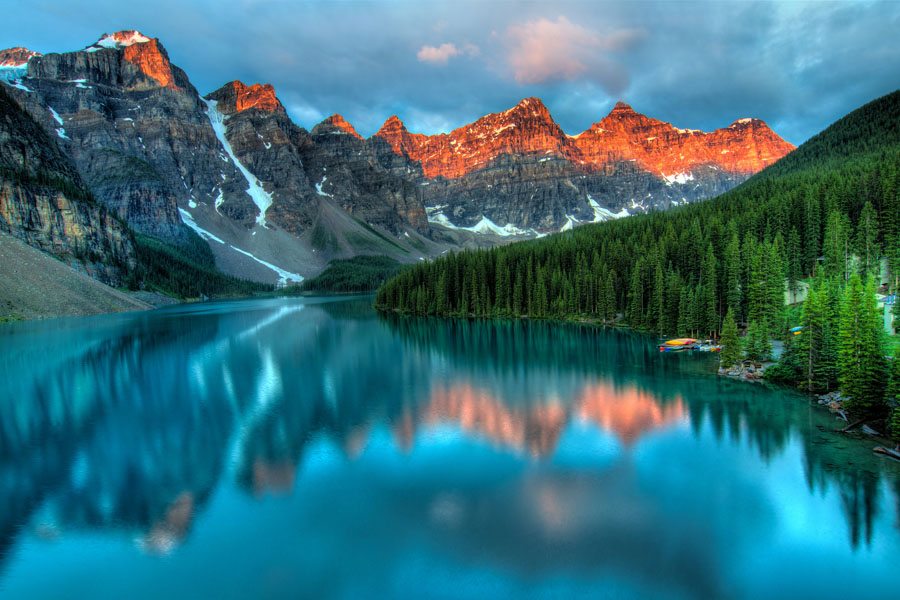
Moraine Lake, Canada
Moraine Lake in Alberta, Canada

Out of the billions of galaxies in the universe, what is planet Earth that God should care about it?  Even on our planet there are billions of creatures. Yet, out of all those bugs, animals, fish, and birds, God has a special relationship with us, humanity, and cares for us deeply. God has even entrusted us with the responsibility to care for creation.  We are the only creatures who have the charge to steward all that God has created.  To put it another way, we, as people created in the image of God, have a job that is befitting of royalty, and it is more than a duty – it is a delight.

Furthermore, it is a godly and spiritual thing to engage in good creation care, whether it is properly feeding and caring for a pet, properly attending to relationships with grace and civility, or playing a crucial role in responsible land use.  Whatever it may be within this vast created world, God has entrusted to us this expansive Earth we live upon.  Literally everything in all creation is under our stewardship.

Out of all the creatures on earth, only people have been given the task of caring for every other created thing.  Only we as people have the self-awareness and perspective of the world which is needed to govern the world.  So, then, we can only find our true purpose and belonging in the stewardship of creation.  Care-giving is at the heart of being a person.

The glitch to this, and why so many lose their way, is that the world is still living under a curse due to the original fall of humanity into sin.  When we allow other dominions to supersede God’s dominion, then we have major problems.  When the power of money, or the significance of a position or job title, or the ability to do certain tasks is our basic identity and place of belonging, then we will likely succumb to anxiety. Other dominions cannot help us find our true God-given majesty as people created in God’s image.  Living any other way than being a proper steward of the world is beneath us because we have inherent dignity as God’s vice-regents over creation.

“There is no such thing as a small thing – only small things done with big love.” –Mother Teresa

That sentiment perfectly captures the vision of the psalmist – that all people are crowned with glory and honor and rule with God to do all the small things of life with a love that comes from our Creator.

Going forward, we have the possibilities of engaging in good stewardship of all that God has given us.  We can use our words in ways that care for others and build them up, rather than saying uncaring things which are not helpful.  We have the chance to be attentive to all the little things of life, whether gardening, building a bird house, working with diligence and care at our jobs, or keeping our community clean and its citizens healthy and happy, it is all important and has a significant place.

Let us, then, continually improve what we do, no matter what it is, so that it befits us as God’s people crowned with honor.  May this topsy-turvy year become one of joy and contentment, knowing the majesty we share with God as humans in his wondrous world.

Creator God, you make all things and weave them together in an intricate tapestry of life. Teach us to respect the fragile balance of life and to care for all the gifts of your creation. Guide by your wisdom those who have power and authority, that, by the decisions they make, life may be cherished, and a good and fruitful Earth may continue to show your glory and sing your praises. Almighty God, you have called us to tend and keep the garden of your creation. Give us wisdom and reverence for all your plants and animals who share this planet with us and whose lives make possible our own. Help us to remember that they too love the sweetness of life and join with us in giving you praise. Amen.