God of the Living (Ezekiel 39:7-8, 21-29)

I will make sure that my people Israel know my holy name, and I will not let my name be disgraced any more. Then the nations will know that I, the Lord, am the holy God of Israel.”

The Sovereign Lord said, “The day I spoke about is certain to come….

The Lord said, “I will let the nations see my glory and show them how I use my power to carry out my just decisions. The Israelites will know from then on that I am the Lord their God. And the nations will know that the Israelites went into exile because of the sins which they committed against me. I turned away from them and let their enemies defeat them and kill them in battle. I gave them what they deserved for their uncleanness and their wickedness, and I turned away from them.”

The Sovereign Lord said, “But now I will be merciful to Jacob’s descendants, the people of Israel, and make them prosperous again. I will protect my holy name. When they are once more living in safety in their own land, with no one to threaten them, they will be able to forget how they were disgraced for having betrayed me. In order to show to the many nations that I am holy, I will bring my people back from all the countries where their enemies live. Then my people will know that I am the Lord their God. They will know this, because I sent them into captivity and now gather them and bring them back into their own land, not leaving even one of them behind. I will pour out my spirit on the people of Israel and never again turn away from them. I, the Sovereign Lord, have spoken.” (Good News Translation)

“God is trying to sell you something, but you don’t want to buy. This is what your suffering is: Your fantastic haggling, your manic screaming over the price!”

Hafiz, 14th century Persian mystic poet

A lot of folks struggle with their relationship with God in trying to make sense of the hard things they go through. Some interpret their troubles as a punishment from God. Others resign themselves to the difficulty and, at best, believe there must be some purpose to it all; and, at worst, simply state in defeat, “It is what it is.”

God most certainly does allow some awful things to happen. Although the Lord is not the author of the evil, God providentially bends all circumstances for the divine glory and for our benefit.

We may still cry out and insist, “But why must God do it this way? Isn’t there another path than the one I’m on?” It’s not bad to ask those questions. After all, the Lord Jesus himself cried out, “My Father, if it is possible, may this cup [of suffering] be taken from me. Yet not as I will, but as you will.” And, “My God, my God, why have you forsaken me?” (Matthew 26:39, 27:46, NIV)

In many ways, life is about detaching from all that hinders us from attaching to God. If we are mindful of this project, it’s likely we will realize a fulfilling connection with the divine. If, however, we lose sight of this, and become unaware of the vital relationship between God and humanity, then the Lord loves us enough to work on bringing us back into healthy relations.

It takes a lifetime of practice to let go and die to self.

And God will use every circumstance – both good and bad – to help us do that.

The Lord is glorified and shown forth as holy when we detach from all that is unhealthy and attach to everything that is just, right, and good.

God’s own Holy Spirit is the very person we need to guide us through each situation of our lives.

Typically, it is we ourselves who need to change, and not necessarily our circumstances. Yet, we too often fear change. The ego – the false self – hates change because it has bought into the belief that the outward projection of oneself to the world is the real thing (which it is not). Therefore, the ego tends to interpret each negative situation as an attack, rather than discerning that this might be the Lord getting at the inner heart of the person.

We must come to grips with the reality that one must change in order to love, and to love in order to change. Anytime we love someone or something else, we have died on some level; we let go of something so that we can grab hold of something else. The monkey who refuses to let go of the banana is trapped; the one who releases it grabs hold of freedom.

“Sin” is much less about moralistic religion, and much more about mistaking ourselves for someone we aren’t and not knowing to whom we belong. The ancient Israelites, whom the prophet Ezekiel addressed, had lost touch with who they are and whose they are. So, the Lord was determined to clarify it for them.

The realization of our true selves comes through love. And since God is love, knowing God enables us to regain our true essence.

The ego, although the necessary scaffolding for the emerging construction of the soul, must eventually be jettisoned. It would be weird if you erected a building, then kept up the façade. God is alive and deals with the living, and not the dead things around us.

Jesus said, “He’s not the God of the dead but of the living. In God’s sight all people are living.” (Luke 20:38, GW)

O Holy One, we call to you and name you as eternal, ever-present, and boundless in love. Yet there are times, O God, when we fail to recognize you in the dailyness of our lives. Sometimes shame clenches tightly around our hearts, and we hide our true feelings. Sometimes fear makes us small, and we miss the chance to speak from our strength. Sometimes doubt invades our hopefulness, and we degrade our own wisdom.

Holy God, in the daily round from sunrise to sunset, remind us again of your holy presence hovering near us and in us. Free us from shame and self-doubt. Help us to see you in the moment-by-moment possibilities to live honestly, to act courageously, and to speak wisdom. Amen.

John 12:20-33 – Life By Death

Welcome, friends! Jesus let us in on how the world can be changed. For that to happen, there are some things we will need to die to. Click the videos below, and let’s find out….

John 12:20-33, Pastor Tim Ehrhardt
From the album by the Oslo Gospel Choir, “We Lift our Hands, Part 2” 2006

May the peace of God which surpasses all understanding, keep our hearts and minds in the knowledge and love of God, and of his son Jesus Christ our Lord; and the blessing of God almighty, the Father, the Son, and the Holy Spirit be amongst us and remain with us forever. Amen.

John 12:20-33 – What It Means to Follow Christ

dying to self

“Very truly, I tell you, unless a grain of wheat falls into the earth and dies, it remains just a single grain; but if it dies, it bears much fruit.  Those who love their life lose it, and those who hate their life in this world will keep it for eternal life.  Whoever serves me must follow me, and where I am, there will my servant be also. Whoever serves me, the Father will honor.” (NRSV)

The fifth Sunday in Lent is now here.  We are quickly approaching Jerusalem.  Holy Week will be here before you know it.  Why is this all significant?  Because Jesus is important.  When we take advantage of Lent with its focus on spiritual discipline, prayer, and repentance, we come face-to-face with the shadowy parts of our selves.  We discover that within us there is the pull to hold-on to unhealthy rhythms and habits of life, as well as a push to arrange our lives with the fragmentation of disordered love.

Perhaps our reflexive response to things we do not like about ourselves is to either use sheer willpower to change or try to somehow manage our brokenness, as if we could boss our way out of darkness.  The problem and the solution are much more radical than we often would like to admit.

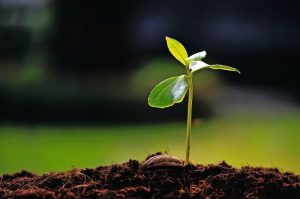
We must die.  Yes, this is the teaching of the Lord Jesus.  That is, we need to die to ourselves.  Sin cannot be managed or willed away – it must be eradicated and completely cut out, like the cancer it is.  Transformation can only occur through death.  Jesus uses the familiar example of a seed to communicate his point.  A tiny little seed can grow, break the ground, and develop into something which provides sustenance for others.  It does no good to remain a seed in the ground.

Jesus did not tell others to do with what he himself does not do.  Christ is the ultimate example of the one who died to himself and literally died for us.  Only through suffering and death did he secure deliverance for us.  Through his wounds we are healed.  Through his tortuous death a resurrection became possible – and we must always remember that there must be a death if there is to be a resurrection.  Death always comes before there is life.  There must be suffering before there is glory.

Only through dying to self and following Jesus will there be the kind of transformative change which the world so desperately needs.  If we persist in making puny attempts at trying to straddle the fence in dual/rival kingdoms, we will be spiritually schizophrenic and left with a divided soul.

Following Jesus, leaving all to walk with him, is true repentance and authentic discipleship.  The act of journeying with Christ is the means to having a new life.  Change only happens when we allow Jesus Christ to be the center from which all our life springs.

Maybe you think I’m being too forceful, too insistent about this Jesus stuff.  Yes, you have perceived well.  I am being quite single-minded about the need to die to self and live for Christ.  Somehow, within many corners of Christianity, this wrongheaded notion that suffering is not God’s will has made it into the life of the church.  But I’m here to say, on the authority of God’s Holy Word, that dying to ourselves is necessary and it hurts like hell.  The epistle reading for today bears this out:

“In the days of his flesh, Jesus offered up prayers and supplications, with loud cries and tears, to the one who was able to save him from death, and he was heard because of his reverent submission.  Although he was a Son, he learned obedience through what he suffered; and having been made perfect, he became the source of eternal salvation for all who obey him.” (Hebrews 5:7-9, NRSV)

We are not above our Master.  Even Christ’s life on this earth, before his death and resurrection, was marked with suffering.  Even Jesus learned obedience through struggle and adversity.  Our Lord himself did what he is now asking us to do.  He gave himself up to do the Father’s will.  We must give up ourselves to submit to King Jesus.  Jesus offered loud cries and tears and submitted to what the Father wanted.  We must do no less.  We don’t get to choose which parts of Christ’s life and teaching we will adhere to and which ones we don’t need to, as if Jesus were some spiritual buffet line.  All who live for Jesus will follow him into the path of suffering, of death to self, and of new life through the power of his resurrection.  In Christ’s own words: “Those who love their life lose it, and those who hate their life in this world will keep it for eternal life.”

So, then, how do we follow Jesus through dying to self?  What does that mean for you and me on a practical daily basis?

Thanks for asking.

Surrender

Every moment of every day we can give up ourselves to Jesus.  We have hundreds, maybe thousands of small decisions every day with the use of our time, our money, our energy, and our relationships.  If we have tried to fix what is broken inside of us, we will likely just try to hastily fix the problems and the people in our lives and move on with getting things done on our to do list.  Instead, we need to surrender.  We need to create the sacred space for solitude and silence, prayer and repentance.  Take the time to sit with a person in pain and listen.  Reflect on how to use your money in a way which mirrors kingdom values.  Begin to see your life as a holy rhythm of hearing God and responding to what he says.  It takes intentional surrender to do that.

Sacrifice

Holding-on to our precious stuff and time is the opposite of sacrifice.  Are we truly willing to give-up everything to follow Jesus?  It is more than true that we are not Jesus.  Our sacrifice and suffering are not efficacious, that is, it doesn’t deliver other people from sin.  Only Christ’s death does that.  Yet, we are still called to sacrifice.  The Apostle Paul understood this:

“I am now rejoicing in my sufferings for your sake, and in my flesh I am completing what is lacking in Christ’s afflictions for the sake of his body, that is, the church.” (Colossians 1:24, NRSV)

I’m just going to let you wrestle with that verse and mull it over without comment on my part.

We were not placed on this earth only to strive for happiness.  Our lives are not meant to be lived for ourselves. Jesus has called us to see our places, communities, neighborhoods, and families as our mission field of grace to a world who needs him.  This takes sacrificial love on our part.

Christianity is not really a religion that is for people who have put together neat theological answers and tidy packaged certainties to all of life’s questions.  Rather, Christianity is a dynamic religion of learning to follow Jesus, discovering how to die to self, and struggling to put Christ’s teaching and example into practice.

Those who don’t struggle are in big trouble.  But those who go through the pain of dying to themselves for the sake of their Lord, find that the fruit they end up bearing leads to eternal life.

May you struggle well, my friend.

Letting Go

20171207_091111

Across the street from where I live is a small old cemetery.  Each morning, after arising, I go to the large patio window facing the old tombstones and I am reminded of the brevity of life.  Yes, we all shall die.  From dust we came, and to dust we shall return.  But the daily look at the graveyard is much more than a future reminder of what awaits us all; it is also a very present call for me to die to myself.

One way of looking at our lives is to discern that it is a pilgrimage into the inner depths of our souls.  As we move within, there is a great need to put away selfishness, arrogance, and the hubris of settled certainty about everything.  When I became an adult, I discovered that life was not all about doing whatever I wanted (as I so naively thought as a kid).  Instead, life was also full of responsibilities, stewarding my work, school, and relationships.  I found that if I was to do anything well, it involved a significant degree of death to self.  When I married my lovely wife, I quickly discovered that marriage was a whole lot more than sex and being fed grapes from a beautiful woman while lounging on the couch.  Instead, it was a new journey of dying to my expectations and learning to meet the needs of this other person.  And, just when I thought I might be getting a handle on this new way of life, I became a father.  Now my whole life seemed upside-down caring for this helpless little baby girl that only screamed and pooped if she was not sleeping and eating.  My goodness, more death to self so that I may care for another.

I could go on and on with this motif of death (the Apostle Paul certainly did! i.e. Romans 6).  Caring for others as a pastor; becoming a grandfather; being attentive to the great needs of society and the world; it all involves being reminded each day that the cemetery awaits me.  As I write, the Christian Church is well into the season of Advent.  The coming of Christ is quite the fascinating and gracious reality.  If you think about it, Jesus could have just appeared on earth.  He could have shown up as a fully developed adult ready for his ministry.  Jesus could have circumvented the whole thing about experiencing the pain of growing and learning.  But, instead, he came to earth through a woman.  The King of the universe gestated in the womb of Mary and was born in humble circumstances.  He was a baby, a child, a young man, and a teacher and Savior.  Jesus learned obedience through what he suffered (Hebrews 2:10-18).  And then he died.  But death could not hold him in the grave.

When I look at that old cemetery I am also reminded of a bigger picture, and a larger portrait that God is painting.  I am daily learning, even now, to continually die to myself so that Christ might live in me.  He must grow and gestate within, overtaking me so that His life might be preeminent.  More of Him, less of me.  He must increase; I must decrease.  But out of that death to self, something extraordinary and supernatural occurs:  resurrection to a new life.  Someday, just as Christ came in his first Advent, He will come again in a second Advent.  The graves will open.  With the presence of Christ in me, I shall rise again, just as He did.

There cannot be a resurrection without a death.  All great spiritualities have in common the need to let go.  Christianity just puts it in the frame of dying to self and living for Jesus so that the world will be blessed by encountering the great truth that He is Immanuel, God with us.

The graveyard does not have the last word.  It is a daily reminder that I must die.  But it is also an abiding picture that new life is possible through death, both in this life and in the life to come.