
Walk on Water? Why? (Matthew 14:22-33)

Jesus Walks on Water, by Konstantin Alexejewitsch Korowin, 1890 

Immediately Jesus made the disciples get into the boat and go on ahead of him to the other side, while he dismissed the crowd. After he had dismissed them, he went up on a mountainside by himself to pray. Later that night, he was there alone,and the boat was already a considerable distance from land, buffeted by the waves because the wind was against it.

Shortly before dawn Jesus went out to them, walking on the lake. When the disciples saw him walking on the lake, they were terrified. “It’s a ghost,” they said, and cried out in fear.

But Jesus immediately said to them: “Take courage! It is I. Don’t be afraid.”

“Lord, if it’s you,” Peter replied, “tell me to come to you on the water.”

“Come,” he said.

Then Peter got down out of the boat, walked on the water and came toward Jesus. But when he saw the wind, he was afraid and, beginning to sink, cried out, “Lord, save me!”

Immediately Jesus reached out his hand and caught him. “You of little faith,” he said, “why did you doubt?”

And when they climbed into the boat, the wind died down. Then those who were in the boat worshiped him, saying, “Truly you are the Son of God.” (New International Version)

In the New Testament Gospels, we see Jesus for who he is – Son of God and true Sovereign of the universe – seeking to reconcile people to God through his life, miracles, and teaching. In the Gospels we also see Christ’s disciples for who they are – a rag-tag bunch who express both belief and doubt, and experience both faith and failure.

The reality of the Christian life is that it is a sort of three-steps-forward and two-steps-backward kind of experience. The expectation that we will “succeed” and have everything go hunky-dory each time we step out in faith, is far from how things actually work in both the world and in God’s kingdom. Doubt and failure are important experiences for the believer in Jesus.

Without failure, there is no Christian life. Why? Because it means we are still in the boat.

It’s evidence that we never left the safety of established routines and responded to God’s command to step out of our comfort zone, and boldly go where we’ve never gone before.

Our failures may, like Peter, be colossal bellyflops. Yet, Jesus is there – extending grace to Peter and helping him, even in his failure of faith. Failure does not define us; it isn’t our identity. Jesus is Lord over everything, including storms, hardship, and trouble. 

Yes, there are a lot of scary things in life. Learning to ride a bike was scary. Driving for the first time on an icy road was scary. Getting married and having kids was scary. Admitting a fault, mistake, or weakness is scary. Being vulnerable with another person is scary.

It can even be scary to be at church. Why? Because we might fail, and it may crush us.

The fear of failure, however, need not control our lives. Why? Because grace overcomes everything.

We all find ourselves, at times, caught midway between faith and doubt. But to know this situation is to experience grace. If the worst scenario you worry about in your head would actually come to pass, it will still never change the reality that God loves you! And it will not stop Jesus from extending his hand to you in a life-saving grip of grace. 

Fear melts away when we keep our eyes on Jesus. So, we must focus on Christ, instead of fixating on the waves around us. The truth sets us free. Therefore, let’s notice five truths about Jesus that help us overcome the fear of failure and embrace a life of faith.

1. Jesus is a person of prayer

Jesus was deeply dependent on his heavenly Father. His life exhibited the necessities of simple prayer and obedience. If Jesus found the need for solitude and prayer for his life and ministry, how much more to we need it!? 

The Lord had his disciples get into the boat and go out on the lake. Jesus knew they were about to face a storm. The boat ended up getting thrown around by the waves. Even though the disciples were doing God’s will by going out on the lake, they were not spared from adversity.  

Jesus wanted his disciples to experience the storm. Why? Because it is through the storm that we learn faith.  

Faith is developed through experience and adversity. Faith that never endures distress, never grows and matures. Faith must be exercised – and if it isn’t, it atrophies and becomes useless. 

Show me a person with great faith, and I’ll show you a person that has gone through a boatload of adversity and hurt, having allowed Jesus to grace them with healing.

2. Jesus is present with us, and this presence brings an end to fear

Being in the middle of a lake during a storm did not prevent Jesus from being present with the disciples – he just walked on the water to be with them. Even though the disciples had just participated in the miracle of Jesus feeding the five thousand, another miracle was not on their radar – which is why they did not recognize Jesus and were afraid when they saw him.

While afraid, we don’t see Jesus, even when he’s right in front of our faces. Why? Because we don’t expect him to be there and mistake him for a ghost.  

When the disciples cried out in fear, Jesus responded. I used to have a factory job, training workers. When the training was completed, I had the trainees evaluate our time together. The top response I received is that my presence helped them to learn their job – the freedom to fail time and time again without judgment. Having me there to rescue them, when things got too much, built confidence that they could do it on their own.

3. Jesus desires those who follow him to imitate him

Jesus walked on water. Jesus invited Peter to walk on water. Peter was not chided by Jesus for getting out of the boat, but for doubting that he could continue in the miracle that was happening. 

Jesus isn’t merely interested in disciples being able to regurgitate his teaching. Why? Because he wants us to exercise our learning through actual deeds of faith.  

Once the command of Jesus was given to Peter, “Come”, then walking on water became only a matter of trust.

“Christianity has not been tried and found wanting. It has been found difficult and left untried.”

G.K. Chesterton

We understandably get nervous when a crazy Jesus and an unpredictable Holy Spirit call us to change by getting out of the friendly confines of the boat. Why? After all, we might fail. 

However, it is at those times that we bank on God’s Word and promises. The Apostle James said that if we find ourselves lacking wisdom to deal with the unpredictable and unknowable, we are to ask God who gives generously to all without finding fault and will be given to us. (James 1:5)
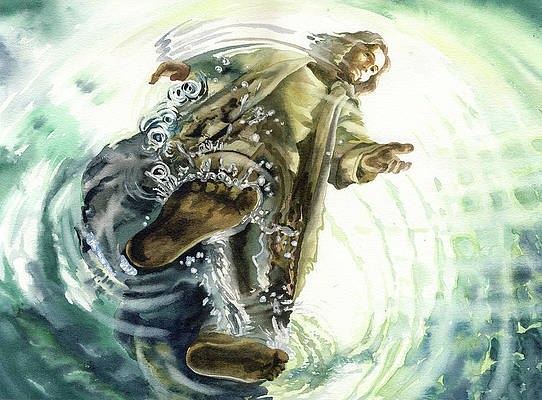
Christ Walking on the Sea, by Natali Fedorova

Peter responded to his predicament by crying out to Jesus, “Lord, save me!” Jesus immediately reached out and saved Peter from his own doubt and lack of faith. Jesus called Peter a “little-faith.”

Many people have lived too long with the notion that God is some stern angry deity who is constantly displeased with sinful people, and that only through perfection will God ever be happy with us. The truth is that Jesus wants us to imitate him; and, when we fail, he is there to pick us up. 

4. Jesus has the authority to settle the storm when he is ready to do it

Jesus is King. Christ is Sovereign of the world. He will bring the crisis to an end according to his own good pleasure and good timing. Rather than spending all our emotional capital by worrying or conniving to get out of a situation, we can trust God and keep our eyes on Jesus.  Our job is to believe; God’s job is everything else.

5. Jesus’ power led the disciples to acknowledge who he is

Worship happens when we see Jesus as he really is, the Son of God. Flat, dull, boring worship comes from flat, dull, boring Christians who are unable to see the power of Jesus in their lives. We discover the power of God when we are in a situation which requires God’s strength to deliver us. Grasping Jesus as the Son of God is more than a verbal confession of faith; it is being able to trust him, like getting out of a boat in the middle of a lake.

We are to live by faith in the Son of God who loved us and gave himself for us (Galatians 2:20). It doesn’t require much faith to pray that Aunt Mable’s bunions will feel better. It only requires a little faith to give a dollar when you have ten dollars. It takes no faith to discuss the weather and steer clear of hard conversations.

But it does require faith:

  • to pray for a miraculous healing every day without giving up for a little boy who is racked by epilepsy, and trust God to spare his life
  • to write a check for $100 to someone in need when you have exactly $100 in your checking account, and trust God to provide for you own necessities. 
  • to go off the grid of the routine schedule to have a difficult discussion about social justice, and trust God to act on Christ’s teachings. 
  • to live as though the mission of God in this world is the most important thing we could ever do, and trust God to step out and do it.

It would be great if we could pray and act without ever doubting or failing, yet the only way to do that is to never step out of the boat. Instead, live life. Trust God. And see what happens.

Holy God, help us, your people, to embrace the life that is truly life by stepping out of the boat.  May Jesus define our lives instead of letting failure define us. May we accept the grace that is ours in Jesus Christ our Lord, in whose name we are bold to pray. Amen.

I Am Sending You (Judges 6:11-24)

The Messenger of the Lord came and sat under the oak tree in Ophrah that belonged to Joash from Abiezer’s family. Joash’s son Gideon was beating out wheat in a winepress to hide it from the Midianites. The Messenger of the Lord appeared to Gideon and said, “The Lord is with you, brave man.”

Gideon responded, “Excuse me, sir! But if the Lord is with us, why has all this happened to us? Where are all the miracles our ancestors have told us about? Didn’t they say, ‘The Lord brought us out of Egypt?’ But now the Lord has abandoned us and has handed us over to Midian.”

The Lord turned to him and said, “You will rescue Israel from Midian with the strength you have. I am sending you.”

Gideon said to him, “Excuse me, sir! How can I rescue Israel? Look at my whole family. It’s the weakest one in Manasseh. And me? I’m the least important member of my family.”

The Lord replied, “I will be with you. You will defeat Midian as if it were only one man.”

Gideon said to him, “If you find me acceptable, give me a sign that it is really you speaking to me. Don’t leave until I come back. I want to bring my gift and set it in front of you.”

“I will stay until you come back,” he said.

Then Gideon went into his house and prepared a young goat and unleavened bread made with 18 quarts of flour. He put the meat in a basket and the broth in a pot. Then he went out and presented them to the Messenger of the Lord under the oak tree.

The Messenger of the Lord told him, “Take the meat and the unleavened bread, put them on this rock, and pour the broth over them.” Gideon did so. Then the Messenger of the Lord touched the meat and the bread with the tip of the staff that was in his hand. Fire flared up from the rock and burned the meat and the bread. Then the Messenger of the Lord disappeared. That’s when Gideon realized that this had been the Messenger of the Lord. So he said, “Lord God! I have seen the Messenger of the Lord face to face.”

The Lord said to him, “Calm down! Don’t be afraid. You will not die.” So Gideon built an altar there to the Lord. He called it The Lord Calms. To this day it is still in Ophrah, which belongs to Abiezer’s family. (God’s Word Translation)

Today’s story is familiar in more ways than one. It’s a typical interaction between the Lord and the individual. And it’s also the typical way people respond to God, even now in our contemporary world.

Notice how the interaction between the Lord and Gideon unfolds:

The message: The Lord is with you. You are brave.

The pushback: It doesn’t look like the Lord is with our people (and a purposeful ignoring of the bravery thing).

The message: The Lord is sending you (and a purposeful ignoring of the pushback).

The pushback: I’m too weak for that.

The message: The Lord is with you. You got this.

The pushback: It can’t be me. Give me sign.

The message: I will stay. I am with you.

The pushback: I am not acceptable. Here’s an offering.

The message: Chill, dude. You’re wound way too tight. I am with you. You got this.

The acceptance of the message: Here’s an altar to remind me that God is here, and God calms my fear.

Sound familiar? How many times have you had a similar sort of interaction with the Lord?

The message: “Don’t be afraid. The Lord is with you. You have everything you need.” (assurance and reassurance)

The pushback: “Huh!? If I had everything I need, why are my circumstances so hard? Every time I turn around, there’s another adversity staring me in the face!” (ignoring the presence of God)

The message: “Go and make disciples. Love God. Love your neighbor.” (ignoring the bunny trail)

The pushback: “I’m the least gifted person in the world to be doing that sort of ministry.” (goes off point)

The message: “I am with you always until the end of time.” (stays on point)

The pushback: “It can’t be me. Give me a sign.” (i.e. I can’t accept myself, so there’s no way that you do!)

The message: “You will receive power when the Holy Spirit comes upon you.” (a demonstration of the presence)

The pushback: “I’m not the acceptable person for this… Here, I’ll put something in the offering plate.” (having a hard time wrapping head and heart around God’s grace)

The message: “You are anxious and upset about a great many things. I am with you. You got this.” (still remains on point)

The acceptance of the message: “Here I am, Lord, a living sacrifice.” (now on the same page with the Lord)

Christian ministry is not the absence of doubt or fear; it is doing what the Lord calls us to do, despite the surrounding circumstances.

We are never promised anywhere in Holy Scripture that life will be a bowl of cherries, that somehow circumstances will always be smooth. Instead, we are continually reminded of the promise that God is with us.

It’s the presence of the Lord that makes all the difference. Our abilities, or lack thereof, have nothing to do with the equation. We are already in the image and likeness of God, created with the inner resources to do the will of God.

The Lord is my shepherd;
    I have everything I need. (Psalm 23:1, GNT)

We have everything we need to live a life that pleases God. It was all given to us by God’s own power. (2 Peter 1:3, CEV)

You already have God’s acceptance; you don’t need to earn it.

“I now realize that it is true that God treats everyone on the same basis. Those who fear him and do what is right are acceptable to him, no matter what race they belong to.” (Acts 10:34-35, GNT)

When God promised Abraham and his descendants that the world would belong to him, he did so, not because Abraham obeyed the Law, but because he believed and was accepted as righteous by God. (Romans 4:13, GNT)

Honor God by accepting each other, as Christ has accepted you. (Romans 15:7, CEV)

There’s a lot we don’t know. Yet, what we do know is that God is with us and God has accepted us. And that’s all we need to hang our hat on.

Breakfast In the Liminal Space

Welcome, friends! John 21:1-19 is a story of Jesus and the disciples in the six weeks between Christ’s resurrection and ascension. It’s an awkward time for the disciples, as they try and come to grips with a new reality in which all the old rules have changed. Click the videos below and let’s help each other move into a new reality….

Pastor Tim Ehrhardt, John 21:1-19

Before us it is blessed, behind us it is blessed,
below us it is blessed, above us it is blessed,
around us it is blessed as we set out with Christ.
Our speech is blessed as we set out for God.
With beauty before us, with beauty behind us,
with beauty below us, with beauty above us,
with beauty around us, we set out for a holy place indeed. Amen. –A traditional Navajo blessing

John 21:1-19 – Breakfast in the Liminal Space

Miraculous Draught of Fishes by John Reilly, 1978

Afterward Jesus appeared again to his disciples, by the Sea of Galilee. It happened this way: Simon Peter, Thomas (also known as Didymus), Nathanael from Cana in Galilee, the sons of Zebedee, and two other disciples were together. “I’m going out to fish,” Simon Peter told them, and they said, “We’ll go with you.” So, they went out and got into the boat, but that night they caught nothing.

Early in the morning, Jesus stood on the shore, but the disciples did not realize that it was Jesus.

He called out to them, “Friends, haven’t you any fish?”

“No,” they answered.

He said, “Throw your net on the right side of the boat and you will find some.” When they did, they were unable to haul the net in because of the large number of fish.

Then the disciple whom Jesus loved said to Peter, “It is the Lord!” As soon as Simon Peter heard him say, “It is the Lord,” he wrapped his outer garment around him (for he had taken it off) and jumped into the water. The other disciples followed in the boat, towing the net full of fish, for they were not far from shore, about a hundred yards. When they landed, they saw a fire of burning coals there with fish on it, and some bread.

Jesus said to them, “Bring some of the fish you have just caught.” So, Simon Peter climbed back into the boat and dragged the net ashore. It was full of large fish, 153, but even with so many the net was not torn. Jesus said to them, “Come and have breakfast.” None of the disciples dared ask him, “Who are you?” They knew it was the Lord. Jesus came, took the bread and gave it to them, and did the same with the fish. This was now the third time Jesus appeared to his disciples after he was raised from the dead.

When they had finished eating, Jesus said to Simon Peter, “Simon son of John, do you love me more than these?”

“Yes, Lord,” he said, “you know that I love you.”

Jesus said, “Feed my lambs.”

Again, Jesus said, “Simon son of John, do you love me?”

He answered, “Yes, Lord, you know that I love you.”

Jesus said, “Take care of my sheep.”

The third time he said to him, “Simon son of John, do you love me?”

Peter was hurt because Jesus asked him the third time, “Do you love me?” He said, “Lord, you know all things; you know that I love you.”

Jesus said, “Feed my sheep. Very truly I tell you, when you were younger you dressed yourself and went where you wanted; but when you are old you will stretch out your hands, and someone else will dress you and lead you where you do not want to go.” Jesus said this to indicate the kind of death by which Peter would glorify God. Then he said to him, “Follow me!” (New International Version)

The Miraculous Catch of Fish by Belgian artist Erik Tanghe

Sometimes, maybe oftentimes, it takes a bit of time to wrap both our heads and our hearts around a new reality. After all, if you’ve been used to operating a particular way for a long time, it can be hard to come around to embracing something different – even if that change is really good.

Good ol’ Peter, bless his heart, you’ve got to love him. The Lord Jesus is risen from death and he, along with some of the other disciple fishermen, are not quite up to speed on resurrection. Christ is alive, the disciples have already seen him on two separate occasions, yet they seem like a dog who has chased a rabbit and now don’t know what to do with it once they’ve surprisingly gotten it cornered.

So, Peter goes fishing. Yep, when all else seems upside-down and topsy-turvy, just go fishing. The problem is: Peter and the boys are going back to a life that doesn’t exist anymore. And that’s pretty much what we all tend to do when we are stuck in a liminal space (to be at the threshold of something new, but not quite there yet) caught in a situation of uncertainty without much of a clue what to do. We simply go back to what we’ve always done and hope we catch some fish.

But we can’t catch fish. It isn’t the same anymore. There’s a new reality. The resurrection of Jesus has completely upended the world. There is no going back to any sort of pre-resurrection days. All has changed. I’m not sure if the disciples believed they were going to catch any fish, or not. Seems they just had to go do something familiar.

Unbeknown to them, the rules changed. The old way of fishing won’t work, anymore. While they’re off trying to live from the familiar confines of the old life, Jesus shows up on shore. The disciples don’t realize its him. So, they don’t anticipate that when Jesus calls out and encourages them that they’ll end up with a nice haul of fish.

While the old life yields nothing, the new life with Christ brings abundance, blessing, and fellowship. After the big catch of fish, here are the disciples now eating breakfast with the King of Kings, yet they’re still scratching their heads. What’s going on? Who is it? Well, of course, it’s Jesus, but is it? What’s the plan? I’m so confused.

In the passage and through the journey from one reality to another – the place of familiarity to a place of a future we’ve never seen – there is both the shadow of doubt which makes everything feel so uncertain and the confidence of faith which keeps us going forward.

In this middle passage, this liminal space, there is a continual vacillating between doubt and faith. Rarely is there ever a black-and-white existence. Instead, it’s wise to become friends with the gray because most lessons we learn come while inhabiting this weird in-between space.

When the disciples encountered Christ in today’s Gospel story, it was an experience of Jesus in the middle – a six-week time between resurrection and ascension. It was also an experience of the disciples in the middle. There was no going back to a pre-resurrection time of walking and talking with Jesus as they had done before. And there is also no future where they can live in the past or pick up the fishing business just like before.

Although we have the advantage of knowing how the story shakes-out with Christ’s ascension, the giving of the Spirit, and a robustly bold group of disciples going out to change the world – the disciples cannot picture that future in their present liminal space on the beach.

This is why Jesus helps and coaxes Peter along with three consecutive questions – enabling this Rock of a disciple to move through his own liminal space to a new place of the bold and confident apostle that we find in the book of Acts.

We, too, inhabit a middle space. We are in-between the two advents of Christ. This truly is an awkward time in which we, along with disciples, experience a mix of belief and doubt because we are not yet at the end of the story.

So, a strange combination of worship and wondering exists in the here-and-now. Jesus did not chide the disciples for sometimes believing and sometimes not. And, what’s more, our Lord isn’t exasperated with us. That’s because one of the certainties for the Christian is that grace overcomes and overwhelms literally everything. Sitting down with Word and Meal creates a new space where we can begin to make sense of our sometimes very nonsensical lives.

Great God of Resurrection, help me to embrace both the meaning and the mystery of faith as I negotiate and interpret every situation in my life through the light of Jesus Christ, your Son, my Lord, who lives and reigns with you and the Holy Spirit, one God, now and forever. Amen.