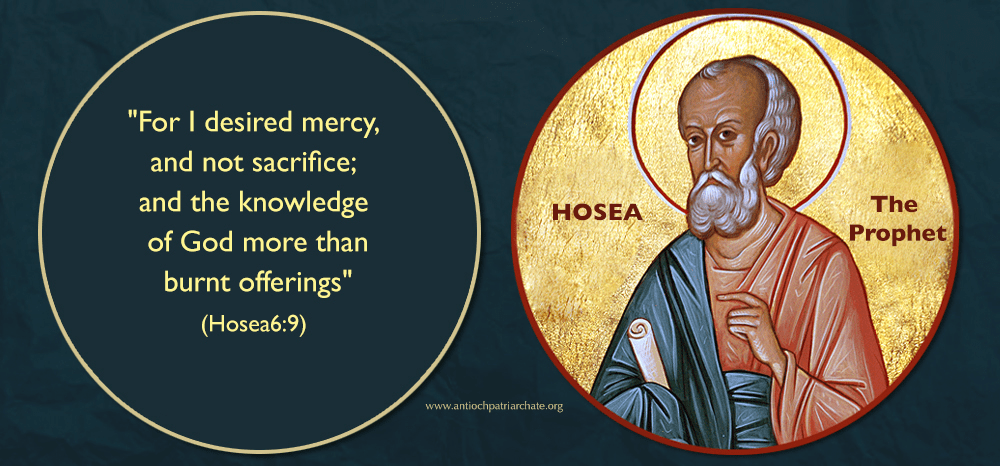
Mercy, Not Sacrifice (Hosea 6:1-6)

“Come, let us return to the Lord,
    for it is he who has torn, and he will heal us;
    he has struck down, and he will bind us up.
After two days he will revive us;
    on the third day he will raise us up,
    that we may live before him.
Let us know, let us press on to know the Lord;
    his appearing is as sure as the dawn;
he will come to us like the showers,
    like the spring rains that water the earth.”

What shall I do with you, O Ephraim?
    What shall I do with you, O Judah?
Your love is like a morning cloud,
    like the dew that goes away early.
Therefore I have hewn them by the prophets;
    I have killed them by the words of my mouth,
    and my judgment goes forth as the light.
For I desire steadfast love and not sacrifice,
    the knowledge of God rather than burnt offerings. (New Revised Standard Version)

My favorite word in all of Holy Scripture is the Hebrew word chesed (חֶסֶד pronounced “hes-ed” with a guttural sound on the “h”). It’s such a rich word that no single English word can capture its depth. 

So, chesed is translated in various ways across the English translations of the Bible as “mercy,” “grace,” “steadfast love,” “covenant loyalty,” “kindness,” “compassion,” and more. It’s no wonder, then, that since chesed marks the character and activity of God, the Lord very much desires people to reflect this same stance toward others. 

In today’s Old Testament lesson, God was calling and wooing wayward people to return to a divine life of closeness with the Lord. God demonstrated chesed by not putting the people away, like a spouse outright divorcing an unfaithful partner. But instead, God committed to loving the Israelites even when they were unlovely.

At all times, the response God wants is not simply going through the motions of outward worship. Ritual practices mean little if there is no heart behind them. The Lord longs for people to demonstrate both fidelity and fealty through mercy and a steadfast love to God and neighbor. Both our work and our worship are to be infused with divine mercy. 

God deeply desires a close relationship with humanity and is profoundly pained when people seek after other gods to meet their needs and to love them. Hosea’s prophecy is an impassioned plea for all persons to find their true fulfillment and enjoyment in a committed loving divine/human union, just like a marriage.

In Christian readings of Hosea’s prophecy, repentance means accepting God’s chesed through Jesus Christ. The believer is to allow the character of God to rule and reign in their heart so that commitment comes flowing out in loving words, actions, thoughts, and dispositions. Mercy finds its highest expression in the person and work of Jesus. Thus, Advent is a season of anticipating the great love and mercy of God through the incarnation of Christ.

It, therefore, ought to be no surprise that Jesus lifted Hosea’s prophecy as a treasured principle of operation when asked why he deliberately made connections with “questionable” people:

While Jesus was having dinner at Matthew’s house, many tax collectors and sinners came and ate with him and his disciples. When the Pharisees saw this, they asked his disciples, “Why does your teacher eat with tax collectors and sinners?” On hearing this, Jesus said, “It is not the healthy who need a doctor, but the sick. But go and learn what this means: ‘I desire mercy, not sacrifice.’ For I have not come to call the righteous, but sinners.” (Matthew 9:10-12, NIV)

And when confronted about “questionable” activities Jesus appealed to the same source of Hosea’s prophecy:

“Look! Your disciples are doing what is unlawful on the Sabbath.” Jesus answered, “Haven’t you read what David did when he and his companions were hungry? He entered the house of God, and he and his companions ate the consecrated bread—which was not lawful for them to do, but only for the priests. Or haven’t you read in the Law that the priests on Sabbath duty in the temple desecrate the Sabbath and yet are innocent? I tell you that something greater than the temple is here. If you had known what these words mean, ‘I desire mercy, not sacrifice,’ you would not have condemned the innocent.” (Matthew 12:2-7, NIV)

One can never go wrong with mercy and grace. If in doubt between whether to judge another or show mercy, the Christian’s choice is clear. Grace and love create connections – reconnecting the disconnected. The heart of true Christian spirituality is a deep kinship with the divine. Whenever that relation is broken or severed, it is vital to restore it. The means of doing so is not judgment but mercy.

Chesed is more than a word; it is a way of life. God wants mercy. Grace is the Lord’s divine will.

So, let us today receive the forgiveness of Jesus and devote ourselves to prayer and works of love which come from a heart profoundly touched by grace. May the result be healing of that which has been broken, and reconciled relationships with others.

Merciful and loving God, the One who shows amazing grace, forgive us for our wanderings away from the divine life. Return us, again, to the grace of Jesus Christ our Savior so that our hearts will be renewed and aflame with love for others. In the Name of the Father, Son, and Spirit, the Great Three in One. Amen.

Our Dwelling Place (Psalm 90:1-6, 13-17)

Lord, you have been our dwelling place
    in all generations.
Before the mountains were brought forth
    or ever you had formed the earth and the world,
    from everlasting to everlasting you are God.

You turn us back to dust
    and say, “Turn back, you mortals.”
For a thousand years in your sight
    are like yesterday when it is past
    or like a watch in the night.

You sweep them away; they are like a dream,
    like grass that is renewed in the morning;
in the morning it flourishes and is renewed;
    in the evening it fades and withers…

Turn, O Lord! How long?
    Have compassion on your servants!
Satisfy us in the morning with your steadfast love,
    so that we may rejoice and be glad all our days.
Make us glad as many days as you have afflicted us
    and as many years as we have seen evil.
Let your work be manifest to your servants
    and your glorious power to their children.
Let the favor of the Lord our God be upon us
    and prosper for us the work of our hands—
    O prosper the work of our hands! (New Revised Standard Version)

Out of the 150 psalms we have in the biblical psalter, only this one is attributed to Moses. At Mount Sinai, when God was entering into covenant with the Israelites, the Lord had Moses come up the mountain to receive the Law. Meanwhile, the people began to rebel and became idolatrous.

And God was angry with them – so angry that the Lord was ready to do away with them all, and start from scratch with Moses. Yet, at that time, Moses interceded for the people and implored God saying:

“O Lord, why does your wrath burn hot against your people, whom you brought out of the land of Egypt with great power and with a mighty hand? Why should the Egyptians say, ‘It was with evil intent that he brought them out to kill them in the mountains and to consume them from the face of the earth’? Turn from your fierce wrath; change your mind and do not bring disaster on your people. 

Remember Abraham, Isaac, and Israel, your servants, how you swore to them by your own self, saying to them, ‘I will multiply your descendants like the stars of heaven, and all this land that I have promised I will give to your descendants, and they shall inherit it forever.’” (Exodus 32:11-13, NRSV)

Moses prayed for God to turn and change his mind. And, amazingly, God did.

In a terrible event of the golden calf experience, Moses had the wherewithal to step back and see the larger perspective.

And it is this view of time which governs the prayer of Psalm 90. This psalm sees the transience of human life and the permanence of an eternal God.  From this perspective, we gain wisdom in order to pray as we ought. The center of Moses’ prayer states:

For all our days pass away under your wrath;
    our years come to an end like a sigh.
The days of our life are seventy years
    or perhaps eighty, if we are strong;
even then their span is only toil and trouble;
    they are soon gone, and we fly away.

Who considers the power of your anger?
    Your wrath is as great as the fear that is due you.
So teach us to count our days
    that we may gain a wise heart. (Psalm 90:9-12, NRSV)

Today’s psalm lesson is a genuine prayer that begs for divine wisdom so that we may live with an eternal perspective. Armed with such a view, the psalmist prays for divine mercy so that our lives may be redeemed and we might know joy. And from wisdom and mercy, prayer is offered for divine blessing upon the work of our hands.

God’s presence ought to cause the people’s acknowledgment and obedience. If it doesn’t, then that presence can turn to wrath. This is precisely why we need wisdom to live rightly – to seek the Lord and know the spiritual laws of the universe. Ignorance leads to death, but wisdom to life.

We do not always live as we ought – which is why we need to seek grace and mercy from God. The psalmist trusts that God can redeem times of evil and the darkness of the human heart. The Lord is able to overcome for us what we cannot overcome for ourselves. God can (and will, in God’s own good time) deliver us from our unhealthy spiritual condition.

Moses led the people out of Egyptian slavery. But it was God who delivered the Israelites and was present with them always. Eventually, Moses died because God took him (Deuteronomy 34:5). And, at that time, the people had not yet entered the Promised Land; they were landless and homeless.

God, however, was their true dwelling place; the presence of God was there and continues to be there. The Lord has not taken a vacation. The Lord’s presence and power is still operative in this world. It’s the perspective of eternity.

Home, for the believer, is God. The Lord is our dwelling place, with us no matter where we go. God is the One who keeps redeeming our time, blessing us with joy, and prospering our work.

“O God, Our Help in Ages Past” by Isaac Watts, 1719, verses 1-3

O God, our Help in ages past,
our Hope for years to come,
our Shelter from the stormy blast,
and our eternal Home.

Under the shadow of Thy throne
Thy saints have dwelt secure;
sufficient is Thine arm alone,
and our defense is sure.

Before the hills in order stood,
or earth received its frame,
from everlasting Thou art God,
to endless years the same.

Mercy Is Why Jesus Came (Matthew 9:9-13, 18-26)

The Hem of His Garment, by Crystal White, 2018

As Jesus went on from there, he saw a man named Matthew sitting at the tax collector’s booth. “Follow me,” he told him, and Matthew got up and followed him.

While Jesus was having dinner at Matthew’s house, many tax collectors and sinners came and ate with him and his disciples. When the Pharisees saw this, they asked his disciples, “Why does your teacher eat with tax collectors and sinners?”

On hearing this, Jesus said, “It is not the healthy who need a doctor, but the sick. But go and learn what this means: ‘I desire mercy, not sacrifice.’ For I have not come to call the righteous, but sinners….”

While he was saying this, a synagogue leader came and knelt before him and said, “My daughter has just died. But come and put your hand on her, and she will live.” Jesus got up and went with him, and so did his disciples.

Just then a woman who had been subject to bleeding for twelve years came up behind him and touched the edge of his cloak. She said to herself, “If I only touch his cloak, I will be healed.”

Jesus turned and saw her. “Take heart, daughter,” he said, “your faith has healed you.” And the woman was healed at that moment.

When Jesus entered the synagogue leader’s house and saw the noisy crowd and people playing pipes, he said, “Go away. The girl is not dead but asleep.” But they laughed at him. After the crowd had been put outside, he went in and took the girl by the hand, and she got up. News of this spread through all that region. (New International Version)

The late Abigail Van Buren, better known as the newspaper columnist, “Dear Abby,” was the person who made famous the phrase: “The church is a hospital for sinners, not a museum of saints.” That quote is an accurate reflection of what Jesus was doing and saying. We occasionally need words like Dear Abby’s to remind and reorient us toward why the church exists.  

The church of the Lord Jesus does not remain on this earth solely for our benefit, any more than a hospital exists for the benefit of the doctors or insurance companies! Rather, the church lives to extend the mission of Jesus through proclamation of good news with the restorative touch of grace. The church’s calling is not to find others who can help them with their giving and attendance. Instead, the church is the community of the redeemed, the temple of the Holy Spirit, gathered and sent to be the continuing presence of Jesus on this earth.

Some of us are not healthy. Some are sick – sick with guilt and shame, heart-sick, or just plain sick-and-tired of being sick-and-tired. Jesus came neither to condemn nor heap a pile of unrealistic expectations on us. Rather, Christ points us to the source of healing and restoration; and invites us to admit our need and come to him. 

The question I want us to grapple with is this: Why did Jesus come to this earth? The answer to that question is to also answer the question of our own purpose and existence as followers of Christ.

Jesus came to forgive sin and transform sinners.Forgiveness, healing, and restoration are the three activities which bring about true spiritual and physical healing. There are two healings In today’s Gospel lesson: one is a spiritual healing; and the other a physical healing.

The Calling and Healing of Matthew

At the heart of the human condition is spiritual brokenness. And Jesus is all about taking away guilt and shame, creating a new person and a new community. It’s a radical vision which seeks to encompass and embrace all persons – which means Jesus touched many people overlooked by others.

Jesus came to call the despised people of society, the “sinners.” He called Matthew, a tax collector. Tax collectors were hated. They were corrupt characters who extorted money from innocent people just trying to make ends meet. Jesus not only called the despised Matthew, but he also had dinner with him and all his unsavory buddies. This kind of behavior by Jesus was deeply offensive to the upstanding citizens and religious leaders of the time.

Yet, Jesus did not back down. He responded by saying that it is not the healthy who need a doctor, but those who are sick. And he backed up his social actions with Scripture by encouraging offended folks to meditate on what this biblical phrase means: “I desire mercy, not sacrifice.” (Hosea 6:6)

It is possible to engage in outward rituals of worship, do all the right things, fulfill our duties, yet still miss the heart of God wants for humanity. Mercy is what God wants. Jesus knew this. So, Christ entangled himself with sinners to bring spiritual healing and restoration.

When Corrie Ten Boom sought to bring deliverance of the Jews from the Nazis during World War II, she had to entangle herself with Jewish refugees. When Christian missionaries seek to be the light of Jesus to people, they must entangle themselves with the people’s culture. If we want to see God deliver people from their situations, we must entangle ourselves with them, into complicated lives that are not pretty, with persons who have been tainted by sin. 

Lots of people are in awful predicaments. Christians, like their Lord, will need to get their hands dirty and their feet wet to extend Christ’s ministry of mercy and forgiveness. The gospel was never intended to be proclaimed from afar, but up close and personal through entanglement in people’s lives. If the merciful mission of Jesus is to occur, it requires the following three levels of intimacy with others:

  1. Intimacy with Jesus. Engaging in the spiritual disciplines of prayer, giving, fasting, reading, and meditating on Scripture are the activities which help us to know Christ better and know and how to respond with mercy.
  2. Intimacy with fellow believers. We are hard-wired by God for community. Superficial relationships can only provide superficial community. Christians need to help one another with spiritual growth. They must hold one another accountable for the mission of Christ.
  3. Intimacy with “sinners.” This world is filled with sick, needy, hurt, and lonely, people who are locked in unhealthy patterns of living. They need a merciful change of life that comes from the merciful Jesus acting through merciful Christians.

Mercy, not judgment, is at the heart of all change. If we desire others to be different, we will need to be acquainted with the mercy of God.

The Approach of a Grieving Father and Bleeding Woman for Healing

The dead girl being raised to life and the bleeding woman experiencing healing are, perhaps at the surface, unrelated. Yet, Matthew’s Gospel presents them together in a sandwich story. The dead girl’s father approaches Jesus, and in the middle of the story, while Jesus and the father are on the way to the deceased girl, a woman who had been hemorrhaging for twelve years approaches Jesus without saying a word.

In both cases, the father and the woman exhibited confident faith that their heartfelt desires would be met with Jesus. And, in both situations, two people were restored, not only to health, but to fully functioning members of the community.

And this is where the two of them are related to Matthew. With all three persons, the healings involved a restoration to society. When Jesus heals a person, that person is completely healed – both body and soul – and healed not only of traumatic physical ailments (even death!) but also healed of disordered or demented minds, of deep emotional wounds, and of spiritual neglect and/or abuse.

In the woman’s case, she had to contend with being separated from the community because of her bleeding. She was ritually unclean and could not participate like the others in worship and communal life. And in the case of the father and synagogue ruler with a dead daughter, he would have to put up with not only the severe grief of a lost daughter, but also the misguided cultural beliefs of an untimely death being the result of either the girl’s personal sin, or the sin of the father. Oy.

So, when Jesus heals, Jesus heals completely! It always involves forgiveness (if needed) and a restoration of the individual (and sometimes whole families) back into arms of the society which everyone is dependent upon for each other’s welfare.

And, also like Matthew, Jesus was willing to cut through any cultural barriers and existing societal norms in order to accomplish God’s will and purpose of restoring lost people. I want us to observe that Jesus asks us to follow him because he himself is also willing to do so.

A woman with a bloody discharge and a dead girl’s body were touched by Jesus, who reached across Israel’s purity laws in doing so. Two people who were ritually unclean and not to be touched were given a new lease on life through Christ’s willingness to follow God’s will. Notice that Jesus did not initiate the contact, but followed them in their requests and desires.

Sometimes the church needs to learn the art of following by observing how Christ followed.

Many churches today, including yours and mine, wonder how to draw people in rather than how to engage human beings where they live. Instead of waiting for people to come in, or trying to attract through marketing efforts, perhaps the church should follow our neighbors out into the world, responding to their needs as they emerge.

Maybe, just maybe, we might explore how to participate in what is already going on in the community and follow the leading of the Spirit, who is the continuing presence of Jesus on this earth. Maybe we could put our focus on how to show mercy, not sacrifice.

Lord Jesus Christ, you stretched out your arms of love on the hard wood of the cross so that everyone might come within the reach of your saving embrace. Clothe us in your Spirit so that we, reaching forth our hands in love, may bring those who do not know you to the knowledge of your love, for the glory of your Name. Amen.

Hosea 6:1-10 – “I Want Mercy, Not Sacrifice”

“Come, let us return to the Lord.
He has torn us to pieces
    but he will heal us;
he has injured us
    but he will bind up our wounds.
After two days he will revive us;
    on the third day he will restore us,
    that we may live in his presence.
Let us acknowledge the Lord;
    let us press on to acknowledge him.
As surely as the sun rises,
    he will appear;
he will come to us like the winter rains,
    like the spring rains that water the earth.”

“What can I do with you, Ephraim?
    What can I do with you, Judah?
Your love is like the morning mist,
    like the early dew that disappears.
Therefore I cut you in pieces with my prophets,
    I killed you with the words of my mouth—
    then my judgments go forth like the sun.
For I desire mercy, not sacrifice,
    and acknowledgment of God rather than burnt offerings.
As at Adam, they have broken the covenant;
    they were unfaithful to me there.
Gilead is a city of evildoers,
    stained with footprints of blood.
As marauders lie in ambush for a victim,
    so do bands of priests;
they murder on the road to Shechem,
    carrying out their wicked schemes.
I have seen a horrible thing in Israel:
    There Ephraim is given to prostitution,
    Israel is defiled. (New International Version)

My favorite word in all of Holy Scripture is the Hebrew word חסד (“chesed” pronounced in English “kes-ed).  It is such a rich word that no one English word can capture its depth and import. 

So, chesed is translated in various ways across English translations of the Bible as:

  • Goodness (American Standard Version)
  • Faithful love (Common English Bible)
  • Loyalty (God’s Word Translation)
  • Constant love (Good News Translation)
  • Mercy (King James Version)
  • Love that lasts (The Message)
  • Faithfulness (New English Translation)
  • Loving-kindness (New Life Version)
  • Steadfast love (New Revised Standard Version)

Chesed is God’s committed, gracious, and loving covenant loyalty to people. The Lord’s very attributes are sheer Love.

Since chesed marks the character and activity of God, the Lord very much desires people to reflect this same stance toward one another. In other words, because God is merciful and kind, we, as people created in God’s image, are to be marked with this same character in all we do. 

In today’s Old Testament lesson, God is calling and wooing wayward people to return to a life of closeness with the Lord. God demonstrated chesed by not sending the people away, like a spouse outright divorcing an unfaithful partner. Instead, the Lord is committed to loving the Israelites even when they were unlovely.

At all times, the response God wants from people is not simply to go through the motions of outward worship. Ritual practices mean little if there is no heart behind them. The Lord longs for people to demonstrate both fidelity and fealty through mercy and a steadfast love to God and neighbor.

Both our work and our worship are to be infused with divine mercy. 

God deeply desires a close relationship with humanity. The Lord is deeply grieved when people whore after other gods to meet their needs for love and belonging. Hosea’s prophecy is an impassioned plea for all persons to find their true fulfillment and enjoyment in a committed loving divine/human union, like a marriage.

In Christian readings of Hosea’s prophecy, repentance means accepting God’s chesed through Jesus Christ.

The believer is to allow the character of God to rule and reign in their heart so that love and commitment come flowing out in words, actions, thoughts, and dispositions.

Mercy, in Christianity, finds its highest expression in the person and work of Jesus.

It is no wonder, then, that Jesus lifted Hosea’s prophecy as a treasured principle of operation when asked why he deliberately made connections with “questionable” people:

As Jesus continued on from there, he saw a man named Matthew sitting at a kiosk for collecting taxes. He said to him, “Follow me,” and he got up and followed him. As Jesus sat down to eat in Matthew’s house, many tax collectors and sinners joined Jesus and his disciples at the table.

But when the Pharisees saw this, they said to his disciples, “Why does your teacher eat with tax collectors and sinners?”

When Jesus heard it, he said, “Healthy people don’t need a doctor, but sick people do. Go and learn what this means: I want mercy and not sacrifice. I didn’t come to call righteous people, but sinners.” (Matthew 9:9-13, CEB)

And when confronted about “questionable” activities, Jesus appealed to the same source of Hosea’s prophecy:

“Look! Your disciples are doing something that is not right to do on the day of rest—a holy day.”

Jesus asked them, “Haven’t you read what David did when he and his men were hungry? Haven’t you read how he went into the house of God and ate  the bread of the presence? He and his men had no right to eat those loaves. Only the priests have that right. Or haven’t you read in Moses’ Teachings that on the day of rest—a holy day, the priests in the temple do things they shouldn’t on the day of rest yet remain innocent? I can guarantee that something  greater than the temple is here. If you had known what ‘I want mercy, not sacrifices’ means, you would not have condemned innocent people. (Matthew 12:2-7, GW)

One can never go wrong with mercy and grace. If in doubt between whether to judge another or show mercy, the Christian’s choice is clear.

Grace and love reconnects the disconnected. The heart of true Christian spirituality is a deep kinship with the divine. Whenever that relation is broken or severed, it is vital to restore it. The means of doing so is not judgment; it’s mercy.

Chesed is more than a word; it is a way of life.

God wants mercy. Grace is the Lord’s divine will. So, let us today receive the forgiveness of Jesus and devote ourselves to prayer and works of love which come from a heart profoundly touched by grace. 

May the result of our return to the Lord be healing of that which has been broken, and reconciled relationships with others.

Merciful and loving God, the One who shows amazing grace, forgive us for our wanderings away from the divine life. Return us, again, to the grace of Jesus Christ our Savior so that our hearts will be renewed and aflame with love for others. In the Name of the Father, Son, and Spirit, the Great Three in One. Amen.