Jesus Stills the Storm (Mark 4:35-41)

Calming the Storm #1, by Tigran Ghulyan

On that day, when evening had come, he said to them, “Let us go across to the other side.” And leaving the crowd behind, they took him with them in the boat, just as he was. Other boats were with him. 

A great windstorm arose, and the waves beat into the boat, so that the boat was already being swamped. But he was in the stern, asleep on the cushion, and they woke him up and said to him, “Teacher, do you not care that we are perishing?” 

And waking up, he rebuked the wind and said to the sea, “Be silent! Be still!” Then the wind ceased, and there was a dead calm. He said to them, “Why are you afraid? Have you still no faith?” And they were filled with great fear and said to one another, “Who then is this, that even the wind and the sea obey him?” (New Revised Standard Version)

Jesus taught the people all day beside the sea. So many of them crowded around that he ended up getting into a boat and speaking from the water to the folks on land. It was an eventful day of telling memorable parables.

Then, evening came. Jesus told his disciples they were crossing over to the other side of the Sea of Galilee. In doing this, they were also crossing boundaries from Jewish to Gentile territory.

Christ’s disciples had not yet gotten used to Jesus crossing over to places they’ve never been to before. For them, it might as well be an ancient version of Star Trek, going boldly where no Jew had gone before. Following Jesus was like a science fiction trip into the unknown in which they had already seen things beyond their imagination.

Although Jesus respected people’s personal boundaries, he continually crossed both social and spiritual boundaries galore. Christ ate with the wrong kind of people; broke Sabbath laws and healed people at the wrong time; and was leading his motley band of disciples to the wrong sort of place.

Jesus kept going to where the religious establishment had firm boundaries not to cross. Hanging out with Christ meant taking risks at unpredictable times in unknown places.

The disciples were not quite ready for crossing a weather boundary, and they were understandably scared. Although they evidenced a certain lack of faith, conversely, it took some faith to even listen to Jesus and do what he told them to do and get in a boat to cross the sea.

There’s really nothing safe about being a follower of Jesus Christ, at least from a human existential perspective. Jesus put his disciples in all sorts of different situations that were downright dangerous. So, I’m not sure why any Christian would be surprised whenever they face trouble and danger in their lives; it’s part of following Jesus.

Christ Asleep During the Tempest, by Eugene Delacroix, 1853

A big windstorm popped up as the ship crossed the sea at night. A lot of people I know get scared and anxious when a thunderstorm hits; and they’re in a safe place within their own house. So, to be in a wooden ship with old school sails and oars at night, and a storm strikes, we can see that panic quickly set into the disciples. They, of course, cried out in their fear and distress.

But where is Jesus? Lo and behold, it turns out he was asleep, down in the hold of the ship, without a worry in the world. That struck the disciples the wrong way (much like talking to the wrong people and going to the wrong places and doing the wrong things). They interpreted this event of a peaceful sleeping Christ as calloused and insensitive to their collective plight.

How many times have we thought the same thing, and uttered along with the disciples, “Don’t you care that we are perishing!?” O you of little hermeneutic.

The truth is, those who wish to save their life will lose it – it will perish, be destroyed. But those who lose their life and let it perish for Christ’s sake, and for the sake of the gospel, will save it.

Yes, the dangers of death and destruction are very real; but taking up our cross and following Jesus turns out to be the safest option we have. It’s the deliberate choice of walking by faith, not sight.

Jesus, awakened by his disciples, proceeded to rebuke the wind and told the sea to settle down. That’s the same sort of language Jesus used when doing an exorcism.

Just as crowds marveled that the demonic realm obeyed Jesus when he healed persons of bad spirits, so Christ’s disciples were amazed at the authority which calmed a wild storm. Yet, no matter the situation or the reality, Jesus can and does bring orderly calm from disruptive chaos.

The eerie resemblance to exorcism in calming the storm let’s us know that Christ has power and authority over all evil in this world. Therefore, the teaching and ministry of Jesus is authoritative. Christ rules with a great power of benevolence and mercy over everything.

This understanding of Christ’s power and authority is the believer’s basis for faith and not fear. The lack of courage points to the lack of faith. To be both a coward and a Christian is incompatible and nonsensical.

We all become afraid, at times, because of various things. And some of that fear is warranted; it’s part of being human. Cowardice, however, is a different thing. Both the courageous and cowardly are fearful – the difference is that the former acts despite the fear, and the latter does not act because of the fear.

What matters is what the person of faith does in the face of a fearful situation, and not because they are afraid. There is no sin in the actual emotion of fear; it’s what we do with being afraid that makes the difference.

Following Jesus is no guarantee of a fear-free or a storm-free life. We may, especially in times of high stress, find ourselves blurting out to Jesus to wake up and help us because we feel he isn’t paying attention or doesn’t care.

The reality is that the power and authority of Jesus is needed most in fearful places. So, the Christian (and especially Christ’s Church) better get used to having courageous encounters and conversations with others.

Wherever there is pain, suffering, and neediness, that’s where the words and touch of Jesus are found. So then, if we are looking for Jesus, we ought to know where to find him.

Christianity is a religion which will send us where we’ve never been before – both externally and internally – into the violent storms. Entering the fray takes faith. And feeling afraid is expected. But this is where real needs are met, as well as the place of genuine spiritual development.

No matter what or who we face, we have the confidence that Jesus is with us. And even if he is sleeping during a storm, we are in a good place of peace.

Almighty and everlasting God, preserve us from faithless fears and worldly anxieties, and grant that no clouds of this mortal life may hide from us the light of that love which is immortal, and which you have manifested to us in your Son, Jesus Christ our Lord. Amen.

Epiphany of the Lord (Isaiah 60:1-6)

Adoration of the Magi, Basilica of the National Shrine of the Immaculate Conception, Washington D.C.

“Arise, shine, for your light has come,
    and the glory of the Lord rises upon you.
See, darkness covers the earth
    and thick darkness is over the peoples,
but the Lord rises upon you
    and his glory appears over you.
Nations will come to your light,
    and kings to the brightness of your dawn.

“Lift up your eyes and look about you:
    All assemble and come to you;
your sons come from afar,
    and your daughters are carried on the hip.
Then you will look and be radiant,
    your heart will throb and swell with joy;
the wealth on the seas will be brought to you,
    to you the riches of the nations will come.
Herds of camels will cover your land,
    young camels of Midian and Ephah.
And all from Sheba will come,
    bearing gold and incense
    and proclaiming the praise of the Lord. (New International Version)

We are drawn to light. I don’t know if you have ever been in a situation with complete darkness surrounding you. When things are totally dark, we begin to fear and panic.

I grew up in a rural area in which there were no lights at night, other than the moon and the stars. More than once, I got myself into a situation, when the sky was overcast, in which I didn’t have a flashlight and could not see my hand in front of my face. I was groping to discern any little bit of light that I could see. Without the light, I was lost.

Our souls are also drawn to light. We no longer want to have darkness enveloping us; we cannot live with the darkness residing within our hearts. This is one reason why the Magi were attentive to the bright star over Bethlehem, and traveled toward it. We have a need for light because nobody can abide in darkness for too long.

The glory of the Lord is associated with bright light. Spiritually, we can find ourselves in such darkness that it’s impossible to discover light, unless God shows up displaying divine mercy and glory.

The Christian season of Epiphany has to do with this divine light. Each year on January 6, on the Church Calendar, and after the twelve days of Christmas, is the celebration of Epiphany. 

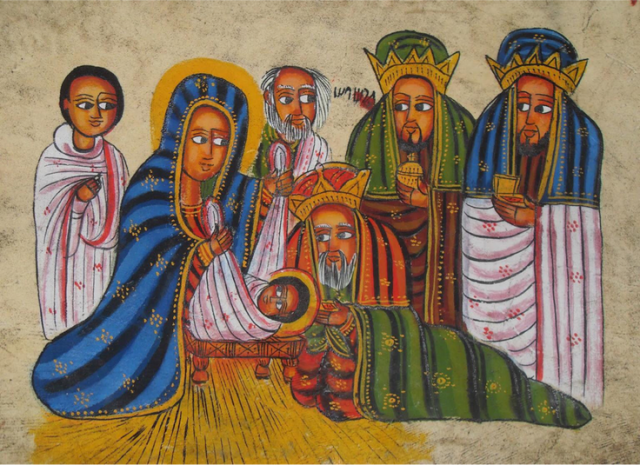
The Three Kings, Ethiopian Orthodox Church

It is a celebration of light – that Christ came to this earth as a child and became like us. Epiphany helps to bring a vision and understanding of God’s glory to all kinds of people in the world.

“Epiphany” literally means “manifestation” or “appearance.” The event most closely associated with this season is the visit of the Magi to Jesus. Included in this time of the year between the seasons of Christmas and Lent is a special emphasis on the teaching and healing ministry of Jesus. 

The people walking in darkness
    have seen a great light;
on those living in the land of deep darkness
    a light has dawned. (Isaiah 9:2; Matthew 4:16, NIV)

The great celebration and focus of these weeks is that salvation is not limited to Israel but extends to the Gentiles, as well.

“I will also make you a light for the Gentiles, that my salvation may reach to the ends of the earth.” (Isaiah 49:6; Luke 2:32; Acts 13:47, NIV)

In this season of Epiphany, the manifestation of God’s grace is one of the most scandalous truths of Christianity: God graces common ordinary people, who seem far from God, with the gift of Jesus. 

God grants repentance that leads to life for all kinds of people, no matter what their race, ethnicity, class, or background. It is a wondrous and astounding spiritual truth that God’s merciful concern is not limited to a certain type of person or a particular group of people.

Grace is (and ought to be) the guiding factor in how we interact with people. 

Losing sight of grace leads to being critical and defensive. Like King Herod of old, a graceless person becomes enamored with earthly power and control. But embracing grace, leads to humility, so that we see the image of God in people very different from ourselves. 

Like the Apostle Peter, who learned in a vision to bring the gospel to non-Jews, old legalisms begin to wear away so that people from all walks of life can have access to Jesus and his gracious saving and healing ministry. 

Grace brings down barriers and causes us to do away with unnecessary distinctions between others. And so, the appropriate response to such a grace is to glorify God for this marvelous and amazing work.

It is a gracious and merciful reality that the Magi, or Wise Men, who were really pagan astrologers, were directed to the Messiah. A light was provided to lead them to Jesus. Apart from God’s care and intervention they would have remained in darkness. 

And it is no less true for people today. This old broken world has a lot of shadowy places to it; there is darkness all around.  All kinds of people have no light at the end of the tunnel of their lives for hope and new life. But the gospel of Jesus Christ brings that light to those walking around with no ability to see. And Jesus exhorted his followers to be the reflectors of divine light for the world.

“Let your light shine before others, that they may see your good deeds and glorify your Father in heaven.”

Jesus (Matthew 5:16, NIV)

Sometimes, maybe oftentimes, the best way to bring resolution to our own troubles and problems is through helping others make sense of their lives through the gracious light of Christ so that they can see an appearance, an epiphany, of what their lives can be in the gracious rule of the kingdom of God. 

As we celebrate Epiphany and journey with Jesus through his earthly upbringing and into his gracious ministry to people, let us keep vigilance to not let our light grow dim. Instead, let us hunger and thirst after Christ’s righteousness so that our joy is full and our light is bright.

God of radiant light, your love illumines our hopes before we know them, and our needs before we ask. Kindle your flame within us, that in our prayers and service, we may know your transforming presence at work in the world around us. All this we ask through Jesus Christ, our Lord. Amen.

Mercy, Not Sacrifice (Hosea 6:1-6)

“Come, let us return to the Lord,
    for it is he who has torn, and he will heal us;
    he has struck down, and he will bind us up.
After two days he will revive us;
    on the third day he will raise us up,
    that we may live before him.
Let us know, let us press on to know the Lord;
    his appearing is as sure as the dawn;
he will come to us like the showers,
    like the spring rains that water the earth.”

What shall I do with you, O Ephraim?
    What shall I do with you, O Judah?
Your love is like a morning cloud,
    like the dew that goes away early.
Therefore I have hewn them by the prophets;
    I have killed them by the words of my mouth,
    and my judgment goes forth as the light.
For I desire steadfast love and not sacrifice,
    the knowledge of God rather than burnt offerings. (New Revised Standard Version)

My favorite word in all of Holy Scripture is the Hebrew word chesed (חֶסֶד pronounced “hes-ed” with a guttural sound on the “h”). It’s such a rich word that no single English word can capture its depth. 

So, chesed is translated in various ways across the English translations of the Bible as “mercy,” “grace,” “steadfast love,” “covenant loyalty,” “kindness,” “compassion,” and more. It’s no wonder, then, that since chesed marks the character and activity of God, the Lord very much desires people to reflect this same stance toward others. 

In today’s Old Testament lesson, God was calling and wooing wayward people to return to a divine life of closeness with the Lord. God demonstrated chesed by not putting the people away, like a spouse outright divorcing an unfaithful partner. But instead, God committed to loving the Israelites even when they were unlovely.

At all times, the response God wants is not simply going through the motions of outward worship. Ritual practices mean little if there is no heart behind them. The Lord longs for people to demonstrate both fidelity and fealty through mercy and a steadfast love to God and neighbor. Both our work and our worship are to be infused with divine mercy. 

God deeply desires a close relationship with humanity and is profoundly pained when people seek after other gods to meet their needs and to love them. Hosea’s prophecy is an impassioned plea for all persons to find their true fulfillment and enjoyment in a committed loving divine/human union, just like a marriage.

In Christian readings of Hosea’s prophecy, repentance means accepting God’s chesed through Jesus Christ. The believer is to allow the character of God to rule and reign in their heart so that commitment comes flowing out in loving words, actions, thoughts, and dispositions. Mercy finds its highest expression in the person and work of Jesus. Thus, Advent is a season of anticipating the great love and mercy of God through the incarnation of Christ.

It, therefore, ought to be no surprise that Jesus lifted Hosea’s prophecy as a treasured principle of operation when asked why he deliberately made connections with “questionable” people:

While Jesus was having dinner at Matthew’s house, many tax collectors and sinners came and ate with him and his disciples. When the Pharisees saw this, they asked his disciples, “Why does your teacher eat with tax collectors and sinners?” On hearing this, Jesus said, “It is not the healthy who need a doctor, but the sick. But go and learn what this means: ‘I desire mercy, not sacrifice.’ For I have not come to call the righteous, but sinners.” (Matthew 9:10-12, NIV)

And when confronted about “questionable” activities Jesus appealed to the same source of Hosea’s prophecy:

“Look! Your disciples are doing what is unlawful on the Sabbath.” Jesus answered, “Haven’t you read what David did when he and his companions were hungry? He entered the house of God, and he and his companions ate the consecrated bread—which was not lawful for them to do, but only for the priests. Or haven’t you read in the Law that the priests on Sabbath duty in the temple desecrate the Sabbath and yet are innocent? I tell you that something greater than the temple is here. If you had known what these words mean, ‘I desire mercy, not sacrifice,’ you would not have condemned the innocent.” (Matthew 12:2-7, NIV)

One can never go wrong with mercy and grace. If in doubt between whether to judge another or show mercy, the Christian’s choice is clear. Grace and love create connections – reconnecting the disconnected. The heart of true Christian spirituality is a deep kinship with the divine. Whenever that relation is broken or severed, it is vital to restore it. The means of doing so is not judgment but mercy.

Chesed is more than a word; it is a way of life. God wants mercy. Grace is the Lord’s divine will.

So, let us today receive the forgiveness of Jesus and devote ourselves to prayer and works of love which come from a heart profoundly touched by grace. May the result be healing of that which has been broken, and reconciled relationships with others.

Merciful and loving God, the One who shows amazing grace, forgive us for our wanderings away from the divine life. Return us, again, to the grace of Jesus Christ our Savior so that our hearts will be renewed and aflame with love for others. In the Name of the Father, Son, and Spirit, the Great Three in One. Amen.

Our Dwelling Place (Psalm 90:1-6, 13-17)

Lord, you have been our dwelling place
    in all generations.
Before the mountains were brought forth
    or ever you had formed the earth and the world,
    from everlasting to everlasting you are God.

You turn us back to dust
    and say, “Turn back, you mortals.”
For a thousand years in your sight
    are like yesterday when it is past
    or like a watch in the night.

You sweep them away; they are like a dream,
    like grass that is renewed in the morning;
in the morning it flourishes and is renewed;
    in the evening it fades and withers…

Turn, O Lord! How long?
    Have compassion on your servants!
Satisfy us in the morning with your steadfast love,
    so that we may rejoice and be glad all our days.
Make us glad as many days as you have afflicted us
    and as many years as we have seen evil.
Let your work be manifest to your servants
    and your glorious power to their children.
Let the favor of the Lord our God be upon us
    and prosper for us the work of our hands—
    O prosper the work of our hands! (New Revised Standard Version)

Out of the 150 psalms we have in the biblical psalter, only this one is attributed to Moses. At Mount Sinai, when God was entering into covenant with the Israelites, the Lord had Moses come up the mountain to receive the Law. Meanwhile, the people began to rebel and became idolatrous.

And God was angry with them – so angry that the Lord was ready to do away with them all, and start from scratch with Moses. Yet, at that time, Moses interceded for the people and implored God saying:

“O Lord, why does your wrath burn hot against your people, whom you brought out of the land of Egypt with great power and with a mighty hand? Why should the Egyptians say, ‘It was with evil intent that he brought them out to kill them in the mountains and to consume them from the face of the earth’? Turn from your fierce wrath; change your mind and do not bring disaster on your people. 

Remember Abraham, Isaac, and Israel, your servants, how you swore to them by your own self, saying to them, ‘I will multiply your descendants like the stars of heaven, and all this land that I have promised I will give to your descendants, and they shall inherit it forever.’” (Exodus 32:11-13, NRSV)

Moses prayed for God to turn and change his mind. And, amazingly, God did.

In a terrible event of the golden calf experience, Moses had the wherewithal to step back and see the larger perspective.

And it is this view of time which governs the prayer of Psalm 90. This psalm sees the transience of human life and the permanence of an eternal God.  From this perspective, we gain wisdom in order to pray as we ought. The center of Moses’ prayer states:

For all our days pass away under your wrath;
    our years come to an end like a sigh.
The days of our life are seventy years
    or perhaps eighty, if we are strong;
even then their span is only toil and trouble;
    they are soon gone, and we fly away.

Who considers the power of your anger?
    Your wrath is as great as the fear that is due you.
So teach us to count our days
    that we may gain a wise heart. (Psalm 90:9-12, NRSV)

Today’s psalm lesson is a genuine prayer that begs for divine wisdom so that we may live with an eternal perspective. Armed with such a view, the psalmist prays for divine mercy so that our lives may be redeemed and we might know joy. And from wisdom and mercy, prayer is offered for divine blessing upon the work of our hands.

God’s presence ought to cause the people’s acknowledgment and obedience. If it doesn’t, then that presence can turn to wrath. This is precisely why we need wisdom to live rightly – to seek the Lord and know the spiritual laws of the universe. Ignorance leads to death, but wisdom to life.

We do not always live as we ought – which is why we need to seek grace and mercy from God. The psalmist trusts that God can redeem times of evil and the darkness of the human heart. The Lord is able to overcome for us what we cannot overcome for ourselves. God can (and will, in God’s own good time) deliver us from our unhealthy spiritual condition.

Moses led the people out of Egyptian slavery. But it was God who delivered the Israelites and was present with them always. Eventually, Moses died because God took him (Deuteronomy 34:5). And, at that time, the people had not yet entered the Promised Land; they were landless and homeless.

God, however, was their true dwelling place; the presence of God was there and continues to be there. The Lord has not taken a vacation. The Lord’s presence and power is still operative in this world. It’s the perspective of eternity.

Home, for the believer, is God. The Lord is our dwelling place, with us no matter where we go. God is the One who keeps redeeming our time, blessing us with joy, and prospering our work.

“O God, Our Help in Ages Past” by Isaac Watts, 1719, verses 1-3

O God, our Help in ages past,
our Hope for years to come,
our Shelter from the stormy blast,
and our eternal Home.

Under the shadow of Thy throne
Thy saints have dwelt secure;
sufficient is Thine arm alone,
and our defense is sure.

Before the hills in order stood,
or earth received its frame,
from everlasting Thou art God,
to endless years the same.