Come Away with Me (Song of Songs 2:8-15)

Song of Songs No. 19, by Egon Tschirch, 1923

Ah, I hear my lover coming!
    He is leaping over the mountains,
    bounding over the hills.
My lover is like a swift gazelle
    or a young stag.
Look, there he is behind the wall,
    looking through the window,
    peering into the room.

My lover said to me,
    “Rise up, my darling!
    Come away with me, my fair one!
Look, the winter is past,
    and the rains are over and gone.
The flowers are springing up,
    the season of singing birds has come,
    and the cooing of turtledoves fills the air.
The fig trees are forming young fruit,
    and the fragrant grapevines are blossoming.
Rise up, my darling!
    Come away with me, my fair one!”

My dove is hiding behind the rocks,
    behind an outcrop on the cliff.
Let me see your face;
    let me hear your voice.
For your voice is pleasant,
    and your face is lovely.

Catch all the foxes,
    those little foxes,
before they ruin the vineyard of love,
    for the grapevines are blossoming! (New Living Translation)

Spring is the season of love, the time of coming together and enjoying one another’s presence.

God is love. God is calling us. God wants to be with you.

There is a reason why so many people in this cruel and calloused world are unloving and unkind: They are unaware that God loves them, desires to be with them, and is calling out to them. 

If we neither believe nor know God’s infinite love and desire for us, then our words and our actions will reflect more of hate than love. God really truly does want to be with you and me. This is crucial. Do not forget this. Believe it. Live it. Enjoy it. Know it. Tell it to yourself until you are thoroughly bathed in it, because it is more wonderful than any ‘70’s sappy love song could ever describe it.

I believe the small Old Testament book of Solomon’s Song of Songs too often gets a weird hermeneutical spin of literalism from modern-minded simpletons. For nearly all of history, this poetic ode to love was understood as an allegory of divine love for humanity – and the believer’s reciprocal response.
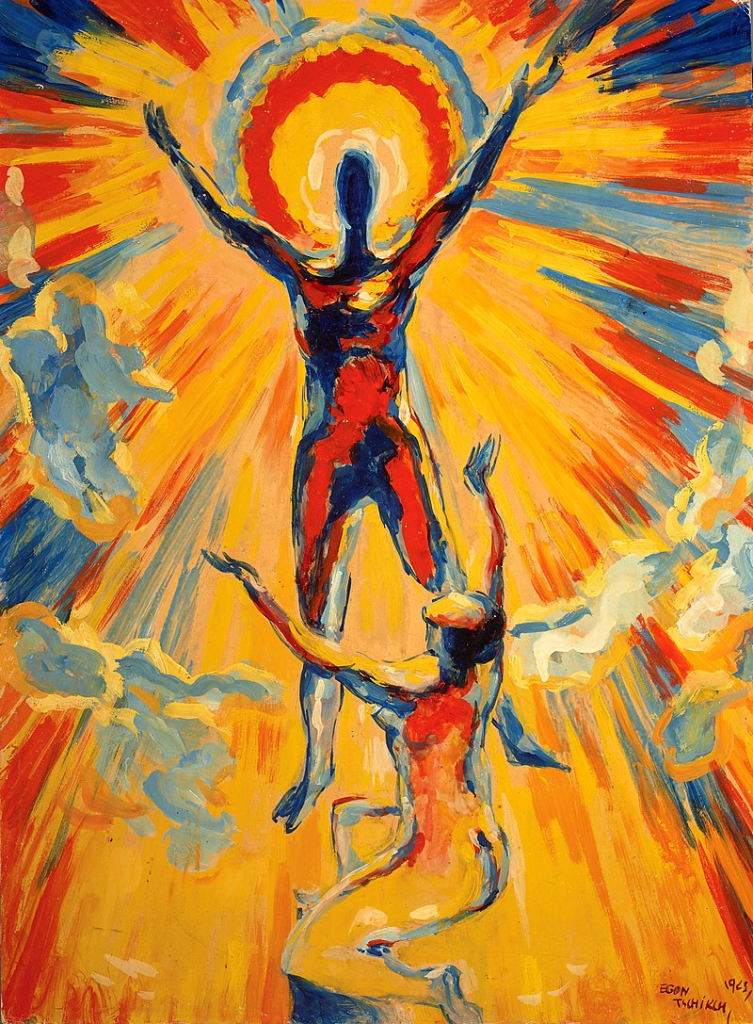
Song of Songs No. 8, by Egon Tschirch, 1923

When Scripture says I am my beloved’s and my beloved is mine, and that his desire is for me, it is a wonderful way of communicating that God’s love for us is not abstract, distant, or detached. (Song of Songs 6:3, 7:10) 

The truth is: We belong to God. The Lord’s desire is for you and me. God has an intense and overpowering longing for you. Let the deep desire of God for you shape and form your thoughts so that fear is replaced with faith; loneliness with enjoyment; the fickle nature of others with satisfaction; praying as duty with praying because I want to be with the God who loves me so much.

Oh, how we need a vision of God singing over us with joy! Yes, God loves you that much! Grab a hold of what the prophet says:

The Lord will take delight in you with gladness.
    With his love, he will calm all your fears.
    He will rejoice over you with joyful songs. (Zephaniah 3:17, NLT)

Even the most unlovely of people are made lovely through God’s persistent and pursuing love for them. You are being wholly seen every single day by the infinite gaze and eternal compassion of God, who watches our every step with delight.

Christianity does not “happen” simply by knowing some beliefs about God, as if it is a mere contractual signing-off on a doctrinal statement. Rather, Christianity “happens” when individuals experience the white hot burning love of God in Jesus Christ. 

Jesus came not only for those who skip church and only occasionally read their Bibles. Christ came also for the hard-hearted prick, the immoral adulterer, the strung-out addict, the terrorist, the murderer, and for all those caught in bad choices and failed relationships. 

“I have not come to call respectable people, but outcasts.” (Matthew 9:13, GNT)

“Go out and train everyone you meet, far and near, in this way of life.” (Matthew 28:19, MSG)

“You will be witnesses for me.” (Acts 1:8, GNT)

“Love each other in the same way that I have loved you.” (John 13:34, GW)

All Christ’s words and actions are because of the Lord’s intense desire to love the world, and to love it through the divine beloved people of God.

God’s love is never based on our performance, or how good we look to others; it is never conditioned by our moods. The love of God only looks longingly at you and me with the potential of what we can become in Christ and cares for us as we are. It is a world-altering revolutionary thought that God loves me as I am and not as I should be. 

God has shown us how much he loves us—it was while we were still sinners that Christ died for us! (Romans 5:8, GNT)

Despite the erosion of church attendance, the majority of people still believe God exists. Conversely, however, many people do not believe God really loves them. We are in a crisis of love. People need to know the God who is pure Love. They need to hear and heed the call to come away with God.

Christianity never begins with what we do for God to make ourselves lovely. Christianity always starts with what God has done for us, the great and wonderful love that exists for us in Christ Jesus.

It wasn’t so long ago that we ourselves were stupid and stubborn, easy marks for sin, ordered every which way by our glands, going around with a chip on our shoulder, hated and hating back.

But when God, our kind and loving Savior God, stepped in, he saved us from all that. It was all his doing; we had nothing to do with it. He gave us a good bath, and we came out of it new people, washed inside and out by the Holy Spirit.

Our Savior Jesus poured out new life so generously. God’s gift has restored our relationship with him and given us back our lives. And there’s more life to come—an eternity of life! You can count on this. (Titus 3:3-8, MSG)

All the wrong turns in the past, the mistakes and the moral lapses, everything that is ugly or painful, all melts in the light of God’s acceptance and love for us.

If the consuming passion of Christ’s followers is not showing God’s love, then we have lost both our mission and our first love of Jesus. Perhaps we must let time evaporate, as we bow at the foot of the cross, and experientially know the great love of God in Christ for us and for the world.

May it be so, to the glory of God.

Because of Love (Psalm 21)

God Is Love by Lisa Voss, 2015

How the king rejoices in your strength, O Lord!
    He shouts with joy because you give him victory.
For you have given him his heart’s desire;
    you have withheld nothing he requested.

You welcomed him back with success and prosperity.
    You placed a crown of finest gold on his head.
He asked you to preserve his life,
    and you granted his request.
    The days of his life stretch on forever.


Your victory brings him great honor,
    and you have clothed him with splendor and majesty.
You have endowed him with eternal blessings
    and given him the joy of your presence.


For the king trusts in the Lord.
    The unfailing love of the Most High will keep him from stumbling.

You will capture all your enemies.
    Your strong right hand will seize all who hate you.
You will throw them in a flaming furnace
    when you appear.
The Lord will consume them in his anger;
    fire will devour them.

You will wipe their children from the face of the earth;
    they will never have descendants.
Although they plot against you,
    their evil schemes will never succeed.

For they will turn and run
    when they see your arrows aimed at them.
Rise up, O Lord, in all your power.
    With music and singing we celebrate your mighty acts. (New Living Translation)

The structure of today’s psalm is significant. Our contemporary way of crafting arguments is by stating a thesis at the beginning of a paper, then providing points of support for that thesis, and concluding with a restatement of the thesis. That’s not how the biblical psalms do it.

The psalm’s major thesis statement is not found at the beginning but in the middle. The verses before the major statement lead to the middle; and the verses after the middle look back and point to it.

So, what’s in the middle? An affirmation of faith in the Lord’s love prevents the king from having a failure of faith.

God’s love is smack in the middle because everything hinges on love.

The Lord leads us to victory, and prayers are answered because of love.

The Lord guides us toward prosperity of body and preservation of soul because of love.

The Lord shepherds us to the green pastures of blessing and encouragement because of love.

God is Love.

The Lord has our backs by eradicating the enemies to our souls.

The Lord follows after us and foils the evil plots of wicked people.

The Lord works behind the scenes for us, putting down devilish strategies so they won’t come near us.

Just as the core of God is love, we have been created in God’s image and likeness of love; love is the very core of our being.

So, why in the world are people not always loving in everything they do and say?

Because we have lost touch with our middle; we lack awareness of who we truly are.

How do we get in touch and reconnect with the core of our being? Here are a few simple ways of doing so:

  • Pray a psalm every single day, even multiple times in the day. Notice I said pray, not read. Psalms are prayers meant to be prayed. Reading them is wonderful but praying them is sublime!

I will praise you seven times a day because all your regulations are just. (Psalm 119:164, NLT)

Answer me, Lord, out of the goodness of your love; in your great mercy turn to me. (Psalm 69:16, NIV)

  • Pay attention to what makes you happy. The psalmist experienced God giving him the desires of his heart. He asked for what he wanted and needed to be happy.

Be happy with the Lord, and he will give you the desires of your heart. (Psalm 37:4, GW)

  • Pursue someone you’ve lost touch with. Reconnect with an old friend. Oftentimes, doing this helps reawaken a part of ourselves we forgot about.

Loyal love and faithfulness meet; deliverance and peace greet each other with a kiss. (Psalm 85:10, NET)

  • Practice self-care. Observe the Sabbath. Put your feet up. Give yourself a break. and don’t try to be perfect. Make some margin in your schedule – enough to have some extended times of silence and solitude. After all, one cannot connect with their inner core unless they are quiet enough to hear themselves.

When you are disturbed, do not sin;
    ponder it on your beds, and be silent.
Offer right sacrifices,
    and put your trust in the Lord. (Psalm 4:4-5, NRSV)

  • Praise the Lord and give thanks to God. Our self-awareness comes alive by means of offering trust and thanksgiving back to the Lord for the great things God has done.

Know that the Lord is God.
    It is he who made us, and we are his;
    we are his people and the sheep of his pasture.

Enter his gates with thanksgiving
    and his courts with praise.
    Give thanks to him; bless his name.

For the Lord is good;
    his steadfast love endures forever
    and his faithfulness to all generations. (Psalm 100:3-5, NRSV)

Since God is Love, God is in the middle and is the center of all things. Everything in the universe revolves around the Lord of Love. So, as we align our lives around this reality, we rediscover the love at the core of our being.

If we desire love, then let us go to the source of Love.

Bless us with love, O Merciful God, so that we may love as you love – and that we might be patient, tolerant, kind, caring, and loving to all people. Grant us your compassion so that we may help those in need. And bless us with your divine Love, O Lord, bless us with your love! Amen.

Psalms 42 & 43 – Longing for Another World

As a deer gets thirsty
    for streams of water,
I truly am thirsty
    for you, my God.
In my heart, I am thirsty
for you, the living God.
    When will I see your face?
Day and night my tears
    are my only food,
as everyone keeps asking,
    “Where is your God?”

Sorrow floods my heart,
    when I remember
leading the worshipers
    to your house.
I can still hear them shout
    their joyful praises.
Why am I discouraged?
Why am I restless?
    I should trust you, Lord.
I will praise you again
because you help me,
    and you are my God.

I am deeply discouraged,
    and so I think about you
here where the Jordan begins
at Mount Hermon
    and at Mount Mizar.
Your vicious waves
    have swept over me
like an angry ocean
    or a roaring waterfall.

Every day, you are kind,
    and at night
you give me a song
as my prayer to you,
    the God of my life.

You are my mighty rock.
    Why have you forgotten me?
Why must enemies mistreat me
    and make me sad?
Even my bones are in pain,
    while all day long
my enemies sneer and ask,
    “Where is your God?”

Why am I discouraged?
Why am I restless?
    I trust you, Lord!
And I will praise you again
because you help me,
    and you are my God…

Show that I am right, God!
Defend me against everyone
    who doesn’t know you;
rescue me from each
    of those deceitful liars.
I run to you for protection.
Why do you turn me away?
Why must enemies mistreat me
    and make me sad?

Send your light and your truth
    to guide me.
Let them lead me to your house
    on your sacred mountain.
Then I will worship
at your altar because you
    make me joyful.
You are my God,
    and I will praise you.
Yes, I will praise you
    as I play my harp.

Why am I discouraged?
Why am I restless?
    I trust you, Lord!
And I will praise you again
because you help me,
    and you are my God. (Contemporary English Version)

Longing is a universal human experience. It is also an integral part of the human condition.

“If we find ourselves with a desire that nothing in this world can satisfy, the most probable explanation is that we were made for another world.”

C.S. Lewis

Before that statement, Lewis spoke of the nature of longing – how all that we experience in this life is not the ultimate object of our desire, of our longing. The beauty and satisfaction we seek:

“was not in them, it only came through them, and what came through them was longing. These things—the beauty, the memory of our own past—are good images of what we really desire; but if they are mistaken for the thing itself they turn into dumb idols, breaking the hearts of their worshipers. For they are not the thing itself; they are only the scent of a flower we have not found, the echo of a tune we have not heard, news from a country we have never yet visited.”

C.S. Lewis, The Weight of Glory

If we follow the path of any pain, any psychological or emotional wounding, it will lead us to this one primal pain: the pain of separation.

That’s because, having been born into this world, we are banished from Paradise and carry the scars of our Edenic estrangement – the separation from God.

Although it may sound counter-intuitive, if we will but embrace this suffering, if we allow it to lead us deep within ourselves, it will take us deeper than any healing this world can offer.

In other words, longing is itself the cure. It is when our hearts break that they become open for the love to come pouring out of it.

The grief we acknowledge and express draws us toward intimacy with the Divine and with others. It brings union, not separation. The problem itself becomes the cure.

“Do not seek for water. Be thirsty.”

Jalāl al-Dīn Muḥammad Rūmī (1207-1273)

The longing for love, belonging, and connection needs to be deeply felt, because it is really the only way of actually loving another. It is in hungering and thirsting – that is, in longing – which leads us to pray and seek to end our separation.

Prayer is the voice we give to our longings.

Naming our sadness for what it is, even our depression, is most necessary. Since we are emotional creatures, profound sadness even to the point of depression and/or despondency will happen.

Yet, despite the universal nature of discouragement, tears, and the longing for better and beauty, many Christians buck the feelings. Far too many believers focus so exclusively on victory in Jesus through his resurrection, ascension, and glorification that they use religion as their denial when unwanted emotions come banging at the doorstep of their soul.

Depression is not sin. To be discouraged is not the Enemy. And our longings are the evidence that this is so. We must sit with our emotions and feel the breadth and depth of them. Both our spiritual and emotional health come through an awareness and robust engagement with our feelings. Refusing to feel is, in reality, putting the stiff arm to God.

The psalmist does anything but deny his feelings. He brings them before the Lord and spreads them out before the Divine. Why am I discouraged? Why am I restless? Why the sadness? Could it be that God has forgotten me? Where is the Lord? Is God angry with me? Are my troubles the result of divine wrath?

To blandly say we have never uttered or thought such questions is a telltale sign of denying our deep longings. The bottom line for many folks is that they do not want to feel discouraged or cry any tears because it complicates their lives. Besides, it hurts!. “Why feel,” we reason, “when it only brings pain?”

Ah, yes, the avoidance of pain. And there is no pain quite like emotional and spiritual pain of separation and longing for things to be different.

Much like an open wound which needs a liberal application of painful peroxide, so our spiritual wounds must sting with the salve of emotional feeling. Healing is neither cheap, easy, nor painless. It typically hurts like hell.

The psalmist’s own pain revolved around feelings of alienation from God, being cut off from fellow worshipers, and harassed by others around him. Understandably, he experienced despondency and loneliness. The psalmist wondered if anyone, including God, even cared what he was going through. In other words, he is desperate for God to show up. So, he prayed as if his life depended on it.

The psalmist did not get answers to his questions. But that was never the point of the asking.

Hope arises from holding the big picture of the past, present, and future together at the same time. When present circumstances are difficult, and it appears we are about to swallowed up into the now, we must hold the past and future along with it, in careful tension.

While we desperately search for a cure, none will be found in this life – at least not in full. We are occasionally and surprisingly graced with glimpses of our deepest longings whenever we experience the kindness of a stranger, an answer to a prayer we uttered years ago, or the peace of an unexpected rest.

Then, our trust reawakens, and we are encouraged to take another step in the long walk of life – a walk in which God is beside us, even if we cannot discern it.

Gracious God, help us to know wonder in our waiting, patience in our wonderings, and a vision of how life is supposed to be lived. May our deepest longing find its satisfaction in you and in the many ways you mercifully hold the world together, through Jesus Christ our Lord. Amen.

1 Corinthians 3:10-17 – Being a Holy Temple

Albi Cathedral in Sainte-Chapelle, France

By the grace God has given me, I laid a foundation as a wise builder, and someone else is building on it. But each one should build with care. For no one can lay any foundation other than the one already laid, which is Jesus Christ. If anyone builds on this foundation using gold, silver, costly stones, wood, hay or straw, their work will be shown for what it is, because the Day will bring it to light. It will be revealed with fire, and the fire will test the quality of each person’s work. If what has been built survives, the builder will receive a reward. If it is burned up, the builder will suffer loss but yet will be saved—even though only as one escaping through the flames.

Don’t you know that you yourselves are God’s temple and that God’s Spirit dwells in your midst? If anyone destroys God’s temple, God will destroy that person; for God’s temple is sacred, and you together are that temple. (New International Version)

God is holy, pure, beautiful, and completely separated from all that is evil. 

However, there is a problem; but it isn’t with God. 

Ever since the fall of humanity into guilt, shame, and impurity, people cannot be near or approach a perfect Being. Just as we will surely go blind by looking directly at the sun – or be totally disintegrated by getting too close to it – so humans cannot be with such a holy God.

In the Old Testament, God graciously devised a system whereby people could approach the divine. A temple was built. It had very detailed and strict prescriptions about how it was to be built. There needed to be curtains, walls, and borders everywhere to shield the people from being destroyed by the sheer holiness of God.

Entering the New Testament, Jesus is the exact representation of God’s holy being and presence. In Christ, God became intimately close to people. Through the redemptive events of Jesus, humanity is delivered from the vexing problem of being far away from God. 

If that were not enough, God the Father and Son sent God the Holy Spirit to be the continuing presence of Jesus on this earth. 

In today’s New Testament lesson, the Apostle Paul tells us that, as the church, we are a holy temple which is graciously, patiently, and with great care being built into a spiritual house that can be the place where God meets with humanity.

The triune God has conspired and gone out of the way to be with us. The Lord has bended the arc of history for good purposes to be with us. Like a lover separated from his beloved, God has pulled out all the stops to make us holy so that we can abide with him in divine holiness.

From the solid foundation of Jesus Christ as the chief cornerstone, we take care to build a spiritual infrastructure worthy of holiness.

As he who called you is holy, be holy yourselves in all your conduct;for it is written, “You shall be holy, for I am holy.” (1 Peter 1:15-16, NRSV)

God’s will is for you to be holy… God has called us to live holy lives, not impure lives. (1 Thessalonians 4:3, 7, NLT)

Some Christians mistakenly believe that holiness means to exclusively separate as far from everything and everyone who is impure. Any hint or smell of unsound dogma or nonconformity with established rules results in separation. Yet, this predilection for separation is really a form of division – which is contrary to the holiness of God. Because the Lord bends over backwards to accommodate the sinner’s ability to approach the divine presence.

Indeed, holiness involves a separation from all that is evil so that we can attach ourselves to God and others. Holiness isn’t simply an end in itself. To be holy means we are prepared and ready to engage in the highest of aims: Love.

Now that you have purified yourselves by obeying the truth so that you have sincere love for each other, love one another deeply, from the heart. For you have been born again, not of perishable seed, but of imperishable, through the living and enduring word of God. (1 Peter 1:22-23, NIV)

Holiness without a clear trajectory toward love is like putting a new collar on a dead dog. It just doesn’t make any sense.

Yet, too many folks have put a leash on that shiny new collar and are dragging the deceased around – much to the chagrin and revulsion of the world – who rightly sees this behavior as both downright crazy and plain stupid.

Paul would say that kind of behavior will be shown for what it is: Building on the wrong spiritual foundation.

It’s really all about Jesus. Christians bear the name of Christ because we (ideally) center our entire existence – past, present, and future – on the redemption provided through Jesus.

And that’s what this Christian season of the year is about: We celebrate the birth of Christ, God’s breaking into this world, to bridge the great divide between divinity and humanity.

The incarnation of Jesus Christ is our foundation.

Being a holy temple means being a sacred space large enough to hold love for all people.

From that strong support, there is no limit to the breadth and height of God’s kingdom. So, may you, along with the Apostle Paul pray:

I’m asking God to give you a gift from the wealth of his glory. I pray that he would give you inner strength and power through his Spirit. Then Christ will live in you through faith. I also pray that love may be the ground into which you sink your roots and on which you have your foundation. This way, with all of God’s people you will be able to understand how wide, long, high, and deep his love is. You will know Christ’s love, which goes far beyond any knowledge. I am praying this so that you may be completely filled with God. (Ephesians 3:16-19, GW)

Amen.