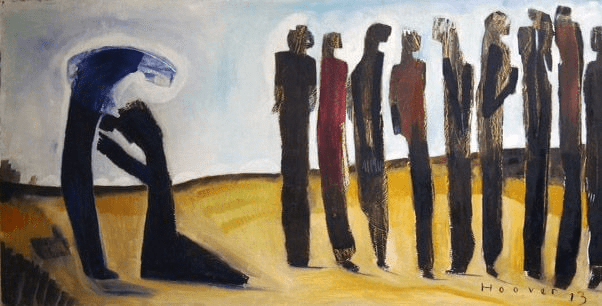
“Your Faith Has Made You Well” (Luke 17:11-19)

Jesus heals ten lepers, with one returning to give him thanks

On the way to Jerusalem Jesus was going through the region between Samaria and Galilee. As he entered a village, ten men with a skin disease approached him. Keeping their distance, they called out, saying, “Jesus, Master, have mercy on us!” When he saw them, he said to them, “Go and show yourselves to the priests.” And as they went, they were made clean. Then one of them, when he saw that he was healed, turned back, praising God with a loud voice. He prostrated himself at Jesus’s feet and thanked him. And he was a Samaritan. Then Jesus asked, “Were not ten made clean? So where are the other nine? Did none of them return to give glory to God except this foreigner?” Then he said to him, “Get up and go on your way; your faith has made you well.” (New Revised Standard Version)

Ten persons seeking healing called out to Jesus. And they got it. Yet, those persons were much more than passive receivers of healing. And Jesus was more than simply a giver.

Even though the lepers had heard about Jesus, they did not personally know him. It seems that – from their perspective – they had a chance encounter with Jesus. When they least expected a healing, a healing happened.

They called out to Christ, recognizing who it was that had entered their village. There was enough faith present for the diseased persons to make themselves known to Jesus – to expectantly put themselves out there and cry out for a healing to happen.

If you think about it, the power of any healing is really in the connection of being seen and heard in crying out to Jesus.

Although the healing of a person can come through a wondrous miracle, healing most often happens by the beautiful act of mutuality and participation. That is, the healer and the one in need of healing encounter each other with the willingness to both give and receive.

It’s in real human connection that healing happens. And it’s more than a physical cure; it’s also a healing reconnection of persons who were once isolated from the community. In other words, the healed person no longer needs to be on the outside of society, but can once again be a full participant in neighborhood and community.

Faith is central to what happens in the healing process. We all have some agency in realizing our own healing. We need not be passive spectators just wishing for things to be different.

Our anxiety and/or discouragement of present circumstances can move to a different place. We can discover relief through participating in social activities, taking walks in nature, and other modes requiring us to actively make a meaningful connection.

It requires faith.

Where faith is present, relational interaction and participation happens. In this context, a healing can occur. Rarely, if ever, does healing happen in complete isolation from others.

The fact that Jesus declared to the cleansed leper, “your faith has made you well,” indicates the mutuality of the healing encounter.

Let’s keep in mind that it takes at least two in order to have a healing: the healer and the healed one. Both participate together in the healing.

What’s more, when Christ heals, he heals without prejudice or favoritism.

In my front yard is a large ash tree with broad and expansive boughs. It is the ultimate shade tree. The tree’s name is Bob (I have a tendency to name trees, especially the ones I enjoy daily). Bob and I share the similarity of being created by the same Creator; and we both glorify God by simply being who we are created to be.

For Bob, he provides shade to people and animals without prejudice or favoritism. Anyone who comes under his great limbs can enjoy his shade. All that is needed for the protective and enjoyable experience of Bob’s boughs is a person under him.

Although it is appropriate to highlight the need for gratitude and praise in today’s story, the narrative itself builds to the climax of faith, of a participatory experience between Jesus and the leper(s).

And it did not matter if the persons healed were lepers, Samaritans, or even miscreants. What mattered was the faith-dialectic of the healer Jesus and the ones to be healed. All may enjoy the grace of divine shade if they move to becoming participants together with Christ by merely coming under his mercy.

I find that many people get hung-up about faith. We often make faith either too simple or too difficult. We create an overly simplistic faith when it becomes a completely passive affair of just waiting on God, or expecting someone else to heal me. We make faith a great difficulty whenever it becomes all about our level or amount of faith through the strenuous effort of intense prayer and contacting umpteen prayer chains.

But more or less prayer, more or less work, more or less of anything misses the point – because even a puny amount of faith will do, if it moves toward Jesus and seeks the participatory experience of a divine/human relation.

There is a cost to healing. It requires participation, relationship, and most of all, the humility to be seen and heard, instead of trying to control some sort of process to get the healing I want.

We call this genuine participation faith.

When the Son of Man comes, will he find faith on the earth? (Luke 18:8)

The only thing that counts is faith expressing itself through love. (Galatians 5:6)

Your faith has made you well. (Luke 17:19)

In your love, O God of all, your people find healing. Grant that the pains of our journey may not obscure the presence of Christ among us, but that we may always give thanks for your healing power as we travel on the way to your kingdom; through Jesus Christ, your Son, our Lord, who with you and the Holy Spirit are one God, now and forever. Amen.

The Need for Partnership and Participation (Malachi 3:5-12)

“So I will come to put you on trial. I will be quick to testify against sorcerers, adulterers and perjurers, against those who defraud laborers of their wages, who oppress the widows and the fatherless, and deprive the foreigners among you of justice, but do not fear me,” says the Lord Almighty.

“I the Lord do not change. So you, the descendants of Jacob, are not destroyed. Ever since the time of your ancestors you have turned away from my decrees and have not kept them. Return to me, and I will return to you,” says the Lord Almighty.

“But you ask, ‘How are we to return?’

“Will a mere mortal rob God? Yet you rob me.

“But you ask, ‘How are we robbing you?’

“In tithes and offerings. You are under a curse—your whole nation—because you are robbing me. Bring the whole tithe into the storehouse, that there may be food in my house. Test me in this,” says the Lord Almighty, “and see if I will not throw open the floodgates of heaven and pour out so much blessing that there will not be room enough to store it. I will prevent pests from devouring your crops, and the vines in your fields will not drop their fruit before it is ripe,” says the Lord Almighty. “Then all the nations will call you blessed, for yours will be a delightful land,” says the Lord Almighty. (New International Version)

Return To God

God and God’s people were at odds with each other. The Lord was weary of the people’s constant complaining. They had a wrongheaded notion that God was absent, just because circumstances were not going their way.

Yet it is important to keep in mind that belief in God’s presence and God’s inherent goodness is absolutely essential to a faithful and good life.

If you think God is absent, then the best place to find God is at the outskirts or margins of a society. The Lord is there to protect the weakest persons and those who have been neglected by others.

The needy in Israel were on the outside without any power or a voice, which is why the prophet Malachi called the people to repentance – to change and amend their ways. They should return to God.

But what does a return to God look like? Since the people generally did not think they were doing anything necessarily wrong, they didn’t have a clue how to do this returning to God. They didn’t have the sense to know they were on the outs with God – which is why the prophet Malachi was speaking to them.

To the people at that time, and practicing the injustice that they were practicing, God responded that they should return by stopping their robbery of God.

Tithes and Offerings

Specifically, the people should reinstate the full mandated practice in the law of tithes and offerings.

Please understand that these tithes and offerings have nothing to do with modern capital fund campaigns for building churches or establishing new ministries. Rather, these words have a specific context that we must pay attention to.

The “tithe” in Israel was the temple tax, paid to the Levites, because this was the tribe of Levi’s only source of income. (Numbers 18:20-30)

An “offering” is a general term, referring to all the sorts of sacrifices offered at the temple as a part of Israelite worship. And once again, the Levites depended upon these offerings in order to eat and live.

Thus, tithes and offerings in Israel had a synergistic purpose of providing the people an opportunity to worship God and center their communal life around the Lord; and also providing for the Levites, so that they could make their living.

And then, the priests who attended to all the temple functions would use funds from the tithes and offerings to help the poor and indigent in the community.

So, a failure to provide tithes and offerings was an injustice, because it was neglecting to care for fellow members of society who needed help.

People could starve and die without practicing God’s law concerning tithes and offerings. And that is why it angered God so much whenever people reneged on their duty toward the temple practices.

Cooperation, Not Competition

Therefore, repentance and returning to God would happen only when the priests and the people cooperated together. Then, God’s faithfulness could be made effective and manifest itself among the entire social structure of Israel.

The entire society was built upon a divine/human cooperative. It required both human action and divine blessing working together.

None of this was a contract or a deal in which people do the right thing, and then God automatically blesses, like some divine slot machine that persons put coins into.

Instead, it is a system in which the laity work together with the clergy; and then all the people work together with God. In other words, God’s ideal is partnership and participation.

God will bring a great produce. But the people would have to do the hard work of planting and harvesting the crops. This is very far from any sort of name-it-and-claim-it theology in which a person prays for whatever they want and God will give it to them. That is not how an abundant life is produced.

Abundance comes wherever there are partners who participate with each other. If that system breaks down, then people are in a world of trouble.

So, people must take the social justice of God quite seriously – with its specific requirements about caring for one another.

Although we may not have the same particular system of Levites and a Temple, God’s heart for justice, for people’s basic needs to be met and satisfied, has never changed. That value still stands the test of time throughout all of human history.

Almighty God, who created us in your own image: Grant us grace to fearlessly contend against evil, and to make no peace with oppression. Enable us to reverently use our freedom, in the establishment and maintenance of justice in our communities and among the nations, to the glory of your holy Name. Amen.

Immortal God and Mortal Humanity (Psalm 90)

Digital artwork by Bruce Butler

Lord, you have been our dwelling place
    in all generations.
Before the mountains were brought forth
    or ever you had formed the earth and the world,
    from everlasting to everlasting you are God.

You turn us back to dust
    and say, “Turn back, you mortals.”
For a thousand years in your sight
    are like yesterday when it is past
    or like a watch in the night.

You sweep them away; they are like a dream,
    like grass that is renewed in the morning;
in the morning it flourishes and is renewed;
    in the evening it fades and withers.

For we are consumed by your anger;
    by your wrath we are overwhelmed.
You have set our iniquities before you,
    our secret sins in the light of your countenance.

For all our days pass away under your wrath;
    our years come to an end like a sigh.
The days of our life are seventy years
    or perhaps eighty, if we are strong;
even then their span is only toil and trouble;
    they are soon gone, and we fly away.

Who considers the power of your anger?
    Your wrath is as great as the fear that is due you.
So teach us to count our days
    that we may gain a wise heart.

Turn, O Lord! How long?
    Have compassion on your servants!
Satisfy us in the morning with your steadfast love,
    so that we may rejoice and be glad all our days.
Make us glad as many days as you have afflicted us
    and as many years as we have seen evil.
Let your work be manifest to your servants
    and your glorious power to their children.
Let the favor of the Lord our God be upon us
    and prosper for us the work of our hands—
    O prosper the work of our hands! (New Revised Standard Version)

All of the psalms are prayers. Most of them are prayers of David. Today’s psalm is a prayer of Moses.

Moses acknowledged and affirmed that God is eternal, and we humans are not. We are frail and in need of God. We are dependent upon God for health, hope, and happiness in life.

There are observations to notice in today’s Psalm lesson, that are then followed by prayerful petitions which arise from those observations.

First Observation: God Is Eternal

God is immortal. God has always been, and will always be. Therefore, the Lord’s rule and reign existed way before this world was ever created, and shall extend way beyond the lifespan of creation. God’s dwelling place is without beginning or end – which means that God isn’t going anywhere. That is a great comfort to me.

Second Observation: Humans Are Finite

Whereas God is immortal, we humans are mortal beings. We are creatures with limited time on this earth. We all eventually die. Everyone returns to the dust from which they came – which isn’t even a blink of an eye when compared to God’s eternal existence.

This isn’t meant to be a downer for us, but rather to help us. It is necessary to work within our limitations while living in this world. To live as if we are immortal has grave consequences (pun intended).

Third Observation: The World Is Broken

Our world is fundamentally messed up. Another way of saying this is that everything in creation is under a curse. Things are not as they should be. And that’s on us, not God. Because of our own human proclivity to sin, our world is beset with a great deal of suffering and toil.

Hopefully, in the best scenario, people learn to understand the brevity of life, and gain wisdom on how to live a humble, just, and good life with one another, and with their God.

Now notice the petitions which Moses offered to God, based upon the observations of God’s nature, human nature, and the world’s situation.

First Petition: Turn, O Lord!

Moses was pleading with God to turn away from divine judgment and wrath, which was more than deserved for a group of people who were chronically complaining and disobedient. Moses was well aware of all Israel’s sins, and was counting on the Lord’s mercy for God’s covenant people.

Second Petition: How long, O Lord?

Moses was asking one of those questions that we ask, knowing that he wasn’t really going to get an answer. Yet, in the asking, there is an understanding that human misery won’t go on forever. Our suffering is temporary.

In this petition of Moses, he was also calling for a change, for God to deal with the people in a different way. Moses wanted gladness to replace affliction, and the sufferings of this life to give way to the joy of living in a good world.

Third Petition: Prosper the work of our hands

This wasn’t a petition for God to simply make everyone healthy and wealthy. It was a focused prayer that God’s work and our human work would be one seamless activity. That is, this is a prayerful longing for what we do in our lives to completely synchronize with God’s law in this world we all inhabit together.

Whenever we sin, we cause damage, not prosperity. Yet, with a divine/human cooperative in which we acknowledge and affirm God’s sovereignty over our lives, and take up our own human responsibility, then humanity thrives and flourishes in the goodness we were meant to enjoy as God’s creatures.

Christian Observations

In Christianity, the immortal and invisible God comes to us in the mortal and visible life of Jesus. In Christ, the sovereignty of God and the responsibility of humanity is not only synchronized; it is perfectly united and harmonized so that there is deliverance from the power of evil and from God’s judgment.

God’s steadfast love is brought to us with skin on.

For the Christian, Jesus is the answer to the prayers and petitions of Moses. Christ is the prophet foretold by Moses who was to come:

I [Yahweh]will raise up for them [the Israelites] a prophet like you [Moses] from among their own people; I will put my words in the mouth of the prophet, who shall speak to them everything that I command. (Deuteronomy 18:18, NRSV)

The incarnation, life, ministry, crucifixion, death, resurrection, ascension, and glorification of Jesus Christ has dealt with the weeds and overgrowth of guilt and shame that has taken over the garden of this world.

In Christ, we can begin to hack through all the stuff, in order to see the beauty underneath all of the spiritual neglect which has occurred for so long.

May the grace of the Lord Jesus Christ, the steadfast love of God the Father, and the encouragement of the Holy Spirit be with you, now and forever. Amen.

Longing For God (Psalm 63)

O God, you are my God; I seek you;
    my soul thirsts for you;
my flesh faints for you,
    as in a dry and weary land where there is no water.
So I have looked upon you in the sanctuary,
    beholding your power and glory.
Because your steadfast love is better than life,
    my lips will praise you.
So I will bless you as long as I live;
    I will lift up my hands and call on your name.

My soul is satisfied as with a rich feast,
    and my mouth praises you with joyful lips
when I think of you on my bed
    and meditate on you in the watches of the night,
for you have been my help,
    and in the shadow of your wings I sing for joy.
My soul clings to you;
    your right hand upholds me.

But those who seek to destroy my life
    shall go down into the depths of the earth;
they shall be given over to the power of the sword;
    they shall be prey for jackals.
But the king shall rejoice in God;
    all who swear by him shall exult,
    for the mouths of liars will be stopped. (New Revised Standard Version)

David, the psalmist, had a great longing for God.

This sort of longing has nothing to do with lustful desires which want something specific under the Christmas tree. To long for God is to have a deep inner wish for fulfillment and connection.

People have all sorts of longings in their lives, because they miss someone or are missing something important.

A parent longs for an estranged child to return, or at least to talk to them.

A spouse wishes to be with their loved one without the ravages of dementia.

A teacher has a deep longing to impact her students in a positive and profound way that will change their lives.

A person longs to see their friend realize the dream they have been seeking.

An individual has been living with chronic pain for years, and longs to be at least pain-free enough to enjoy the simple pleasures of taking a walk, visiting family, or going to a restaurant for a nice meal.

These longings, and thousands more, make up the future hope which keeps us going day after day. And they are all, in one way or another, related to the ultimate longing for divine connection.

Many types of longing come from a place of relationship, of love and support for another. It is this kind of longing that the psalmist had for God. The deep longing to experience a divine/human contact, to commune with the living God, is what motivated and fueled David throughout much of his life.

Like a person looking to satiate their thirst in a hot dry desert, is the one who actively seeks and goes after the longing they have. I believe that every person on planet earth has a deep abiding desire and need for something transcendent in this life, to encounter a power which is higher and greater than us – knowing that the basic nature of this power is loving and good.

My need for communion with God is on the same level as my daily need for water. I cannot survive without either of them.

Spiritual survival requires being watered and fed by an intimate relationship with our Creator. The presence of God is just as necessary and life-sustaining as food. Along with the psalmist David, God’s words are the spiritual food I need to live and survive.

Longing involves memory. Our various longings are often a remembrance of special events, seasons, or people. Deep hope activates those memories, and drives us to prayer, because God has the strength and the ability to honor those honest longings.

The greatness of God, and the divine purposes for this world, are heavy laden with longing. God’s heart longs for humanity to realize a renewed and revitalized relationship with God.

So, the Lord serves humanity in a myriad of ways, bringing deliverance from all that hinders us in a relationship with God, so that we might associate meaningfully and purposefully with what is good, right, and just.

We are invited by God to unpack the gift of faith, and the various spiritual gifts given to us, for the benefit of the church and the world.

God’s steadfast love is indeed better than life itself, because it is beyond what we humans can even conceive of as to what a good life truly is.

God is Love, and Love is God. Love transcends life and brings us to a place of connection beyond what our minds can imagine, and our hearts can only long for.

Since God is always gracious, loving, and good within God’s basic character, God always does what is good and loving. And that makes praise and adoration of God always open season.

Praising God reminds us of what God has done. The Lord is personally invested and involved in God’s big world. Thus, praise is quite appropriate whenever one is going through difficult times; because it accesses memories of God’s help in times past, enabling divine help in the present.

God’s gracious actions are both communal and personal. God not only helps others; God helps me. The Lord’s faithfulness endures throughout all generations. And God is big enough to notice me, and to help me in my own time of need.

Therefore, any occasion is appropriate in coming to God.

Are you in need of rest? Do you need encouragement? Are you in need of some help?

Then, come to God. Praise the Lord. Remember God. Consider the works God has done throughout history for God’s people. Do it during the day while working. Do it at night with your head on the pillow. Do it anytime, anywhere. Because God is there.

The Lord will provide – perhaps not on your timetable, yet God will nonetheless help, often in a way you may not expect.

Faith in God isn’t about trying to avoid God’s anger or wrath; faith is about syncing my wishes and my longings with the heart of God. That is called “repentance.” And it’s the way of finding our great inner longings satisfied.

We must tend to our relationship with the Lord; for God has made it possible to do so.

Receive this blessing from author John O’Donohue in his book, To Bless the Space Between Us: A Book of Blessings…

Blessed be the longing that brought you here
And quickens your soul with wonder.

May you have the courage to listen to the voice of desire
That disturbs you when you have settled for something safe.

May you have the wisdom to enter generously into your own unease
To discover the new direction your longing wants you to take.

May the forms of your belonging—in love, creativity, and friendship—
Be equal to the grandeur and the call of your soul.

May the one you long for long for you.

May your dreams gradually reveal the destination of your desire.

May a secret Providence guide your thought and nurture your feeling.

May your mind inhabit life with the sureness with which your body inhabits the world.

May your heart never be haunted by ghost-structures of old damage.

May you come to accept your longing as divine urgency.

May you know the urgency with which God longs for you.

Amen.