A Calling Is a Sacred Responsibility (2 Kings 9:1-13)

King Jehu

The prophet Elisha called to a member of the group of prophets, “Get ready, take this jug of oil with you, and go to Ramoth-Gilead. When you arrive there, look for Jehu, Jehoshaphat’s son and Nimshi’s grandson. Go to him, then pull him away from his associates, taking him to a private room. Take the jug of oil and pour it on his head. Then say, ‘This is what the Lord has said: I anoint you king of Israel.’ Then open the door, and run out of there without stopping.”

So the young prophet went to Ramoth-Gilead. He came in, and the military commanders were sitting right there. He said, “Commander, I have a word for you.”

“For which one of us?” Jehu asked.

The young prophet said, “For you, Commander.”

So Jehu got up and went inside. The prophet then poured oil on his head and said to him, “This is what the Lord, Israel’s God, says: I anoint you king over the Lord’s people, over Israel. You will strike down your master Ahab’s family. In this way I will take revenge for the violence done by Jezebel to my servants the prophets and to all the Lord’s servants. Ahab’s whole family will die. I will eliminate from Ahab everyone who urinates on a wall, whether slave or free, in Israel. I will make Ahab’s dynasty like the dynasty of Jeroboam, Nebat’s son, and like the dynasty of Baasha, Ahijah’s son. And as for Jezebel: The dogs will devour her in the area of Jezreel. No one will bury her.” Then the young prophet opened the door and ran.

Jehu went out to his master’s officers. They said to him, “Is everything okay?

Why did this fanatic come to you?”

Jehu said to them, “You know the man and the nonsense he talks.”

“That’s a lie!” they said. “Come on, tell us!”

Jehu replied, “This is what he said to me: ‘This is what the Lord says: I anoint you king of Israel.’”

Then each man quickly took his cloak and put it beneath Jehu on the paved steps. They blew a trumpet and said, “Jehu has become king!” (Common English Bible)

The biblical books of 1 & 2 Kings (originally one book of Kings) tells of the kingdoms of Israel and Judah over a five-hundred year period from c.960-586 B.C.E. The dynasties of the house of Omri and the house of Jehu were the longest lasting in Israel.

The books of First and Second Kings are primarily concerned with an evaluation of the 20 kings of Judah and the 19 kings of Israel. Of greatest concern was whether the particular king was loyal to God, or not. If the king tolerated worship of other gods besides Yahweh, and established sacrifices outside of Jerusalem, then that king was evaluated as doing evil in the eyes of the Lord.

This judgment of the kings is consistent with Deuteronomic laws of sole loyalty to God, and the importance of a central location for all Jewish people to worship (in Jerusalem).

To understand why it was so important for Jehu to be anointed with a mission is to know something of the house of Omri, and in particular, the king Ahab and his queen Jezebel. They are both conveyed to us in the biblical text as a power couple who want what they want, without a lot of concern about the subjects of their kingdom.

Jezebel was a follower of Baal and Asherah, not Yahweh. She provided for hundreds of their prophets. Her husband the king was fine with this situation. Jezebel was a clear enemy of God’s prophets, and killed hundreds of them, so that there were only a few left, including Elijah and Elisha (1 Kings 18:13).

Ahab and Jezebel’s powerful misuse of authority is relayed in the story of Naboth (1 Kings 21). Ahab wanted to buy Naboth’s vineyard, which was adjacent to his own land. But Naboth refused to sell, mainly because the land was his family’s ancient generational inheritance.

Jezebel went to work and arranged false witnesses to claim that Naboth had cursed both God and King (which was the ultimate sign of treason in Israel). As a result, Naboth was wrongly stoned to death; and Ahab unjustly confiscated his property.

Elijah prophesied that Ahab’s descendants would die, his dynasty will perish, and that Jezebel would be eaten by dogs (1 Kings 21:17-24). In our story for today, this is alluded to in the reference of God eliminating all that belong to Ahab who “urinate on a wall,” that is, unjustly marking the territory of another as their own property.

Indeed, it all shook-out according to prophecy. Ahab died in battle. Then, Ahab and Jezebel’s son Ahaziah succeeded him as king. Young Ahaziah died two years into his reign, and his brother Jehoram became king. Jehoram was then killed by Jehu. After this, some of Jezebel’s own palace officials tossed her out a window to her death, and dogs descended on her carcass – all to Elijah’s earlier prophecy.

Injustice, unrighteousness, abuse of power, and selfish concerns are ugly nasty business. These sorts of attitudes and behaviors ruin people, and keep others locked into patterns of poverty and powerlessness. God is not okay with any of it.

Whenever we are in the middle of oppression and/or authoritative people abusing their power for their own benefit, its hard to maintain our sense of rightness and goodness. Yet, we must. In such times, patience and perseverance is needed without resorting to attempts of paying back evil with evil.

What’s more, we can find ways of tapping into the spiritual power of God within us, in order to resist and subvert unjust authority with righteousness. To some degree, everyone can do something by employing nonviolent resistance tactics like networking, protest, persuasion, non-cooperation, and speaking out through either speech or writing.

Only those who possess nothing can be entrusted with everything. Systemic evil isn’t changed from the top, because those at the top benefit from the system. Rather, structural evil is transformed through grass roots efforts from the bottom up. What’s more, individuals rarely change from the outside-in, but rather from the inside-out.

A ruling establishment is not always necessarily wrong. Yet, it takes a lot of willing accountability and plenty of intentional soul searching for administrations to remain on the straight and narrow.

Such realities characterized Jehu. He was a non-descript military man. There was nothing, in particular, which distinguished him as having a special calling from God.

Yet, although Jehu fulfilled his calling, he added to the call; the Lord was not pleased with Jehu’s form of violent bloodshed, and so, put an end to Jehu’s house, just as Omri’s house had been purged from Israel.

Power and authority will do that to a person – which is why leaders must be continuously vigilant to guard against developing a thick ego and following their pride.

And so do we. Anyone who receives a call from God has a sacred responsibility and trust to fulfill that calling with competence, care, and conscientiousness.

Almighty God, direct me in all my activity with Your grace, wisdom, and help, so that in all I do and say may glorify Your holy Name; through Jesus Christ our Lord, in the power of the Holy Spirit. Amen.

Have a Piece of Humble Pie (Romans 9:14-29)

What can we say—that God is unfair? That’s unthinkable! For example, God said to Moses, “I will be kind to anyone I want to. I will be merciful to anyone I want to.” Therefore, God’s choice does not depend on a person’s desire or effort, but on God’s mercy.

For example, Scripture says to Pharaoh, “I put you here for this reason: to demonstrate my power through you and to spread my name throughout the earth.” Therefore, if God wants to be kind to anyone, he will be. If he wants to make someone stubborn, he will.

You may ask me, “Why does God still find fault with anyone? Who can resist whatever God wants to do?”

Who do you think you are to talk back to God like that? Can an object that was made say to its maker, “Why did you make me like this?” A potter has the right to do whatever he wants with his clay. He can make something for a special occasion or something for everyday use from the same lump of clay.

If God wants to demonstrate his anger and reveal his power, he can do it. But can’t he be extremely patient with people who are objects of his anger because they are headed for destruction? Can’t God also reveal the riches of his glory to people who are objects of his mercy and who he had already prepared for glory? This is what God did for us whom he called—whether we are Jews or not.

As God says in Hosea:

“Those who are not my people
I will call my people.
Those who are not loved
I will call my loved ones.
Wherever they were told,
‘You are not my people,’
they will be called children of the living God.”

Isaiah also says about Israel:

“Although the descendants of Israel are
as numerous as the grains of sand on the seashore,
only a few will be saved.
The Lord will carry out his sentence on the land,
completely and decisively.”

This is what Isaiah predicted:

“If the Lord of Armies hadn’t left us some descendants,
we would have been like Sodom and Gomorrah.” (God’s Word Translation)

In Christianity, humility is a virtue. Yet, sometimes Christians forget this, and they have to eat some humble pie.

In other words, there are times we need to be put in our place. It would go a lot better for us if we could just cultivate a humble spirit, rather than have humility forced upon us under embarrassing conditions.

The Apostle Paul realized he needed to make the Roman Church eat some humble pie. They were acting arrogant. The Jewish Christians and the Gentile Christians each thought they were better than the other. So, Paul reminded them both who was really in charge of things.

The proud person’s cry, when things don’t go their way, is “It’s not fair!” That’s because they believe they deserve to have something, to be on top, to call the shots on how things ought to go.

Paul was particularly hard on his fellow Jewish Christians, probably because he was quite familiar with their mindset about Gentiles (non-Jewish persons). The Jews tended to feel superior over Gentiles, and thus, to believe that they have the high ground and the right to trump Gentile thinking.

But Paul also took the Gentile Christians to task. They had a nasty habit of rolling their eyes whenever their Jewish sisters and brothers talked. The Gentiles mostly saw the Jews as hopelessly stuck in their old traditions and ways of doing things. And so, they believed new leadership was needed, wanting those crusty old guys out.

Therefore, each group – both the Jewish Christians and the Gentile Christians – had some major hang up’s about who should be in the Church and heading things up, and who should be out.

The Apostle (bless his exasperated heart) didn’t take sides. That’s because he knew that both groups were being knuckleheads. Each of them needed to get out of their pride. So, Paul cut them each some humble pie and dished it out.

Who is in and who is out is none of their concern. And what’s more, you’re never going to really know why some are in and some are out. The reason is that God is going to do what God is going to do. None of the petty posturing amongst each other means anything. In truth, everything is based on God’s call, and not on human decision, race, ethnicity, gender, politics, or anything else. It all comes down to God, not us.

God makes decisions and extends calls to people, all the time, that we don’t like. And Paul knew this. It is, in fact, what kept him humble. Paul understood he didn’t deserve a thing from God; everything good thing he had came from the Lord.

In his conversion from Jewish Saul to Christian Paul, the Apostle felt the sting of rejection from both groups. The Jews saw him as a traitor, a turncoat. The Gentiles didn’t trust him and wouldn’t accept him. But Paul, having had to eat humble pie himself – dished out by Jesus himself – learned to be patient and gentle. (Acts 9:1-5)

Yet, Paul had his boundaries and his limits. And the Roman Church crossed them. It was time for the entire church to hear a “suck it up, buttercup,” speech.

For the Jewish Christians, they were never “in” just because they were Abraham’s descendants. Abraham was called by God; therefore, everyone is called by God and not the other way around – and God calls whomever God chooses to call. There was nothing in Abraham to warrant a good choice. But God chose him anyway. And if God wants to take some of the Jews, the “chosen” people out, God will do it, because God isn’t accountable to us.

For the Gentile Christians, they weren’t brought “in” because of their own choice. Before they ever had a chance to choose God, God chose them. They were lost in darkness, far from God. But God, by sheer mercy and grace, called the Gentiles. And now that the Gentiles are “in” they can just as easily be “out” if God so chooses.

“The wonder is not that some are saved and others not, but that anybody is saved at all. If we receive what we deserve (judgment) or if we receive what we do not deserve (mercy), then in neither case is God unjust.”

John R.W. Stott

All of this is more than a bunch of power politics from the ancient world; these same dynamics impact us today in quite similar ways.

Any group of people who enjoy privilege over another group needs a slice of humble pie. Any group who continually disparages those in authority also needs a slice of humble pie.

In reality, there are times when every single one of us – including every community, institution, organization, corporation, and nation – needs a stiff reminder of who we really are, why we are really here, and what we are really supposed to be doing.

To eat humble pie means to acknowledge one’s mistake or wrongdoing and accept the humiliation that goes with that acknowledgement. We need to confess our sins and complicity in a host of the world’s ills. And we need to acknowledge that our awful predicaments aren’t just somebody else’s fault; we caused the crud.

We need the humility to ask for help; the humility to work with others very different from ourselves; and the humility to realize we could make the same mistakes again, if not for the grace of God.

Amongst us humans, we are all a community of equals. Yet, amongst God, none of humanity is equal to divinity. A clay pot has neither the right nor the ability to question the potter; they aren’t on the same level.

To enjoy divine privileges never gives us the right to show human prejudice. So let us be people who help one another live according to justice, mercy, and humility – for these are the very things which God calls us to embrace. (Micah 6:8)

Disturb us, Lord, when we are too well pleased with ourselves, and so, disparage others.
Disturb us, Lord, when with the abundance of things we possess, we lose our perspective and believe we are the masters of our own fate.

Disturb us, Lord, to dare more boldly by doing justice, loving mercy, and walking humbly with Jesus, in the enablement of the Holy Spirit. Amen.

Come Away with Me (Song of Songs 2:8-15)

Song of Songs No. 19, by Egon Tschirch, 1923

Ah, I hear my lover coming!
    He is leaping over the mountains,
    bounding over the hills.
My lover is like a swift gazelle
    or a young stag.
Look, there he is behind the wall,
    looking through the window,
    peering into the room.

My lover said to me,
    “Rise up, my darling!
    Come away with me, my fair one!
Look, the winter is past,
    and the rains are over and gone.
The flowers are springing up,
    the season of singing birds has come,
    and the cooing of turtledoves fills the air.
The fig trees are forming young fruit,
    and the fragrant grapevines are blossoming.
Rise up, my darling!
    Come away with me, my fair one!”

My dove is hiding behind the rocks,
    behind an outcrop on the cliff.
Let me see your face;
    let me hear your voice.
For your voice is pleasant,
    and your face is lovely.

Catch all the foxes,
    those little foxes,
before they ruin the vineyard of love,
    for the grapevines are blossoming! (New Living Translation)

Spring is the season of love, the time of coming together and enjoying one another’s presence.

God is love. God is calling us. God wants to be with you.

There is a reason why so many people in this cruel and calloused world are unloving and unkind: They are unaware that God loves them, desires to be with them, and is calling out to them. 

If we neither believe nor know God’s infinite love and desire for us, then our words and our actions will reflect more of hate than love. God really truly does want to be with you and me. This is crucial. Do not forget this. Believe it. Live it. Enjoy it. Know it. Tell it to yourself until you are thoroughly bathed in it, because it is more wonderful than any ‘70’s sappy love song could ever describe it.

I believe the small Old Testament book of Solomon’s Song of Songs too often gets a weird hermeneutical spin of literalism from modern-minded simpletons. For nearly all of history, this poetic ode to love was understood as an allegory of divine love for humanity – and the believer’s reciprocal response.

Song of Songs No. 8, by Egon Tschirch, 1923

When Scripture says I am my beloved’s and my beloved is mine, and that his desire is for me, it is a wonderful way of communicating that God’s love for us is not abstract, distant, or detached. (Song of Songs 6:3, 7:10) 

The truth is: We belong to God. The Lord’s desire is for you and me. God has an intense and overpowering longing for you. Let the deep desire of God for you shape and form your thoughts so that fear is replaced with faith; loneliness with enjoyment; the fickle nature of others with satisfaction; praying as duty with praying because I want to be with the God who loves me so much.

Oh, how we need a vision of God singing over us with joy! Yes, God loves you that much! Grab a hold of what the prophet says:

The Lord will take delight in you with gladness.
    With his love, he will calm all your fears.
    He will rejoice over you with joyful songs. (Zephaniah 3:17, NLT)

Even the most unlovely of people are made lovely through God’s persistent and pursuing love for them. You are being wholly seen every single day by the infinite gaze and eternal compassion of God, who watches our every step with delight.

Christianity does not “happen” simply by knowing some beliefs about God, as if it is a mere contractual signing-off on a doctrinal statement. Rather, Christianity “happens” when individuals experience the white hot burning love of God in Jesus Christ. 

Jesus came not only for those who skip church and only occasionally read their Bibles. Christ came also for the hard-hearted prick, the immoral adulterer, the strung-out addict, the terrorist, the murderer, and for all those caught in bad choices and failed relationships. 

“I have not come to call respectable people, but outcasts.” (Matthew 9:13, GNT)

“Go out and train everyone you meet, far and near, in this way of life.” (Matthew 28:19, MSG)

“You will be witnesses for me.” (Acts 1:8, GNT)

“Love each other in the same way that I have loved you.” (John 13:34, GW)

All Christ’s words and actions are because of the Lord’s intense desire to love the world, and to love it through the divine beloved people of God.

God’s love is never based on our performance, or how good we look to others; it is never conditioned by our moods. The love of God only looks longingly at you and me with the potential of what we can become in Christ and cares for us as we are. It is a world-altering revolutionary thought that God loves me as I am and not as I should be. 

God has shown us how much he loves us—it was while we were still sinners that Christ died for us! (Romans 5:8, GNT)

Despite the erosion of church attendance, the majority of people still believe God exists. Conversely, however, many people do not believe God really loves them. We are in a crisis of love. People need to know the God who is pure Love. They need to hear and heed the call to come away with God.

Christianity never begins with what we do for God to make ourselves lovely. Christianity always starts with what God has done for us, the great and wonderful love that exists for us in Christ Jesus.

It wasn’t so long ago that we ourselves were stupid and stubborn, easy marks for sin, ordered every which way by our glands, going around with a chip on our shoulder, hated and hating back.

But when God, our kind and loving Savior God, stepped in, he saved us from all that. It was all his doing; we had nothing to do with it. He gave us a good bath, and we came out of it new people, washed inside and out by the Holy Spirit.

Our Savior Jesus poured out new life so generously. God’s gift has restored our relationship with him and given us back our lives. And there’s more life to come—an eternity of life! You can count on this. (Titus 3:3-8, MSG)

All the wrong turns in the past, the mistakes and the moral lapses, everything that is ugly or painful, all melts in the light of God’s acceptance and love for us.

If the consuming passion of Christ’s followers is not showing God’s love, then we have lost both our mission and our first love of Jesus. Perhaps we must let time evaporate, as we bow at the foot of the cross, and experientially know the great love of God in Christ for us and for the world.

May it be so, to the glory of God.

The Ministry of Jesus (Matthew 4:12-23)

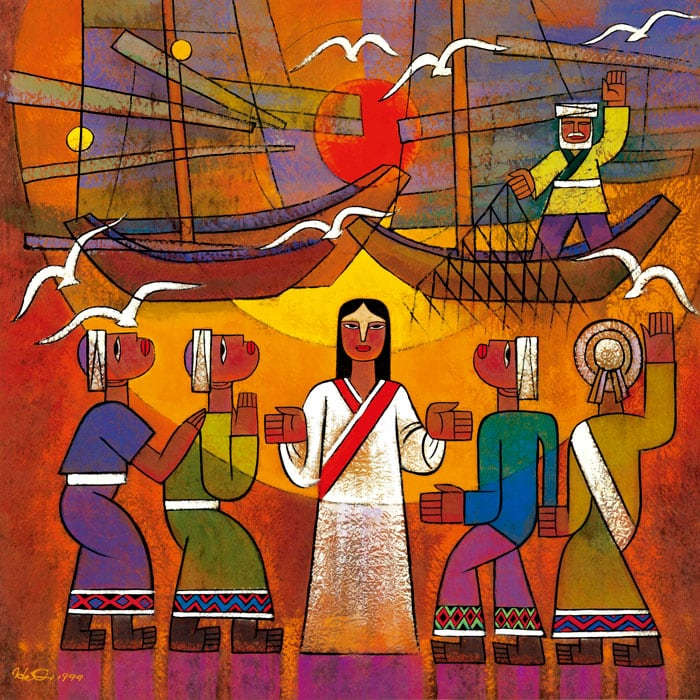
Jesus Calls His Disciples by He Qi

When Jesus heard that John had been put in prison, he withdrew to Galilee. Leaving Nazareth, he went and lived in Capernaum, which was by the lake in the area of Zebulun and Naphtali—to fulfill what was said through the prophet Isaiah:

“Land of Zebulun and land of Naphtali,
    the Way of the Sea, beyond the Jordan,
    Galilee of the Gentiles—
the people living in darkness
    have seen a great light;
on those living in the land of the shadow of death
    a light has dawned.”

From that time on Jesus began to preach, “Repent, for the kingdom of heaven has come near.”

As Jesus was walking beside the Sea of Galilee, he saw two brothers, Simon called Peter and his brother Andrew. They were casting a net into the lake, for they were fishermen. “Come, follow me,” Jesus said, “and I will send you out to fish for people.” At once they left their nets and followed him.

Going on from there, he saw two other brothers, James son of Zebedee and his brother John. They were in a boat with their father Zebedee, preparing their nets. Jesus called them, and immediately they left the boat and their father and followed him.

Jesus went throughout Galilee, teaching in their synagogues, proclaiming the good news of the kingdom, and healing every disease and sickness among the people. (New International Version)

What is “ministry”? 

For some, ministry is only about the souls of people; it is seeing as many people respond to the message of salvation in Christ as possible. 

For others, ministry is meeting the tangible needs of people because there is such a breadth and depth of human social and physical problems. 

And, for others, ministry is defined in terms of what takes place within the four walls of a church building, led by pastors and church leaders.

“Ministry takes place when divine resources meet human needs through loving channels to the glory of God.”

Warren Wiersbe

Problems, however, arise whenever we:

  • Focus on one dimension of ministry. Because, in reality, ministry is multidimensional.
  • Fulfill the outward, administrative demands of ministry – without going after the relational heart of what ministry entails. 
  • Forget about whole groups of people who are different than us. Ministry is for everyone, not some.

We need to look at the ministry of Jesus – what he did and why he did it. Christ’s purpose is to be our purpose: Minister to the total life of all people.

Jesus Preaching

Before there were newspapers, CNN, and 24 hour news cycles, ancient people heard what was happening from heralds or preachers who loudly announced in the streets the important news of the day.

Jesus had a ministry to both Jew and Gentile. Although his ministry was chiefly directed toward his fellow Jews, Christ went out of his way to engage Gentiles, as well, with a message of repentance.

Repentance is turning the whole person – body, soul, mind, will, and emotions – from sin and disobedience to God in obedience to the message of Christ. It involves humility, sorrow for sin, and a commitment to following Jesus.

To repent doesn’t mean to manage sin or clean up parts of my life; it’s a radical conversion from an old way of life to a new way of life. Repentance is not simply adding Jesus to our schedule but is a complete change of how we live.

Christianity is a life, not just an event. Following Jesus is a journey, a life-long process of inner transformation; a complete forsaking of anything that does not please God; and a desire to reorient my life around what’s important to God. 

To illustrate this in a contemporary context, I ask, “What does it mean to follow the Green Bay Packers football team?” A fan not only watches all the games from start to finish, but cheers loudly for the Packers; talks about the Packers with everyone, even strangers; and doesn’t cheer for the Chicago Bears! Fans are committed to their team.

The difference, however, between football and Christianity, is that followers of a team are fans, whereas followers of Jesus are not fans in the stands or watching the television. Instead, Christ followers are on the field of play as teammates with Jesus.

So, when it comes to repentance, we turn from being fans of Jesus to followers of Jesus, doing what he did and saying what he said. We are active participants in the kingdom of God – embracing and embodying a message of repentance to new life in Christ.

Jesus Calling

Jesus calling the first disciples illustrates the kingdom message: a radical break with the old life. Each disciple walked away from a good life and embraced of a new life following Jesus.

Some understanding of Jewish culture in the time of Jesus is helpful here. Central to the life of any Jew was the Torah, the Law. Around age 6, Jewish boys would begin to go to the synagogue for schooling in the Torah by the local rabbi. 

This first level of education was called Beth Sefer (“House of the Book”) and would last until about age 10. In those four years, the first five books of the Old Testament, the Pentateuch, were thoroughly memorized.

By age 10, some of the boys would distinguish themselves as good students and able to handle Torah. So, they would continue on in the second level of schooling called Beth Talmud (“House of Learning”). Those that did not continue with school would then learn the family trade and become an apprentice. Those that went on with school would then memorize the rest of the Old Testament.

At about age 14, only the best of the best were studying Torah. At the completion of their studies, they would apply to a well-known rabbi in order to become his disciple. The goal of this third level was to become just like the rabbi. This was called Beth Midrash (“House of Study”). The rabbi essentially interviews the teenager to find out if he has the stuff to become like the rabbi. 

If the rabbi believes the kid doesn’t have it in him, he tells him to go back to the family business. If, however, the rabbi grills the kid and finds he has what it takes, then he will say to him, “Come, follow me.” It was considered a great privilege and opportunity, and the teenager would leave everything to literally follow the rabbi everywhere he went.

Now, let’s return to Christ’s disciples. Jesus calls Andrew, Peter, James, and John. At the time, they were fishing because they were fishermen. That meant somewhere along the line they didn’t have what it took to further their education, or to follow a rabbi. 

Let’s, then, not miss the import and impact of Jesus saying to them, “Come, follow me!”  Jesus is expressing a belief that these men can become just like him. Well, of course you drop your nets and follow him! Jesus believes I can be like him! Jesus took a group of young men who couldn’t make the grade and used them to change human history. 

Jesus also says the same thing to you and me: I choose you. Come, follow me. 

Christ believed in us before we believed in him. Yes, Jesus believes you can do all the work of embodying the very words of God and becoming like him.

The attitude here is not, “Oh, geez, I have to go do ministry,” as if I were a teenager who was just asked to do the dishes. Rather, the attitude is of privilege and opportunity. If we fail to view ministry in this way, then we must come back to the message of repentance and have an attitude adjustment. People who follow Jesus do so because they get to, not because they have to.

Jesus Healing

            Envision yourself walking with Jesus and following him. You observe several things about his ministry of healing:

  • Jesus heals every problem. Christ has the power and authority to do so.
  • Jesus heals the whole person – not just the physical, or just the spiritual.
  • Jesus heals people whether they repent or not. Christ never made repentance a prerequisite for healing. He heals simply because he wants to.
  • Jesus heals to defeat the devil. Christ continually looks to reverse the hold that sin has on people.
  • Jesus chose to focus on healing the destitute, the poor, and the disadvantaged – rather than directing ministry to the higher classes and royalty to mediate his wishes to the people.

Who are the people – the least, the lonely, the lost – in need of healing in your family, neighborhood, and community?

  1. Those who are ill with various diseases
  2. Those suffering severe pain – of body, mind, emotion, and spirit
  3. The demon possessed or demonically influenced
  4. Prisoners and ex-convicts
  5. The working poor, and the elderly poor
  6. Those in the hospital with no one to visit them
  7. Those who grieve alone
  8. Those with addictions and behavioral issues
  9. Victims of verbal or physical abuse
  10. And many, many more….

Jesus had a ministry of both word and deed. To follow Christ is to become like him and pass on what we have learned to reliable people who will do the same.