Keep the Main Thing the Main Thing (Galatians 2:1-10)

Fourteen years after that first visit, Barnabas and I went up to Jerusalem and took Titus with us. I went to clarify with them what had been revealed to me. At that time I placed before them exactly what I was preaching to the non-Jews. I did this in private with the leaders, those held in esteem by the church, so that our concern would not become a controversial public issue, marred by ethnic tensions, exposing my years of work to denigration and endangering my present ministry.

Significantly, Titus, non-Jewish though he was, was not required to be circumcised. While we were in conference we were infiltrated by spies pretending to be Christians, who slipped in to find out just how free true Christians are. Their ulterior motive was to reduce us to their brand of servitude. We didn’t give them the time of day. We were determined to preserve the truth of the Message for you.

As for those who were considered important in the church, their reputation doesn’t concern me. God isn’t impressed with mere appearances, and neither am I. And of course these leaders were able to add nothing to the message I had been preaching. It was soon evident that God had entrusted me with the same message to the non-Jews as Peter had been preaching to the Jews.

Recognizing that my calling had been given by God, James, Peter, and John—the pillars of the church—shook hands with me and Barnabas, assigning us to a ministry to the non-Jews, while they continued to be responsible for reaching out to the Jews. The only additional thing they asked was that we remember the poor, and I was already eager to do that. (The Message)

The former devout Jew, Saul, had become the Christian apostle and missionary, Paul. His ministry was as radical and dramatic as his conversion to Christianity was.

The Struggle

Keep in mind that the earliest church was predominantly made up of Jewish Christians. They had to struggle with the relationship between their historic Judaism and their newfound Christianity. For many of them, Paul was doing the unthinkable; he not only purposely sought to reach Gentiles (non-Jewish people) with the message of Jesus Christ, but he also did not require them to be circumcised. For Paul, one did not have to first become Jewish before becoming Christian.

Paul doggedly sought to preserve the core essence and spirit of Christ’s message, that is, to proclaim the good news of forgiveness and new life through the person and work of Jesus – and not by means of retaining Jewish customs or laws, including circumcision.

The Main Thing

Christianity is more than set of beliefs and practices; it’s a way of life which can be summed up in three important words: faith, hope, and love. 

Both new believers in Jesus and veterans in the faith know from experience how difficult it can be to live the Christian life. One reason for this difficulty, even when we want to please the Lord, is due to the confusion that occurs between our inner feelings and our outer actions.

The Confusion

The confusion starts with the creation and fall of humanity. In the beginning, God created humans as persons with a divine/human relationship as central to daily life. (Genesis 1:26; 2:16-25) 

What’s more, God created people with the capacity to receive divine revelation through our ability to think and reason. (Ephesians 4:24; Colossians 3:10) 

Before disobedience entered the world, in the original state before humanity’s fall, all human functions were under complete control with an inner experience of unity and harmony with one another and God. (Genesis 1:31; 2:7, 16-25) 

It is imperative for us to recognize the distinction between our personal being and our personal functions. (Romans 1:21-32; 6:16-22; 1 Corinthians 9:27; Ephesians 4:21-32)

If we don’t grasp how cataclysmic the fall of humanity was, we are going to have big struggles with living the Christian life – illustrated in the way that Paul needed to fend off a bunch of professing Christians who still seemed spiritually stuck. 

The Disobedience

In Adam and Eve’s original disobedience to God, the authority for life was transferred from God to us so that our sinful bent is to call our own shots without God. The source of authority also got whacky, transferred from a holistic and synergistic approach of body, mind, emotions, and spirit to a one-dimensional approach of simply how we feel at any given moment.

If we fail to understand this dynamic, we will be continually frustrated with people because they do irrational things. For example, many church pastors are flabbergasted that parishioners do not simply take what they teach them and go and do it. Yet, if it were that simple, there would be no place for the Holy Spirit!

Unfortunately, there’s more. In humanity’s fall, we lost control of our capacity to function well. We are all now vulnerable to manipulation, too easily swayed by the surrounding culture, and, of course, Satan. (Ephesians 2:2-3; Galatians 5:16-21) 

As a result, our inner conscience has become confused. We are not always certain of right and wrong. We misunderstand what life is really supposed to be all about. 

We lose sight of the main thing. And, in that state, there’s no way we can keep the main thing the main thing.

Instead, we become obsessed with feeling comfortable and secure; so, we pursue false gods – leaving usdisappointed and with a lack of fulfillment in life.

The Good News

However, the good news is that through the redeeming work of Jesus Christ, new life emerges; the bondage of sin is broken in our lives, and we are legally reinstated in a relationship with God in which the Lord is central in our daily life and the final authority. 

In this new relationship we can again receive truth through the Holy Spirit and the Holy Scriptures. We regain control of our functions. 

Yet, unless we learn the Scriptures and growin a daily walk with Jesus, the practical experience of this relationship with all its freedom, joy, assurance,  power, and fruitfulness may be greatly limited. (Romans 7:14-25; 1 Corinthians 3:1-4)

Even though we have redemption and faith, it is still possible to regress and give in to our old ways of functioning. This is a big reason why Christians can experience conflict, doubt, fear, anxiety, frustration, disappointment, and confusion.

To live keeping the main thing the main thing means to grow in the experience and application Christ’s centrality and authority in our lives. 

The Awareness

We must, therefore, make daily decisions of faith, hope, and love based in who we are in Christ and recognize his authority in our lives. The following seven recognitions and awareness may be helpful for you in experiencing Christian freedom and unity:

  1. You are a person with the ability to function in faith, hope, and love as God’s beloved child in Christ (2 Corinthians 7:1; Romans 8:14-17)
  2. There is a difference between who you are and what you do (or don’t do).  Evil thoughts and emotions do not make you evil, anymore than fantasizing about being a unicorn makes you a unicorn.
  3. You can take charge of your actions and your life (Galatians 5:22-23)
  4. The key is the use of your will through living in harmony with revealed biblical truth. In other words, you really can make choices of faith, hope, and love, no matter the situation. (Romans 4:17-21; Psalm 56:3; Psalm 43:5-11)  
  5. Reject whatever is contrary to Scripture, reason, and conscience. Listen to your whole self. Unhealthy patterns of acting and speaking must be broken in Jesus’ name. (Ephesians 4:22; Colossians 3:5-9; Titus 2:11-12)
  6. Choose to obey the Holy Spirit and the Holy Scriptures. Learn to think and act on the basis of truth. (Acts 27:25)
  7. Practicing the truth results in freedom, a re-patterning of thinking and functions, as well as the fruit of the Spirit. (John 8:32; Titus 2:11-14; Philippians 2:12-16)

The church is intended to be a supportive community of fellow redeemed people who worship and love Jesus together. 

Without sharing our collective learning of the Scriptures and daily struggles of faith, hope, and love, believers will inevitably be spiritually immature over the long haul. Instead, talk about your shared experiences of worship, Scripture reading, and Christian living. 

In doing so, God is glorified, the church is strengthened, and the cranky circumcisers are seen as the legalistic lunkheads they really are.

The Effects of the Fall (Genesis 6:11-22)

The Flood of Noah by Majd Ramadan, 2014

In God’s sight, the earth had become corrupt and was filled with violence. God saw that the earth was corrupt because all creatures behaved corruptly on the earth.

God said to Noah, “The end has come for all creatures, since they have filled the earth with violence. I am now about to destroy them along with the earth, so make a wooden ark. Make the ark with nesting places and cover it inside and out with tar. This is how you should make it: four hundred fifty feet long, seventy-five feet wide, and forty-five feet high. Make a roof for the ark and complete it one foot from the top. Put a door in its side. In the hold below, make the second and third decks.

“I am now bringing the floodwaters over the earth to destroy everything under the sky that breathes. Everything on earth is about to take its last breath. But I will set up my covenant with you. You will go into the ark together with your sons, your wife, and your sons’ wives. From all living things—from all creatures—you are to bring a pair, male and female, into the ark with you to keep them alive. From each kind of bird, from each kind of livestock, and from each kind of everything that crawls on the ground—a pair from each will go in with you to stay alive. Take some from every kind of food and stow it as food for you and for the animals.”

Noah did everything exactly as God commanded him. (Common English Bible)

The entire world is profoundly broken. 

Everywhere, people are messed-up. In one breath they can tell you they’re sorry for another’s abuse or violence against you, then turn right around and say some irrational nonsense and terribly insensitive things to you.

It doesn’t matter where you go – whether school, work, home and even church, there is institutional brokenness. Individual persons, and the human structures and systems they put in place, all contain elements of bondage instead of freedom. It doesn’t take a religious person to observe that there’s such a thing as sin.

Holy Scripture’s description of this sad reality goes all the way back to a story about the fall of humanity into sin and rebellion. Satan, the devil, led the original persons, Adam and Eve, into disobedience of God. Satan tempted Eve to doubt whether God really had her best interests at mind; to question the truthfulness of God’s Word; and, to wonder about the wisdom of listening to God (Genesis 3:1-5). Adam just flat out chose to disobey God, and, so, the entire world changed (Genesis 3:16-17). 

Immediately, everything was different in the world and with people. The choice to disobey God brought feelings of fear and shame; a loss of fellowship with God; hiding from God; a bent to pervert the truth; the propensity for the genders to try and dominate each other; expulsion from the garden; and physical death (Genesis 3:7-24). 

And the unholy tools people used against one another were violent and corrupt. People thought nothing of oppressing each other, abusing one another, attacking others – both verbally and physically. Rape, assault, theft, and murder became daily experiences. That’s some downright icky stuff. 

No wonder the world is messed up.

God saw that human evil was out of control. People thought evil, imagined evil—evil, evil, evil from morning to night. God was sorry that he had made the human race in the first place; it broke his heart. God said, “I’ll get rid of my ruined creation, make a clean sweep: people, animals, snakes and bugs, birds—the works. I’m sorry I made them.” (Genesis 6:5-7, MSG)

Noah was the only guy on the face of the earth for whom the Lord saw any good. And it was enough good worth saving. Yet, people are still in the nasty habit of turning on each other, like a bunch of sharks with blood in the water.

Unfortunately, the fall of humanity still affects us all. It has brought not only physical death, but spiritual death. That means we are alienated from God, in rebellion, and enslaved to our own passions and desires (Isaiah 1:2-6; Romans 2:14-15; Ephesians 2:1-3). 

We are also alienated from one another by having continual bents toward discord, suspicion, and jealousy instead of love and trust (Romans 1:29-31; James 3:14-16). 

We are even alienated and totally out of touch with ourselves by either loving ourselves as gods or hating ourselves with an inordinate emotional masochism (Philippians 2:21; 2 Timothy 3:2-4). In short, we are selfish people who experience separation from God, others, and self.

If this is the true reality of humanity, then it is awfully depressing, discouraging, and damaging. And we know it’s true because we’ve all been both victims and victimizers. So, who then, will rescue us from this horrific death? 

Thanks be to God who has given us the victory through our Lord Jesus Christ (Romans 7:24-25; 1 Corinthians 15:57). 

The good news is that, through the death and resurrection of Jesus, the curse has been reversed. Christ has restored us to our original place of fellowship with God. He is the way, the truth, and the life. In Christ, there is hope for humanity (John 14:6). 

To live in freedom, therefore, involves knowledge, honesty, and sincere decisions of faith and love whereby truth is applied to life.

Just as the world needed a thorough purging of evil through a cleansing worldwide flood, so we need a bath of grace, to be completely awash with the love of God in Christ, to have all the crud of evil scrubbed from our soul. And this is precisely what Christian baptism symbolizes.

Jesus offered himself for us so that we might live without violence and no longer be separated from God, others, and self. He has brought us reconciliation. In him we have been blessed with every spiritual blessing (2 Corinthians 5:16-19; Ephesians 1:3; 2 Peter 1:3).

In Christianity, the purpose of ministry is to come alongside people trapped in their awful cycles of brokenness and communicate good news of grace and forgiveness with both words and actions.

Although the world is terribly askew, God has demonstrated his love for us in that, while we were still violent and corrupt sinners, Christ died for us (Romans 5:8). 

We needed a Savior. God provided One. 

Are you in touch with the ways you are separated from God, others, and self? 

Are you aware of the ways in which your church or faith community has an unhealthy separation from the world? 

In what ways can you apply the love of God to broken people and systems in your community? What will it take to reach them?

Sin, guilt, shame, rebellion, disobedience, and violence need not define us. We can do better.

Almighty God, we have sinned against you, through our own fault, in thought, and word, and deed, and in what we have left undone. For the sake of your Son, our Lord Jesus Christ, forgive us all our offenses; and grant that we may serve you in newness of life, to the glory of your Name. Amen.

Nehemiah 9:26-31 – Judgment and Grace

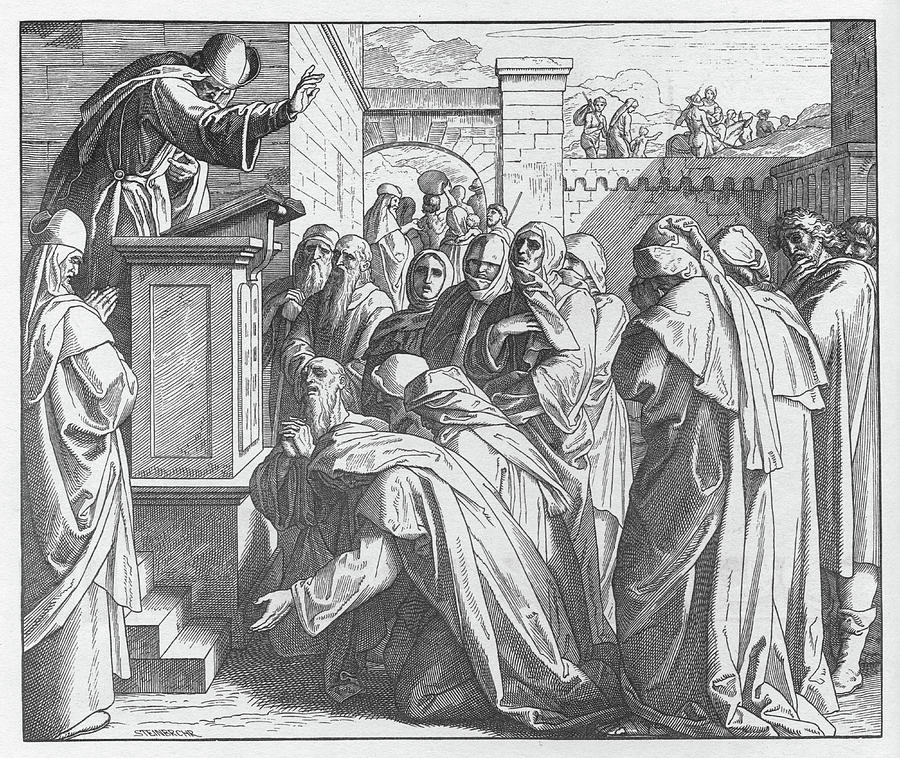
“Repentance of the People” by German painter Julius Schnoor von Carolsfeld (1794-1872)

But despite all this [God’s blessings] they were disobedient and rebelled against you. They turned their backs on your Law, they killed your prophets who warned them to return to you, and they committed terrible blasphemies. So, you handed them over to their enemies, who made them suffer. But in their time of trouble, they cried to you, and you heard them from heaven. In your great mercy, you sent them liberators who rescued them from their enemies.

But as soon as they were at peace, your people again committed evil in your sight, and once more you let their enemies conquer them. Yet whenever your people turned and cried to you again for help, you listened once more from heaven. In your wonderful mercy, you rescued them many times!

You warned them to return to your Law, but they became proud and obstinate and disobeyed your commands. They did not follow your regulations, by which people will find life if only they obey. They stubbornly turned their backs on you and refused to listen. In your love, you were patient with them for many years. You sent your Spirit, who warned them through the prophets. But still, they wouldn’t listen! So once again you allowed the peoples of the land to conquer them. But in your great mercy, you did not destroy them completely or abandon them forever. What a gracious and merciful God you are! (New Living Translation)

Much of the Old Testament is a rhythmic pattern of God’s judgment and grace. The storyline often goes something like this: 

God makes promises and gives commands. 

People get stubborn, refuse to listen, and disobey. 

God responds with judgment. 

People cry out in their distress.

God gives grace and fulfills divine promises. 

People enjoy, then get stubborn again…. 

The promise of God always involves judgment and grace. Proclaiming only a message of judgment without grace brings despair, death, and hell; there is no hope. Speaking only of grace apart from judgment is oxymoronic – it doesn’t exist because there is no need for grace if there is no judgment; grace is an undeserved mercy given freely by God in the face of our stubborn obstinate selves.

Nehemiah chapter nine is a beautiful prayer of confession. Having heard the Word of God proclaimed, the people released their obstinacy; they realized exile occurred because of their own stubborn refusal to listen to God. So, they repented. 

“Fallen man is not simply an imperfect creature who needs improvement: he is a rebel who must lay down his arms.”

C.S. Lewis

The ancient Jewish people acknowledged their checkered past of ignoring God’s prophets, and they bellied-up and took ownership of their past choices. And God was faithful. Even though the city of Jerusalem had been overtaken and the people sent into exile, God brought them back and the broken wall was rebuilt.

It’s never too late to turn from a past filled with poor decisions, broken relationships, and spiritual disobedience. The time of confession is available, and the time is now. God’s grace always overwhelms our dubious past. 

The appropriate response to today’s Old Testament lesson is to spend some time in confession to God. This chapter, along with Nehemiah chapter one, are good places to begin with understanding just what to say to God. 

For the Christian, confession ought always to conclude with accepting the grace available to us in Christ. 

Today is a new day and a new Christian Year. Let it be a life with the love of Jesus implanted in your heart. As we enter the Advent season, allow that love of Christ to gestate within your soul. Anticipate the birth. Look forward to the Nativity. Long for Christmas and the inbreaking of God to this earth.

Holy Lord, in this time of Advent, we confess we often are distracted by the season’s busyness, by the stress of commitment, and even by putting our own traditions ahead of the true meaning of Christmas. We confess we also often prefer being sentimental to being sacrificial.

Forgive us for all the times we have missed seeing You in our midst, for all the times we have doubted Your presence, and for all the times we have failed to hold the holidays as holy days. Pour peace into our lives and let us be bearers of Your peace to others. Remind us that this is a season of waiting and preparation for the greatest Gift of all. In the holy Name of our Savior, Jesus, we pray. Amen.

Daniel 9:15-25 – A Prayer of Confession, Part 2

“But now, my Lord, our God—you who brought your people out of Egypt with a strong hand, making a name for yourself even to this day: We have sinned and done the wrong thing.” My Lord, please! In line with your many righteous acts, please turn your raging anger from Jerusalem, which is your city, your own holy mountain. Because of our sins and the wrongdoing of our parents, both Jerusalem and your people have become a disgrace to all our neighbors.

“But now, our God, listen to your servant’s prayer and pleas for help. Shine your face on your ruined sanctuary, for your own sake, my Lord. Open your ears, my God, and listen! Open your eyes and look at our devastation. Look at the city called by your name! We pray our prayers for help to you, not because of any righteous acts of ours but because of your great compassion. My Lord, listen! My Lord, forgive! My Lord pay attention and act! Do not delay! My God do all this for your own sake because your city and your people are called by your name.

While I was still speaking, praying, and confessing my sin and the sins of my people Israel—while I was still praying my prayer for help to the Lord my God about my God’s holy mountain— while I was still speaking this prayer, the man Gabriel approached me at the time of the evening offering. This was the same Gabriel I had seen in my earlier vision. He was weary with exhaustion.

He explained as he spoke with me: “Daniel, here is why I have come: to give you insight and understanding. When you began making your requests, a word went out, and I have come to tell it to you because you are greatly treasured. So now understand this word and grasp the meaning of this vision! Seventy weeks are appointed for your people and for your holy city to complete the rebellion, to end sins, to cover over wrongdoing, to bring eternal righteousness, to seal up prophetic vision, and to anoint the most holy place.

“So, you must know and gain wisdom about this: There will be seven weeks from the moment the word went out to restore and rebuild Jerusalem until a leader is anointed. (CEB)

We learn to pray through praying the prayers of the Bible. One of the great wrestlers of prayer in Holy Scripture is Daniel. His prayer when disaster overtook the people of Jerusalem is apropos for us in our national disasters of egregious sin. Today I take the second part of Daniel’s prayer and use it as my own prayer (this is a continuation from yesterday’s prayer of confession).

Prayer is an act of subversion. It challenges the status quo. It looks evil in the face and gives it a name. Real change begins with the step of real prayer, and real prayer is modeled after the great prayers of Scripture. The season of Lent, with its focus on repentance and spiritual discipline, is the appropriate time to offer prayers of confession and express fealty to the God who deserves it.

Our Lord God, with your own mighty arm you brought our forefathers from religious harassment to a place of religious freedom. You graced us with liberation to become what we could not in other places. Through this you made yourself famous to this very day, but we have sinned terribly.

We turned around and did to others what they did to us.

We have been unequal in our treatment of all people. In our pride, we think we are better than others, even though we have been called to treat others better than ourselves.

We keep killing one another with words and then with guns, all the while justifying our behavior through inaction and spiritual gerrymandering. Meanwhile, our children and our neighbors keep dying. 

In the past you treated us with such undeserved kindness. We now beg you to stop being so terribly angry and hear our plea for your grace to awash us again. Although we have suffered public disgrace from our own stupidity, we throw ourselves upon your great mercy.

I am your servant, Lord God, and I beg you to answer my prayers and bring honor to yourself by having pity on our grieving families as well as the people who have forgotten you. Please show mercy to us, not because we deserve it, but because of your great kindness. Forgive us! Pay attention to us, even though we failed to give you the time of day. Hurry and do something, not only for us, but to bring honor to yourself through Jesus Christ our Savior in the might of your blessed Holy Spirit. Amen.