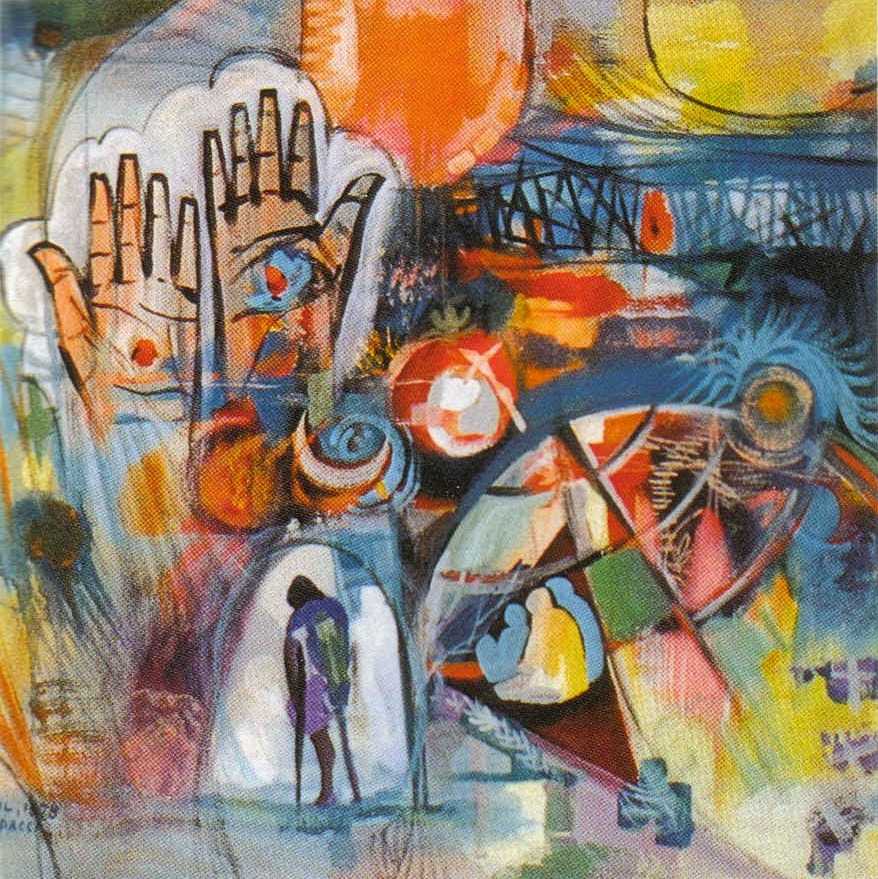
Psalm 42 – Sadness and Hope

As a deer gets thirsty 
    for streams of water, 
    I truly am thirsty 
    for you, my God. 
In my heart, I am thirsty 
for you, the living God. 
    When will I see your face? 
Day and night my tears 
    are my only food, 
    as everyone keeps asking, 
    “Where is your God?” 

Sorrow floods my heart, 
    when I remember 
leading the worshipers 
    to your house.  
    I can still hear them shout 
    their joyful praises. 
Why am I discouraged? 
Why am I restless? 
    I trust you! 
And I will praise you again 
    because you help me, 
    and you are my God. 

I am deeply discouraged 
    as I think about you 
from where the Jordan begins 
at Mount Hermon 
    and from Mount Mizar.  
Your vicious waves 
    have swept over me 
    like an angry ocean 
    or a roaring waterfall. 

Every day, you are kind, 
    and at night 
you give me a song 
    as my prayer to you, 
    the living Lord God. 

You are my mighty rock.  
    Why have you forgotten me? 
    Why must enemies mistreat me 
    and make me sad? 
Even my bones are in pain, 
    while all day long 
my enemies sneer and ask, 
    “Where is your God?” 

Why am I discouraged? 
Why am I restless? 
    I trust you! 
And I will praise you again 
    because you help me, 
    and you are my God. (CEV) 

Sadness. Every human on planet earth knows the feeling. Since we are emotional creatures, profound sadness even to the point of depression and/or despondency will happen. Yet, despite the universal nature of discouragement and tears, many Christians buck the sadness.

Far too many believers focus so exclusively on victory in Jesus through his resurrection, ascension, and glorification that they use religion as their denial when unwanted emotions like sadness come banging at the doorstep of their soul. 

So, I most emphatically say: Depression is not sin. To be discouraged is not the Enemy. Experiencing sadness is neither wrong nor selfish. Quite the opposite, in fact. It is necessary to sit with our emotions and feel the breadth and depth of them. Both our spiritual and emotional health come through an awareness and robust engagement with our feelings. To refuse to feel is to put the stiff arm to God.  

The psalmist does anything but deny his feelings. He brings them before the Lord and spreads them out before the Divine. Why am I discouraged? Why am I restless? Why the sadness? Could it be that God has forgotten me? Where is the Lord? Is God angry with me? Are my troubles the result of divine wrath? 

To blandly say we have never uttered or thought such questions is a telltale sign of denial. The bottom line for many folks is that they do not want to feel because such emotions complicate their lives. Besides, discouragement and sadness hurt. “Why feel,” we reason, “when it only brings pain?” 

Ah, yes, the avoidance of pain. And there is no pain quite like emotional and spiritual pain. Much like an open wound which needs a liberal application of painful peroxide, so our spiritual wounds must sting with the salve of emotional feeling. Healing is neither cheap, easy, nor painless. It typically hurts like hell. 

The psalmist’s own pain revolved around feelings of alienation from God, being cut off from fellow worshipers, and harassed by others around him. Understandably, he experienced despondency and loneliness. The psalmist wondered if anyone, including God, even cared what he was going through. In other words, he is desperate for God to show up. 

I am going to make a simple observation about this psalm: The psalmist did not get any answers to the several questions he posed. He even repeated them, to no avail. The only form of comfort the psalmist received was to remember what God had done in the past. Somehow, someway, this will help with the difficulties of the present. 

There are times in life when we must recall what we know about God, ourselves, and others. If the Lord has delivered in the past, God can do it again. If others helped before, perhaps they will be present in the here and now. And just maybe, even likely, you and I will discover a resilient spirit within. We already possess everything we need to not only survive but to grow and thrive in life. 

Hope arises from holding the big picture of the past, present, and future together at the same time. When present circumstances are difficult, and it appears we are about to swallowed up into the now, we must hold the past and future along with it, in careful tension. Then, we shall find the ennoblement to keep going. 

Trust in the future, a confident expectation of hope, is born from the trustworthiness of the past. A prayerful song in our heart will carry us through till our hope is realized. 

Psalm 28 – To Be, or Not to Be

David pelted with stones
David being pelted with stones, by unknown Slovakian artist, 1937

I cry out to you, Lord.
You are my rock; don’t refuse to hear me.
If you won’t talk to me,
I’ll be just like those going down to the pit.
Listen to my request for mercy when I cry out to you,
when I lift up my hands to your holy inner sanctuary.
Don’t drag me off with the wicked and those who do evil;
the type who talk nice to their friends
while evil thoughts are in their hearts!
Pay them back for what they’ve done!
Pay them back for their evil deeds!
Pay them back for their handiwork!
Give back to them exactly what they deserve!
Because they have no regard for what the Lord has done,
no regard for his handiwork,
God will tear them down and never rebuild!

Bless the Lord
because he has listened to my request for mercy!
The Lord is my strength and my shield.
My heart trusts him.
I was helped, my heart rejoiced,
and I thank him with my song.
The Lord is his people’s strength;
he is a fortress of protection for his anointed one.
Save your people, God!
Bless your possession!
Shepherd them and carry them for all time! (CEB)

The biblical character David, in frustration and agony, cried out for help, for God to hear his prayers. And, when his prayer was heard, David gave exuberant praise to the Lord for listening to him. We are not told specifically of how that prayer was answered and what happened between the request and the response. It seems the juicy details are left out on purpose, so that maybe we would not get lost in the retribution but stick with the fact that there was a desperate need and the Lord stepped in and did something about it.

As I pondered this psalm and its lack of life-detail, I wondered about David’s situation: Could it be that David gave God praise just for being heard by him?  Was David cured in some way, or was he healed from the need to be healed?  Was there even any actual deliverance that occurred?  Did David come to praise God despite a lack of deliverance?  Was David’s joy in his relationship with God conditional, or unconditional?

Hamlet
Hamlet, played by actor Matt Amendt in the Pittsburgh Public Theater, 2018

William Shakespeare’s Hamlet (c.1601 C.E.) put the question this way: “To be, or not to be, that is the question.” Hamlet’s soliloquy went on to say:

“Whether ’tis nobler in the mind to suffer
The slings and arrows of outrageous fortune,
Or to take arms against a sea of troubles,
And by opposing end them? To die: to sleep;
No more; and by a sleep to say we end
The heartache and the thousand natural shocks
That flesh is heir to, ’tis a consummation
Devoutly to be wish’d. To die, to sleep;
To sleep: perchance, to dream: ay, there’s the rub;
For in that sleep of death what dreams may come
When we have shuffled off this mortal coil,
Must give us pause: there’s the respect
That makes calamity of so long life;
For who would bear the whips and scorns of time,
The oppressor’s wrong, the proud man’s contumely,
The pangs of despised love, the law’s delay,
The insolence of office and the spurns
That patient merit of the unworthy takes,
When he himself might his quietus make
With a bare bodkin (knitting needle)?”

Hamlet, much like David of old, was miserable and burdened with a profound lack of power to change his circumstances. So, he reflects on life and death in a morbid and melancholy way. It is not that Hamlet was contemplating suicide as much as he meditated on what life truly is and finding some meaning within it. Unlike David, Hamlet cannot find the courage to deal with his frustration and feels stymied with fear of the unknown.

If we are blatantly honest with ourselves, we must admit that far too often we have a particular outcome in mind for God to do.  Our hopes and expectations are tethered to God doing something extremely specific so that, if it does not come to pass (or does not come quickly!) we become discouraged and disillusioned. Like Hamlet, we become lost in the shadows of our thinking and ponder some sort of escape.

So, here is another set of questions I am asking myself: If my adverse circumstances do not change, can I praise God anyway?  Can I, like David, take joy in simply being heard?  Can I find gratitude in all situations?  Do I only express thanks and praise to God when things are going my way?  Am I open to whatever God wants to do in my life, even if it is not what I would choose?  Do I feel that I am above having to put up with the wickedness of this world?  Am I expecting heaven on earth, or am I willing to suffer as Jesus did?

I honestly believe the answers to those questions will determine the trajectory of our Christian experience. For the identity and meaning of all persons is found in the divine.

I praise you, O God, in the good and the bad, the easy and the difficult, the failures and the victories.  You are Lord over all things.  You are my strength and shield in every circumstance.  When I am weak, I am strong. I can do all things through Christ who strengthens me.  Amen.

Romans 8:22-25

            Advent is a season for patience, waiting, and anticipation.  As Christians, we have the confident hope that Jesus is coming.  His arrival is certain.  It will happen.  When my wife was pregnant with our firstborn daughter, the nine months seemed to go agonizingly slow.  And the closer the time came for her to be born it seemed she would never come!  But, of course, she did.  My first gander at a live childbirth was not a pretty sight; there was nothing at all romantic or glamorous about it.  It was not easy seeing my wife in such unique pain.  Yet, after it was all over, it was as if she had forgotten the difficulty of pregnancy and birth because her joy was so immense.
 
            In this world which is so full of physical, emotional, and even spiritual pain, we groan inwardly longing for the day when the promise will be realized and Jesus arrives.  Christians have a settled expectation that Jesus is coming.  If we keep our focus on this future reality, it helps to give shape and purpose to what we do now.  If we hope for what we do not yet see, we wait for it with patience.
 
            But sometimes we lose sight of our hope.  How do we hold on and not give in to discouragement?  How might we remain vigilant and steady, especially when times are difficult?  One way we persist is by not going it alone.  Christians all share the same common experience of needing to embrace hope.  We are to remind one another of our forgiveness in Christ, our shared love of Jesus, and our commitment to remain true to the Lord’s way of love.  Perhaps today you need to be vulnerable enough to openly share with a trusted believer how much you need your hope reawakened; or, maybe you have noticed someone who is losing hope and needs an intervention of encouragement.  Let us keep reminding each other that better days are coming….


            God Almighty, although this is a season of hope, many suffer in silence with hurting hearts.  Open my eyes to those around me who need their hope reawakened today, and use me to remind them of your abiding grace in Jesus Christ, our coming Savior.  Amen.

1 Thessalonians 5:12-18

            The Apostle Paul came to the conclusion of his letter to a discouraged congregation at Thessalonica and, like a parent barking final instructions to the kids as they go out the door, gave them a series of short exhortations so they would be careful to keep their minds on living their Christian lives with focus and intention.
 
            Paul succinctly made it quite clear what the will of God is for the church.  Rather than sitting idle and waiting for Christ to return, believers are to be busy doing good to one another, encouraging each other, and listening well to their spiritual leaders.  As for our relationship with God we are to “Rejoice always, pray without ceasing, give thanks in all circumstances for this is the will of God in Christ Jesus for you.”  If we were to simply focus on those three short commands of Scripture it would completely alter the spiritual landscape of our lives and our churches.
 
            Historically, believers throughout the ages have obeyed these commands by keeping the Daily Office of pausing at set times during the day to offer thanksgiving and prayer.  Falling to our knees when arising from bed; break times at work; a few minutes at lunch; family devotions at supper; and, prayer with a spouse before retiring at night are all potential opportunities to build a rich inner life of spirituality to our souls and fortify us to have a joyous relationship with Jesus that lasts a lifetime.  If actually scheduling these times in our calendars and planners will help us to remember and do it, then let us be about the business of having appointments with God without procrastination.
            Lord God Almighty, thank you for the privilege of prayer and the perspective of giving thanks in each situation I am faced with every day.  Help me to effectively and joyously connect with you today so that your will is done in my life, just as your will is always done in heaven.  Through Jesus my Lord, Amen.