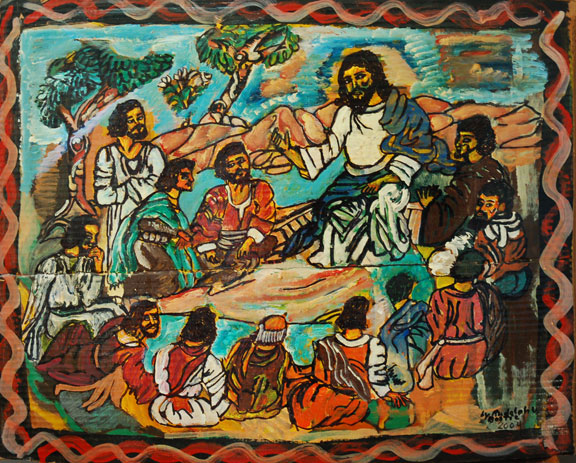
Jesus the Mentor (Mark 3:13-19)

Jesus and the Disciples, by Rudolph Bostic

Jesus went up on a mountainside and called to him those he wanted, and they came to him. He appointed twelve that they might be with him and that he might send them out to preachand to have authority to drive out demons. These are the twelve he appointed: Simon (to whom he gave the name Peter), James son of Zebedee and his brother John (to them he gave the name Boanerges, which means “sons of thunder”), Andrew, Philip, Bartholomew, Matthew, Thomas, James son of Alphaeus, Thaddaeus, Simon the Zealotand Judas Iscariot, who betrayed him. (New International Version)

For me, every place in Holy Scripture is significant, even the seemingly mundane portions of it. Today’s verses might appear rather insignificant. However, there is some important meaning to recording who Christ called as his disciples and why he did it.

Jesus appointed twelve Jewish men to be his close disciples, his apostles. In choosing them, let’s not read into it something that isn’t there. This choosing, in no way, is meant to convey that church leadership boards are always supposed to have twelve men. It seems to me, that if such churches believe this, they ought to go all the way by insisting that they ought also to be Jewish Christians – no Gentiles on the election ballot at the annual meeting!

Excluding women, maintaining a particular number of people to a group, or considering only one ethnicity to leadership is nowhere to be interpreted in this text of Scripture. I can imagine Jesus sitting at the right hand of the Father raising a Spock-like eyebrow to such hermeneutical gymnastics and stating the lone word, “fascinating!”

A disciple is a follower. An apostle is one who is sent out with a specific purpose. Jesus called these particular people in order to send them out with a mission. In other words, Christ’s disciples are really missionaries. And these apostles, these missionaries, are appointed in order that they might be with Jesus, follow him everywhere, learn from him, and then have the received authority to go out and accomplish the mission given them to do.

An apostle can only properly carry out the instructions of the Teacher by first being a disciple who spends copious amounts of time in that Teacher’s presence. Indeed, if we are looking for some contemporary application in these more mundane texts of Scripture, let us find here an insight into our own Christian formation.
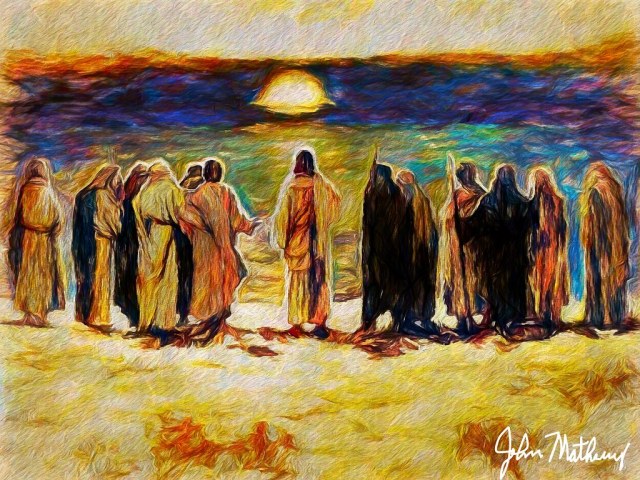
Jesus and the Disciples, by John Mathews

Christian ministry is rightly patterned after the Teacher we follow, Jesus our Lord. Christ himself demonstrated for us the way of mentoring or discipling, through his own words and actions. He called particular individuals, taught them, and equipped them for spiritual warfare in this world by granting them authority to do the work.

If we need a pattern, there it is. It’s a model of mentoring others in the ways of Christian mission and ministry. The idea is that we call, teach, equip, and authorize others in the words and ways of Jesus. I really don’t much care what you call it: Christian discipling, relational mentoring, small group teaching, spiritually forming, or any other word or phrase.

The important thing is to actually understand and do this very Christ-like work of developing mature followers of Jesus who can do the important work of spiritual warfare and ministry, then in turn, develop others. We are to pass on a body of faith and doctrine, of mission and ministry, to a group of people who will do the work. And they then do the same for others.

I rather like the word “mentoring” because for most people it evokes the idea of putting time and effort into some relationships for a specific purpose. And when we look at Christianity as a great mentoring project, perhaps we will see why church is becoming a byword in many parts of the Western world. This also ought to perhaps clue us into how we might move forward as Christians.

I am suggesting that, generally speaking, we have neglected this pattern of Jesus in calling, teaching, equipping, and authorizing. It is one large reason why there is such a decline in church attendance (and participation) in the West. And until we collectively take up this mantle of mentoring ministry, we shall continue to lessen, because we are irrelevant to people’s daily lives – both inside and outside the church.

As a first course of action, I invite you – no matter your age or stage in life – to make it a priority to simply “hang out” with individuals and groups of people. Maybe that sounds like an extrovertish sort of thing to do. However, this invitation is coming from me, an introvert. I didn’t say you have to be the life of the party, or engage in a lot of talking. But I am saying that mature followers of Jesus ought to strongly consider some intentional relationships with people other than family and a few friends.

Hang out around any given church, on any given Sunday, after any given worship service, and you are likely to see small groups of people talking with each other. Those groups typically center around friends according to age. What is often lacking are intentional interactions between the generations.  

Ethiopian Orthodox Church depiction of Christ and his disciples

The younger generations (particularly persons aged 18-29) often need and want to have relationships with more experienced (older!) believers in the faith. Younger adults, however, tend to lack the confidence to go after older adults in order to be mentored or influenced by them. I believe the onus is on the older generations to go after the younger.  

Maybe I’m just old, but it seems like younger generations have an incredible array of relationships, differing levels of friendship, and a complexity to their interactions that I didn’t have “back in my day.” What’s different, it seems, is that their relationships are more gray, and less black and white. And they appear to do a solid amount of hanging out.

Hanging out is typically sitting around with a group of people, eating and drinking, watching movies, studying (or doing bible study) or any other activity. Its doing just about anything, but doing it together with others. And this is the perfect environment for initially establishing how to begin living into the words and ways of Jesus to mentor others.

One of the things we older folks can do is to really understand the reality of younger generations’ relational interactions. For example, when I lived in a university town I used to often just “hang out” with college students, with no agenda other than just being with them. The local Perkins restaurant was at its busiest at midnight, filled with college students hanging out.

There are places in every town and city where young adults go, especially the bar scene. Bars aren’t just places to drink, but are locations of conviviality where persons have the chance to be around one another in a kind of secular church where fellowship happens, looking for a chance to relate meaningfully with others.

All people desire intimacy and want to know that someone else cares about them. This is a very real and felt need. How that need is going to be met can be either legitimate or illegitimate. And we can help with that.

One of the best things we can do for others is to communicate to them that we “have their back,” that we care, love, and genuinely like them.

No one can sniff out a disingenuous attitude quite like a young adult. So, our interactions have to be an authentic desire to be around them. Also, this does not mean we have to pretend to be younger than we are. Instead, one of the greatest needs a young person has is to be in a mentoring relationship with someone older and wiser who can help them navigate life and bring some sort of definition to relationships that they may lack.

The older generations could learn to “hang out” with younger generations and find individuals for whom they can build a solid one on one or group relationship with. If they can have such relationships now, it will serve them for a lifetime.

It seems to me that, as I look at the biblical text, being a mentor, and walking alongside another with love, grace, and wisdom, is built into Christianity by Jesus himself. So, let’s consider how we might best go about this important work.

May your love overflow more and more with knowledge and full insight to help you to determine what really matters, so that in the day of Christ you may be pure and blameless, having produced the harvest of righteousness that comes through Jesus Christ for the glory and praise of God. (Philippians 3:9-11, NRSV)


Luke 9:51-62 – The Cost of Following Jesus

As the time approached for him to be taken up to heaven, Jesus resolutely set out for Jerusalem. And he sent messengers on ahead, who went into a Samaritan village to get things ready for him; but the people there did not welcome him, because he was heading for Jerusalem. When the disciples James and John saw this, they asked, “Lord, do you want us to call fire down from heaven to destroy them?” But Jesus turned and rebuked them. Then he and his disciples went to another village.

As they were walking along the road, a man said to him, “I will follow you wherever you go.”

Jesus replied, “Foxes have dens and birds have nests, but the Son of Man has no place to lay his head.”

He said to another man, “Follow me.”

But he replied, “Lord, first let me go and bury my father.”

Jesus said to him, “Let the dead bury their own dead, but you go and proclaim the kingdom of God.”

Still another said, “I will follow you, Lord; but first let me go back and say goodbye to my family.”

Jesus replied, “No one who puts a hand to the plow and looks back is fit for service in the kingdom of God.” (New International Version)

“The will of God, to which the law gives expression, is that men and women should defeat their enemies by loving them.”

Dietrich Bonhoeffer, The Cost of Discipleship

In his earthly ministry, Jesus made it clear to the large crowds of people following him that the life of a disciple is of utmost importance. People are to discover what following Jesus truly entails. They are to count the cost of Christian discipleship.

Following Jesus in Christian discipleship requires radical obedience. 

Love of family must not stand in the way. Jesus insisted our primary loyalty must lie with following him over every earthly relationship. To follow Jesus means that we will not use family responsibilities to avoid obeying Christ or use other loyalties and commitments to work and/or school as a reason to lay down our cross. 

This talk of Christian discipleship might smack of being like a cult. I don’t believe it is. Whereas a cult typically requires a radical withdrawal from the world so that the leader has complete control over the group, Jesus requires a radical engagement with the world.

Following Jesus is meant to impact the world with grace and love. Jesus went out of his way to not be like other leaders who use power, control, and gaslighting as the means of ruling and leading. Instead, Jesus shares his power with others. Christians are to bless the world and be involved in it.

The call of Jesus to Christian discipleship not only takes precedence, but it also re-defines the other loyalties we have. 

This call involves some level of detachment in order to pursue following Jesus. All of life is to be infused with being a disciple of Jesus. If we insist on making other commitments and loyalties as high a priority as following Jesus, we will find ourselves torn between two masters. 

Several years ago, I took a trip with some other church leaders into the Canadian wilderness. We were so far out in the boonies that we needed special first aid training because, if someone got hurt, it would be hours before help could come. 

We canoed the lakes and carried our backpacks and canoes between lakes for an entire week. Whatever we took with us, we had to carry. Some people thought they needed all kinds of clothes and other accessories. Not far into the week, they quickly began to leave things along the trail and learned, over time, that what they thought was important in their life, wasn’t really important to what they were doing.

It’s good to get back to basics and do what is essential. And what is of most importance is following Jesus. 

An un-salty disciple is worthless. Making a profession of Christ, without counting the cost, is foolish. Christian discipleship was never designed to be easy; it was intended to be a public display that Jesus is Savior and Lord in every area of life. That means we will struggle with questions, such as: 

  • How do I be a faithful follower of Jesus in my family? 
  • How do I be a disciple, and do the work of discipleship at my job? 
  • How do I practice following Jesus in my neighborhood, and everywhere I go?

If we do not plan to follow Jesus at home, at work, in the neighborhood, and in the world, we won’t, because all kinds of competing loyalties will take over.

Christians need to be very intentional about being disciples who loyally follow the words and ways of Jesus.The going will get difficult. And that’s okay.

“Jesus has many who love his kingdom in heaven, but few who bear his cross. He has many who desire comfort, but few who desire suffering. He finds many to share his feast, but few his fasting. All desire to rejoice with him, but few are willing to suffer for his sake. Many follow Jesus to the breaking of bread, but few to the drinking of the cup of his passion. Many admire his miracles, but few follow him in the humiliation of the cross.”

Thomas à Kempis, The Imitation of Christ

“Anyone who does not carry his cross and follow me cannot be my disciple.”

Jesus (Luke 14:27)

Joy comes not by pursuing happiness; it comes through discovering that to live is to die to self. Until we come to grips with that reality, we will likely be frustrated with our circumstances and other people.  

So, rather than trying to fit Jesus into our calendar, we are to let our calendar fill-out around the center of following Jesus. If Christians feel too busy for prayer; or for daily reading of Holy Scripture; or for loving one another; or for making disciples, then they have lost their way and must listen to the call of Jesus to be his disciple.

How, then, shall we live? What shall we do?

“Jesus stands between us and God, and for that very reason he stands between us and all other people and things. Christ is the Mediator, not only between God and people, but between person to person, between humanity and reality.”

Dietrich Bonhoeffer, The Cost of Discipleship

Imagine that in our heart is a big conference room including a big table, leather chairs, coffee, bottled water, and a whiteboard. A committee sits around this table in your heart. There is the social self, the private self, the work self, the sexual self, the recreational self, the religious self, and others.

The committee is arguing, debating, and voting. They’re agitated and upset. Rarely can they come to a unanimous, wholehearted decision.

We tell ourselves we’re this way because of our many responsibilities or our high level of stress. Yet, the truth is that we are internally divided, unfocused, hesitant, and feeling trapped. 

One way of dealing with this situation is to invite Jesus to come sit as a committee member. Give him a vote, too. But then he becomes just one more complication.

A better way is to say to Jesus, “My life isn’t working. Please come in, become my CEO and fire my committee, every last one of them. I hand myself over to you. I am your responsibility now. Please run my whole life for me.” 

Being a disciple of Christ is not just adding Jesus; it is also subtracting the idols that are in my heart. 

Following Jesus is not for the faint of heart; it is for those who humbly acknowledge that Jesus is the way, the truth, and the life. This is the path of Christian discipleship. Let’s give Jesus his due: our very lives.

Gracious and almighty God, all hearts are open to you, all desires known, and no secrets are hid. Cleanse the thoughts of our hearts by the inspiration of your Holy Spirit so that we may perfectly love the Lord with all our hearts and magnify the holy Name of Jesus Christ our Lord. Amen.

Breakfast In the Liminal Space

Welcome, friends! John 21:1-19 is a story of Jesus and the disciples in the six weeks between Christ’s resurrection and ascension. It’s an awkward time for the disciples, as they try and come to grips with a new reality in which all the old rules have changed. Click the videos below and let’s help each other move into a new reality….

Pastor Tim Ehrhardt, John 21:1-19

Before us it is blessed, behind us it is blessed,
below us it is blessed, above us it is blessed,
around us it is blessed as we set out with Christ.
Our speech is blessed as we set out for God.
With beauty before us, with beauty behind us,
with beauty below us, with beauty above us,
with beauty around us, we set out for a holy place indeed. Amen. –A traditional Navajo blessing

James 4:11-16 – On Planning Well

Brothers and sisters do not slander one another. Anyone who speaks against a brother or sister or judges them speaks against the law and judges it. When you judge the law, you are not keeping it, but sitting in judgment on it. There is only one Lawgiver and Judge, the one who can save and destroy. But you—who are you to judge your neighbor?

Now listen, you who say, “Today or tomorrow we will go to this or that city, spend a year there, carry on business and make money.” Why, you do not even know what will happen tomorrow. What is your life? You are a mist that appears for a little while and then vanishes. Instead, you ought to say, “If it is the Lord’s will, we will live and do this or that.” As it is, you boast in your arrogant schemes. All such boasting is evil. (NIV)

Listening is both art and hard work. A few years back I spent a week at a prayer retreat. It was time intentionally set aside to hear God. It was hard work. I stayed in a little one room hermitage in the woods surrounding by God’s creation. On the first morning, I was in bed and at dawn I heard this loud thud on one of the windows. I woke up and heard it again, and then again. Outside there was a big male robin going at the window like there was no tomorrow. He did it about a dozen times before finally flying away. I laid there a bit frustrated with this stupid bird waking me up, and yet also wondered about that robin. Since I was there to connect with God, I started asking the question: “God, what are you trying to teach me through that stupid robin?”

I did not get an answer to my question. Then, the next day it happened again. Mr. Robin came by and took about a dozen hard tries at my window before flying away. However, this time I finally realized what was going on. Mr. Robin was perching just outside the window and looking at his own reflection. All he could see was a big rival robin staring back at him, on his turf, and he was going to tear into that interloper. Little did the birdbrain know that he was fighting a losing battle, against himself. 

“God, what are you trying to teach me through this robin?” Now, I had my answer. I was a Pastor tackling the issues and problems of others in the church and the world. Yet, I came to understand that I was only tackling myself, seeing my own reflection and struggling in a losing battle. I investigated the face of the enemy, and the enemy was me.

We are our own worst enemies. Much of life is determined by whether we plan for and with God. The natural temptation of us all is to view the landscape of human problems, assign enemies, and then fail to see that our greatest enemy is staring at us in the window’s reflection. Another temptation is to believe that when things are going well, it is because of our own doing – as if somehow, we can live and move and have our being independent of God in the equation. So, I ask, is God in our plans?

That is a big question. Here is just a smattering of what Jesus said about living for him: 

“Any of you who does not give up everything he has cannot be my disciple.” (Luke 14:33)

“Anyone who does not carry his cross and follow me cannot be my disciple.” (Luke 14:27)

“If you hold to my teaching, you are really my disciples.” (John 8:31)

“No one who puts his hand to the plow and looks back is fit for service in the kingdom of God.” (Luke 10:62) 

We are not called by God to control other people or events; we are called to practice self-control and listen to God as we determine the course of our lives in both the big and small things of life.

The Apostle James had to deal with some birdbrain robins. They were only looking at themselves and not doing the good they knew they ought to do.

The Actual Situation

Some of the people James addressed were planning and mapping out their lives without consideration of what God wanted. They neither looked to God before beginning their planning process nor intended on including him in their dealings. These certain businesspersons were independent minded. They viewed their time and money as their own. In their minds, they give God an hour on Sunday, and the rest of the time is their own; they make their own money and no one can tell them what to do with it; they make their own plans, and maybe ask God afterward to bless it all.

The actual situation was that people were holding back on God, only giving him a certain portion of their effort.  And this can happen to any of us, with anything we have.  We may not all have money and power, yet we all have time, and how we use our time says a lot about our faith.

One of the many things God taught me at my prayer retreat was through all my business and busy-ness that I was holding back in some ways. Yes, I could compassionately connect with people but was guarded with it. Having my armor up was coming from a fear of not doing something perfect, or at least not doing it really well; and, if I would give myself completely to compassionately connecting with others, I might get hurt (because I’ve been hurt before). I wonder if you can resonate with this.

God just wants us to show up, be present, and not be perfect. We are to do the best with the gifts and abilities given us and leave it all on the playing field so that it cannot be said of us that we did not do the good we knew we should have done.  Furthermore, there is nothing wrong with being afraid.  In fact, true courage involves fear because real bravery is doing what is right when it is scary to do it, no matter what the consequences might be.

The Analysis of the Situation

Life is truly short – like a mist that appears for a little while in the morning, and then vanishes. Thus, the scheming we might do to make money and guard our investments; the posturing to make ourselves look good; the power-plays we engage to get our way; and, the anxiety which prevents us from the things we know we ought to do amounts to nothing at the end of our lives.

I have talked with far too many people over the years who crucify themselves between the two thieves of regret over yesterday’s missed opportunities, and fear of what will happen tomorrow. I have observed far too many people who made lots of money, patented inventions, and won awards, yet had no one at the end of their lives to be with them. They were not there for others, and so others were not there for them. 

Jesus said we cannot serve both God and money (Matthew 6:24). In God’s economy, money is simply a tool to be used to meet needs and bless others. Yet, we tend to make audacious plans with money through accumulating debt and presuming we can pay it off; encouraging our kids to get high paying jobs as their highest objective; and, putting faith in the market economy to provide for us in the end. 

James was not saying money is bad and making plans is wrong; he was saying that the almighty dollar is not to be the motivating factor in our lives, and that God needs to be squarely in the middle of all that we do.

The Alternative to the Situation

The alternative to making plans independent of God is to plan carefully for God to be in everything – to find and do his will without trying to impose our will upon the divine.

This requires listening well. It is easy to rush and keep busy and then are unable to hear what God might be saying. When things are rough, we may work so we do not have to stop long enough to feel what is really going on inside of us. James encourages us to say, “If it is the Lord’s will, we will live and do this or that.”  Listening well enables living well.

The Audacity of the Situation

Some people in James’ day were boasting over their accomplishments.  Like Kings Nebuchadnezzar and Herod of old, they made plans and did what they wanted with delusions of grandeur. They believed they were the ultimate sovereigns of what could and should go on in the world of which they controlled. They had to learn the hard way that they were only masters of small worlds.

Boasting merely sets us up for a higher fall. We need God, and we need each other, and whenever we lose sight of that truth, we are on a one-way road to implosion. Whereas some might call it independence, God calls it evil.

The Awfulness of the Situation

The tragedy of independent planning and acting is that God is left out due to purposeful ignorance. Like the deceitful husband and wife duo, Ananias and Sapphira, there were certain persons who withheld their money and their resources so that they could look good to the rest of the community and influence happenings within the church (Acts 5:1-11).  It did not end so well for them.

Conclusion

Doing more with greater efficiency may help, yet it misses the point. We are to take the time and effort to relate meaningfully with God so that we can plan with confidence and make faith-based decisions on what we believe the Lord wants us to do.

Let us not find ourselves repeatedly flying into a window. Instead, let the Lord shape life in such a way that conforms to his purposes, so that we will then know genuine lasting joy and peace.

One mark of the mature person is that he/she has the same benevolence and character whether they are rich or poor. Since we are all rich in faith, let us continually demonstrate it by living for Jesus Christ, loving one another, and planning to reach a lost and unjust world with the good news of God’s grace.