To Be, or Not to Be (Psalm 28)

Only you, Lord,
    are a mighty rock!
Don’t refuse to help me
    when I pray.
If you don’t answer me,
    I will soon be dead.
Please listen to my prayer
    and my cry for help,
as I lift my hands
    toward your holy temple.

Don’t drag me away, Lord,
    with those cruel people,
who speak kind words,
    while planning trouble.
Treat them as they deserve!
    Punish them for their sins.
They don’t pay any attention
    to your wonderful deeds.
Now you will destroy them
    and leave them in ruin.

I praise you, Lord,
    for answering my prayers.
You are my strong shield,
    and I trust you completely.
You have helped me,
and I will celebrate
    and thank you in song.

You give strength
    to your people, Lord,
and you save and protect
    your chosen ones.
Come save us and bless us.
Be our shepherd and always
    carry us in your arms. (Contemporary English Version)

Today’s Psalm, in the Revised Common Lectionary, is alongside the Old Testament story of Joseph and his brothers in the book of Genesis. While out caring for the vast flocks of sheep and goats, Joseph’s brothers hatched a cabal against their younger sibling. They tossed him into an empty cistern (a deep water well) and intended to leave him for dead.

But when a caravan came along, heading to Egypt, the brothers decided on yet another diabolical plan. So, they brought Joseph out of the cistern and sold him into slavery. And, if that weren’t enough, the hateful brothers kept rolling out the devious scheming by making it look like a wild animal killed Joseph, so that they could hide their shameful guilt from Jacob, their father.

So, we are invited to view the psalm from Joseph’s perspective of frustration and agony, crying out to God. Then, praising the Lord for listening and saving his life – even if it meant becoming a servant in a foreign country.

Although becoming a slave was certainly not an ideal situation, Joseph faced a desperate need, even death, and the Lord saved him from it. And Joseph was encouraged and emboldened by the reality that God was with him, no matter where, nor what the situation.

Joseph, along with the original craftsman of the psalm, David, gave praise to God for hearing their prayers. Whereas we may get lost in anger and want retribution, perhaps our orientation is best directed toward offering praise to God for being with us and saving us from certain death.

This raises several questions, at least for me, about being in situations where I experience being heard by God, protected from ultimate harm, yet still left between a-rock-and-hard-place:

  • Can I praise God just for being heard and listened to? 
  • Do I really need to be healed or delivered? Or do I actually need to be delivered from the need for deliverance? 
  • What if I don’t get everything I pray for? Am I expecting to receive something God never promised? 
  • Will I offer praise and thanksgiving, even if God is silent? 
  • Is my joy in a relationship with God either conditional, or unconditional?

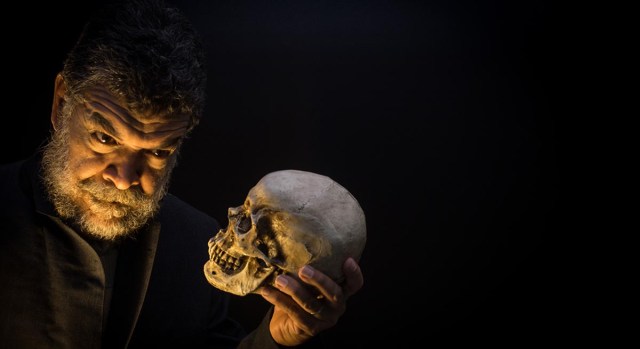
William Shakespeare’s Hamlet (c.1601 C.E.) put the question this way: “To be, or not to be, that is the question.” Hamlet’s soliloquy went on to say:

“Whether ’tis nobler in the mind to suffer
The slings and arrows of outrageous fortune,
Or to take arms against a sea of troubles,
And by opposing end them? To die: to sleep;
No more; and by a sleep to say we end
The heartache and the thousand natural shocks
That flesh is heir to, ’tis a consummation
Devoutly to be wish’d. To die, to sleep;
To sleep: perchance, to dream: ay, there’s the rub;
For in that sleep of death what dreams may come
When we have shuffled off this mortal coil,
Must give us pause: there’s the respect
That makes calamity of so long life;
For who would bear the whips and scorns of time,
The oppressor’s wrong, the proud man’s contumely,
The pangs of despised love, the law’s delay,
The insolence of office and the spurns
That patient merit of the unworthy takes,
When he himself might his quietus make
With a bare bodkin [knitting needle]?”

Like Joseph left for dead in an empty cistern, Hamlet was miserable and burdened with a profound lack of power to change his circumstances. So, he reflected on life and death in a morbid and melancholy way. It’s not that Hamlet had suicidal ideation, as much as he meditated on what life truly is, and tried to find some meaning within it.

Unlike Joseph, Hamlet cannot find the courage to deal with his frustration and feels stymied with fear of the unknown. He became lost in the injustice of it all.

If we are blatantly honest with ourselves, we much too often have a particular outcome in mind that we want or expect God to do. 

Our hopes become tethered to God doing something extremely specific so that, if it does not come to pass, or does not come quickly, or doesn’t happen as we want, then discouragement, disillusionment, and even depression may settle down in our souls like a lead weight. 

Like Hamlet, we become lost in the shadows of our thinking and ponder some sort of escape.

So, here is another set of questions I am asking myself: 

  • If my adverse circumstances do not change, can I praise God anyway? 
  • Can I, like David, take joy in simply being heard? 
  • Can I find gratitude in all situations? 
  • Do I only express thanks and praise to God when things are going my way? 
  • Am I open to whatever God wants to do in my life, even if it is not what I would choose? 
  • Do I feel that I am above having to put up with the wickedness of this world? 
  • Am I expecting heaven on earth, or am I willing to suffer as Jesus did? 

I honestly believe the answers to those questions will largely determine the trajectory of our spiritual development, our emotional maturity, our mental thoughts, and our overall religious experience.

I praise you, O God, in the good and the bad, the easy and the difficult, the failures and the victories. You are Lord over all things. You are my strength and shield in every circumstance. When I am weak, then I am strong. I can do all things through Christ who strengthens me. Amen.

A Prayer of Desperation (Jonah 2:1-10)

From inside the fish, Jonah prayed to the Lord his God:

When I was in trouble, Lord,
I prayed to you,
    and you listened to me.
From deep in the world
    of the dead,
I begged for your help,
    and you answered my prayer.

You threw me down
    to the bottom of the sea.
The water was churning
    all around;
I was completely covered
    by your mighty waves.
I thought I was swept away
    from your sight,
never again to see
    your holy temple.

I was almost drowned
by the swirling waters
    that surrounded me.
Seaweed had wrapped
    around my head.
I had sunk down deep
    below the mountains
    beneath the sea.
I knew that forever,
    I would be a prisoner there.

But you, Lord God,
    rescued me from that pit.
When my life was slipping away,
    I remembered you—
and in your holy temple
    you heard my prayer.

All who worship worthless idols
turn from the God
    who offers them mercy.
But with shouts of praise,
I will offer a sacrifice
    to you, my Lord.
I will keep my promise,
because you are the one
    with power to save.

The Lord commanded the fish to vomit up Jonah on the shore. And it did. (Contemporary English Version)

Desperate (adjective):

  1. reckless or dangerous because of despair, hopelessness, or urgency: a desperate prayer for help
  2. having an urgent need, desire: desperate to stay alive in a watery grave
  3. leaving little or no hope; very serious or dangerous: desperately stuck in the belly of a fish
  4. extremely bad; intolerable or shocking: skin being bleached white inside of a stomach
  5. extreme or excessive: swallowed and puked-out by a fish

Out of all the postures of prayer I have taken in my life, and in every prayer of desperation I’ve ever uttered to God, none of my experiences were ever quite like Jonah’s. Curled up in a fetal position inside the belly of a big fish will tend to bring out a desperate plea for help. And desperate prayers are the sort God wants from us.

I am God Most High!
    The only sacrifice I want
is for you to be thankful
    and to keep your word.
Pray to me in time of trouble.
I will rescue you,
    and you will honor me. (Psalm 50:14-15, CEV)

The Lord says, “If you love me
    and truly know who I am,
I will rescue you
    and keep you safe.
When you are in trouble,
    call out to me.
I will answer and be there
    to protect and honor you.
You will live a long life
    and see my saving power.” (Psalm 91:14-16, CEV)

Anyplace of difficulty, adversity, or overwhelming situation, can be transformed from the acid belly of a fish to a womb of possibility and new life.

In running from God, Jonah chose unwisely, and took the path of separation and death. Being swallowed whole by a great fish, and languishing in such a place of sheer isolation, is also a metaphor mirroring the actual circumstance of Jonah’s great separation from everyone, everything, especially God.

Our own fleeing from what we hate, and searching for safety apart from the Lord, only lands us in a place of horror. Jonah got himself so far from everything that he became entombed in a living death. In truth, God is the only safe and sacred place we have, our only secure refuge. We don’t need to run in order to be protected – not when God has our backs.

The turning point is whenever we come to our senses and make the choice to unmask our actual thoughts, feelings, and intentions before the Lord. The change comes whenever we make an honest cry of desperation in prayer. For prayer is the very breath of life; it is our hope.

What do you do when you are in distress?

Prayer elicits mercy from the heart of God. The value of adopting biblical prayers, like the ones in the psalter and Jonah’s prayer, is that frequent use of praying them fills our minds and hearts with words in times of great distress.

Its when we are in overwhelming need that scriptural prayers and familiar passages reawaken us with fresh hope for deliverance and renewal.

Jonah’s dark watery grave became empty when he decided to voice his desperate prayer to God. It’s one thing to pray because you want something; it’s another thing to pray because your very life is on the line.

Living for God is much more than holding to particular doctrines or making pious statements about God. The spiritual life is one in which we open ourselves to new beginnings and new life – going beyond ourselves and connecting with a transcendent God.

We must abandon ourselves to God. We are in no position to negotiate or make deals with the Lord. There needs to be a radical letting go of hatred and bigotry, injustice and unrighteousness, and especially our bent toward wanting things our way.

It is from the empty places of life that we find possibility. It was from the grave of the fish’s belly that set up Jonah’s experience of being vomited out in a spiritual resurrection.

Jonah was in the stomach of a big fish for three days and nights, just as the Son of Man will be deep in the earth for three days and nights. (Matthew 12:40, CEV)

Abandoning the false self, forsaking the old life, and coming to the end of ourselves, puts us in a position to pray desperate prayers which God delights to answer beyond what we can even ask or think.

Most holy and merciful God, I am in your care. Help me know that I need not face my troubles alone. May you grant me consolation in my sorrow, courage in my fear, and healing in the midst of my suffering. Fill me with the grace to accept whatever lies ahead for me; and strengthen my faith. Thank you that I have a living hope, through Jesus Christ my Lord, who with you and the Holy Spirit are one God, now and forever. Amen.

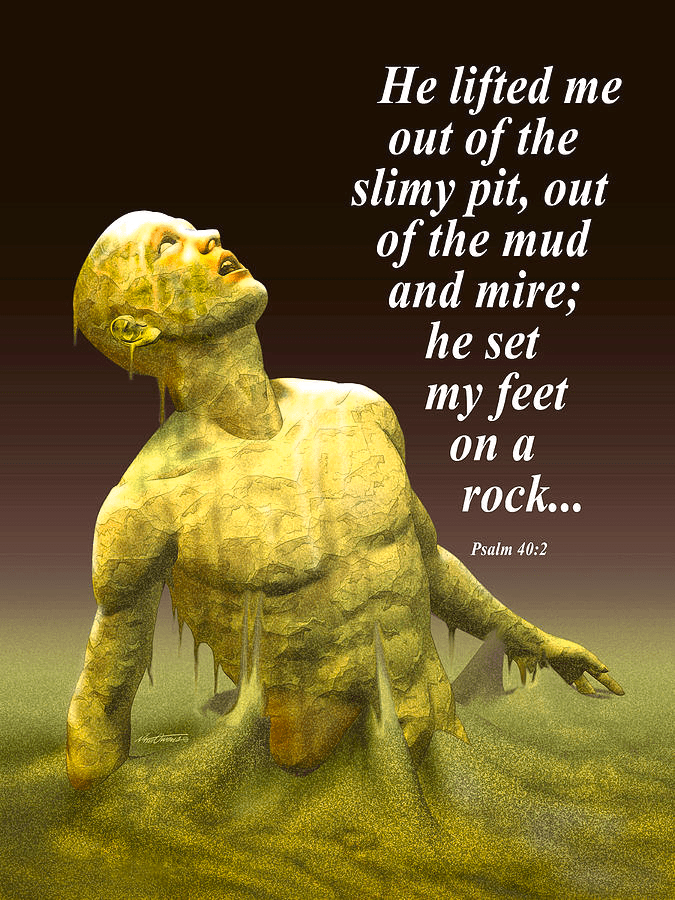
Out of the Slimy Pit (Psalm 40:1-11)

He Lifted Me by Nate Owens

I put all my hope in the Lord.
    He leaned down to me;
    he listened to my cry for help.
He lifted me out of the pit of death,
    out of the mud and filth,
    and set my feet on solid rock.
        He steadied my legs.
He put a new song in my mouth,
    a song of praise for our God.
Many people will learn of this and be amazed;
    they will trust the Lord.
Those who put their trust in the Lord,
    who pay no attention to the proud
    or to those who follow lies,
    are truly happy!

You, Lord my God!
    You’ve done so many things—
    your wonderful deeds and your plans for us—
        no one can compare with you!
    If I were to proclaim and talk about all of them,
        they would be too numerous to count!
You don’t relish sacrifices or offerings;
    you don’t require entirely burned offerings or compensation offerings—
    but you have given me ears!
So I said, “Here I come!
    I’m inscribed in the written scroll.
    I want to do your will, my God.
    Your Instruction is deep within me.”
I’ve told the good news of your righteousness
    in the great assembly.
    I didn’t hold anything back—
        as you well know, Lord!
I didn’t keep your righteousness only to myself.
    I declared your faithfulness and your salvation.
I didn’t hide your loyal love and trustworthiness
    from the great assembly.

So now you, Lord—
    don’t hold back any of your compassion from me.
Let your loyal love and faithfulness always protect me. (Common English Bible)

Every follower of the Lord has a powerful story of God’s grace in lifting them out of a slimy pit experience. 

We live in a profoundly broken world; and no one is exempt from its effects upon us. Whether physical problems, emotional trials, or relational hardships, there is always something going on in our lives – with the added pull toward trusting in things other than God. 

The temptation to say unjust words and do unjust actions is always over-promised and under-delivered. 

It’s easy to get sucked-in to poor decisions and be stuck in an empty hole with seemingly no way out. We often find ourselves slipping into a slimy pit because of our own bad decisions, as well as by no fault of our own. 

Living in a fallen world means that we inevitably experience troubles and hardships.

So, what do we do if we find ourselves in a slimy pit?

Look for Hope

David, the psalmist, waited patiently for the Lord. With great expectation, he fully anticipated God to act on his behalf. The sort of patience he practiced was an intense waiting – a waiting filled with longing and expectant hope, a patience that kept looking and praying and seeking.

The reason believers in Jesus keep hoping beyond hope is that we know that God is ultimately the One who delivers from the pit. 

But what if you have been looking for deliverance from the slimy pit experience and you have not seen it come to pass? 

Expectantly expect God to act. Wait patiently. Do not give up. Keep praying and watching. Like the father in the story of the prodigal son, keep looking out the window, waiting for the son to return, and picture the deliverance coming – because our waiting is not in vain.

flickr.com/photos/joshtinpowers

The psalmist, David, was eventually delivered. The Lord leaned down to him. God listened and lifted him. The Lord God set him on a firm place to stand and put a new song in his mouth. 

This was not only a personal matter for David; it was also an occasion that other people needed to know about.

Look for God

We all must finally come to the end of ourselves and look up. Whenever the deliverance doesn’t come quickly, we may look to other people or things to give us the freedom we long for. It’s easy to become impatient and begin searching for answers in everything else but God. 

Yet, if we will let patient hope have its way, we are blessed when we trust in the Lord.

In all my years of churchgoing as a kid, I had never read my Bible. But God was gracious to me. I remembered all those sermons I heard about Jesus. I gained a newfound sense of my own inner darkness, as well as the desire to read God’s Word. And God saved me. 

My circumstances did not change, but I did. My loneliness turned to joy; my aimlessness turned into purpose; and my selfishness became a deep concern for others. My heart had been black, and what God did to change it was nothing less than miraculous.

Look Within

The person who looks for hope and seeks God is also a person who looks into their own heart and there finds the attitude which God will bless. 

Blessing does not come from great sacrifice, but by syncing one’s heart with the heart of God. 

The Lord cares little about how much money or stuff you have, or how many sacrifices were made for God; that’s because God wants your heart, your mind, your will, and your emotions. In other words, God wants you! 

And God desires you because the Lord made you with a heart that beats for the same things God cares about: justice, mercy, and humility.

If you and I will but look within at the very spirit God has put within us, we shall find resources beyond what we can ask or think.

Look to Bless Others

We possess more than a personal faith which is to benefit ourselves; we also have an equal responsibility to bless the community with our experiences of what God has done in our lives. 

The telling of stories about what God has done for us is a necessary part of building up the church and helping others move forward in faith, hope, and love.

The psalmist proclaimed his testimony in the great assembly, that is, publicly. This isn’t about standing behind a microphone in front of lots of people; it’s about being so touched by God that we cannot keep our mouths shut about the Lord’s deliverance on our behalf.

So, let’s not shelve the idea of giving testimony to others as if it were only for pastors, missionaries, or other very religious people. 

When a person decides to play hockey in -20 degrees below zero weather, we might think that person is a little crazy;  but, hey, we reason, if they love hockey that much, more power to them. 

We must not think about Christianity in the same way, that if a person is passionate about Jesus and desires to tell others about what God has done for them, more power to them; just don’t expect me to go out in the cold and do that because it isn’t my thing. 

Christianity is a life, not a hobby; it’s about humble service, and not a means to look respectable; it cannot be reduced to a few practices, such as church attendance or putting money in an offering plate.

Christianity is a relationship with God through Jesus. Try looking at marriage as simply showing up for supper and paying the bills and see how far that gets you.

Look to Get Lost to Get Found

We may become obsessed with getting out of our slimy pit of illness, infirmity, pain, adversity, hardship, or discord. If that happens, we will likely lose our proper focus.

Instead, get lost in the wonder of God. The Lord does wondrous things when we are immersed in God’s wonders.

“Any of you who try to save the life you have will lose it. But you who give up your life for me will find true life.” Jesus (Matthew 16:25, ERV)

New life comes from a change of heart, not a change of circumstances. Wherever there is a firm reliance on God; a glad obedience to God; and a readiness to give testimony to God’s actions, then we are living into the spirit of today’s psalm.

Lamb of God, who takes away the sins of the world, have mercy on us.
Lamb of God, who takes away the sins of the world, grant us your peace. Amen.

2 Chronicles 20:1-22 – Praying in Desperate Times

Photo by cottonbro on Pexels.com

The armies of Moab and Ammon, together with the Meunites, went to war against Jehoshaphat. Messengers told Jehoshaphat, “A large army from Edom east of the Dead Sea has invaded our country. They have already reached En-Gedi.”

Jehoshaphat was afraid, so he asked the Lord what to do. He then told the people of Judah to go without eating to show their sorrow. They immediately left for Jerusalem to ask for the Lord’s help.

After everyone from Judah and Jerusalem had come together at the Lord’s temple, Jehoshaphat stood in front of the new courtyard and prayed:

You, Lord, are the God our ancestors worshiped, and from heaven you rule every nation in the world. You are so powerful that no one can defeat you. Our God, you forced out the nations who lived in this land before your people Israel came here, and you gave it to the descendants of your friend Abraham forever. Our ancestors lived in this land and built a temple to honor you. They believed that whenever this land is struck by war or disease or famine, your people can pray to you at the temple, and you will hear their prayer and save them.

You can see that the armies of Ammon, Moab, and Edom are attacking us! Those are the nations you would not let our ancestors invade on their way from Egypt, so these nations were not destroyed. Now they are coming to take back the land you gave us. Aren’t you going to punish them? We won’t stand a chance when this army attacks. We don’t know what to do—we are begging for your help.

While every man, woman, and child of Judah was standing there at the temple, the Lord’s Spirit suddenly spoke to Jahaziel, a Levite from the Asaph clan. Then Jahaziel said:

Your Majesty and everyone from Judah and Jerusalem, the Lord says that you don’t need to be afraid or let this powerful army discourage you. God will fight on your side! So, here’s what you must do. Tomorrow the enemy armies will march through the desert around the town of Jeruel. March down and meet them at the town of Ziz as they come up the valley. You won’t even have to fight. Just take your positions and watch the Lord rescue you from your enemy. Don’t be afraid. Just do as you’re told. And as you march out tomorrow, the Lord will be there with you.

Jehoshaphat bowed low to the ground, and everyone worshiped the Lord. Then some Levites from the Kohath and Korah clans stood up and shouted praises to the Lord God of Israel.

Early the next morning, as everyone got ready to leave for the desert near Tekoa, Jehoshaphat stood up and said, “Listen my friends, if we trust the Lord God and believe what these prophets have told us, the Lord will help us, and we will be successful.” Then he explained his plan and appointed men to march in front of the army and praise the Lord for his holy power by singing:

“Praise the Lord!
    His love never ends.”

As soon as they began singing, the Lord confused the enemy camp. (Contemporary English Version)

King Jehoshaphat and Judah were about to be attacked. War was imminent. Anxiety was high. The people were on edge. What were they going to do in the face of a combined army that seemed as if they’d steamroll over the nation of Judah? 

Here’s what Jehoshaphat did: He admitted his fear, sought the Lord for help, and proclaimed a national fast for everyone in Judah. Then, the king prayed, and God responded.

A most unconventional method of defeating the enemy was put into motion. The king and the people of Judah put together a praise team and a worship gathering to go before the army; they believed God was good for divine promises and would deliver them.

The king’s prayer was a deeply felt and sincere belief that God could and would answer, according to ancient promises to the people. The meat of the prayer affirmed both the powerlessness of their situation and the power of God to transcend even the most difficult of circumstances. They didn’t know how deliverance was going to come; they simply believed it was going to happen. 

This is, indeed, the kind of prayer God delights to answer! It was a prayer born of great need and desperation – a prayer upholding the name of God and discerning that unless the Lord showed up, all would be lost.

The foundational basis of all prayer to God is the recognition that we do not know what to do, other than look to the Lord. 

We pray because we desperately need God to show up and do for us what we cannot do for ourselves. 

We cry out to God in our affliction and believe that the gracious ears of the Lord will hear and save us from our terrible plight. 

And once we pray, we are to stand firm, hold our position, and see the salvation from God on our behalf. 

If we need some inspiration for prayer and find ourselves in need of faith to believe what God can do, then take the time to read carefully and prayerfully over today’s Old Testament lesson several times. 

Then, let the prayers arise to the God of deliverance so that our stressful and worrisome pressure is transformed into praise for the Lord’s steadfast love.

Almighty God, you rule over all the nations of the earth. In your hand are power and might, so that none are able to withstand you. My eyes are fixed on looking for you to act on my behalf so that I might declare that your steadfast love endures forever, through Jesus Christ, my Savior. Amen.