
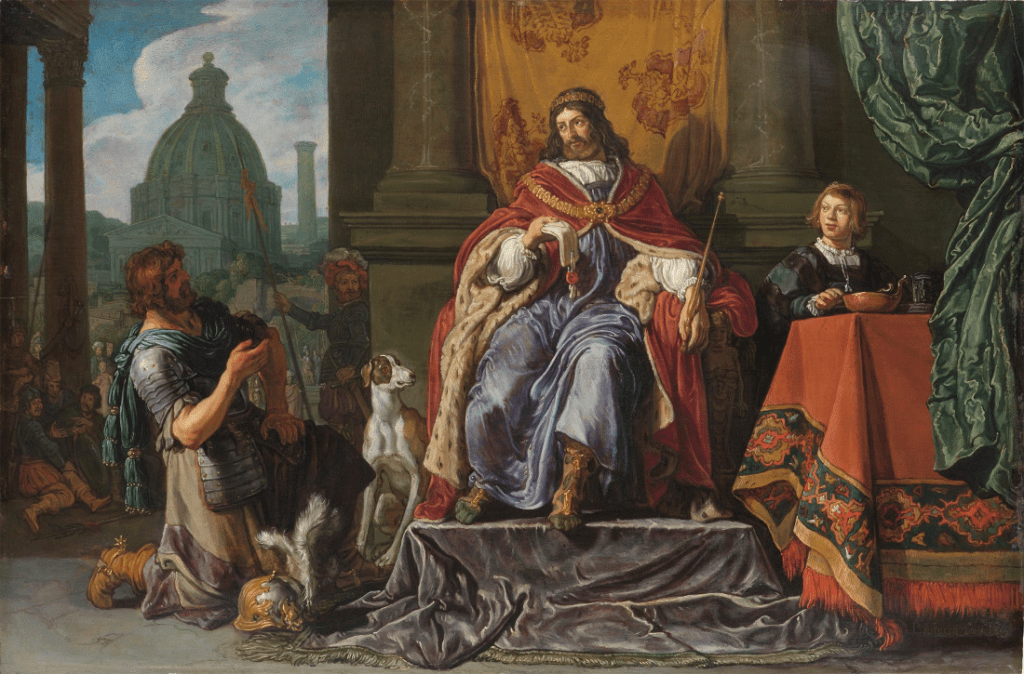
Be Careful about Your Decisions (2 Samuel 11:14-21)

David and Uriah, by Rembrandt, c.1665

In the morning David wrote a letter to Joab and sent it with Uriah. In it he wrote, “Put Uriah out in front where the fighting is fiercest. Then withdraw from him so he will be struck down and die.”

So while Joab had the city under siege, he put Uriah at a place where he knew the strongest defenders were. When the men of the city came out and fought against Joab, some of the men in David’s army fell; moreover, Uriah the Hittite died.

Joab sent David a full account of the battle. He instructed the messenger: “When you have finished giving the king this account of the battle, the king’s anger may flare up, and he may ask you, ‘Why did you get so close to the city to fight? Didn’t you know they would shoot arrows from the wall? Who killed Abimelek son of Jerub-Besheth? Didn’t a woman drop an upper millstone on him from the wall, so that he died in Thebez? Why did you get so close to the wall?’ If he asks you this, then say to him, ‘Moreover, your servant Uriah the Hittite is dead.’” (New International Version)

Today we have a lesson in the middle of a story about King David’s greatest error in judgment and cover up of that decision. Indeed, bad decisions can often beget even more bad decisions.

It would be an understatement to say that David blew it. Our Old Testament books of 1 and 2 Samuel are arranged by the original editor in such a way that the chapter of 2 Samuel 11 is a hinge upon which the life of David moves.

All of the material before 2 Samuel 11 is generally positive, describing a man devoted to God in every way. But everything after this chapter is mostly tragic. The editor wanted readers and listeners to understand that God cares about morality and ethics by showing the consequences of both a life well-lived, as well as a life that is self-centered.

Before our verses for today, the story begins with David choosing adultery and taking another man’s wife. King David should have been doing the work of a king – protecting and serving Israel. But instead, he hung out in Jerusalem and avoided all the needed military stuff. (2 Samuel 11:1)

The editor wants us to see that King David was shirking his responsibility, which then brought a set up for moral failure. It appears David was resting on his laurels, content with his victories and successes. For the most part, at the time, the nation was happy and prosperous.

The king was walking around on the roof of his palace, instead of being in the trenches with his men, leading them in the defense of Israel.

Rather than giving proper orders as a king ought to do, David was sending people to do his personal bidding in satisfying his earthly wants. This is a significant reversal of what we see from earlier chapters in the story of David.

Up to this point we have observed David as a merciful king, seeking to use power for benevolent purposes in the common good of the nation. But in today’s chapter, David turns into the typical earthly king, ordering others around and using his authority to get what he wants.

The editor wants us to learn some lessons from David’s life. One of those lessons is that if the right and just King David can fall, then none of us are immune from falling into bad decisions which alter people’s lives forever.

The moment we think we are above falling, look out, because an arrogant nose dive into depravity is probably not far behind.

The stories of people who fall into immorality are mostly the same. Having some power or authority to wield, they use it to assert control over another person or group in order to get what they want – without being concerned for the needs and wants of others, and usually unconcerned for the negative consequences it brings upon other people.

It’s important that we call such behavior what it is: Evil. Awful. Selfish. Ungodly. A violation of ethics and morality. An offense against God.

David committed adultery, then lied, manipulated others, and covered up his actions. He murdered an innocent man, and was okay with an entire regiment of soldiers getting killed to ensure that an innocent man would be dead.

None of that icky nasty stuff was a mistake, or a lapse in judgment. It was pre-meditated sin.

And the way to deal with such sin is not to say something like “I did it, but it wasn’t really me; I’m not really like that!” Well, apparently, you are. Maybe David thought he was above it all, and believed it wasn’t really something he could ever do. But he did.
David gives Uriah a letter for Joab, by Pieter Lastman, 1619

Once we make an immoral and ungodly decision, it often causes us to start selling-out our principles and convictions. Sin only begets more sin, until we deal with it squarely.

Truth is a celebration of openness and honesty. Shame keeps to the shadows and prizes secrecy and remaining quiet. If one chooses not to go down the path of truth, then they will be continually encrusting their lives with lies so that no one ever knows.

In fact, much of religious legalism is nothing more than a person piling on the rules in order for others to not see the guilt and shame that hides deep within. Only through confession, repentance, and faith, will forgiveness, wholeness, and happiness ever occur.

Yet another lesson we can learn from this story of David is that the results which may satisfy our wants may not necessarily satisfy our needs, or God.

David accomplished what he wanted. He was successful in covering up his sin, and he got the woman he wanted. But God saw the whole thing, and was not okay with any of it. 

We must not assume that because we do something, and there was no immediate lightning strike, that it was okay. 

To only selfishly satisfy ourselves is to be a spiritual cannibal who eats other people alive.

So, how might we avoid falling into the same sorts of bad decisions which befell David?

  • Make prayers of confession a regular staple of your daily spiritual regimen. Had David engaged in prayer on the roof instead of being bored, we would likely have a very different story.
  • Maintain an active and engaged mind. An idle mind is the devil’s workshop. David was wandering around the palace instead of actively engaged in the government of his kingdom.
  • Keep the Sabbath. A day of rest helps the body to be in healthy rhythms of care, as well as enabling the spirit to connect meaningfully with God. Without adequate rest, we are like the little kid in a grocery store at 9pm throwing a fit and having a meltdown. David got out of a healthy rhythm as king, and it led to a fall.
  • Strengthen your family relationships. If you are married, live from the place of your marriage. Marriage is more than living with someone and having occasional fun; it is a one-flesh relationship that is meant to be a priority. Only from this relational place can a spouse effectively take on the world with all its needs and brokenness. 
  • Submit to accountable relationships. There are far too many lonely people with few friends in this world, even among people who are constantly around others. Everyone needs a small coterie of confidants with whom to share anything and everything with.  David’s close friends were all out with the army, and he was alone. Not a good thing.
  • Avoid stuffing all desire down as selfish and bad. Jettisoning desire only sets us up for a fall. But identifying godly desire enables us to make better decisions which engage the whole person.

Almighty God, you are the fountain of all wisdom and grace. You know our needs before we even ask, and our ignorance in not asking for the things we really need. Have compassion on our weakness, and mercifully give us those things that in our blindness we don’t know to ask for. 

Gracious Lord, we acknowledge and confess our sinful nature, prone to evil and slow to good.  You know our secret sins, and how often we have offended you and damaged others through wandering from your ways, wasting your gifts, and forgetting your love. Cleanse us from our hidden sins and forgive our faults for the sake of your Son, our Savior, Jesus Christ who loved us and gave himself for us. Amen.

People Are a Bundle of Contradictions (Romans 7:7-20)

“Contradictions” by Michael Lang, 2015

But I can hear you say, “If the law code was as bad as all that, it’s no better than sin itself.” That’s certainly not true. The law code had a perfectly legitimate function. Without its clear guidelines for right and wrong, moral behavior would be mostly guesswork. Apart from the succinct, surgical command, “You shall not covet,” I could have dressed covetousness up to look like a virtue and ruined my life with it.

Don’t you remember how it was? I do, perfectly well. The law code started out as an excellent piece of work. What happened, though, was that sin found a way to pervert the command into a temptation, making a piece of “forbidden fruit” out of it. The law code, instead of being used to guide me, was used to seduce me. Without all the paraphernalia of the law code, sin looked pretty dull and lifeless, and I went along without paying much attention to it. But once sin got its hands on the law code and decked itself out in all that finery, I was fooled, and fell for it. The very command that was supposed to guide me into life was cleverly used to trip me up, throwing me headlong. So sin was plenty alive, and I was stone dead. But the law code itself is God’s good and common sense, each command sane and holy counsel.

I can already hear your next question: “Does that mean I can’t even trust what is good [that is, the law]? Is good just as dangerous as evil?” No again! Sin simply did what sin is so famous for doing: using the good as a cover to tempt me to do what would finally destroy me. By hiding within God’s good commandment, sin did far more mischief than it could ever have accomplished on its own.

I can anticipate the response that is coming: “I know that all God’s commands are spiritual, but I’m not. Isn’t this also your experience?” Yes. I’m full of myself—after all, I’ve spent a long time in sin’s prison. What I don’t understand about myself is that I decide one way, but then I act another, doing things I absolutely despise. So if I can’t be trusted to figure out what is best for myself and then do it, it becomes obvious that God’s command is necessary.

But I need something more! For if I know the law but still can’t keep it, and if the power of sin within me keeps sabotaging my best intentions, I obviously need help! I realize that I don’t have what it takes. I can will it, but I can’t do it. I decide to do good, but I don’t really do it; I decide not to do bad, but then I do it anyway. My decisions, such as they are, don’t result in actions. Something has gone wrong deep within me and gets the better of me every time. (The Message)

“Contradictions in human character are one of its most consistent notes.”

Muriel Sparks, “Loitering with Intent”

The Apostle Paul’s vulnerable expression of his dilemma resonates deeply with many people. There are times when we say things to ourselves such as:

“I told myself I wasn’t going to be like my mother, and here I am responding just like she would.”

“I know better than to drive by the liquor store on my way home and pick up a pint of vodka, yet, I still did it.”

“I don’t want to die, but my thoughts keep racing about a plan for suicide.”

There are many situations in which we are both frustrated and befuddled by doing the things we do not want to do, and not doing the things we want to do.

Yes, indeed, Paul’s existential angst is a timeless description of our common human condition. We all can relate to the seeming inability to do what is right in so many situations. It can drive us nuts, even to a constant and never-ending low-level discouragement that underlies almost everything we do.

Paul’s prescription for dealing with this does not rely on law. He understood that putting our willpower and effort into obeying commands gets us nowhere, because we will eventually fail. Neither our brains nor our spirits work that way. Our willpower was never designed to be the driver of what we do and do not do. If anything, willpower, and the lack thereof, demonstrates just how much we are climbing the ladder on the wrong wall.

People are a bundle of contradictions, doing good, then bad, and flip-flopping back and forth with great frustration.

God’s law was not crafted to transform us from the inside-out. The law has three solid purposes, none of which are meant to bring deep personal transformation:

  1. Attention to the law works to restrain sin in the world
  2. Use of the law provides us with a helpful guide for grateful living in response to divine grace
  3. Reflection on the laws show us how bad off we really are in this world, and how much we are in need of forgiveness

We need a change of habits, and this is different than adopting a list of laws.

Habits are developed from our desires, our affections. In other words, we do what we love – more specifically, our ultimate love(s) drive us to do what we want. To put it in a more straightforward way:

We sin because we like it. And the path to overcoming any besetting sin is to have an ultimate love surpass the lesser sin which we like.

For example, I have developed daily habits or rituals of faith which enable me to commune with God. I love God with all my heart, soul, mind, and strength, and this ultimate love enables me to push out all competing gods who want my devotion. I also love my wife with all my heart. We work on developing habits of a marital relationship which reinforce our love for each other. Love is what drives me to do right and good by her.

So, what do we do when we mess up? For the Christian, no matter what the question is, the answer is always grace.

God’s grace in the finished work of Jesus Christ applied to us by the Holy Spirit is the operative power that changes lives. The law has no power to do that kind of work. Freedom from the tyranny of our misplaced desires and disordered loves comes from Christ’s forgiveness through the cross. Like a lover enamored with his beloved, our desires become oriented toward Jesus for his indescribable gift to us. That is the strength of grace.

Saving God, I thank you for delivering me from sin, death, and hell through your Son, the Lord Jesus. May your Holy Spirit apply the work of grace to my life every day so that I can realize spiritual healing and practical freedom from all that is damaging and destructive in my soul. Amen.

Make Room for Jesus (John 8:39-47)

Christ and Pharisee, by Russian painter Ivan Filichev, 1993

“Abraham is our father,” they [the religious leaders] answered.

“If you were Abraham’s children,” said Jesus, “then you would do what Abraham did. As it is, you are looking for a way to kill me, a man who has told you the truth that I heard from God. Abraham did not do such things. You are doing the works of your own father.”

“We are not illegitimate children,” they protested. “The only Father we have is God himself.”

Jesus said to them, “If God were your Father, you would love me, for I have come here from God. I have not come on my own; God sent me. Why is my language not clear to you? Because you are unable to hear what I say. You belong to your father, the devil, and you want to carry out your father’s desires. He was a murderer from the beginning, not holding to the truth, for there is no truth in him. When he lies, he speaks his native language, for he is a liar and the father of lies. 

Yet because I tell the truth, you do not believe me! Can any of you prove me guilty of sin? If I am telling the truth, why don’t you believe me? Whoever belongs to God hears what God says. The reason you do not hear is that you do not belong to God.” (New International Version)

Glass-half-full or glass-half-empty? I confess I really don’t like those binary categories for people. That’s because I believe it misses a very important aspect of being a human. What’s most necessary is to have glass-fully-empty people.

While the religious leaders of Christ’ day were debating the subject of whether Jesus is of God, or not, they failed to notice something significant about themselves:

Their glasses were so full that they had no room for Messiah, even when he was standing right in front of their faces.

You cannot be full of God and full of yourself at the same time.

Only an empty vessel can be filled. Half-full or half-empty people only end up being in conflict with each other. They cannot find any room for Jesus in their lives.

Jesus had been dealing with these sort of shenanigans even before he was born. His poor parents had a dickens of a time finding a place for him to be born. There was no room in the inn. All the places were full. God was about to break into the world, and everyone was scuttling about as glass-half-full and glass-half-empty people.

In his earthly ministry, the religious leaders viewed Jesus as a competitor, not a compatriot – pitting themselves in conflict with him, even to the extreme.

“You are looking for a way to kill me, because you have no room for my word.” (John 8:37, NIV)

Conflict is inevitable. Put a bunch of sinners together in one place, add a few grumpy curmudgeons, some know-it-alls, then fireworks happens. I’ve always thought that every human institution is about one or two knock-down drag-out fights away from being non-existent.

At the heart of all the conflict is either an inability or an unwillingness to make room for another’s point of view. Where there is no room for mystery, there’s no room for Jesus.

How many settled beliefs and behaviors do you have? So many that your head and hands have no room for Jesus to do the unexpected?

Are you full of thoughts, opinions, and convictions? So much so that your interpretation of everything leaves no room for the contrary, even if it comes from Jesus?

Here’s how we get full of ourselves:

  1. Desire arises within. Options are considered in meeting the want or need.
  2. Conflict enters because there are others with competing desires.
  3. Expectations are formed when the desire is unmet. 
  4. Demands are made because of missed expectations.
  5. Judgment is meted-out to those not complying to the demands.
  6. Separation occurs with the intent of hurting another through a withdrawal of relationship.

You end up not making room for the other in your heart and life. You don’t make room because you’re already full of yourself and don’t want to change.

We, however, are to make room for Jesus and others because Jesus made room for us and expects us to do so for others.

My Father’s house has room to spare. (John 14:2, CEB)

Make room in your hearts for us. (2 Corinthians 7:2, NRSV)

Let the Word of Christ—the Message—have the run of the house. Give it plenty of room in your lives. (Colossians 3:16, MSG)

Finding true and lasting satisfaction in Jesus as the Way is how to realize forgiveness, peace, and reconciliation. There is room at the foot of Christ’s cross for both me and you.

There’s Room at the Cross for You, by Billy Gaines

The cross upon which Jesus died
Is a shelter in which we can hide
And its grace so free is sufficient for me
And deep is its fountain as wide as the sea.

There’s room at the cross for you
Though millions have come, there’s still room for one
Yes there’s room at the cross for you.

Though millions have found him a friend
And have turned from the sins they have sinned
The Savior still waits to open the gates
And welcome a sinner before it’s too late.

The hand of my Savior is strong
And the love of my Savior is long
Through sunshine or rain, through loss or in gain,
The blood flows from Calvary to cleanse every stain.

What’s On Your Wish List? (Acts 26:24-29)

Before Paul finished defending himself, Festus shouted, “Paul, you’re crazy! Too much learning has driven you out of your mind.”

But Paul replied, “Honorable Festus, I am not crazy. What I am saying is true, and it makes sense. None of these things happened off in a corner somewhere. I am sure that King Agrippa knows what I am talking about. That’s why I can speak so plainly to him.”

Then Paul said to Agrippa, “Do you believe what the prophets said? I know you do.”

Agrippa asked Paul, “In such a short time do you think you can talk me into being a Christian?”

Paul answered, “Whether it takes a short time or a long time, I wish you and everyone else who hears me today would become just like me! Except, of course, for these chains.” (Contemporary English Version)

The Apostle Paul was quite the guy – a zealous, indefatigable, intense, Type-A dude. Yet it wasn’t those characteristics that Paul wanted others to see in him. He simply desired others to see Christ in him. 

Having been arrested for preaching the good news of forgiveness and new life in Jesus Christ, Paul found himself before King Agrippa, engaging in a DTR (define the relationship) talk; and making a strong apologetic for the Christian faith. 

Agrippa asked Paul, “In such a short time do you think you can talk me into being a Christian?” Paul answered with confidence and conviction, “Whether it takes a short time or a long time, I wish you and everyone else who hears me today would become just like me!” 

“Trial of the Apostle Paul” by Nikolai Bodarevsky, 1875

I wonder how many of us could boldly say the same thing as Paul. 

Are we the sort of Christians that others could emulate? 

Has our faith journey led us to the place of being a solid model of what a follower of Christ should look like? 

Do we expect others to change while avoiding change ourselves? 

Do we deeply desire and work toward others coming to know Jesus? 

So, what is on your wish list?

  • I wish each Christian everywhere would spend their relational and emotional energy making this world a better place by living into the words and ways of Jesus Christ.
  • I wish every person I encounter would have the privilege of knowing Christ as I have.
  • I wish all my parishioners and patients would become what I am, except, of course, for my self-made chains.

Perhaps we all must look in the mirror and examine our true desires. It’s easy to put our energy into good yet lesser wishes in life. Yet, if Christians are to become like their ancient forefather in the faith, the Apostle Paul, we will begin focusing our energies into things such as the following:

  • Making outreach a priority. We do what is most important to us. That’s probably self-evident. But churches and believers that do not make outreach a primary priority are really making it no priority, at all.

Paul said, “Do the work of telling the Good News. Do all the duties of a servant of God.” (2 Timothy 4:5, ERV)

  • Mentoring others into the words and ways of Jesus. Many church laypersons believe that training other Christians is what we pay the clergy to do.But this is really the responsibility of every believer.

Paul said, “You have often heard me teach. Now I want you to tell these same things to followers who can be trusted to tell others.” (2 Timothy 2:2, CEV)

  • Taking responsibility for spreading the good news. Blaming and shaming gets us nowhere. Pastors complain about churches. Churches bellyache about Pastors. And both attack the culture, the denomination, or some other external scapegoat. It’s time for all of us to own what needs to be said and done.

Paul said, “Be ready to spread the word whether or not the time is right. Point out errors, warn people, and encourage them. Be very patient when you teach.” (2 Timothy 4:2, GW)

  • Connecting prayer with telling the message of Christ. It doesn’t take a lot of energy to pray for Aunt Mable’s bunions to go away. It’s altogether another thing to pray sustained, focused, and passionate prayers for the people in my life to know Christ and him crucified, risen, ascended, and coming again.

Paul said, “Don’t forget to pray for us, that God will open doors for telling the mystery of Christ… Pray that every time I open my mouth I’ll be able to make Christ plain as day to them.” (Colossians 4:3-4, MSG)

  • Being compassionate and kind, like Christ, to others. There not only needs to be a clear articulation of the gospel, but also a clear demonstration of basic human kindness. Many Christians never get the opportunity to share the gospel because they’re just downright obnoxious.

Set Christ apart as Lord in your hearts and always be ready to give an answer to anyone who asks about the hope you possess. Yet do it with courtesy and respect, keeping a good conscience. (1 Peter 3:15-16, NET)

  • Establishing every Christian ministry as an opportunity to share the gospel. Intentional effort and energy toward proclaiming the gospel in both word and deed needs to go into everything we do.

Paul said, “So take special care how you conduct yourselves. Don’t be unwise but be wise. Make use of any opportunity you have because these are wicked times we live in.” (Ephesians 5:15-16, NTE)

  • Caring, not at all, that new Christians will change our lives or our church too much. I’m serious. I’ve heard the line many times by church folk in my years of pastoral ministry that new believers come in and change things we like. Come on, man. Get over it. Change is built into the Christian experience. God said:

I am about to do a new thing; now it springs forth; do you not perceive it? I will make a way in the wilderness and rivers in the desert. (Isaiah 43:19, NRSV)

You don’t need a personality like the Apostle Paul to live into your calling as a Christian. You and I only need to put our will and energy into things that matter most to God.

Risen and ascended Lord, you are the king of all creation. May your rule and reign take over my life to such a degree that everything that comes out of my mouth, and every action I take would be worthy of emulation in your way of love. Amen.