Jesus Intervenes (Matthew 19:23-30)

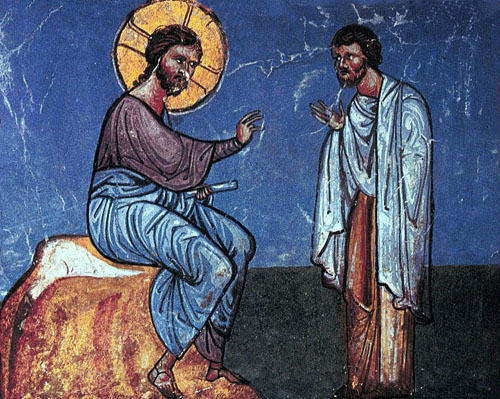
Orthodox depiction of Jesus and the rich young ruler

Then Jesus said to his disciples, “I assure you that it will be very hard for a rich person to enter the kingdom of heaven. In fact, it’s easier for a camel to squeeze through the eye of a needle than for a rich person to enter God’s kingdom.”

When his disciples heard this, they were stunned. “Then who can be saved?” they asked.

Jesus looked at them carefully and said, “It’s impossible for human beings. But all things are possible for God.”

Then Peter replied, “Look, we’ve left everything and followed you. What will we have?”

Jesus said to them, “I assure you who have followed me that, when everything is made new, when the Human One sits on his magnificent throne, you also will sit on twelve thrones overseeing the twelve tribes of Israel. And all who have left houses, brothers, sisters, father, mother, children, or farms because of my name will receive one hundred times more and will inherit eternal life. But many who are first will be last. And many who are last will be first. (Common English Bible)

We all have a chronic struggle and relapse with some besetting shortcomings. And we compulsively do them even though they harm us.

Whether it’s an addiction (alcohol, illicit drugs, etc.) or things we don’t readily notice as addictive (gossip, food, shopping) we need to be weaned off our damaging obsessions. In Holy Scripture, the most pervasive and compulsive vice is the addiction to wealth and money.

Everyone has their own unique tussle with money. If our initial knee-jerk reactions to money issues is to think of someone else (“I don’t have as much money as…” or, “So-and-so really has a problem with this…”) then this is what we call denial. Truth be told, all of us offer some disclaimer about how our trust is not in paychecks, bank accounts, and material stuff. For me, money buys books, of which my voracious appetite is never satiated.

Even people who truly have little money and scant resources can have an addiction to money. They think about money and wish for it to an unhealthy degree, as if wealth is the thing that will make them happy. Folks in denial rarely have any idea how much they harm others, themselves, and even God. In fact, the consistent witness of the early church fathers is that the sheer accumulation of stuff is the same as stealing from the poor.

Sometimes, because of denial, people need an intervention – and to be jolted back to their senses. Intervention is a gift. Someone cares enough to intervene. Yet, many interventions don’t work because the person can walk away and refuse to change.

Jesus performed an intervention with a rich young man (literally, a twenty-something). The young man was obsessed with wealth and money, but didn’t see it. He thought of himself as godly and spiritual. It’s really a sad story because the rich man walked away unchanged by his encounter with Jesus. He failed to see himself as desperately needing to change. He held to his denial. (Matthew 19:16-22)

Jesus and the Rich Young Man by Chinese artist, 1879

Jesus exposed the rich young man’s divided loyalties of trying to serve both God and money. He would have to choose between the two masters. And this is our choice, as well.

God wants an undivided heart and loyal allegiance. Jesus is looking for those who are poor in spirit and recognize their great need for God, rather than believing they are okay and just need to add a little Jesus to their lives. God wants spiritual beggars who understand their desperate situation and do not practice denial by sugar-coating their actual spiritual state.

Just like an addict who either cannot or will not give up the addiction, the rich young man would not give up his disordered love for money and possessions. So, Jesus intervened. Christ doesn’t ask everybody to do exactly as he called the rich young man to do. For example, Jesus asked neither the wealthy Zacchaeus to do it, nor the disciple Peter to sell his fishing business.

However, Jesus does ask all of us to do what seems impossible and let God meet our needs.

Christ had the original come-to-Jesus-meeting with his disciples in debriefing about his conversation with the rich man. If it is so impossible and so difficult for a rich person to be saved because his wealth gets in the way, who then can be saved, the disciples wondered? We cannot save or redeem ourselves. We need grace. We need help.

So serious is Jesus about this business of genuine discipleship, about what it really takes to follow God, that he repeated himself using a colorful illustration: It’s easier for a camel to go through the eye of a needle than for a rich man to enter the kingdom of God. 

Jesus wants us, who have lots of stuff, bank accounts, and money to see ourselves in the illustration. Only the discouraged, the hopeless, and the helpless will see their absolute need for grace and will seek the miracle of salvation Jesus offers.

Peter, always the big mouthpiece for the disciples, blurts out that they have left everything to follow Jesus. So, what then will there be for the disciples? What’s in it for me?

We may avoid the idol of money only to find ourselves with the idol of pride. Twentieth-century theologian, Reinhold Niebuhr, once said that a person had to achieve a great deal of good to be able to commit the sin of pride.

Yet, grace always has the last word. Jesus gives grace and assures us of reward even when we are stinkers by asking prideful questions. 

“The promise of a hundredfold recompense does not seem to square with experience. Usually those who for the testimony of Christ are deprived of parents or children and other relatives, or their marriage partners, or have lost all their money, do not recover but struggle out their life in lonely and deserted exile and in poverty. But I reply that if anyone rightly assesses God’s grace by which he alleviates the miseries of His children he will confess that is to be preferred to all the riches of this world.”

John Calvin

The first step in facing any harmful compulsion is to be honest about it – without telling our story in a way that makes us look surprisingly good so that others are pleased with us.

Life is about following Jesus. To follow Jesus, we must not be in denial. Perhaps the best way to express our faith is to tell someone about our obsessions to compulsively work in order to feel better and pad our savings; or that we are afraid to charitably give because we worry about the future; or that we love to buy things we don’t really need, so that we’ll feel better.

An honest awareness of our compulsions sometimes causes us to feel awful about ourselves. We may disparage ourselves for always screwing up, never saying “no” to others, or feeling unable to stop the anxiety.

Yet, grace abundantly overwhelms any and all addictions, shortcomings, and pride when it comes money or anything else. God has unlimited patience with people; Jesus never tires of inviting us to follow him. God’s love and acceptance is not based on our screw-ups, but on Christ’s forgiveness through the cross.

Allow the words of Jesus to sink deep into your life so that you ooze the grace of God in your life.

Camels cannot pass through the needle’s eye by means of dieting, positive thoughts, or luck. It happens not because the camel can squeeze through the narrowness of the needle’s eye but because there is a wideness in God’s mercy.

God’s grace will pull you through. Unlike the rich young man, once you hear and understand that piece of delightful news, you do not walk away sad but with boundless joy.

God of wisdom, help me in the mess of my finances; in my fear of taking charge of the resources entrusted to my care; in my preference for ignorance  over honest acknowledgment of the ways I use and fail to use my wealth; in my anxiety over debt, and in all the pressures of my financial life.  

Help me to take one step at a time toward honoring you through my use of money and honoring others from whom I buy and borrow. Make me humble to seek counsel, grateful for my abundance, prudent with my limited means, and patient with myself as I seek to be a better steward of all you have given me. Amen.

Dealing with Denial (Jeremiah 32:1-9, 36-41)

The Lord spoke to me in the tenth year that Zedekiah was king of Judah, which was the eighteenth year that Nebuchadnezzar was king of Babylonia. At that time, the Babylonian army had surrounded Jerusalem, and I was in the prison at the courtyard of the palace guards. Zedekiah had ordered me to be held there because I told everyone that the Lord had said:

I am the Lord, and I am about to let the king of Babylonia conquer Jerusalem. King Zedekiah will be captured and taken to King Nebuchadnezzar, who will speak with him face to face. Then Zedekiah will be led away to Babylonia, where he will stay until I am finished with him. So, if you people of Judah fight against the Babylonians, you will lose. I, the Lord, have spoken.

Later, when I was in prison, the Lord said:

Jeremiah, your cousin Hanamel, the son of your uncle Shallum, will visit you. He must sell his field near the town of Anathoth, and because you are his nearest relative, you have the right and the responsibility to buy it and keep it in the family.

Hanamel came, just as the Lord had promised. And he said, “Please buy my field near Anathoth in the territory of the Benjamin tribe. You have the right to buy it, and if you do, it will stay in our family.”

The Lord had told me to buy it from Hanamel, and so I did. The price was 17 pieces of silver, and I weighed out the full amount on a scale….

Jeremiah, what you said is true. The people of Jerusalem are suffering from hunger and disease, and so the king of Babylonia will be able to capture Jerusalem.

I am angry with the people of Jerusalem, and I will scatter them in foreign countries. But someday I will bring them back here and let them live in safety. They will be my people, and I will be their God. I will make their thoughts and desires pure. Then they will realize that, for their own good and the good of their children, they must worship only me. They will even be afraid to turn away from me. I will make an agreement with them that will never end, and I won’t ever stop doing good things for them. With all my heart I promise that they will be planted in this land once again. (Contemporary English Version)

Denial is a powerful mental force.

Disaster was about to befall Jerusalem and its inhabitants. Few were prepared for what was ahead. But they should have been ready. That’s because the prophet Jeremiah repeatedly told the king and the people about their need to live in justice and righteousness.

The dominant belief within the city was that judgment would never come to them. The people looked at their covenant with the Lord, and the presence of the temple, as some sort of rabbit’s foot or insurance policy that would keep invading armies at bay.

But they were in denial about what was actually occurring. The people lived as they wanted, giving Yahweh some temple time and a bit of worship, but then turned around and also worshiped other gods. Furthermore, they exploited the poor, took advantage of the needy, and engaged in unscrupulous business practices. So, the prophet Jeremiah was given a message by God to the people:

I brought you here to my land,
    where food is abundant,
but you made my land filthy
    with your sins.
The priests who teach my laws
    don’t care to know me.
Your leaders rebel against me;
your prophets
    give messages from Baal
    and worship false gods….

You, my people, have sinned
    in two ways—
you have rejected me, the source
    of life-giving water,
and you’ve tried to collect water
in cracked and leaking pits
    dug in the ground. (Jeremiah 2:7-8, 14, CEV)

The message was repeatedly ignored, along with warnings of judgment, if the people did not change their errant ways. The city’s denial was palpable, holding the false belief that the Babylonians could never take them, and that God was on their side.

Pay attention, people of Judah! Change your ways and start living right, then I will let you keep on living in your own country. Don’t fool yourselves! My temple is here in Jerusalem, but that doesn’t mean I will protect you. I will keep you safe only if you change your ways and are fair and honest with each other. Stop taking advantage of foreigners, orphans, and widows. Don’t kill innocent people. And stop worshiping other gods. Then I will let you enjoy a long life in this land I gave your ancestors. (Jeremiah 7:3-7, CEV)

The antidote to denial is acceptance – not necessarily accepting that a situation is okay, fine, or right – but that the situation is actually there; it’s true, and I’ve got to face it as it is, and not as I want it to be.

The Babylonians were at the city gate. Yet, even then, Jeremiah was getting the stiff arm from King Zedekiah and was in prison for preaching sedition. Nobody wanted to face the music – that a funeral dirge was about to play. But they needed to own up to what was happening and why they were in such a position.

It’s a sad scene. It’s hard to watch, whenever others refuse to listen, knowing what will happen if they keep to their denial. There were some things Jeremiah did and didn’t do when he was in this awkward and precarious position.

Jeremiah did not:

  • Give up and/or shut up. He didn’t give in to the temptation of being frustrated, throwing up his hands, and walking away; and he didn’t adopt their denial and stop talking.
  • Manipulate by resorting to shaming the people, or using Machiavellian tactics to force or leverage repentance out of them.
  • Say, “I told you so!” In fact, he did just the opposite; he grieved and lamented the unchanged hearts and the destruction which did happen.

Jeremiah did:

  • Connect with both God and the people. He was able to differentiate himself from the situation, while at the same time, remaining connected as a voice to the people.
  • Accept his role as prophet. He took responsibility for himself and his own particular calling – and nothing more than that. He focused on what needed to be said and done in the moment, and left the rest to God.
  • Kept living his life. He went and bought a relative’s field, keeping the land in the family, knowing he was still going to have a life after such devastation.

The Lord, as the Good Shepherd, isn’t going to herd cats – so we must follow as the sheep who trust in the Lord’s voice and actions, to say and do what we most need to hear and obey.

Just and right God, you invite us to give ourselves in service to others, equipped with justice and righteousness. Be with me as I choose each day to reflect your divine presence in our world. Give me the courage and generosity to respond to your love, and to your call. May all your people speak your message with bravery, humility, and skill. Open the minds and hearts of those in denial — that they may accept you and your words. Amen.

Mark 10:17-22 – Jesus Intervenes

Eastern Orthodox mural of Jesus and the rich man

As Jesus started on his way, a man ran up to him and fell on his knees before him. “Good teacher,” he asked, “what must I do to inherit eternal life?”

“Why do you call me good?” Jesus answered. “No one is good—except God alone. You know the commandments: ‘You shall not murder, you shall not commit adultery, you shall not steal, you shall not give false testimony, you shall not defraud, honor your father and mother.’”

“Teacher,” he declared, “all these I have kept since I was a boy.”

Jesus looked at him and loved him. “One thing you lack,” he said. “Go, sell everything you have and give to the poor, and you will have treasure in heaven. Then come, follow me.”

At this the man’s face fell. He went away sad because he had great wealth. (New International Version)

We are all addicts. 

We all have our own sin addictions which keep us stuck in guilt and shame.

We may not all struggle with the same sin. Yet we all have some besetting sin(s) that we must be weaned off of. The most pervasive addiction found in Holy Scripture is neither substance abuse nor alcohol – it is the addiction to wealth and money.

Maybe your initial response was of someone else, besides yourself: “I don’t have as much money as____” or, “So-and-so has a real problem with that!” Those statements are what we call, in terms of addiction, denial. 

In truth, all of us are in some sort of denial about how much we really trust in paychecks, bank accounts, investments, and owning material stuff. I’m no exception. I own more books than I’ll be able to read in a lifetime, and yet, I tend to believe I don’t have enough of them.

Even the poor can have an addiction wealth and money by thinking about it and wishing for it to an unhealthy degree, as if wealth is the thing that will ultimately make them happy.

People in denial rarely have any idea how much they are hurting others, themselves, and God.  In fact, the consistent witness of the early church fathers is that the sheer accumulation of stuff is the same as stealing from the poor. 

Because of denial, people need an intervention. They need to be jolted back to their senses. Intervention is a gift. Someone cares enough about the person to intervene. Yet, interventions don’t always work. The person can choose to walk away and refuse to change.

Jesus did a gracious intervention with a rich young man. The man was addicted to wealth and money, but he didn’t see it. In fact, he thought he was quite godly and spiritual. It’s a sad story because the man walks away untransformed by his encounter with Jesus and did not accept the gracious invitation to follow the Lord. 

Chinese depiction of Jesus and the rich man, 1879

The man simply did not see himself as hopeless and desperately needing to change. He held to his denial.

The man approached Jesus with a question: “What must I do to inherit eternal life?” Whereas I would probably get all excited about being asked a question like this and launch into some long-winded gospel answer, Jesus immediately picked up on the attitude and the need behind the question. 

What must I do to get? It’s almost as if the man wants to acquire eternal life like he would acquire wealth. “I am a successful businessman with plenty of money, and a respected citizen with lots of wealth – now I want to be a success with God, as well.” 

The question may have been sincere, yet it was misguided. Eternal life is not spiritual real estate for an upwardly mobile person to acquire and possess. The man seems to believe he can purchase eternal life, as if everyone has their price, even God. “After all,” he may have been reasoning, “I have gotten everything else in life, so why not obtain eternal life?”

Jesus questioned the question. He went after the underlying assumption of doing something good to obtain eternal life. The fact of the matter is that the man cannot do anything. He can’t because only God is good. Jesus points him to God by changing the action from getting to entering. And he changed the language from a market acquisition to entering into a journey.

Jesus was inviting the man to walk with him.

Eternal life is a journey of faith in the God who is good, and not a transaction to get it. And, we too, must be careful not to treat eternal life as if it were a transaction, as if we must get a person to sign on the dotted line through a “sinner’s prayer” or some other formula that will seal the deal for eternal life. 

Instead, eternal life is a walk of obedience with God and his commands.

Jesus responded to the rich man with the Ten Commandments, specifically the ones which focus on human relationships. Jesus wanted him to realize that the path into the kingdom of God and eternal life goes through and not around how we treat our fellow human beings.

Christ and the Rich Young Ruler by Heinrich Hofmann, 1889

The Lord sought to expose the impossibility of continuing in life on the rich man’s terms. The guy just could not imagine what he might be lacking. So, Jesus helped him out. Christ gave him some major interventional language…. Sell. Give. Follow.

Sell everything. Give to the poor. Come, follow me.

One cannot simply add Jesus to their life, like adding a new car or a new fishing rod. Rather, one’s heart must change in order to accommodate real, genuine eternal life. 

Jesus offered the rich man someone to be, rather than something to get

It’s one thing to give from what you have; it’s another thing to surrender your life and all you have. 

In the New Testament Gospels, there are no easy conversations with Jesus. He gets personal in every encounter and gets under everybody’s skin. Christ doesn’t settle with superficial small talk when there are people whose hearts are little more than idol factories. 

Jesus never leaves us alone, because there is always the invitation to “Come, follow me.”

Christ exposed the wealthy man’s divided loyalties – he was trying to serve both God and money. But he would have to choose between the two. 

And that is our choice, as well. 

The question for us is not, “Am I completely devoted to money?” Instead, the question from our Gospel story today is, “Am I trying to serve God while maintaining a moonlighting job with the world?” 

God wants from us an undivided heart; the Lord desires absolute allegiance.

Jesus is looking for those who are poor in spirit, who recognize their great need for God – instead of believing that they are okay and just need to add a little Jesus to their lives. 

God is looking for spiritual beggars who understand their desperate situation and don’t practice denial by sugar-coating their actual spiritual state.

Like a drunkard who won’t give up his vodka; like a sex addict who won’t give up strip clubs or emotional affairs; or like a workaholic who just can’t come home; the rich man would not give up his disordered love for money and possessions. 

So, Jesus did an intervention. 

The Lord Jesus didn’t ask everybody to do exactly as he called the rich man to do. He didn’t ask the very wealthy Zacchaeus to do it, and he didn’t tell Peter to sell his fishing business. 

But Jesus does tell us to do something which seems impossible. Yet, where the impossible exists, so exists grace.

Blessed Lord, you have taught us that all our doings without loving generosity are worth nothing. Send your Holy Spirit and pour into our hearts your gift of love, the true bond of peace and of all virtues, without which whoever lives is counted dead before you. Grant this for the sake of your only Son Jesus Christ, who lives and reigns with you, in the unity of the Holy Spirit, one God, now and forever. Amen.

1 Corinthians 2:1-11 – Relying on Spiritual Power

Brothers and sisters, when I came to you, I didn’t speak about God’s mystery  as if it were some kind of brilliant message or wisdom. While I was with you, I decided to deal with only one subject—Jesus Christ, who was crucified. When I came to you, I was weak. I was afraid and very nervous. I didn’t speak my message with persuasive intellectual arguments. I spoke my message with a show of spiritual power so that your faith would not be based on human wisdom but on God’s power.

However, we do use wisdom to speak to those who are mature. It is a wisdom that doesn’t belong to this world or to the rulers of this world who are in power today and gone tomorrow. We speak about the mystery of God’s wisdom. It is a wisdom that has been hidden, which God had planned for our glory before the world began. Not one of the rulers of this world has known it. If they had, they wouldn’t have crucified the Lord of glory. But as Scripture says:

“No eye has seen,
no ear has heard,
and no mind has imagined
the things that God has prepared
for those who love him.”

God has revealed those things to us by his Spirit. The Spirit searches everything, especially the deep things of God. After all, who knows everything about a person except that person’s own spirit? In the same way, no one has known everything about God except God’s Spirit. (God’s Word Translation)

We need the Holy Spirit of God.

Without the Spirit’s help, Jesus is just one guy out of thousands who were crucified in history – merely an example of someone martyred for his faith. Yet, Jesus was infinitely more. Christians discern Jesus as the Son of God and Savior of the world. 

Because of Christ’s life, death, resurrection and ascension, people can be redeemed from empty lives, saved from destructive life-patterns, and given the kind of security and purpose which God intended from the beginning. The Spirit’s role is to take these redemptive events of Jesus and apply them to our lives. 

Christian Trinitarian theology understands we are unable to see the truth about the cross of Jesus Christ unless God the Holy Spirit, sent by God the Father and the Son, breaks into our lives and does an intervention, showing us our denial about how we are really doing – as well as our delusions about who we really are.

Admitting we need the Holy Spirit of God means the power of Christianity and the Christian life rests with Jesus Christ and him crucified, and not with us.

We are, in many ways, powerless. I realize this is not a popular message, especially in Western society. Tell the average American they are powerless, and they’ll think you’re off your rocker. It sounds ridiculous. Some would argue that we have done quite well, thank you very much, on our own. We have a couple of cars, a house, a job, and a family. After all, we worked hard, and we did it.

However, any worldly success we gain, and getting the things we want, may lead us to the delusion we have the power to do whatever we want.

Oh, sure, we might reason, we have problems just like everybody else. After all, we cannot control everything.  But we are not completely powerless. Just because we have difficult circumstances and a few problem people in our lives doesn’t mean I am weak, right? God will step in a take-over where I leave off, right?…

Wrong. Apart from the Holy Spirit of God, we are unable to become Christians and live the Christian life.

If we believe we manage our lives fine, with some help from God, then we might be in denial about how much we place ourselves at the center of the world. Whenever our consistent response to adversity, or the realization we are not handling something well, is to try and fix ourselves, we are living the delusion we have the power to independently change.

A reflexive response in asking Google to find answers to our problems; or dealing privately with our personal issues; or expecting our willpower to be enough; or passively resigning ourselves to mediocre lives because we have tried to change or be different; then we are feeding the delusion we don’t really need the Holy Spirit of God. I just need more effort or information to overcome my problems, right?

Wrong. More won’t solve our issues. And when it doesn’t, we easily become discouraged. We might even chide ourselves for our inability to deal with problems.

Our real need is for the true power source of the Christian life. We need the Holy Spirit applying the work of Jesus Christ to our lives so that we can live a victorious life.

Unfortunately, it typically takes a tragedy or crisis to break our delusion of power – a bad marriage, a family member’s addiction, a runaway child, a terminal illness, a bankruptcy, a death.

How bad do you and I need to hurt before we will admit we are not managing our lives well, at all, and that the real power to change resides with the Holy Spirit?

There is power in the cross of Jesus Christ. The Apostle Paul believed this with all his heart. Although Paul was an intelligent and learned person, he did not rely on his abilities but on proclaiming the power of Jesus and him crucified.

The crucifixion of Christ was a past action with continuing and forceful ripples into the present time.

The cross of Jesus is more than an historical event; it is an ongoing reality to experience for victory over all the brokenness of this world and all the mess we have made of things putting ourselves at the center of the universe.

The Reformer, John Calvin, repeatedly instructed and encouraged his Geneva congregation that the Spirit joins us to Christ, assures us of salvation, and grows us in confidence through the Scriptures. Calvin, although a genius, did not rely on his intellect or abilities but insisted we need the Spirit’s witness to mature as followers of Jesus.

There are tough situations and incredibly sad realities which are mysteries beyond our comprehension. They defy simplistic answers and are greater than our attempts to explain them. Hard problems stretch our faith. And they ought to cause us to cry out to God and Christ’s Church for help because we are powerless to manage our lives.

We absolutely and totally need the Holy Spirit of God. Without the Spirit, we are lost. But with the Spirit we experience the saving power of Christ’s cross to deal with everything in our lives.

The Serenity Prayer: God grant me the serenity to accept the things I cannot change; courage to change the things I can; and wisdom to know the difference.  Living one day at a time; enjoying one moment at a time; accepting hardships as the pathway to peace; taking, as Jesus did, this sinful world as it is, not as I would have it; trusting that he will make all things right if I surrender to his will; that I may be reasonably happy in this life and supremely happy with him forever in the next. Amen.