An Advent Message of Suffering and Deliverance (Micah 4:8-13)

The Prophet Micah Exhorts the Israelites, by Gustave Doré, 1866

As for you, Jerusalem,
    the citadel of God’s people,
your royal might and power
    will come back to you again.
The kingship will be restored
    to my precious Jerusalem.

But why are you now screaming in terror?
    Have you no king to lead you?
Have your wise people all died?
    Pain has gripped you like a woman in childbirth.
Writhe and groan like a woman in labor,
    you people of Jerusalem,
for now you must leave this city
    to live in the open country.
You will soon be sent in exile
    to distant Babylon.
But the Lord will rescue you there;
    he will redeem you from the grip of your enemies.

Now many nations have gathered against you.
    “Let her be desecrated,” they say.
    “Let us see the destruction of Jerusalem.”
But they do not know the Lord’s thoughts
    or understand his plan.
These nations don’t know
    that he is gathering them together
to be beaten and trampled
    like sheaves of grain on a threshing floor.
“Rise up and crush the nations, O Jerusalem!”
    says the Lord.
“For I will give you iron horns and bronze hooves,
    so you can trample many nations to pieces.
You will present their stolen riches to the Lord,
    their wealth to the Lord of all the earth.” (New Living Translation)

A lot of people don’t understand much about the Bible, especially many parts of what some call the Old or First Testament of it. It seems to them like it’s all either nonsense or gobbledygook.

I am not exaggerating when I say that I have read the entire Bible not once, but hundreds of times. And there are still many places within Holy Scripture which are an enigma to me.

Part of the reason the Bible can seem so difficult is that, at times, the perspective being written about is so expansive, so large, and so wide that it nearly defies human comprehension.

None of this talk on my part is meant to discourage anyone from reading scripture. Rather, it’s meant to encourage you to keep on reading it, listening to it, talking about it, and exploring its contents.

Instead of a being an impossible puzzle we cannot put together, the Bible is, instead, a deep treasure trove of knowledge, wisdom, and insight into the human condition and the human purpose for being on this earth.

The reason the biblical prophets came along – and included into the canon of Holy Scripture – is that they called people back to their original purpose for being here in the first place.

In every prophetic book, the culture, the society, the religion, and the politics of a people had strayed so far from their reason for existing, that it took what seems to us as extreme language in order to get them back on track.

There were some cases so bad that the prophet’s message to people was inevitable doom. And yet, even then, there was a nugget of grace, showing us that no matter how terrible things may get, the arm of God is not too short to pull the faithful from the brink of annihilation.

Examining the Book of Micah, there is nothing easy about it. The prophet wrote at a time when Assyrian power was dominate, and about to swallow up the northern kingdom of Israel. Yet, he spoke directly to Jerusalem in the southern kingdom of Judah.

Much like a woman in labor and about to give birth, Jerusalem’s cry of suffering will be transformed into a cry of deliverance and freedom.

But we aren’t talking about something that will happen in a few days or even a few years; the prophet was giving the people a panoramic sweep of centuries.

Eventually, the Babylonians come, take the people out of the city into exile to Babylon. It is a cry of pain. Micah was speaking about events which would not occur for another two hundred years.

Yet, at the same time, Micah was talking about his own present generation of people in Israel and Judah. What the people were doing, at that time, was leading to a future of great pain. And there would be a great crying out for salvation from it.

Injustice always creates a state of distress for some, while the ones perpetrating the unjust ways become wealthy on the backs of others who are miserable.

Babylon represented both the place of punishment and of liberation. Out of the exilic darkness, a new age bursts into the light.

Born into a time where many people were longing for God’s deliverance, centuries after the destruction of Jerusalem, after the exile and return to Judea, and after the days of the Maccabees, Jesus subversively entered human history.

Despite all of the human sin, the degradation and oppression of others, the injustice and abuse extant in the world, grace comes in the shape of a baby; mercy enters the world in the form of a child.

The God whom all things depend upon, became dependent, needing a mother to clean him up after a filled first-century diaper. Few people knew at the time that this little baby would be the one to clean up a massive spiritual and metaphorical diaper, full of the world’s nasty stinky injustice.

Presently, it is clear that the nations do not know they will be beaten and trampled – that all who are now in power will be answering to that subversive child born two millennia ago.

How you live makes a difference. How you are, matters.

God of both judgment and grace, we pray for all nations, that they may live in unity, peace, and concord; and that all people may know justice, and enjoy perfect freedom. Embrace the most vulnerable members of our society; end the growing disparity between the rich and poor; and grant us courage to strive for economic justice, so that all might know your mercy, and not your wrath. Amen.

Telling a Story of Faith (Deuteronomy 26:5-10)

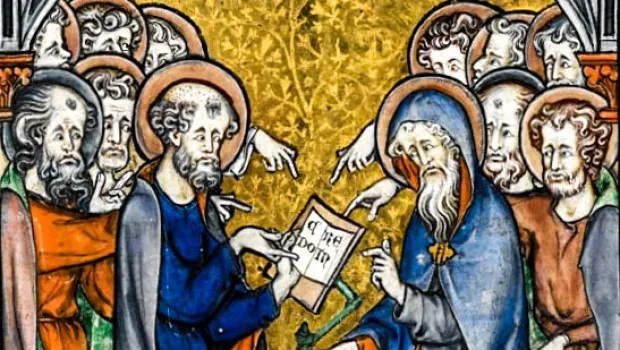
A 13th century artwork depicting the Apostles writing the Creed

Then, standing there in front of the place of worship, you must pray:

My ancestor was homeless,
an Aramean who went to live
    in Egypt.
There were only a few
    in his family then,
but they became great
and powerful,
    a nation of many people.

The Egyptians were cruel
    and had no pity on us.
They mistreated our people
    and forced us into slavery.
We called out for help
to you, the Lord God
    of our ancestors.
You heard our cries;
you knew we were in trouble
    and abused.
Then you terrified the Egyptians
with your mighty miracles
    and rescued us from Egypt.
You brought us here
and gave us this land
    rich with milk and honey.
Now, Lord, I bring to you
the best of the crops
    that you have given me.

After you say these things, place the basket in front of the Lord’s altar and bow down to worship him. (Contemporary English Version)

Forty years of wandering throughout the desert, in the backside of the wilderness. Having been delivered out of Egypt by the mighty hand of God, the Israelites were on a very circuitous journey to the Promised Land.

The Book of Deuteronomy is a restatement of the people’s history and God’s law for the generation about to enter the land of Canaan. Moses told the people that when they enter the land and have their first harvest of crops, they are to remember and give thanks for all their blessings.

People need to be reminded of important things. Sometimes, in the middle of success and good fortune, we can forget to savor the moment, neglect to appreciate what it took to get to this place, and fail to celebrate with others the God who has made good things happen.

Interestingly, in appreciation for the abundance of a harvest, Moses did not tell the people to give thanks for the weather or the crops themselves. Rather, they were exhorted to recall and retell the story of Israel and their ancestors.

Through historical narrative, the Israelites tethered themselves to their present reality. They located themselves in the past, as contemporary links in a holy chain that stretched generations, all the way back to the patriarch Jacob.

This sort of relational and generational gratitude is in stark contrast to what current cultural appreciation and thanksgiving is, for cars, homes, jobs, resources, and stuff. Although thankfulness is appropriate and necessary for those things, none of it is lasting and sustainable.

Beneath all of the purchased things and electronic devices is a longing for connection, a desire to know who we are, where we came from, and what our true roots are.

Greater emotional health comes from knowing where we came from. Our connections to family, friends, church, and community are a vital and essential piece of living a good life with satisfaction and contentment.

Healthy roots enable us to respond well to the challenges of life with strength and resilience.

One way to recall and remember is to recite a creed. Sadly, many churches today recoil at reciting creeds and confessions, as if this were a bad thing. But there is significance and power to a group of people who stand and recite an ancient creed together.

The Christian ecumenical church creeds, including the Apostles’ Creed, Nicene Creed, and Athanasian Creed, capture the settled convictions of early believers in Jesus as they struggled to express their faith in the church and the world.

Those creeds are a part of us, and of our collective spiritual history as the people of God. There are yet other kinds of creeds, as well. We have an even more ancient creed expressed in today’s Old Testament lesson – the sort of creed that tells a story.

Moses gave the Israelites some parting instructions to follow for their future worship in the Promised Land. When they enter the land a bring in their harvest, they were to bring the first-fruits of their crops to the priest, and then profess a creed, which is really a story, a historical narrative of God’s people.

Every Jewish farmer and worshiper who brought their crop to the priest would recite the creed about their ancestors suffering in Egypt and being redeemed by God through a great deliverance. God granted them the gift of land, a promised place to call their own.

We as the people of God must discern the importance of embracing the story of redemption, of crying out and being delivered from the shackles of sin, death, and hell. We receive this salvation with thanksgiving and joy.

Christians tell their story of deliverance not only through the ancient ecumenical creeds, but also through the sacramental means of communion. The Table proclaims the life and death of Christ, given for us, and for our salvation. It is a story with deep roots in the life of Israel.

Believers in Jesus are invited to participate is something bigger than themselves. The Christian’s story begins not at Pentecost in the New Testament, but in the promise to Abraham way back in the Old Testament.

The blessing given to Abraham was a blessing for all nations, not just Israel (Genesis 12:1-3). Knowing the roots of our spiritual life and Christian faith helps inform us how we are to live out that faith and life in this present time.

Within Christianity, our history and story is much bigger than Europe and Western civilization. The earliest church began in the Middle East. Ancient Christian traditions and churches still exist, and worship today in places like Egypt and Ethiopia. There are presently large numbers of Christians in every part of the world, especially in Latin America, Asia, and Africa.

Essentially, we are the lost, the last, the forgotten, the outsiders who cried out to God. And the Lord rescued us, blessed us with every spiritual blessing in Christ, and gave us the privilege of being ambassadors for Christ in the world.

We belong to God. Along with believers throughout the ages, and across the world, we declare:

I believe in God, the Father almighty,
creator of heaven and earth.

I believe in Jesus Christ, his only Son, our Lord.
He was conceived by the power of the Holy Spirit
and born of the Virgin Mary.
He suffered under Pontius Pilate,
was crucified, died, and was buried.
He descended to the dead.
On the third day he rose again.
He ascended into heaven,
and is seated at the right hand of the Father.
He will come again to judge the living and the dead.

I believe in the Holy Spirit,
the holy catholic Church,
the communion of saints,
the forgiveness of sins,
the resurrection of the body,
and the life everlasting. Amen.

Spiritual Wisdom and Power (1 Corinthians 2:1-5)

By Bible Art

When I came to you, brothers and sisters, I did not come proclaiming the testimony of God to you with superior speech or wisdom. For I decided to know nothing among you except Jesus Christ and him crucified. And I came to you in weakness and in fear and in much trembling. My speech and my proclamation were made not with persuasive words of wisdom but with a demonstration of the Spirit and of power, so that your faith might rest not on human wisdom but on the power of God. (New Revised Standard Version)

When it comes to proclaiming the gospel – the good news of Christ’s person and work – both the message and the messenger are important.

The Apostle Paul was dialed in and focused on the Cross of Jesus Christ. Although he could have used various methods of persuasion, he was determined to set aside all other means of proclamation, and declare Christ’s Cross as the message and method itself.

This means that Paul also deliberately faded himself into the background, in order to have the Cross of Christ in the foreground. He emphasized his own weakness, his fear and trembling, in order to highlight the strength and majesty of God.

Paul wanted the messenger to point to the message – which meant that all of his speaking allowed God’s Spirit and power to show itself through him, rather than in spite of him.

The Corinthians came to believe the message not because of a big showy demonstration of Paul’s strength, intellect, and wisdom. Instead, they embraced Christian belief because of spiritual power and effort.

If it is spiritual wisdom and power centered in the message of Christ’s Cross which saves us, then it is also more than good enough to sanctify us, as well, and be the core from which all of the Christian life emanates from.

The Apostle understood that he is God’s agent, God’s ambassador, but that God alone is the One who saves humanity and delivers them from sin, death, and hell.

Christ Carrying the Cross, by Martin Schongauer, c. 1480 C.E.

Paul’s argument doesn’t have anything to do with making sure that the word “cross” is said in every sermon and conversation, or that Christians have only one thing to talk about.

Instead, the Apostle wanted the Corinthian Church to distance themselves from their typical of use of worldly philosophical wisdom, in favor of a distinctly spiritual wisdom which demands a certain kind of ministry:

The cross of Jesus Christ is to be the central event in which all of Christian life and ministry revolves around. In other words, the shape of Christianity is cruciform.

And since the cruciform nature of Christianity is our reality, our wisdom is to be received and flow from the Cross of Christ. To do less is to rely upon a different power other than the distinctive spiritual power of Christ’s death.

It isn’t any one of us which breaks through to another’s spirit; the power of God compels a person to listen, receive the message, and be given faith to believe, grow, and spiritually mature.

When the good news of Christ’s person and work takes root and develops within us, then what comes out of us is spiritual power, and not our own homespun worldly human wisdom.

“Wisdom” is the ability to take a body of knowledge and apply it to concrete situations in life.

So, when it comes to spiritual wisdom, Christians mature in the grace and knowledge of the Lord Jesus; then, they learn to take this important body of knowledge and apply it to all of the various circumstances and situations they are faced with every day.

This isn’t to say that worldly wisdom has no merit or significance, or that it is misguided. Rather, it means that this sort of wisdom doesn’t have the ability, the strength, or the power to move and change us, or others, toward deliverance and new life. We need the wisdom of the Spirit for that. And Paul insisted that this wisdom comes from the Cross of Christ.

The crucifixion of Christ is the wise guide for all of the Apostle Paul’s theology, message, and ministry. That singular event was like a massive meteor hitting the ocean of humanity, with a powerful tsunami of spiritual power and grace still making waves up to this very day.

Indeed, the Cross of Christ impacts all of creation, the entire universe. The person and work of Jesus Christ has cosmic implications for the salvation and deliverance of everything from the grip of evil.

On the practical daily level of things, none of this is about trying to do or be better, to somehow work harder at being a Christian or doing Christian mission and ministry. The fact of the matter is that we can only give to others what we have received from God. This means that:

  • The Holy Scriptures are to be received with reverence and fear, as a message given for us to learn and know so well that it becomes as familiar to you as the backdoor of your house.
  • The Christian life is about dying to self, taking up one’s cross and following Christ. If we desire the power of the resurrection, then this will first require embracing and allowing the powerful suffering of the cross to do its work.
  • Faithfulness is at the heart of living. Our task is to show up, pay attention, and speak the truth in love, and let God use this to accomplish the Divine holy will. Being married to outcomes and consequences will likely lead to reliance upon worldly wisdom, and eventually disappointment.
  • The Cross of Christ is what everything and everyone hinges upon. The world does not revolve around you nor me. So, let’s get in sync with the Spirit of God and rely upon the cruciform power provided for us by means of Christ’s death.

O God, who for our redemption gave your only-begotten Son to the death of the cross, and by his glorious resurrection delivered us from the power of our enemy: Grant us so to die daily to sin, that we may evermore live with him in the joy of his resurrection; who lives and reigns now and forever. Amen.

Sing a New Song (Psalm 98:1-5)

Oh, sing to the Lord a new song!
For He has done marvelous things;
His right hand and His holy arm have gained Him the victory.
The Lord has made known His salvation;
His righteousness He has revealed in the sight of the nations.
He has remembered His mercy and His faithfulness to the house of Israel;
All the ends of the earth have seen the salvation of our God.

Shout joyfully to the Lord, all the earth;
Break forth in song, rejoice, and sing praises.
Sing to the Lord with the harp,
With the harp and the sound of a psalm, (New King James Version)

I still remember, years ago when I was in college, a guy with a pony tail and wearing flip-flops, walking up with a guitar on his back in front of a gathering of fellow students who were Christians.

Yet, most evident, was his broad smile which seemed to engulf his entire face. He talked about his life before Christ – which was all of his life up until the week before – and what Jesus had done for him.

Then, he took his guitar and announced that he wrote a song to this very text, the first few verses of Psalm 98. I wish I had a recording of it, especially because of how he sang it with such volume and exuberance, as if the words had just been crafted yesterday.

Even though the psalm is ancient, the psalmist himself was inviting people to sing a song infused with a new perception of life on this earth.

There is always plenty of room to reflect on what God has done, and is doing, in this very big world. Not only can we consider the immensity and intricacy of the created order, but we can also declare all the things we cannot detect with our five senses.

And perhaps those are the things which impact us the most, when we sense and feel the reality of God’s work in the world, and in our lives. At least that’s what my pony-tailed smiling friend was so excited about.

The things which exist beyond our normal human experience are no less real than our daily mundane activities. This is the realm where the Lord makes the greatest impact of all. God hasn’t only done great things, but has done great things for me.

We have to use metaphors and personifications in order to even begin understanding the wonder and awe of God’s saving power in our very real here-and-now lives. God’s mighty right hand and holy arm of power speak to the incredible strength and authority which can reach into the thickest and nastiest of garbage dumpsters to pull out the pearl of great price, that is, you and me.

Consider God, the One who puts all things right, and is just and good in all things – paying attention to the least of us, and lifting up with divine deliverance from the most dire and awful of circumstances.

Indeed, the Lord has made God’s salvation known, and revealed God’s righteousness to the nations.

Sometimes it takes someone with a fresh new song to wake us up to the reality that we can discern the activity of God every day, in all the ordinary and myriad ways of our lives. Along with all of creation, and pony-tail guy, we join the chorus of those who are already singing with the unique voice God provided for us.

And those many songs all include, at their center, the reality that before I chose God, God chose me; that when I forget, God remembers; that with my waxing and waning of love, God is consistently steadfast and faithful with love; and that God provides salvation, and judges the people with equity, even when I show favoritism.

With each new testimony of God’s saving work, it becomes harder and harder for others to insist that God is absent, hidden, or negligent. God is there. God is here. God is everywhere.

We can get so wrapped up in our own small worlds, and our own little safe places, where everyone looks like me, acts like me, and thinks like me. But the world is much bigger than our contrived spaces in which we can set ourselves up as master and commander.

The Lord mercifully breaks through all of our puny posturing and petulance, and saves us from ourselves. God pushes and cajoles us to see beyond the end of our noses. We are moved to see a new perspective we haven’t noticed before.

And once we make out what God is doing, and does for me, then bursting into song with shouting and volume is the organic response to our experience. If you think about it, there is really no other way to respond, once you have gotten a glimpse of God’s activity, and discerned something that was previously undiscernible.

Even the rocks will cry out in the face of such love and grace.

It’s okay to open your mouth, once your eyes have been opened, and let a new song come tumbling out. Because joy is the response of being delivered from what once bound us.

Gracious and Loving God, you have filled the world with beauty: Open our eyes to behold your gracious hand in all these works; that, rejoicing in your whole creation, we may learn to serve you with gladness; for the sake of him through whom all things were made, your Son Jesus Christ our Lord.