
Justice Remembered (Exodus 12:1-13, 21-28)

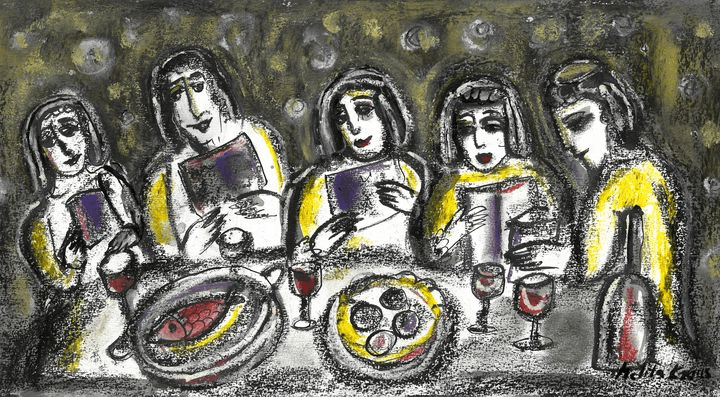
Passover Seder, by Melita Kraus

The Lord said to Moses and Aaron in the land of Egypt, “This month shall mark for you the beginning of months; it shall be the first month of the year for you. Tell the whole congregation of Israel that on the tenth of this month they are to take a lamb for each family, a lamb for each household. If a household is too small for a whole lamb, it shall join its closest neighbor in obtaining one; the lamb shall be divided in proportion to the number of people who eat of it. 

Your lamb shall be without blemish, a year-old male; you may take it from the sheep or from the goats. You shall keep it until the fourteenth day of this month; then the whole assembled congregation of Israel shall slaughter it at twilight. They shall take some of the blood and put it on the two doorposts and the lintel of the houses in which they eat it. 

They shall eat the lamb that same night; they shall eat it roasted over the fire with unleavened bread and bitter herbs. Do not eat any of it raw or boiled in water but roasted over the fire, with its head, legs, and inner organs. You shall let none of it remain until the morning; anything that remains until the morning you shall burn with fire. 

This is how you shall eat it: your loins girded, your sandals on your feet, and your staff in your hand, and you shall eat it hurriedly. It is the Passover of the Lord. I will pass through the land of Egypt that night, and I will strike down every firstborn in the land of Egypt, from human to animal, and on all the gods of Egypt I will execute judgments: I am the Lord. The blood shall be a sign for you on the houses where you live: when I see the blood, I will pass over you, and no plague shall destroy you when I strike the land of Egypt….

Then Moses called all the elders of Israel and said to them, “Go, select lambs for your families, and slaughter the Passover lamb. Take a bunch of hyssop, dip it in the blood that is in the basin, and touch the lintel and the two doorposts with the blood in the basin.

None of you shall go outside the door of your house until morning. For the Lord will pass through to strike down the Egyptians; when he sees the blood on the lintel and on the two doorposts, the Lord will pass over that door and will not allow the destroyer to enter your houses to strike you down. 

You shall observe this as a perpetual ordinance for you and your children. When you come to the land that the Lord will give you, as he has promised, you shall keep this observance. And when your children ask you, ‘What does this observance mean to you?’ you shall say, ‘It is the Passover sacrifice to the Lord, for he passed over the houses of the Israelites in Egypt when he struck down the Egyptians but spared our houses.’ ” And the people bowed down and worshiped.

The Israelites went and did just as the Lord had commanded Moses and Aaron; so they did. (New Revised Standard Version)

The Exodus, by Yoram Raanan

Today’s story of Passover is the highlight of Jewish history concerning both God’s judgment and God’s justice. It is a continual reminder that God is concerned with the divine Name; with his people; and with providing them what they need.

The Lord’s tenth and final plague against the Egyptians was the ultimate judgment of taking their firstborn children. At the same time, the Lord extended great justice to the Israelites by removing the oppressive obstacles which hindered them from having their basic human needs met.

Both God’s judgment and God’s justice were to be annually remembered through rituals established by God. These remembrance rituals of Passover are meant to be brought perpetually to Jewish minds, so that they will maintain a high view of Gods’ Name, and also never be a nation who acts like the Egyptians.

Passover and Exodus constituted a new beginning and new life for Israel. Slaughtering the Passover lamb was the start of liberation for the people; along with the eating of unleavened bread. Both the blood of the lamb, and the absence of leaven, together communicated freedom to the Israelites from God.

Even today, nearly four millennia later, Passover is still celebrated amongst the Jewish community as a great festival of freedom. The primary ritual in this celebration is the seder, an evening meal which involves eating several symbolic foods.

The purpose of coming together to eat special foods is to relive the experience of the Exodus from Egypt. It is a time of passing down the people’s communal memory, as well as reflecting upon God’s divine redemption for them.

The Passover rituals are the root of Christianity’s celebration of communion at the Table. For Christians, the final seder meal of Jesus and his disciples at the Last Supper in the Upper Room is remembered and relived, so that believers may contemplate the Cross of Christ as the ultimate divine redemption.

Table fellowship for both religions – Judaism and Christianity – has a central place in ritual remembrance. God is acknowledged and praised as the great Liberator from oppression. Justice is memorialized. Past events are remembered in order to live justly and rightly in the present.

Deliverance of people from both physical and spiritual slavery is a grand theme throughout all of Holy Scripture. People of freedom are never to let themselves again be placed in bondage. The New Testament puts the matter this way:

For freedom Christ has set us free. Stand firm, therefore, and do not submit again to a yoke of slavery. (Galatians 5:1, NRSV)

The yearning for freedom from oppression and injustice lies within the breast of every human on this earth. It’s why people will go out of their way to use whatever means they have of standing against abusive powers.

It is more than ironic that there are people today who espouse themselves as Christian, yet are hell-bent on using whatever means they have to oppress and abuse others into submission. Such persons are not demonstrating care for the Name of God, especially not the Name of Jesus Christ. Instead, they have another agenda – one that has nothing to do with liberation and freedom.

This is one big reason why we need rituals. Rituals keep us remembering the things we need to remember, and help us forget the things we need to forget.

Earthly power is not the summum bonum of life. Rather, real power is Love. Again, quoting the Apostle Paul from the Book of Galatians:

For you were called to freedom, brothers and sisters, only do not use your freedom as an opportunity for self-indulgence, but through love become enslaved to one another. For the whole law is summed up in a single commandment, “You shall love your neighbor as yourself.” If, however, you bite and devour one another, take care that you are not consumed by one another. (Galatians 5:13-15, NRSV)

Indeed, all that really counts for us in this life is “faith expressing itself through love.” (Galatians 5:6)

Remembering true freedom, and it’s real cost, through established rituals, is perhaps the best way of ensuring that the oppression and injustice of empires like Egypt and Rome do not happen in our present day.

Therefore, if we lose connection with important and seminal events of the past without ritual remembrance, we are setting ourselves up for terrible injustice to occur.

We are better than that. Redemption and remembrance can help show us the way.

Great God of all justice, righteousness, and redemption: Continue to break the yoke of Pharaoh in our time, and forever shatter the bonds of human oppression.. Hasten the Day when we shall all be free, at the coming of your Son, our Lord, Jesus Christ, who with you and the Holy Spirit are one God, now and forever. Amen.

The Lord Will Grant Me Justice (Isaiah 49:1-7)

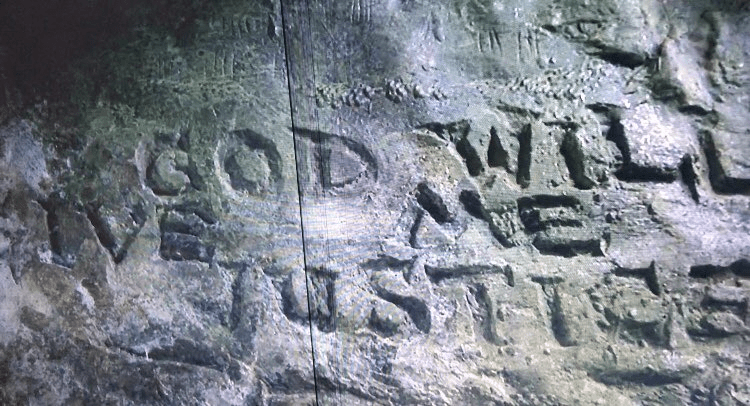
From the final of scene of “The Count of Monte Cristo,” 2002 film from Touchstone Pictures

Listen to me, coastlands;
    pay attention, peoples far away.
The Lord called me before my birth,
    called my name when I was in my mother’s womb.
He made my mouth like a sharp sword,
    and hid me in the shadow of God’s own hand.
He made me a sharpened arrow,
        and concealed me in God’s quiver,
    saying to me, “You are my servant,
        Israel, in whom I show my glory.”
But I said, “I have wearied myself in vain.
    I have used up my strength for nothing.”
Nevertheless, the Lord will grant me justice;
    my reward is with my God.
And now the Lord has decided—
    the one who formed me from the womb as his servant—
    to restore Jacob to God,
    so that Israel might return to him.
    Moreover, I’m honored in the Lord’s eyes;
    my God has become my strength.
He said: It is not enough, since you are my servant,
    to raise up the tribes of Jacob
    and to bring back the survivors of Israel.
    Hence, I will also appoint you as light to the nations
    so that my salvation may reach to the end of the earth.

The Lord, redeemer of Israel and its holy one,
    says to one despised,
    rejected by nations,
    to the slave of rulers:
    Kings will see and stand up;
    commanders will bow down
    on account of the Lord, who is faithful,
    the holy one of Israel,
    who has chosen you. (Common English Bible)

The Servant in today’s Old Testament lesson is referred to as Israel. Israel’s role is identified as being the covenant people of God. And Israel’s purpose is to be a light to the nations. It was the Lord’s intention that through this covenant community God’s glory would be revealed.

But in much of Israel’s history, this purpose and mission from God did not shake-out very well among the people. The prophets were sent to Israel’s leadership in order to point out the incongruence between Israel’s call from God from their actual lived experience.

Among the prophets, like Isaiah, was modeled for the people what they should have been doing all along: Persevering in faithful suffering for the sake of the surrounding nations. Yet, instead of embracing this difficult commission, Israel largely appropriated worship practices and dubious morality from the nations.

Whereas light was supposed to shine in the darkness, the light was hidden and the darkness overwhelmed it.

However, light cannot stay hidden for long. Servant Israel nonetheless discovered what it meant to suffer for righteousness sake. The Servant confessed having fallen short of God’s glory while also speaking confidently about God’s abiding faithfulness.

There is here a recognition by the Servant that Israel’s purpose and mission has not yet been fulfilled. A big task still awaits to bring forth justice to the nations.

Oftentimes, whenever we think of justice, we may tend toward believing that it refers to divine judgment, as if the task is to make sure the bad guys get it in the  end. But that’s a Western movie understanding in which the Sheriff puts some lead in the bandits bellies.

“Justice” in Holy Scripture refers to the good guys – that they receive what they need to live and flourish on this earth. Whenever food, clothing, housing, or basic human rights are withheld or ignored by those in power, that’s injustice. And God is most concerned that everyone receives proper justice, that is, having everything they need for life and godliness in this present evil age.

So, what God cares about, the Servant is to care about. Since God cares about justice, so the Servant is to work toward ensuring there is justice for all.

God has provided. It is the Servant’s task to use that provision and live into the vocation given by God. In other words, the Servant has been equipped to do the work. There’s no excuse for injustice.

Wrapped-up in this call for justice is making sure that the faithful in Israel bring back the unfaithful, so that everyone together might fully engage in God’s purposes for humanity and reach the nations with deliverance from all that stands in the way of justice.

God is continually on a mission of bringing back wayward people. It is the role of God’s people to honor and glorify God by fulfilling their divine call to the nations. The Lord desires restoration, and wants to work with people in a divine/human cooperative which establishes just practices for the common good of everyone on planet earth.

Real strength comes from the Lord. There’s empowerment for God’s people to return to their sense of vocation, to be a light to the nations, and to realize deliverance from injustice so that people may thrive and enjoy creation and the Creator forever.

No matter what the circumstances one faces in this life, everyone has the capacity to trust in God in the middle of their suffering and/or discouragement. It’s in this context that the light of God is best shown among the nations.

Others rarely take note of believers’ faith when things are going well. It’s easy to show faith when life is good. But when life is precipitous, when situations are dire, and the believer nonetheless has a genuine and confident trust that God’s justice will prevail, then the world takes notice of that kind of faith.

Right now many people are facing hardship and feeling powerless due to governmental interventions that they don’t want and didn’t ask for. It’s easy to become discouraged and to be fearful of what will happen.

I definitely feel it. I have a 36-year-old daughter who is a white Christian mother of three living in Minneapolis. Sound familiar? It’s people like my sweet girl who are getting oppressed, abused, even killed. It’s unjust and unrighteous.

God is looking for justice in the public square. God does not forget the downtrodden, the immigrant, the weak, and the powerless. And God holds those in power to account – whether they are using their resources for justice or injustice.

What I need to hear, and maybe you do too, is that ultimately God is still on the throne – and not any earthly ruler or president or national leader of any kind. God still cares about the needs of everyone. The Lord has a heart and a passion for justice for all, and not just some.

The Lord will grant me and you justice.

Grant, O God, that your holy and life-giving Spirit may so move every human heart, that barriers which divide us may crumble, suspicions disappear, and hatreds cease; that our divisions being healed, we may live in justice and peace; through Jesus Christ our Lord. Amen.

It’s Time To Wake Up – First Sunday of Advent (Romans 13:11-14)

Besides this, you know what time it is, how it is already the moment for you to wake from sleep. For salvation is nearer to us now than when we became believers; the night is far gone; the day is near. Let us then throw off the works of darkness and put on the armor of light; let us walk decently as in the day, not in reveling and drunkenness, not in illicit sex and licentiousness, not in quarreling and jealousy. Instead, put on the Lord Jesus Christ, and make no provision for the flesh, to gratify its desires. (New Revised Standard Version)

But make sure that you don’t get so absorbed and exhausted in taking care of all your day-by-day obligations that you lose track of the time and doze off, oblivious to God. The night is about over; dawn is about to break. Be up and awake to what God is doing! God is putting the finishing touches on the salvation work he began when we first believed. We can’t afford to waste a minute, must not squander these precious daylight hours in frivolity and indulgence, in sleeping around and dissipation, in bickering and grabbing everything in sight. Get out of bed and get dressed! Don’t loiter and linger, waiting until the very last minute. Dress yourselves in Christ, and be up and about! (The Message)

I like metaphors, that is, word-pictures that help illustrate and visualize a concept or idea. That’s probably why I like the Apostle Paul, because I find in him a guy who appears to have the same affinity for metaphors that I do.

In the New Testament reading on this First Sunday of Advent, Paul gives four metaphors to help us grab ahold of what he wants to get across to us:

We are not in some holding pattern, passively awaiting heaven. This is because our salvation is not yet complete. Completeness won’t happen until Jesus returns, until the second advent of Christ. Therefore, we are to be active now, working on our faith commitment to Jesus and to his church.

In this advent season, as we remember Christ’s first “advent” (or “coming”) to this earth, we are equally anticipating the second coming of Christ – not knowing quite when that will occur. Only until this event happens will our salvation come in all of its fullness.

The church is a unique community of persons who continually have an eye toward the future return of Jesus. And this future orientation is supposed to give shape to how we live in the present time.

The world-wide Christian community presently follows the way of deliverance. This current time and place is not the arrival point. Today doesn’t mark the time in which our salvation is fully realized or acquired.

In other words, we are to avoid acting as if this is our permanent home. Rather, we are pilgrims on this earth, sojourning through it as if we were but camping out. Our true home is someplace else. And we will get there when Christ comes again.

There is a stark contrast between those who put all their eggs into the present earthly basket, and those who maintain a future orientation of working now with an eye out for Jesus to return. This contrast is illustrated by Paul with images of what it’s like to live for and in the Roman society; and what it’s like to live with Jesus as Lord, instead of Ceasar.

Are you asleep or awake, living for the night or in the day?

Therefore, keep awake, for you do not know when the master of the house will come, in the evening or at midnight or at cockcrow or at dawn, or else he may find you asleep when he comes suddenly. (Mark 13:35-36)

Paul, taking his cues from Jesus, exhorted the believers to stay alert and be prepared for the end when it comes. Living for the nighttime is a metaphor for giving-in to one’s personal sinful desires; whereas living in the daylight hours is a picture of following the words and ways of Jesus.

What are you wearing? What are you taking off, and what are you putting on?

Using the metaphor of clothes – undressing and dressing oneself – Paul is talking about exchanging one set of clothing for another. This isn’t merely putting on a different pair of jeans than what you already have on. It’s much more radical than that. It’s doffing the tuxedo and donning the overalls. The picture is one of doing something completely different than what you’ve been doing before.

Paul wanted a complete makeover, a total change of moral and ethical behavior that is consistent with the gospel of Christ, and not with typical Roman society. It involves taking up one’s cross and following Jesus. It’s gritty and dirty and gets down to it; instead of avoiding hard work and seeking to have someone else do what is unpleasant to me.

Our allegiance and commitment to Christ is on full public display – not in placards with Bible verses on them, but with the sweet aroma of living a humble and just life in all of its simplicity and holiness.

Will you do the works of darkness, or take up the armor of light?

The darkness represents the unjust life of lies, selfishness, conflicts of interest, relational discord, and immoral actions. The light is meant to convey a beautiful life of integrity, wholeness, righteousness, and peace through loving actions.

Christians are to progressively take on the character of Christ, and not of whatever political character happens to be in power.

Using the metaphor of armor points us not only toward the struggle we confront in living a moral and righteous life, but also toward Christ who is our Divine Warrior. Jesus is the One who fights the battle and wins the victory.

Our struggle is not against flesh and blood, but “against the rulers, against the authorities, against the cosmic powers of this present darkness, against the spiritual forces of evil in the heavenly places.” (Ephesians 6:12)

Do you know what time it is? Is there any hopeful expectation?

The Christian is one who knows the time is nearer now than when they first believed. We may not know the precise date on the calendar when Jesus will come again, yet we are convinced that he is returning soon.

Therefore, the believer has no business spending time in trying to predict the day of the end. Instead, the believer must remain faithful and persevere to the end with a firm commitment to Christ, and a dedication to doing what is good, right, and just.

So, herein lies the challenge for every believer: Those of us who name Jesus as Lord will continue to live in a world of injustice and unrighteousness. Christians are continually being pulled in differing directions all at once, all the time.

It’s a hard slog. Yet the Christian finds joy and satisfaction in knowing who they are, who they believe in, and who is coming back to make all things new.

Christianity involves a whole lot more than praying a salvation prayer once, then going on one’s merry way, doing whatever the heck one wants to do.

Rather, Christianity is a radical existence of waking from sleep and changing allegiances from immoral leaders to the true sovereign of the universe.

It’s like moving from seeing shadowy forms just before the dawn to seeing clearly in the sun’s full light of day.

It’s as if I’ve been given a completely new set of clothes to put on, giving up the rags of this world for the raiment of being adopted into royalty.

We remain continually vigilant, always watching, always praying, always believing, always loving – knowing that our salvation is at hand, nearly here, and could happen at any moment.

God of justice and peace, from the heavens you rain down mercy and kindness, so that all on earth may stand in awe and wonder before your marvelous deeds. Raise our heads in expectation, that we may yearn for the coming day of the Lord and stand without blame before your Son, Jesus Christ, who lives and reigns forever and ever. Amen.

The Healing of the Demoniac (Luke 8:26-39)

Mosaic of the exorcism of the Gerasene demoniac from the Basilica of Sant’Apollinare Nuovo, 6th century C.E.

Then they arrived at the region of the Gerasenes, which is opposite Galilee. As he stepped out on shore, a man from the city who had demons met him. For a long time he had not worn any clothes, and he did not live in a house but in the tombs. 

When he saw Jesus, he cried out and fell down before him, shouting, “What have you to do with me, Jesus, Son of the Most High God? I beg you, do not torment me,” for Jesus had commanded the unclean spirit to come out of the man. (For many times it had seized him; he was kept under guard and bound with chains and shackles, but he would break the bonds and be driven by the demon into the wilds.) 

Jesus then asked him, “What is your name?” He said, “Legion,” for many demons had entered him. They begged him not to order them to go back into the abyss.

Now there on the hillside a large herd of swine was feeding, and the demons begged Jesus to let them enter these. So he gave them permission. Then the demons came out of the man and entered the swine, and the herd stampeded down the steep bank into the lake and was drowned.

When the swineherds saw what had happened, they ran off and told it in the city and in the country. Then people came out to see what had happened, and when they came to Jesus, they found the man from whom the demons had gone sitting at the feet of Jesus, clothed and in his right mind. And they became frightened. Those who had seen it told them how the one who had been possessed by demons had been healed. Then the whole throng of people of the surrounding region of the Gerasenes asked Jesus to leave them, for they were seized with great fear. So he got into the boat and returned. 

The man from whom the demons had gone out begged that he might be with him, but Jesus sent him away, saying, “Return to your home, and declare how much God has done for you.” So he went away, proclaiming throughout the city how much Jesus had done for him. (New Revised Standard Version)

Jesus exorcising the Gerasene demoniac, from the Hitda Codex

Jesus came to this earth to deliver people from all obstacles that gets in the way between us and God, so that humanity may freely connect with the divine, each other, and creation.

Whether it was in the synagogue, in public, in private, in a Jewish community, or in Gentile territory, Christ’s ministry was marked by healing people. He did this so that people could (re)attach themselves to the neighborhood, to God, and even to themselves.

Today’s Gospel story has Jesus take an unexpected trip across the Sea of Galilee to a foreign place full of non-Jewish persons. It was a place marked by all sorts of ritual impurity, and sorts of Gentile practices which a good Jew would have nothing to do with.

So, it’s no surprise, in a heathen setting, that Christ encountered the demonic in the form of a man riddled with demons to the point of being named “Legion.” This confrontation became a type of wild west shootout between the superhuman tortured man and the divinely filled Son of God.

The confrontation was intense. The atmosphere was charged with anticipation that someone wasn’t going to walk away from this shootout. But Jesus knew what he was doing: Christ was about to breakout a man from a demonic prison; and it would not go well for the demons.

In this remote western town, Jesus ended up performing a most extraordinary miracle. It would take a miracle to free this demonized person from his satanic jailcell. The legion of demons, however, were no match for the singular Son of God. Christ had no problem using his authority to exorcise the demons from the victimized man.

The demons exited the man and entered an entire herd of pigs. The herd then proceeded to destroy themselves in a powerful scene of what the demonic is all about. Yet, rather than acknowledging a divine miracle, those who were tending the pigs went and told the people in the area of how this interloper came along and upset the status quo. Instead of seeing a delivered man, the pig herders could only see dead swine.

As a result of the pig herders report, the folks in nearby towns wanted nothing to do with Jesus. The people begged him to get out of town. Christ purged the region of a significant presence of bad guys, and all the townspeople could do was fear for what might happen.

But despite the townspeople’s and pig herders’ disturbing lack of faith, there was one man who became a committed disciple of Jesus on the spot. The demoniac, now turned new citizen of God’s kingdom, saw Christ for who he was, and immediately discerned to whom he belonged – not the demonic world but the kingdom of heaven.

Although the newly delivered man begged to remain with Jesus, the Lord had another plan for the new disciple. Christ sent him back to his home to proclaim what God had done for him. In doing so, the man would become a powerful witness to God’s power. And, important for the man, old broken familial and community relations could be renewed and restored. The healing would come full circle.

If we bear witness to the works of God, where we are, it will bear fruit – even if it is among folks who may be in opposition to it.

Not even a legion of demons could keep Christ from restoring a tortured person to himself, his family, and his community. And it all happened on the demons’ turf. Nothing can stop the kingdom of God from expanding it’s good reach over all that is evil.

The good news of Christianity is that Jesus has the power to bring life from death. Christ has the ability to put us in a position where we can reconnect with both the human community and the divine realm.

The satanic in this world is not nearly as powerful as God; and the demons are under Christ’s authority. In fact, there is no power on earth (or under the earth) that can overcome the strength of the almighty God. This can be a comforting thought for every Christian.

Anyone afraid of Jesus has not yet discerned that he is inherently good. Ultimate power needs to be seen in the light of ultimate good. Otherwise, a person will walk around much like the demoniac, oppressed in their soul.

Instead, deliverance from the evil which vexes us is possible. For nothing is impossible with God. Whenever and wherever the healed person becomes a healer to others, then we know that the kingdom of heaven is among us.

Hear our prayers, God of power and might. Through the ministry of your Son, free us from the grip of the tomb, so that we may desire you as the fullness of life, and proclaim your saving deeds to all the world in the strength of the Holy Spirit. Amen.