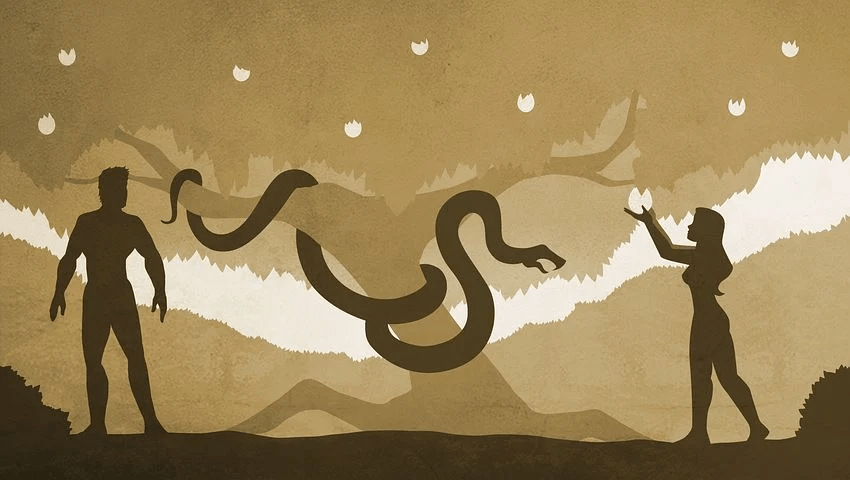
The Fall of Humanity (Genesis 2:15-17, 3:1-7)

The Lord God took the man and put him in the Garden of Eden to work it and take care of it. And the Lord God commanded the man, “You are free to eat from any tree in the garden; but you must not eat from the tree of the knowledge of good and evil, for when you eat from it you will certainly die….”

Now the serpent was more crafty than any of the wild animals the Lord God had made. He said to the woman, “Did God really say, ‘You must not eat from any tree in the garden’?”

The woman said to the serpent, “We may eat fruit from the trees in the garden, but God did say, ‘You must not eat fruit from the tree that is in the middle of the garden, and you must not touch it, or you will die.’”

“You will not certainly die,” the serpent said to the woman. “For God knows that when you eat from it your eyes will be opened, and you will be like God, knowing good and evil.”

When the woman saw that the fruit of the tree was good for food and pleasing to the eye, and also desirable for gaining wisdom, she took some and ate it. She also gave some to her husband, who was with her, and he ate it. Then the eyes of both of them were opened, and they realized they were naked; so they sewed fig leaves together and made coverings for themselves. (New International Version)

Lent is a 40-day season of preparation and repentance for Christians anticipating Good Friday’s cross of Christ and the victory over sin in Easter’s celebration of Christ’s resurrection. To understand why there is a need for repentance, let’s turn to where disobedience, shame, and guilt first entered the world.

Ever since humanity’s fall into sin, our human nature tends to look at the one thing we can’t do, instead of seeing all the range of possibilities that we can do.  The serpent (the devil) was successful in getting Adam and Eve to focus on that one tree they needed to avoid. In our fallen condition, just tell us what we can’t do and we’ll probably be sure to do it – rather than enjoy all the vast prospects we presently have and can actually do with God. 

What’s more, the devil subtly planted a terrible and untruthful idea in the heads of Adam and Eve – that God was somehow holding out on them and was not providing everything they really needed and wanted in life.

Sin may look attractive, and even initially taste good. Yet, disobedience has an awful aftertaste and damages our insides. Indeed, sin always over-promises and under-delivers.

Perhaps the greatest and deepest effect of sin is the shame of disobedience which causes us to hide from God, one another, and even ourselves. All this hiding causes spiritual blindness. We end up sleepwalking through hell, unaware of our awful spiritual plight. 

Because of this reality, we need deliverance; we need a Savior to intervene and save us from our ignorance and guilt. As mere dust, we need God’s Spirit to breathe new life into us so that we may again enjoy the Lord in Paradise.

Our fallen spiritual condition does not want to acknowledge our need for the sheer grace of God. Sewing some fig leaves together is symbolic of Adam and Eve’s new independence from God; from now on, they’re going to operate on their own.  The introduction of sin into the world causes people to look for ways to cope and deal with life apart from God.

We want to return to Paradise. We don’t want to hurt and struggle and be overburdened anymore. So, we devise all kinds of ideas and ways of doing that. And the Paradise we seek always seems to be “out there” somewhere, just out of our reach. 

In our fallen condition, we are plagued with the “if only” syndrome:

If only I had _____ (fill-in the blank) then I would be happy and be in Paradise.

If only I could meet the right person, then that special someone could meet my needs and complete me.

If only the people in my life were better, then everything would be okay and I could enjoy Paradise.

If only I had more money, a bigger house, another car, more power and influence.

If only other people would stop being jerks, care more, serve more, love more. If only my family would listen to me.

If only I could have my way, then there would surely be a restoration to Paradise.

The point to all the “if only” is that it twists us all up into believing that I’m either unlovable or that everyone else is the problem. If they would just change, then the world would be a better place. Or if only I was better, then I wouldn’t have so many problems.

The truth, however, is that we already have what we are so desperately looking for. And since we are unaware that God is with us, and wants to provide for us, we sew fig leaves together and look love in all the wrong places.

No man or woman is going to complete you because no person can fix what is broken in your heart. If you had your ideal relationship, perfect family, and dream job, you would still be empty. Why? Because you and I need a Savior to deliver us from our sin.

We all need deliverance from our disordered loves and misguided attempts to find Paradise in this life apart from God. The temptation after The Fall is to try and manufacture happiness outside of God through perfect relationships and ideal circumstances. 

What to do? Repent. Turn from the shame and guilt of disobedience and deal with the brokenness in our own lives. And that is what the season of Lent is all about.

Without God there are hidden feelings of mistrust, alienation, conditional love, selfishness, greed, and injustice. But with God there is forgiveness, grace, and unconditional love – the very kind of love that we need.

In this season of Lent, we must repent of our hiding and wishing for everything and everyone else to be different without any cost to myself. 

What do you need to repent of in this season? 

Who are the people that you look to do for you what only God can do? 

Have you forsaken your first love of Jesus Christ? 

How is the state of your relationship with God? Has it been stale, dull, and lacking passion, desire, and energy?  Has distance replaced intimacy between you and God? 

Do you avoid the spiritual disciplines of bible reading and prayer because you believe something else will satisfy the real needs of your heart? 

Are you keeping up appearances and hiding, while on the inside you have doubt, depression, and despair that things will never change? 

The prayers of this season are to be prayers of repentance:

Merciful God, we confess that we have hungered after things which do not satisfy.  We have doubted your ability to provide for us. Forgive our lack of faith. Restore in us such trust and love that we may again walk with you in Paradise. 

Loving God, we admit that we’ve given ground to Satan by believing his deception that we can find ultimate happiness in things other than you. So, in the name of the Lord Jesus Christ, we resist all of the devil’s strategies to hold us in spiritual blindness and darkness. 

Blessed Holy Spirit, we invite you to bring the fullness of your power to convict us and lead us into faith in Jesus. We humbly ask that you bring all the power of Christ’s crucifixion and resurrection directly against all forces of darkness seeking to destroy us. Set us free from all that blinds us and keeps us in bondage. 

Grant us, O God, the grace to be faithful and persistent in our walk with you.  Amen.

To the Family of God (2 John 1:1-16)

St. John the Apostle, by sculptor Thomas Ball (1819-1911)

From the Elder—

To the dear Lady and to her children, whom I truly love. And I am not the only one, but all who know the truth love you, because the truth remains in us and will be with us forever.

May God the Father and Jesus Christ, the Father’s Son, give us grace, mercy, and peace; may they be ours in truth and love.

How happy I was to find that some of your children live in the truth, just as the Father commanded us. And so I ask you, dear Lady: let us all love one another. This is no new command I am writing you; it is the command which we have had from the beginning. This love I speak of means that we must live in obedience to God’s commands. The command, as you have all heard from the beginning, is that you must all live in love.

Many deceivers have gone out over the world, people who do not acknowledge that Jesus Christ came as a human being. Such a person is a deceiver and the Enemy of Christ. Be on your guard, then, so that you will not lose what we have worked for but will receive your reward in full.

Anyone who does not stay with the teaching of Christ, but goes beyond it, does not have God. Whoever does stay with the teaching has both the Father and the Son. So then, if some come to you who do not bring this teaching, do not welcome them in your homes; do not even say, “Peace be with you.” For anyone who wishes them peace becomes their partner in the evil things they do.

I have so much to tell you, but I would rather not do it with paper and ink; instead, I hope to visit you and talk with you personally, so that we shall be completely happy.

The children of your dear Sister send you their greetings. (Good News Translation)

The Pastor

Tucked away near the back of the Bible is a short little letter from the Apostle John, identifying himself as “The Elder.” This is meant to convey both his venerable leadership and his affectionate relation as the grandfatherly old man who has something important to say. In other words, John was, in our terms, a Pastor responsible for shepherding the church with care.

The Church and Christians

“The dear Lady” is a metaphor for the church. Through personifying the church, John was assigning worth, respect, and dignity to the mother with spiritual progeny.

“Her children” are the believers within the church, spiritual offspring with the church as their mother. This has been an important motif for most of Christian history – an understanding that has gotten lost over the centuries in much of the Protestant world. Yet, one of the magisterial reformers, John Calvin, retained this view of the church and its members:

“The Church is the bosom which God is pleased to gather his children… who are guided by her motherly care until they mature and at last reach the goal of faith…. How useful, indeed how necessary, it is that we should know her. For there is no other way to enter into life unless this mother conceive us in her womb, give us birth, nourish us at her breast, and keep us under her care and guidance… Our weakness does not allow us to be dismissed from her school until we have been pupils all our lives.”

(Institutes of the Christian Religion, 4.1, 4)

Indeed, Calvin was merely upholding the words of St. Cyprian, Bishop of Carthage (c.200-258, C.E.)  who stated 1,300 years earlier than the reformer:

“No one can have God as Father who does not have the church as Mother.”

St. Cyprian (On the Unity of the Catholic Church, ch.vi)

Love and Truth

The relationship between the mother and her children is to be always characterized by familial love. Everything within Christianity rises and falls with love because God is love.

God extends loving words and actions because love is the stuff that God is made up of. The very character of God is love, through and through. There is never a time when God is not loving.

In fact, God’s anger and wrath are expressions of love – for God is opposed to all which is unloving. Therefore, God extends justice and confronts sin so that love will freely flow once again amongst humanity and all creation.

God is not okay with deceit, not at all alright with errant understandings of his Son, Jesus Christ, being made out as a mere phantom without a real flesh-and-blood body. He had to be made like us in every way. Otherwise, there is no deliverance from the deceitfulness of sin, the sting of death, and the agony of hell.

John, as the Apostle of love, consistently espoused the primacy and permanence of love whenever he had the chance. Truth and love go together, always, insisted John. Love is only really possible when there is truth in the heart.

The true muster of mother church and of individual believing children is their love. No matter what is done – whether outreach, fellowship, or worship – it is all to be done in love and in truth. It’s not enough to be right; the rightness must be applied with the generosity, grace, and liberality of love.

The telltale sign of the deceiver, the false teacher, is that he proclaims only one without the other, either truth or love, but never both together.  

A profound lack of love is the litmus test that belies a faulty and heretical doctrine of Jesus. The absence of love is a red flag that impure teaching is happening. The real enemy of Christ is the one who claims Christianity but does not love, neither in word nor deed. If we really want to love God, we will love one another, and vice-versa.

Love and truth always go together. A mother is a mother because of her children; and a child is a child because of the mother. You cannot have one without the other.

To embrace truth is to love a group of people wherever they are. It is to see them, listen to them, then act on their behalf. Far too often Christians are known for their hubris in superimposing on others what those others need – believing they already know the truth of both Bible and them.

Love abides with the truth of a people. Genuine love seeks the truth and responds accordingly. Love is willing to find out what the issues are of a people. Assuming others need our money, our plans, our service, or our solutions, assumes we already understand their situation without hearing from them.

Love is longsuffering. It is willing to sit with folks for as long as it takes. Love finds itself by carefully applying biblical truth to the truth of a people. And that takes a great deal of time and effort. There are no shortcuts to love.

Love must have its way, or it isn’t love.

Since God is love, God must have his way in us first.

Hope and Happiness

Hope is a confident expectation that promises will be kept and realized.

Happiness is the result.

Hope and happiness go together like bacon and eggs, Tom and Jerry, the moonwalk and Michael Jackson, Friday and fish fry, Harry Potter and Hogwarts, salt and pepper, Adam and Eve, Jesus and the Spirit, and well, I think you get the picture.

Unhappiness is the inevitable result of feeling hopeless. Hope and happiness are both relational terms. They come from having good relations based in love and truth.

Love and truth are very much relational terms, being realized because of mother church’s nurturing.

And the chosen mother came into being because of the Father’s gracious will.

So, tell me, what is your takeaway from this quite brief reflection on John’s little letter?…

Psalm 101 – The Ethics of King David

I will sing to you, Lord!
    I will celebrate your kindness
    and your justice.
Please help me learn
    to do the right thing,
    and I will be honest and fair
    in my own kingdom.

I refuse to be corrupt
or to take part
    in anything crooked,
    and I won’t be dishonest
    or deceitful.

Anyone who spreads gossip
    will be silenced,
    and no one who is conceited
    will be my friend.

I will find trustworthy people
    to serve as my advisors,
    and only an honest person
    will serve as an official.

No one who cheats or lies
    will have a position
    in my royal court.
Each morning I will silence
    any lawbreakers I find
    in the countryside
    or in the city of the Lord. (Contemporary English Version)

King David was one serious dude when it came to dealing with wickedness and injustice. He had a zero tolerance policy toward people who were deceitful and proud. David was determined to deal with slanderous and arrogant people. He sought to establish a rule and reign based in his own personal integrity and practice of being a king who seeks after what is right and just.

And so, David refused to take a second look at corrupt people and things which degraded and debased others. He gathered around himself officials who genuinely care about kindness and justice.

David was not about to put up with anyone in his court who had personal agendas of power and privilege at the expense of the powerless.

For David, a diligent and conscientious application of God’s just and right law was absolutely necessary to a benevolent reign in which everyone felt secure and were able to enjoy the Promised Land. Corrupt officials had no place in the kingdom and would be summarily dealt with.

Unfortunately, there are far too many leaders in our world today who create cultures of fear, insecurity, and walking on eggshells. They are crafty and deceitful, actually using organizational codes of morality and ethics to hide their damaging and destructive effect on people.

We may not be kings like David, yet we can share his stance of not avoiding the evil in front of us and dealing with corruption, dishonesty, and disingenuous behavior from others, especially those in positions of power and authority. Toxic authority figures actively isolate us, making us feel stupid and incompetent and afraid to share our struggles with others, so that they can maintain all of the power. 

How, pray tell, might us lowly persons take on those with leverage and power over us, whether they be job bosses, church pastors, local politicians, or family members?

  • Do everything from a place of integrity. Seek the Lord in doing the right thing. Ultimate power belongs to God, not some puny person who is master of a small world.

Whoever walks in integrity walks securely, but whoever takes crooked paths will be found out. (Proverbs 10:9, NIV)

  • Refuse to play their game. Don’t resort to gossip, backbiting, or displays of your own supposed power. Be just, kind, wise, and, most of all, humble. Virtue will serve you well. Vice will not.

Gossip is spread by wicked people; they stir up trouble and break up friendships. (Proverbs 16:28, GNT)

  • Keep in mind that niceness is often used by corrupt leaders to keep others under their thumb. Dishonest and deceitful people are not necessarily bullying. They’ll use whatever means they can to get their way.

Flattery is nothing less than setting a trap. (Proverbs 29:5, CEV)

  • It is always our place to love, not judge. King Jesus is the Judge, not me, not you. Loving an unlovable person can only happen if we have a love for God which is able to see God’s image in every person we encounter, including that difficult leader. In the end, they will be held accountable – whether in this life, or in the one to come. Jesus said:

“You have heard that it was said, You must love your neighbor and hate your enemy. But I say to you, love your enemies and pray for those who harass you.” (Matthew 5:43-44, CEB)

  • Watch your back. Yes, we are to trust in the Lord. That doesn’t mean we implicitly trust everyone and/or every organization. Jesus said:

“Listen! I am sending you, and you will be like sheep among wolves. So be smart like snakes. But also, be like doves and don’t hurt anyone. Be careful!” (Matthew 10:16-17a, ERV)

We all, like King David of old, need an unequivocal commitment to a zero tolerance policy toward evil. It is simply unacceptable to flirt with it. Whatever we must do to remind ourselves of righteousness, and whatever boundaries we need to set, is most necessary, because no one who practices deceit will dwell in the Lord’s house.

Holy God of justice, I will make a covenant with my eyes to set before them no vile thing. Help me to be strong in your mighty power so that my daily walk of faith in Jesus is righteous, free of guilt, and enjoyable.  Amen.