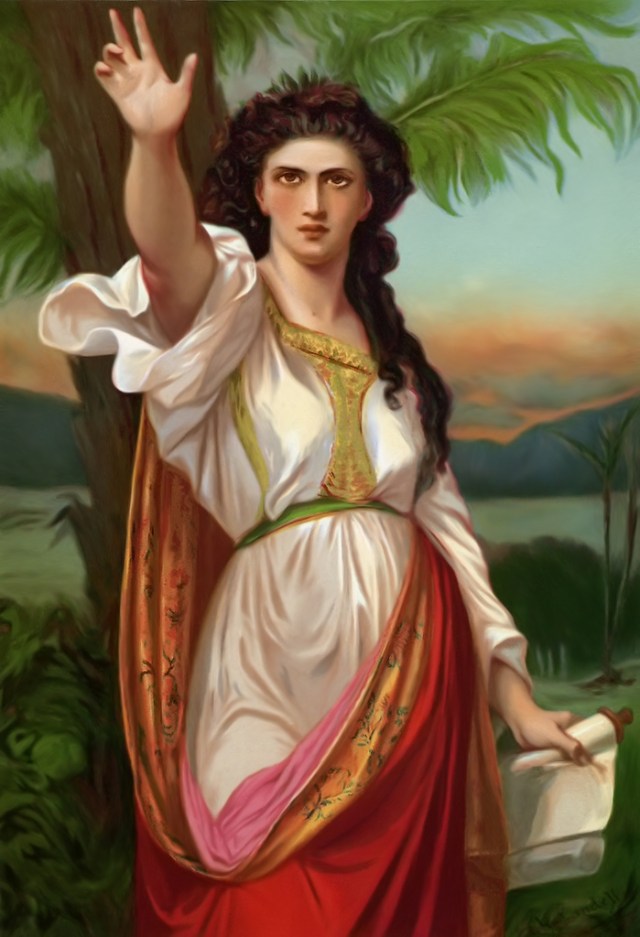
Deborah the Prophet and Judge (Judges 4:8-24)

Illustration from “Woman in Sacred History, A Series of Sketches Drawn from Scriptural, Historical, and Legendary Sources” by Harriet Beecher Stowe, 1873

“I’m not going unless you go!” Barak told her.

“All right, I’ll go!” she replied. “But I’m warning you that the Lord is going to let a woman defeat Sisera, and no one will honor you for winning the battle.”

Deborah and Barak left for Kedesh, where Barak called together the troops from Zebulun and Naphtali. Ten thousand soldiers gathered there, and Barak led them out from Kedesh. Deborah went too.

At this time, Heber of the Kenite clan was living near the village of Oak in Zaanannim, not far from Kedesh. The Kenites were descendants of Hobab, the father-in-law of Moses, but Heber had moved and had set up his tents away from the rest of the clan.

When Sisera learned that Barak had led an army to Mount Tabor, he called his troops together and got all 900 iron chariots ready. Then he led his army away from Harosheth-Ha-Goiim to the Kishon River.

Deborah shouted, “Barak, it’s time to attack Sisera! Because today the Lord is going to help you defeat him. In fact, the Lord has already gone on ahead to fight for you.”

Barak led his 10,000 troops down from Mount Tabor. And during the battle, the Lord confused Sisera, his chariot drivers, and his whole army. Everyone was so afraid of Barak and his army, that even Sisera jumped down from his chariot and tried to escape. Barak’s forces went after Sisera’s chariots and army as far as Harosheth-Ha-Goiim.

Sisera’s entire army was wiped out. Only Sisera escaped. He ran to Heber’s camp, because Heber and his family had a peace treaty with the king of Hazor. Sisera went to the tent that belonged to Jael, Heber’s wife. She came out to greet him and said, “Come in, sir! Please come on in. Don’t be afraid.”

After they had gone inside, Sisera lay down, and Jael covered him with a blanket. “Could I have a little water?” he asked. “I’m thirsty.”

Jael opened a leather bottle and poured him some milk, then she covered him back up.

“Stand at the entrance to the tent,” Sisera told her. “If someone comes by and asks if anyone is inside, tell them ‘No.’ ”

Sisera was exhausted and soon fell fast asleep. Jael took a hammer and drove a tent-peg through his head into the ground, and he died.

Meanwhile, Barak had been following Sisera, and Jael went out to meet him. “The man you’re looking for is inside,” she said. “Come in and I’ll show him to you.”

They went inside, and there was Sisera—dead and stretched out with a tent-peg through his skull.

That same day God defeated the Canaanite King Jabin while the Israelites looked on, and his army was no longer powerful enough to attack the Israelites. Jabin grew weaker while the Israelites kept growing stronger, until at last the Israelites destroyed him. (Contemporary English Version)

The biblical book of the Judges is a sad account of Israel’s downward spiral into ignorance and wickedness. Because of this situation, God would occasionally raise up leaders, or judges, to help the people whenever they cried out in their distress.

Deborah was one of those judges, and the only woman leader during the time of the judges. She was recognized in Israel as both a judge and a prophet. In the time of Deborah, the Israelites had once again become oppressed by Canaanites who had not been dislodged from the land.

Having both legal and prophetic authority, Deborah called for a holy war and became the leader. Her army general, Barak, mustered the troops and led them into battle. The opposing general, Sisera, drew up his forces to attack, but God got involved. The Lord threw Sisera’s soldiers into a panic, and the general ended up fleeing for his life, his army defeated.

Sisera had a safe place in mind to go. Heber, an ally and friend, was in the area with his tents. So, Sisera believed he would find hospitality and protection. Heber’s wife, Jael, however, was no friend of Sisera. She took care of him, lulled him to sleep, and then proceeded to kill him with some surprisingly skilled precision.

Eventually, Barak came along, and Jael showed him the dead general. Deborah’s prophecy that a woman would prevail was realized. We are not told in the text why Jael sided with the Israelites and deliberately brought an end to Sisera. Yet, by killing him, Jael clearly proved sympathetic to Israel.

Whatever was really going on there, it’s illustrative of a prominent theme in the book of Judges. Since the Canaanites were not expelled completely from the land, they would continue to exert religious and ethical influence on the Israelites.

Judges is a book that, as you read it, becomes progressively mixed between Israelite and Canaanite – piety with the Lord and pagan practices were more and more synchronized, so that an odd religious amalgam happened. The people claimed to follow the Lord, and yet, they became increasingly violent and adoptive of the surrounding nations with their bloody practices.

We have, dramatized before us in today’s lesson, the effects and consequences of only a partial obedience to God. Like putting one bad apple into the pie, it causes the whole thing to become rotten.

In our own day, it will not do to dedicate a Sunday or a specific time to the Lord, then walk away and do whatever you want the rest of the time, without any concern to the words and ways of Jesus. We will only please the Lord if we engraft God’s universal law into our entire lives, and not just the religious parts.

Eventually a life only partially attentive to God will crack and then crumble to pieces. We must plan to live the spiritual life with perseverance, endurance, and consistency, each and every day of our lives.

The foundation of our life is built on the cornerstones of the body, mind, emotions, and spirit. A whole and healthy life pays attention to all four with equal consideration, energy, and focus. It won’t do to have any one cornerstone a different size than the others; a life cannot be constructed on such an uneven foundation.

This is why the Israelites in the time of the judges found themselves in such dire straits, time and time again. And it is also a testament to the infinite patience and grace of God, that the Lord continued to respond with mercy whenever the people cried out.

What’s more, today’s story points to the necessity for gender equity and inclusion, as well. We must pay attention to everyone in the community, and not put limitations on particular individuals because they are different. Deborah and Jael, the women, were the heroes of the story – and not just because the men didn’t step up – but because they were the divinely ordained people for the job.

We have enough on our plate in dealing with issues of obedience and disobedience, without adding to it by defining which people can be used of God, or not. Commit yourself to the Lord with your whole life, and the rest will mostly work itself out.

I thank you, Lord, that you love to do extraordinary things through ordinary people like me. Release me from any limitations I, others, or the enemy have put on my life that have kept me from the great plans you have for me, so that I might wake up and arise to shine the glory of the Lord! Amen.

Judges 5:1-11 – A Woman in the Middle

Illustration of Deborah in “Woman in Sacred History” by Harriet Beecher Stowe, 1888

On that day Deborah and Barak son of Abinoam sang this song:

Praise the Lord!
    The Israelites were determined to fight;
    the people gladly volunteered.
Listen, you kings!
    Pay attention, you rulers!
I will sing and play music
    to Israel’s God, the Lord.
Lord, when you left the mountains of Seir,
    when you came out of the region of Edom,
    the earth shook, and rain fell from the sky.
    Yes, water poured down from the clouds.
The mountains quaked before the Lord of Sinai,
    before the Lord, the God of Israel.

In the days of Shamgar son of Anath,
    in the days of Jael,
caravans no longer went through the land,
    and travelers used the back roads.
The towns of Israel stood abandoned, Deborah;
    they stood empty until you came,
    came like a mother for Israel.
Then there was war in the land
    when the Israelites chose new gods.
Of the forty thousand men in Israel,
    did anyone carry shield or spear?
My heart is with the commanders of Israel,
    with the people who gladly volunteered.
    Praise the Lord!
Tell of it, you that ride on white donkeys,
    sitting on saddles,
    and you that must walk wherever you go.
Listen! The noisy crowds around the wells
    are telling of the Lord’s victories,
    the victories of Israel’s people!

Then the Lord’s people marched down from their cities. (Good News Translation)

In the Middle

At the center of the celebration – of Israel’s victory over their oppressors – was a woman.

Today’s Old Testament lesson is a classic Hebrew poem and song of celebration. Yet, there is something a bit different with this poem. The structure of Hebrew poetry points to the middle of the poem as the central idea and focus, with verses before pointing forward to it, and the verses after pointing back to it.

In many poems, God is at the center. The poet’s aim is typically to highlight the Lord as the ballast or resolution to some situation. But today’s poem has Deborah, a woman, smack in the middle. Israel was in a bad way, that is, until Deborah became the leader and judge in Israel. And this was no weird aberration.

Women in the Middle

Women are central to Holy Scripture. God called the people of Israel and labored to shape them into a community built on love, mercy, and justice, reflecting God’s image. Through the Israelites, God continued the work begun in creation, commanding them to love God and serve their neighbors–the orphan, the widow, the stranger, and the alien. Women and men, together, served God in Israel.

The women filled their primary roles in Israel as wives, mothers, and grandmothers. In bearing and caring for children, they patterned their lives on the life of the One who in the beginning labored to bring forth the world, and who later brought forth the nation of Israel and patiently taught it to walk.

Whenever freedom and liberation were needed, women played a central role. The Hebrew midwives Shiphrah and Puah trusted God and refused to obey Pharaoh’s orders. When instructed by Pharaoh to kill the male children, but to let the daughters live, these daughters of Israel preserved the lives of all the newborn. They risked their own lives in order to serve God’s purpose in setting the Israelites free from their slavery in Egypt. (Exodus 1:6-22)

Women were at the heart of hospitality, loving the stranger, as God instructed all the people to do. God empowered the widow of Zarephath to offer lodging and food to the prophet Elijah. Her ministry came at a critical time for Elijah, and this poor widow placed herself and her child at risk by offering her only morsel of food to the prophet. Through her acts of service, the widow advanced God’s work in the world and was sustained by God because of her ministry. (1 Kings 17:7-16)

Miriam and Huldah were prophets, revealing God’s will to the people. (Exodus 15:1-21; 2 Kings 22:11-20). And, along with them, Deborah was both a prophet and a judge, the leader of all the people. She gave wisdom, discernment, and justice to Israel. Deborah even had her hand in the military affairs of the nation. She directed Barak, the general, in a battle against the Canaanites. Although men usually filled such roles, God uses whomever God wants to use in accomplishing the divine will here on this earth, as it is always done in heaven.

God in the Middle

God is the Lord of the past, present, and future. God reigns over both the old and the new, utilizing each for good purposes in the world. In other words, God is not boxed-in. The Lord didn’t start wringing his hands in heaven saying, “Oh, my, I can’t find a man for the job. I guess I’ll have to use a woman!” No, instead, a woman was the Lord’s first and only choice for each situation in which females were used to accomplish God’s will. The Lord is not a victim of circumstances. Rather, God is sovereign and reigns supreme over all situations.

Let’s keep in mind that God is not limited to using men. In fact, God is always doing a new thing in the world. Women and men, equally created in the image and likeness of God, are equally able to be partners with God in the never-ending work of bringing life and redemption to all. Women fulfilling roles of ministry and leadership are not exceptions to God’s order and purpose in creation. Instead, they illustrate God’s true intent for women and men in the world.

We need to hear the stories of women’s leadership and service in Israel as testimony to God’s intent that women and men should be co-laborers with God in God’s work. The Lord isn’t laboring in this world with one hand tied between his back. He is using both hands, both men and women, to establish a benevolent rule and ethical reign.

So, loose the bonds and let the women serve!

Soli Deo Gloria

Judges 4:1-16 – It Takes a Woman

Orthodox icon of Deborah

After Ehud died, the people of Israel again did what the Lord considered evil. So, the Lord used King Jabin of Canaan, who ruled at Hazor, to defeat them. The commander of King Jabin’s army was Sisera, who lived at Harosheth Haggoyim. The people of Israel cried out to the Lord for help. King Jabin had 900 chariots made of iron and had cruelly oppressed Israel for 20 years.

Deborah, wife of Lappidoth, was a prophet. She was the judge in Israel at that time. She used to sit under the Palm Tree of Deborah between Ramah and Bethel in the mountains of Ephraim. The people of Israel would come to her for legal decisions.

Deborah summoned Barak, son of Abinoam, from Kedesh in Naphtali. She told him, “The Lord God of Israel has given you this order: ‘Gather troops on Mount Tabor. Take 10,000 men from Naphtali and Zebulun with you. I will lead Sisera (the commander of Jabin’s army), his chariots, and troops to you at the Kishon River. I will hand him over to you.’”

Barak said to her, “If you go with me, I’ll go. But if you don’t go with me, I won’t go.”

Deborah replied, “Certainly, I’ll go with you. But you won’t win any honors for the way you’re going about this, because the Lord will use a woman to defeat Sisera.”

So, Deborah started out for Kedesh with Barak. Barak called the tribes of Zebulun and Naphtali together at Kedesh. Ten thousand men went to fight under his command. Deborah also went along with him.

Heber the Kenite had separated from the other Kenites (the descendants of Hobab, Moses’ father-in-law). Heber went as far away as the oak tree at Zaanannim near Kedesh and set up his tent.

The report reached Sisera that Barak, son of Abinoam, had come to fight at Mount Tabor. So Sisera summoned all his chariots (900 chariots made of iron) and all his troops from Harosheth Haggoyim to come to the Kishon River.

Then Deborah said to Barak, “Attack! This is the day the Lord will hand Sisera over to you. The Lord will go ahead of you.”

So, Barak came down from Mount Tabor with 10,000 men behind him. The Lord threw Sisera, all his chariots, and his whole army into a panic in front of Barak’s deadly assault. Sisera got down from his chariot and fled on foot. Barak pursued the chariots and the army to Harosheth Haggoyim. So Sisera’s whole army was killed in combat. Not one man survived. (God’s Word)

Deborah was a leader – and a darned good one. And, to state the obvious, she was a woman.

Women are the greatest and largest untapped resource in both the church and the world. Perhaps you wonder why I state such a thing, being that more women attend church than men, and that there slightly more women in the world than men. But I stick to my statement. The reality for many churches and untold institutions around the world is that only men can hold positions of authority.

Within some churches and Christian denominations, the reasoning goes something like this: “The Bible says women can’t serve over men.” That’s curious. So, in other words, in the West, a woman can serve as a CEO of a Fortune 500 company, can be elected as governor of a state, and can manage men on a factory floor, but that same woman cannot serve as an elder in many evangelical churches.  

Those who are of the belief that a church office is based upon gender instead of just good old calling and gifting of the Spirit, then, methinks, it behooves us to ask these questions of the biblical text:

  • If women are not to exercise authority over men in the church, how do we account for actual women leaders in the Bible, such as Deborah, Huldah, Philip’s daughters, Priscilla’s role in Apollos’ life, not to mention the list of women leaders in Romans 16?  If our impulse is to say that these are exceptions because there were no men to “step up,” then what does that say about our theology? That God isn’t big enough to find a man to put into a position of leadership?
  • If we insist that women ought not to teach and be silent based on Paul in the New Testament book of 1 Timothy, why do we ignore Paul’s instruction in 1 Corinthians that women are to publicly prophecy and pray?
  • Doesn’t the prominence of women in the ministry of Jesus and Paul suggest something different than just having women tag along to teach children?
  • Just when does a boy become too old for a woman to legitimately teach him?  If women can’t teach men, why in the world would we ever think that they are the best teachers for boys?
  • How can we apply Galatians 3:26-28 as everyone else, besides women, are free to serve?
  • Does the Reformation doctrine of the priesthood of all believers only apply to men? Doesn’t the absence of women in church leadership go against this?
  • Isn’t it weird and confusing that women have an equal vote in congregational decisions, even when a male leader is being elected and/or disciplined, and they aren’t supposed to exercise authority?

I could go on, ad infinitum ad nauseum, but I think you get the picture. The absence of women in leadership is problematic because there are actual women leaders in the Bible. So, here is my unabashed, dogmatic, and biblical belief:  

All individuals are equally created in God’s image, and, therefore, have equal worth, privilege, and opportunity in Christ’s Church without any limitation, including gender. 

There are far too many wonderful Christian women who are exhausted and depressed because they are trying to live up to a certain expectation of being someone they are not. They suppress their gifts and calling. They think they have to prop-up the fragile male egos around them. They aren’t free to serve in leadership positions. And it’s eating them from the inside-out.  

Some women think there is something wrong with them. But the reality is that there is something wrong with the whole system of male-only authority. What’s more, we are missing the blessing of God because of inequity. It’s high time we value all women, even those with gifts of leadership, by allowing them to serve without limitation.

I have a wife and three daughters. All four of them are more intelligent, more gifted, and better leaders than me, the lone family male who holds a range of authoritative positions in the church and the world. To have the ladies in my life using their superior talents in the church by leading and serving is the least threatening thing to me on this earth. I love it that they can outdo me; it is my joy!  

Even more than that, I believe it is to the joy of Jesus, as well. We must be proactive in cultivating and nurturing the gifts and calling we see in women. They don’t need to be put in their place or dismissed as too emotional or weak. The good ol’ boy systems of the church and in the world need a swift kick in the rear. I, for one, am a man who believes in practicing a leadership that sacrifices on behalf of making women’s leadership a priority.

How about you?