Philippians 2:5-11 – Palm Sunday

In your relationships with one another, have the same mindset as Christ Jesus:

Who, being in very nature God,
    did not consider equality with God something to be used to his own advantage;
rather, he made himself nothing
    by taking the very nature of a servant,
    being made in human likeness.
And being found in appearance as a man,
    he humbled himself
    by becoming obedient to death—
        even death on a cross!

Therefore, God exalted him to the highest place
    and gave him the name that is above every name,
that at the name of Jesus every knee should bow,
    in heaven and on earth and under the earth,
and every tongue acknowledge that Jesus Christ is Lord,
    to the glory of God the Father. (NIV)

I often take the posture of kneeling or prostrating when I pray. I do this, not because I think my prayers are more effective that way, but because this embodies my petitions with a recognition of Christ’s lordship over my life. Also, for me, there is no experience quite like using the kneelers on church pews and bowing together in a common experience of recognizing the lordship of Jesus Christ.

I sometimes ponder a question as I am on my knees: What kind of people would we be if we looked like these verses in Philippians?  The Apostle Paul said to the church in Philippi that their “attitude” should be the same as that of Christ Jesus. Their mindset, the way they think about everything, ought to be just like the mind of Christ. If we want to know how to think well and live well, how to relate to others in a good way, then we ought to thoroughly adopt the mind and the attitude of Jesus.  

How we should think and live comes from God. Within the life of the triune God exists three persons: Father, Son, and Spirit. Within this great three-in-one God exists perfect love, absolute holiness, united harmony, and constant respect. The Holy Scriptures tell us that just as God is holy, we are to be holy. Just as God is love, so we are to love one another. Just as God is harmonious, we are to live in harmony with one another. And just as God is supremely exemplified in the person of Jesus as a humble servant, so we are to practice humility and service in all our relations.

None of this is optional for the Christian. There is no place in the believer’s life for pride, posturing, and power-broking. There is to be humility, taking the posture of lowliness, and using any kind of influence for the benefit and encouragement of others – just like Jesus did while on this earth.

In a world pre-occupied with power and control, safety and security, influence and throwing its weight around, there is Jesus. He did just the opposite of engaging in upward mobility; he practiced downward mobility, and in doing so Christ descended into greatness as Lord and Savior.

Jesus did not consider equality with God as something to be grasped. The pre-incarnate Christ did not sit in heaven as the second person of the Trinity and hold onto his lofty position with tight fists – he did not grasp it tightly. When Jesus came to this earth, there was a humble willingness to open his hands and relinquish his rights and privileges as God. Christ made himself nothing, taking the very nature of a servant. Jesus gladly, not reluctantly, emptied himself for us. Jesus became one of us.

The television series, Undercover Boss, is a reality show in which high-level corporate executives leave the comfort of their offices and secretly take low-level jobs within their companies to find out how things are really working and what their employees are honestly thinking about their jobs and what is happening. In the process of this undercover mission, they learn of the perceptions about their companies, the spirit of their work forces and — maybe — something about themselves as well.

None of the executives cease to be executives. They just make a willing decision to take the lowest level job in their own company to hopefully benefit the employees and the entire corporation. The best episodes are when the most generous executives go above and beyond helping the employees around them at the end of the show. 

Jesus descended to earth. He never ceased to be God. Yet, Christ willingly put his kingly robe in the closet and donned Dickies and work boots. He came among us and purposely limited himself to identify with us fully – and secured for us the greatest generosity imaginable – an answer to the problem of guilt and shame through forgiveness of sins.

Jesus became a servant. He completely tied himself to us. Jesus did not come to this earth seeking to be served, but sought to serve and give his life as a ransom for many. Christ kept going lower and lower to the point of descending to the greatest humiliation of all – death on a cross. Jesus endured the ultimate shame of the ancient world by dying a terrible death. The King of the universe was killed by vicious humanity so that he might redeem and save those very same people from their terrible plight of bondage to evil.

We are to be humble people, embracing a lowly status of slaves to God and to one another. The ancient Philippian church had a real problem with pride which is why Paul talked about emulating the mind and attitude of Christ in his humiliation. The following are exhortations Paul gave to the Philippians, which were to reflect the practice of humility in relationships:

  • Whatever happens, conduct yourselves in a manner worthy of the gospel of Christ (1:27). 
  • Do nothing out of selfish ambition or vain conceit, but in humility consider others better than yourselves (2:3). 
  • Continue to work out your salvation with fear and trembling (2:12). 
  • Do everything without complaining or arguing (2:14). 
  • Join with others in following my example and take note of those who live according to the pattern we gave you (3:17). 
  • Do not be anxious about anything, but in everything, by prayer and petition, with thanksgiving, present your requests to God (4:6). 

Because of Christ’s humble obedience to the Father, he was exalted from the lowest place to the highest place.  King Jesus is on the throne, above everyone and everything. Because of his descent to this earth, Christ has ascended in glory and honor. We can now see God in a new way, through Jesus. And when we do, it causes us to kneel in prayer and profess that Jesus Christ is Lord.

In the ancient world, this was subversive language. If Jesus is Lord, Caesar is not, and ultimate allegiance does not belong to the Roman Empire. If Jesus is Lord, the local gods are not. And in our day, it is no different. Historical characters and religious deities may come and go, but the issue of ultimate allegiance still pertains to us. If Jesus is Lord, no politician or celebrity is owed lordship status. Pride and arrogance are to be put down at every turn in favor of humble service and loving actions.
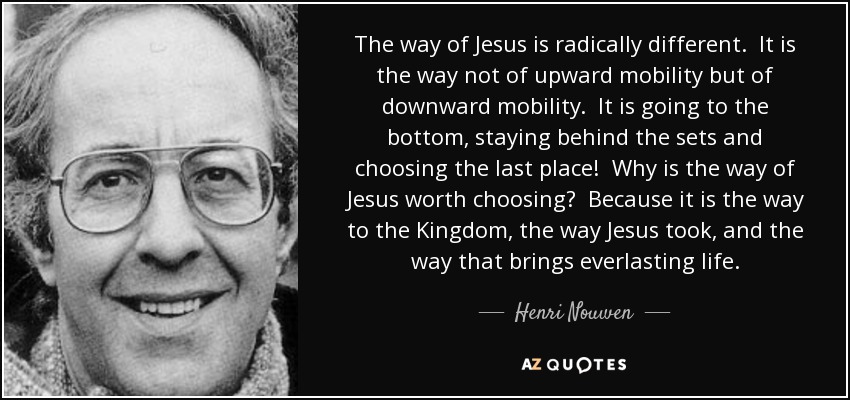
If we are to follow Jesus Christ truly and really, we will practice downward mobility and embrace humility. Bowing, kneeling, and prostrating will become second nature to us as we give our unflagging allegiance to Jesus. We will accept our creaturehood and God as Creator. We will live in the reality that Jesus is Sovereign over all creation. 

As we enter the Christian Holy Week, let us acknowledge and know the humiliation and exaltation of Christ….

Just watch my servant blossom!
    Exalted, tall, head and shoulders above the crowd!
But he didn’t begin that way.
    At first everyone was appalled.
He didn’t even look human—
    a ruined face, disfigured past recognition.
Nations all over the world will be in awe, taken aback,
    kings shocked into silence when they see him.
For what was unheard of they’ll see with their own eyes,
    what was unthinkable they’ll have right before them.

Who believes what we’ve heard and seen?
    Who would have thought God’s saving power would look like this?

The servant grew up before God—a scrawny seedling,
    a scrubby plant in a parched field.
There was nothing attractive about him,
    nothing to cause us to take a second look.
He was looked down on and passed over,
    a man who suffered, who knew pain firsthand.
One look at him and people turned away.
    We looked down on him, thought he was scum.
But the fact is, it was our pains he carried—
    our disfigurements, all the things wrong with us.
We thought he brought it on himself,
    that God was punishing him for his own failures.
But it was our sins that did that to him,
    that ripped and tore and crushed him—our sins!
He took the punishment, and that made us whole.
    Through his bruises we get healed.
We’re all like sheep who’ve wandered off and gotten lost.
    We’ve all done our own thing, gone our own way.
And God has piled all our sins, everything we’ve done wrong,
    on him, on him.

He was beaten, he was tortured,
    but he didn’t say a word.
Like a lamb taken to be slaughtered
    and like a sheep being sheared,
    he took it all in silence.
Justice miscarried, and he was led off—
    and did anyone really know what was happening?
He died without a thought for his own welfare,
    beaten bloody for the sins of my people.
They buried him with the wicked,
    threw him in a grave with a rich man,
Even though he’d never hurt a soul
    or said one word that wasn’t true.

Still, it’s what God had in mind all along,
    to crush him with pain.
The plan was that he gives himself as an offering for sin
    so that he’d see life come from it—life, life, and more life.
    And God’s plan will deeply prosper through him.

Out of that terrible travail of soul,
    he’ll see that it’s worth it and be glad he did it.
Through what he experienced, my righteous one, my servant,
    will make many “righteous ones,”
    as he himself carries the burden of their sins.
Therefore I’ll reward him extravagantly—
    the best of everything, the highest honors—
Because he looked death in the face and didn’t flinch,
    because he embraced the company of the lowest.
He took on his own shoulders the sin of the many,
    he took up the cause of all the black sheep. (Isaiah 52:13-53:12, MSG)

The Need for Sacrifice

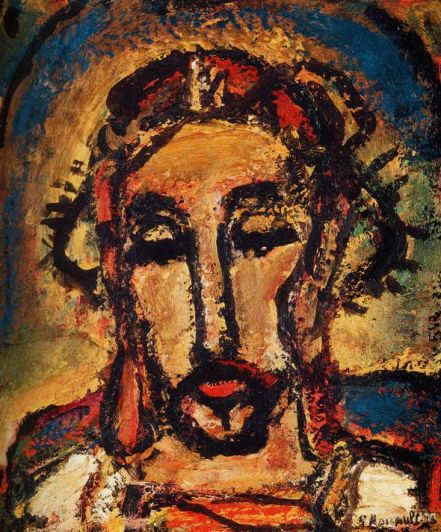
Man of Suffering by Georges Rouault, 1942
Ecce Homo by French artist Georges Rouault, 1942

Christ’s Church is not so much made up of saints or sinners as it is made up of saintly sinners and sinning saints.  The Church is at the same time both beautiful and ugly, holy, and wicked, full of faith and full of fear.  The Body of Christ is the place of spiritual sensitivity as well as a den of depravity.  So, anyone searching for a squeaky-clean church on a nice upward path of success with everything done to perfection and where no one ever gets hurt or unhappy… it does not exist; and, it never did.

Jesus stands alongside his imperfect people, despite their faults and egotism.  Jesus intimately knows our damaged emotions and our open putrid spiritual abscesses.  Yet, he treats us with mercy because he never tires of rehabilitating and reforming his Church.

Christ’s disciple, Peter, is the poster child for all the mixed motives and imperfect following of God we experience. For example, Peter stepped out of the boat in great faith and walked on the water, only to begin sinking because of his great fear. It was Peter who made a bold and right confession of faith, and then turned around here in our story for today and bought into Satan’s agenda. And Jesus was right there next to Peter all the way. Christ both rebukes and loves, all the while never abandoning us, but always working in and through us to accomplish his kingdom purposes.

Here is what we need to know or be reminded of today: Following Jesus involves pain and sacrifice because we live in a broken mixed-up world, and, on top of it, Christ’s Church is still imperfect and in the process of becoming holy.  If we will admit it, we are all like Peter – a little devil who needs to get in line behind Jesus. (Matthew 16:21-28)

Peter Admonishes Jesus
Peter Admonishes Jesus by Unknown artist

We all, at times, get frustrated and/or disgusted with the whole church thing.  We can whine and complain and even avoid it.  Or, we can commit to taking up our cross, and give our lives for Jesus Christ.  We can choose to put love into the church where love is not, even when we do not feel loved. Priest and professor, Ron Rollheiser, once gave the following analogy about staying together around Jesus:

Imagine that the family is home for Christmas, but your spouse is sulking, you are fighting being tired and angry, your seventeen year old son is restless and doesn’t want to be there, your aging mother isn’t well and you are anxious about her, your uncle Charlie is batty as an owl… and everyone is too lazy or selfish to help you prepare the dinner.  You are ready to celebrate but your family is anything but a Hallmark card.  All their hurts and hang-ups are not far from the surface, but you are celebrating Christmas and, underneath it all, there is joy present.  A human version of the messianic banquet is taking place and a human family is meeting around Christ’s birth….

In the same way, here we are, the community of the redeemed. We gather in our imperfect way, a crazy mix of sinner and saint.  But we gather in and around Jesus – and that makes all the difference.  There is a reason we are here on this earth, a reason much bigger than all our dysfunctional ways and dyspeptic attitudes. Jesus Christ is building-up the people of God and he will keep doing it until the end of the age. In other words, Jesus is not quite finished with us yet; we still have some things to learn about the need for sacrifice.

The need for sacrifice by Jesus. (Matthew 16:21-23)

Jesus stated openly and in detail what must happen.  It was necessary for Christ to suffer deeply and die a cruel death; it was God’s will and plan. Yet, good ol’ Peter was not down for this plan, at all.  He took Jesus aside and rebuked him, believing him to be off his rocker for even suggesting such a terrible scenario.  Jesus, however, turned the tables on Peter and rebuked him right back.  Essentially, what Jesus said is that being Christ-centered without being cross-centered is satanic.

The error of Peter was that he presumed to know what was best for Jesus. He believed the suffering of the cross would “never” happen. Peter’s perceptions were dim and limited; he did not clearly see how broken the world really is and how much it would take to heal it. Jesus needed to offer himself as a sacrifice for the sins of the entire planet.

Crucifixion of Christ by Georges Rouault, 1936

Sometimes, like Peter, we might think that the way I see and the way I perceive is the way things really are, or, at least, how they should be. Peter had been walking with Jesus for a few years, watching and enjoying his ministry of teaching, healing, and extending compassion.  It was all good for Peter, and, therefore in his mind, it should not change. Peter wanted to hold this moment forever. After all, why try and fix something that is not broken? Oh, but broken the world is – so much so that it required the ultimate sacrifice.

Just because it was good for Peter did not mean it was good for everybody or should always be this way.  If Peter were to have his way, we would all be in hell right now; it would not have been good for us.  We, like Peter, are finite humans with limited understanding and perceptions.  We can easily slip into a satanic mode of believing that because something is going fine for me that everyone else is doing okay, too.  I like it, I want it, so what is the problem?

The problem is that we too easily look at life through narrowly selfish lenses, and then cannot see other people’s needs; cannot perceive the lost world around us with any sense of reality; cannot see that Jesus has an agenda very different from our own.  Our limited perceptions come out in saying things like, “Oh, she is just depressed because she is avoiding responsibility.”  “People on government welfare are lazy.”  “He’s addicted because he doesn’t want to help himself.”  “They’re demonstrating on the streets because they are a bunch of malcontents.” These, and a legion of statements like it, betray a satanic worldview devoid of grace and a compulsive need to find blame, believing that if there is personal suffering there must be personal sin.

In truth, we are all part of one human family, and we are all in this together; one person’s joys are our joys; one person’s struggles are our struggles. We really are our brother’s keeper. The detachment we can have toward other human beings is completely foreign to the words of Jesus.  The Christian life involves suffering, and Jesus invites us to follow him in his way of sacrifice.

The need for sacrifice by the followers of Jesus. (Matthew 16:24-28)

There is a way to reverse demonic thinking.  Jesus issues an invitation to practice self-denial, to fall in line behind him, and walk with him in his suffering.  Self-denial is not so much doing something like giving up sweets for Lent as it is giving up on ourselves as our own masters.  It is the decision to make the words and ways of Jesus the guiding direction for our lives.  It is the choice to quit holding onto the way I think things ought to be, and to take the time to listen to Jesus.

The logic of Jesus is relentless.  Life comes through death, so, we must give up our lives to find them.  It does us no good to adulterate our lives by serving the gods of success and perfectionism.  Jesus invites us to quit our moonlighting job with the world and go all in with him.  Only in this way will we truly find life.

Jesus was saying more than just submitting to suffering – we are to embrace it. In doing so, we will find reward and joy.  For those familiar with this path, they can tell you that suffering is a blessing because they have found the true purpose and meaning of life.

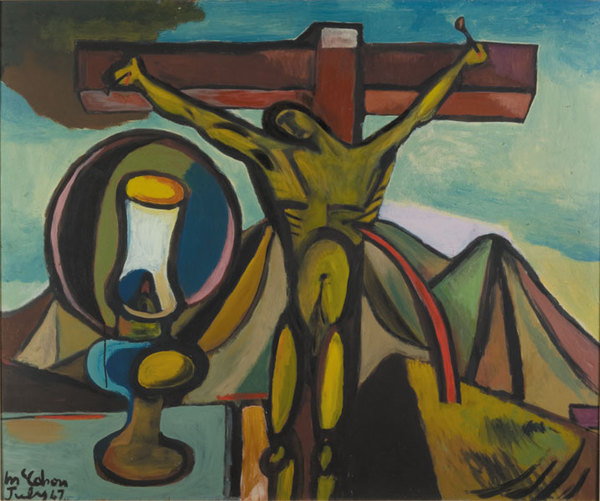
Crucifixion with Lamp by Colin McCahon 1947
Crucifixion with Lamp by New Zealand artist Colin McCahon, 1947

Few people have suffered as much as the nineteenth-century missionary medical doctor to Africa, David Livingstone.  He was a pioneer explorer who opened the interior of Africa to the outside world.  He had two reasons for doing so: To be able to take the good news of Christ’s suffering to the African people; and, to open Africa to legitimate trade so that the illicit slave trade would end.

Dr. Livingstone’s hand was once bitten and maimed by a lion; his wife died while on the mission field; he was most often alone on his travels; the one house he built was destroyed in a fire; he was typically wracked with dysentery and fever, or some other illness in the jungle.  Someone once commented to him that he had sacrificed a lot for going in the way of Jesus. Livingstone’s response was, “Sacrifice? The only sacrifice is to live outside the will of God.”  When asked what helped him get through so much hardship, he said that the words of Jesus to take up his cross were always ringing in his ears.

We may believe we must watch out for ourselves; that we need to push for our personal preferences; that if I accept this invitation to follow Jesus in the way of self-denial I will be miserable and people will walk all over me. Such thoughts are demonic whispers in our ears.

There are two ways of thinking and approaching the Christian life: There is the way which believes success, perfection, and a pain-free life is the evidence of God’s working; while the other way believes that suffering is right and necessary to connect with God and to be in solidarity with those who suffer.

Suffering, rejection, and execution did not fit into Peter’s church growth plan or factor into his view of Messiah. So, I will say it plainly: We do not exist only for ourselves. We do not exist to be a spiritual country club.  We do exist to follow Jesus in his path of sacrifice and suffering for a world of people who desperately need to know the grace of forgiveness and the mercy of Christ. Jesus died.  We are to die to ourselves. Christ lives; so, we are to live a new life.  In God’s upside-down kingdom, joy comes through suffering. We are to follow Jesus as the mix of sinners and saints that we are.

Peter eventually learned his lesson from Jesus. After Christ’s resurrection and ascension, Peter caught fire with courage and boldness – which landed him in hot water with the Jewish ruling council. As a result, he was severely whipped and flogged and told to keep in line. Peter’s response demonstrates how far he had come. He left the experience rejoicing that he had been counted worthy of suffering disgrace for the Name of Jesus Christ. (Acts 5:41)

May dear old Peter’s spiritual tribe increase.

1 Peter 4:1-8 – Holy Saturday

Empty Tomb

Christ suffered here on earth. Now you must be ready to suffer as he did, because suffering shows that you have stopped sinning. It means you have turned from your own desires and want to obey God for the rest of your life. You have already lived long enough like people who don’t know God. You were immoral and followed your evil desires. You went around drinking and partying and carrying on. In fact, you even worshiped disgusting idols. Now your former friends wonder why you have stopped running around with them, and they curse you for it. But they will have to answer to God, who judges the living and the dead. The good news has even been preached to the dead, so that after they have been judged for what they have done in this life, their spirits will live with God.  Everything will soon come to an end. So be serious and be sensible enough to pray.  Most important of all, you must sincerely love each other, because love wipes away many sins. (CEV)

I haven’t been a confessing Christian my entire life.  I can relate to Peter’s exhortation.  I still remember what it feels like to live my life without any thought to God or spiritual matters.  The thing about partying and immorality is that it’s a life filled with constant movement.  Slowing down only makes one come face-to-face with what is truly inside the soul.  And if someone has an empty vacuous soul, or a damaged spirit, or a broken heart, then attempting to drink or work away the inner pain makes sense when there’s no regard for God.  The last thing I ever wanted to do was suffer, yet before my own spiritual awakening it seemed I could never outrun the hurt no matter how hard I tried, even with all the constant locomotion.

Today is Holy Saturday – a quiet place sandwiched between the ignominy of the cross and the celebration of resurrection – a day of solitude, silence, and stillness.  This is something of a lost day for many folks.  In fact, many Christians haven’t had a thought that Holy Saturday could have any significance.  Yet, this very day has its place in the scheme of the Christian life.

There cannot be resurrection and new life without a death and dying to self.  There must be suffering before there can be glory.  Whenever Christians quickly jump to triumphal language about victory and speak little-to-nothing about suffering, then we are left with a cheap grace which has been purchased with the counterfeit currency of velocity.

Today is meant for us to get out of our heads and wrap our hearts around the important reality that Jesus Christ was in the grave.  It was real suffering on Good Friday, and it is a real death on Holy Saturday.  There is no movement.  All is silent and still.  Jesus is in the solitude of a dark tomb.  There’s no getting around it.  If we want a Resurrection Day with all its celebration and glory, then we cannot circumvent Holy Saturday.

To put this in the spirit of the Apostle Peter: Are we ready to follow Jesus and suffer as he did?  Are we willing to stop our striving, manifested through constant movement, and embrace the Holy Saturday of solitude, silence, stillness with its contemplation and embrace of suffering?  Will you and I have sense enough to pray?  Will we practice a Christian counter-cultural shift and face the ridicule of friends so that we might take some much-needed time to be with Jesus in the tomb?  Or, are we so antsy and anxious that we just want to leap into Easter with no solidarity with our Lord in the grave?

You may think I’m being a bit too hard or harsh or cold…. That’s because Jesus is cold.  He has a bona fide cold dead body.  It’s no fake death.  There’s no “swoon theory” here, as if Christ only passed-out and did a weird divine fainting spell.  Nope.  He’s dead.  And if you and I want to live with Jesus, we must die with Jesus.

Anyone who tries to promise a new life apart from journeying with Jesus into the grave is a spiritual charlatan.  Only through death can there be life.

On this Holy Saturday, let’s intentionally slow down, do less, give ourselves a large chunk of unstructured time, and put aside routine matters.  Fill the time with unfettered access to God in Christ.  Slowly read the Gospel accounts of Christ’s death and burial.  Read the book of 1 Peter.  Allow prayers to arise from the careful and mindful reading of Scripture.  Feel the solidarity with Jesus, journey with him along the way from life to death… so that there might be a truly glorious resurrection filled with abundant life and flourishing – a life that doesn’t need hedonism and workaholism to feel happy and significant.

May you die well so that you might live well.

Precious Lord Jesus, today all is silent.  You died a horrific death and gave incredible mercy from your wounded heart.  Now you rest in the tomb as the soldiers keep vigil.  I also keep vigil, although in a very different way.  I know this day doesn’t last forever; there is tremendous glory coming.  Yet, for now I sit quietly mourning your death.  Assist me, God Almighty, to enter the sorrow and the silence of this Holy Saturday.  Today, help me to wait patiently and to sit with this constellation of emotions swirling around my heart.  As I keep this sacred vigil, fill me with hope – not only looking forward to the celebration of your Resurrection – yet also to anticipate the hope of my own share in the new life you offer, as you lay lifeless and still.  May your rest transform the brokenness of my own soul, my weaknesses, and my sin.  I express my trust, O my Father God, in your mighty power to do all things through Jesus Christ, my Lord, your beloved Son, who lives and reigns with you and the Holy Spirit, one God, now and forever.  Amen.

And all is silent….