
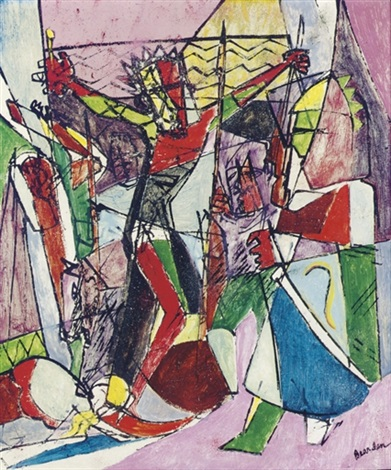
Good Friday (Psalm 22)

Golgotha – Crucifixion, by Romare Bearden, 1945

My God, my God, why have you forsaken me?
    Why are you so far from helping me, from the words of my groaning?
O my God, I cry by day, but you do not answer;
    and by night but find no rest.

Yet you are holy,
    enthroned on the praises of Israel.
In you our ancestors trusted;
    they trusted, and you delivered them.
To you they cried and were saved;
    in you they trusted and were not put to shame.

But I am a worm and not human,
    scorned by others and despised by the people.
All who see me mock me;
    they sneer at me; they shake their heads;
“Commit your cause to the Lord; let him deliver—
    let him rescue the one in whom he delights!”

Yet it was you who took me from the womb;
    you kept me safe on my mother’s breast.
On you I was cast from my birth,
    and since my mother bore me you have been my God.
Do not be far from me,
    for trouble is near,
    and there is no one to help.

Many bulls encircle me;
    strong bulls of Bashan surround me;
they open wide their mouths at me,
    like a ravening and roaring lion.

I am poured out like water,
    and all my bones are out of joint;
my heart is like wax;
    it is melted within my breast;
my mouth is dried up like a potsherd,
    and my tongue sticks to my jaws;
    you lay me in the dust of death.

For dogs are all around me;
    a company of evildoers encircles me;
they bound my hands and feet.
I can count all my bones.
They stare and gloat over me;
they divide my clothes among themselves,
    and for my clothing they cast lots.

But you, O Lord, do not be far away!
    O my help, come quickly to my aid!
Deliver my soul from the sword,
    my life from the power of the dog!
    Save me from the mouth of the lion!

From the horns of the wild oxen you have rescued me.
I will tell of your name to my brothers and sisters;
    in the midst of the congregation I will praise you:
You who fear the Lord, praise him!
    All you offspring of Jacob, glorify him;
    stand in awe of him, all you offspring of Israel!
For he did not despise or abhor
    the affliction of the afflicted;
he did not hide his face from me
    but heard when I cried to him.

From you comes my praise in the great congregation;
    my vows I will pay before those who fear him.
The poor shall eat and be satisfied;
    those who seek him shall praise the Lord.
    May your hearts live forever!

All the ends of the earth shall remember
    and turn to the Lord,
and all the families of the nations
    shall worship before him.
For dominion belongs to the Lord,
    and he rules over the nations.

To him, indeed, shall all who sleep in the earth bow down;
    before him shall bow all who go down to the dust,
    and I shall live for him.
Posterity will serve him;
    future generations will be told about the Lord
and proclaim his deliverance to a people yet unborn,
    saying that he has done it. (New Revised Standard Version)

Crucifixion, by Romare Bearden, 1947

It’s one thing to be alone because of other’s mocking, yelling, spitting at you, even physically beating you; that, in and of itself, is terribly traumatic. Yet, it’s quite another thing altogether to feel forsaken by one’s God, to experience a deafening divine silence amidst all the human commotion.

There are levels of suffering – and physical suffering is the least of our agony; the experiences of mental, emotional – and I insist, spiritual suffering – is worse than a hundred kidney stones.

“Suffering” is a word many would like to avoid. Simply seeing or hearing the word might make us cringe. Suffering? No thanks. I’ll pass. Yet, something inside us instinctively knows we cannot get around it. Everyone suffers in some way; it’s endemic to the human condition. 

Sometimes, maybe even most times, we are not immediately relieved of suffering because it is meant to have a redemptive purpose to it – that somehow, some way, the awful affliction shall result in eventual blessing to either oneself, another, or perhaps to many.

Miracles are miracles not because they fall from heaven with no connection to what’s happening on this earth. No, miracles occur because of suffering, because something gut-wrenching is happening, because someone or many people are tragically hurt.

Jesus intimately knows suffering, first hand. And he knows what suffering can produce: the deliverance of many.

For Christians everywhere, today is “Good” not because of the pain experienced but because the crucifixion of Jesus Christ means the redemption of the world.

On this Good Friday, followers of Jesus remember and commemorate the events that led up to the cross; unpack those events and interpret them with profound meaning and significance; and worship Jesus with heartfelt gratitude because of the redeeming work of the cross.

It is today that Christians remember the last words of Christ, and recognize the significant impact his death had on the immediate persons around him. Believers also contemplate the lasting results of that singular death as an atoning sacrifice; perfect love; reconciliation between God and humanity; victory over evil; and the redemption of all creation.

For believers, there’s the recognition that something deeply impactful is happening in the egregious suffering of Jesus. Therefore, we acknowledge and remember the anguish of Christ; and also what that horrible torment accomplished.

With such profound meaning, one would think that Good Friday is a hugely observed day for all Christians in every tradition. Yet, for a chunk of churches and Christians, it is not. The cross is not a popular subject. It could be because neither Christian nor non-Christian wants to ponder something so tragically bloody and sad.

“Religious people want visionary experiences and spiritual uplift; secular people want proofs, arguments, demonstrations, philosophy, and science. The striking fact is that neither one of these groups wants to hear about the cross.” 

Fleming Rutledge, The Crucifixion: Understanding the Death of Christ

Indeed, as the Apostle Paul has said, the cross of Christ is “a stumbling block to Jews and folly to Gentiles.” (1 Corinthians 1:23)

A personalized religion which leaves the cross out of the picture (too much violence and sacrifice) might seem appealing, yet will only leave us bereft of the communion of the saints both past and present. Consider the confessional witness of the Church:

Christ suffered “in both body and soul – in such a way that when he sensed the horrible punishment required by our sins ‘his sweat became like great drops of blood falling down on the ground.’ He cried, ‘My God, my God, why have you forsaken me?’ And he endured all this for the forgiveness of our sins. Therefore, we rightly say with the Apostle Paul that we know nothing ‘except Jesus Christ, and him crucified;’ we ‘regard everything as loss because of the surpassing value of knowing Christ Jesus our Lord.’ We find all comforts in his wounds and have no need to seek or invent any other means than this one and only sacrifice, once made, which renders believers perfect forever.”

Belgic Confession, Article 21

And let us consider further the New Testament witness:

“Jesus suffered outside the gate in order to sanctify the people through his own blood. Therefore, let us go forth to him outside the camp, and bear the abuse he endured.” (Hebrews 13:12-13, NIV)

“May I never boast of anything except the cross of our Lord Jesus Christ, by which the world has been crucified to me, and I to the world.” (Galatians 6:14, NRSV)

The extent of Good Friday goes far beyond a day on the calendar; it is the fulcrum upon which all of Christianity hinges.

Because Christ suffered, our suffering has meaning. Each situation of trauma; every case of disease; all suffering, abuse, and hardship makes sense, in the Christian tradition, when they are viewed in solidarity with the cross of Jesus Christ.

So, today, let Christians everywhere contemplate the cross, observe the salvation accomplished through Christ’s death, and offer prayers and petitions for those who need deliverance from the power of evil.

The Wonder of Christ’s Resurrection

Welcome, friends! In the New Testament Gospel of Luke 24:1-12, we find an account of women approaching the grave of Jesus, only to find an empty tomb. Today, people search for reality in all kinds of empty places. There is, however, hope, because Christ is risen! He is risen, indeed! Click the videos below and let us enjoy and be in awe that Jesus is alive!

Pastor Tim Ehrhardt, Luke 24:1-12

May the glory and the promise of this joyous time of year bring peace and happiness to you and those you hold most dear.

And may Christ, Our Risen Savior, always be there by your side to bless you most abundantly and be your loving guide. Amen.

Psalm 31:1-4, 15-16 – Holy Saturday

I take refuge in you, Lord.
    Please never let me be put to shame.
        Rescue me by your righteousness!
Listen closely to me!
    Deliver me quickly;
        be a rock that protects me;
        be a strong fortress that saves me!
You are definitely my rock and my fortress.
    Guide me and lead me for the sake of your good name!
Get me out of this net that’s been set for me
    because you are my protective fortress….

My future is in your hands.
    Don’t hand me over to my enemies,
    to all who are out to get me!
Shine your face on your servant;
    save me by your faithful love! (Common English Bible)

Holy Saturday is a quiet place sandwiched between the ignominy of the Cross and the celebration of Resurrection – a day of solitude, silence, and stillness. 

This isn’t a particularly popular day. People don’t rave about Holy Saturday. Many Christians haven’t even a thought that this day could have any significance. Yet, this very day has its place in the scheme of the Christian life.

Whenever Christians quickly jump to triumphal language about victory and speak little-to-nothing about suffering, then we are left with a cheap grace which has been purchased with the counterfeit currency of velocity. 

Today is meant for us to get of our heads and wrap our hearts around the important reality that Jesus Christ was truly and bodily dead in the grave. 

It was real suffering on Good Friday, and it is a real death on Holy Saturday. There is no movement. All is silent and still. Jesus is in the solitude of a dark tomb. 

There’s no getting around this: If we want a Resurrection Day with all its celebration and glory, then we cannot circumvent Holy Saturday with its quiet and somber sadness. 

Holy Saturday must be observed if we are to experience real and practical freedom from the bondage of shame. And shame is powerful. It keeps a person locked within themselves, alone with their secrets hidden far from others.

Far too often we may try and cope with our shameful words or actions through promising to work harder, pledging to have greater willpower, or complaining that life is unfair. None of this gets to the root of our shame.

Unlike guilt, which our conscience identifies as specific behaviors to repent of, shame is the message of our inner critic who obnoxiously decries that we are somehow flawed, not enough, and inherently lacking intelligence, courage, or volition.

Shame is the insidious mechanism which interprets bad events as we ourselves being bad.

Shame is the vampire who lives in the shadows and feeds on secrets – which is why the posture of shame is to hide our face in our hands. If shame persists, we withdraw from others and experience grinding loneliness. 

Therefore, the path out of shame is to openly name our shame and tell our stories. In other words, nailing the stake of vulnerability into the heart of shame, and exposing it to the light, causes it to disintegrate and vaporize.

In contrast to the unhealthy hiding of ourselves within prison walls of shame is seeking refuge and hiding ourselves in God. Even a cursory look at today’s psalm evidences an open and vulnerable person who wants nothing to do with shame. The psalmist unabashedly and without shame is quite forward in presenting his wants to God.

The psalms are meant for repeated use, to be voiced aloud again and again. In doing this simple activity, we shame-proof our lives. God’s face shines upon us and takes away the shadows of shame. It is no coincidence that Jesus forsook the shame of the cross through publicly uttering the words of this psalm: “Into your hands I commit my spirit.” (Luke 23:46)

Unchecked verbal violence will eventually lead to physical violence.

If wordy persecution comes from others, the primary tactic will most likely be shaming the people such persons want to control. Such enemies will frame a justification for violence because the people for whom they are leveling shame are “bad,” even “monsters.” If the verbal persecution comes from within, the shame can reach a critical mass of suicidal ideation and perhaps outright attempts at ending one’s life.

There is no existing with the living death of shame. But the good news is that we don’t have to. Instead, we can live in the strong fortress and the rock of refuge which is God.

The Lord traffics in redeeming mercy and steadfast love, not in the demeaning judgment of shame. We can flee to God and find grace to help us in our time of need. There is no shame in reaching out for help. We all need deliverance from something. It’s a matter of whether we are open to ask for it, or not.

Holy Saturday is here for you to know that Jesus Christ absorbed all of the world’s massive shame, yesterday, on Good Friday. Christ died. And the shame he took on, died with him. It is no more and will rise no more.

But someone will rise….

Father God, into your hands I commit my spirit – everything I am and all that I hope to be – so that Jesus Christ might be exalted in me through the power of your Holy Spirit. I choose to leave shame where it belongs – nailed to the cross. With your divine enablement, I shall walk in newness of life through expressing my needs and wants with courage, confidence, and candor. May it be so according to your steadfast love. Amen.

Isaiah 52:13-53:12 – Good Friday

This stained-glass window was donated to the Sixteenth Street Baptist Church of Birmingham, Alabama by the people of Wales after the church was bombed in 1963.

The Lord says,

“My servant will succeed in his task;
    he will be highly honored.
Many people were shocked when they saw him;
    he was so disfigured that he hardly looked human.
But now many nations will marvel at him,
    and kings will be speechless with amazement.
They will see and understand
    something they had never known.”

The people reply,

“Who would have believed what we now report?
    Who could have seen the Lord’s hand in this?
It was the will of the Lord that his servant
    grow like a plant taking root in dry ground.
He had no dignity or beauty
    to make us take notice of him.
There was nothing attractive about him,
    nothing that would draw us to him.
We despised him and rejected him;
    he endured suffering and pain.
No one would even look at him—
    we ignored him as if he were nothing.

“But he endured the suffering that should have been ours,
    the pain that we should have borne.
All the while we thought that his suffering
    was punishment sent by God.
But because of our sins he was wounded,
    beaten because of the evil we did.
We are healed by the punishment he suffered,
    made whole by the blows he received.
All of us were like sheep that were lost,
    each of us going his own way.
But the Lord made the punishment fall on him,
    the punishment all of us deserved.

“He was treated harshly, but endured it humbly;
    he never said a word.
Like a lamb about to be slaughtered,
like a sheep about to be sheared,
    he never said a word.
He was arrested and sentenced and led off to die,
    and no one cared about his fate.
He was put to death for the sins of our people.
He was placed in a grave with those who are evil,
    he was buried with the rich,
even though he had never committed a crime
    or ever told a lie.”

The Lord says,

“It was my will that he should suffer;
    his death was a sacrifice to bring forgiveness.
And so he will see his descendants;
    he will live a long life,
    and through him my purpose will succeed.
After a life of suffering, he will again have joy;
    he will know that he did not suffer in vain.
My devoted servant, with whom I am pleased,
    will bear the punishment of many
    and for his sake I will forgive them.
And so I will give him a place of honor,
    a place among the great and powerful.
He willingly gave his life
    and shared the fate of evil men.
He took the place of many sinners
    and prayed that they might be forgiven.” (Good News Translation)

We all suffer. 

Whether a chronic physical condition, emotional or moral distress, mental illness, or spiritual oppression, everyone falls prey to this world’s pain and heartache. 

The refugee, the poor, the oppressed, the lonely, the forgotten, the disadvantaged, the diseased, the distressed, and the displaced are just a few of the persons experiencing their own private pain, public humiliation, and an awful suffering.

Suffering that defies reason, the kind of pain which seems senseless, the type of hurt where nothing good appears to be going on at all, is all horribly troubling to the soul.

Perhaps it seems ironic, maybe even cruel, that Christians observe a day called “Good” Friday. Considering the adverse circumstances of so many people, to call today “good” appears awkward, as if Christ’s followers have their collective heads in the sand. 

Even for Christians, “Good Friday” may seem a bit oxymoronic for a day observing the torture and death of an innocent man. Some argue that Christ is no longer on the cross, and so, we need to give all our focus on the resurrected Jesus and the victory he achieved. No need for all this suffering stuff. 

Yet, the Resurrection only has meaning because of this very day, Good Friday. Without the Suffering Servant of Isaiah, there is no King Jesus. 

Holy Hill Stations of the Cross, Hubertus, Wisconsin

For Christians everywhere, this day is very good in the sense that the crucifixion of Jesus Christ means the redemption of the world. On this day we remember and commemorate the events that led up to the cross; unpack those events and interpret them with profound meaning and significance; and worship Jesus with heartfelt gratitude because of his redeeming work of the cross.

The bulk of the New Testament Gospels of Matthew, Mark, Luke, and John are given to the final week of Christ’s life, especially leading to the cross. Good Friday observances often take a somber form due to the brevity of Christ’s experience on the cross. 

Christians remember the last words of Christ and recognize the significant impact his death had on the immediate persons around him. Believers also contemplate the lasting results of that singular death as an atoning sacrifice; perfect love; reconciliation between God and humanity; victory over evil; and redeeming all creation.

Sadness, then, is far from the only emotion on this day. It is appropriate to feel wonder, gratitude, and deep satisfaction for deliverance from the power of sin. There is the recognition that something profound and meaningful has truly happened in the egregious suffering of Jesus. 

Thus, we not only remember the anguish of Christ, but what that horrible torment accomplished. In fact, the cross of Jesus is so significant that an eternity of considering its import and impact could never plumb the depths of its far-reaching effects.

With all that has been said, one would think that Good Friday is a hugely observed day on the Christian Calendar. Yet, for a chunk of churches and Christians, it’s not. The bottom line is that the cross is not popular.  Maybe it’s because neither Christian nor non-Christian wants to ponder something so incredibly violent, hateful, and bloody.

Episcopal priest Fleming Rutledge has adroitly put her finger on the issue:

“Religious people want visionary experiences and spiritual uplift; secular people want proofs, arguments, demonstrations, philosophy, and science.  The striking fact is that neither one of these groups wants to hear about the cross.” 

Fleming Rutledge

Indeed, as the Apostle Paul has said, the cross of Christ is “a stumbling block to Jews and folly to Gentiles” (1 Corinthians 1:23).

A personalized religion which leaves the cross out of the picture (too much blood and violence) might seem appealing. Yet it will only leave us bereft of the communion of saints both past and present. Consider the ancient witness of the Church:

“I believe in Jesus Christ, his only Son, our Lord… he suffered under Pontius Pilate, was crucified, died, and was buried; he descended to hell.”

Apostles’ Creed

“For our sake he [Christ] was crucified under Pontius Pilate; he suffered death and was buried.” –Nicene Creed

Christ suffered “in both body and soul – in such a way that when he sensed the horrible punishment required by our sins ‘his sweat became like great drops of blood falling down on the ground.’ He cried, ‘My God, my God, why have you forsaken me?’ And he endured all this for the forgiveness of our sins. 

Therefore, we rightly say with the Apostle Paul that we know nothing ‘except Jesus Christ, and him crucified;’ we ‘regard everything as loss because of the surpassing value of knowing Christ Jesus our Lord.’ We find all comforts in his wounds and have no need to seek or invent any other means than this one and only sacrifice, once made, which renders believers perfect forever.” –Belgic Confession, Article 21

And let us consider further the New Testament witness:

“Jesus suffered outside the gate in order to sanctify the people through his own blood.  Therefore, let us go forth to him outside the camp, and bear the abuse he endured.” (Hebrews 13:12-13, NIV)

“May I never boast of anything except the cross of our Lord Jesus Christ, by whichthe world has been crucified to me, and I to the world.” (Galatians 6:14, NRSV)

The extent of Good Friday goes far beyond just a day on the calendar; it is the fulcrum upon which all of Christianity hinges. 

Because Christ suffered, our suffering has meaning.

Each situation of trauma; every case of disease; adversity and wholesale hard circumstances, all make sense, in the Christian tradition, when they are viewed in solidarity with Jesus Christ crucified.

So, today, let Christians everywhere contemplate the cross, observe the salvation accomplished through Christ’s death, and offer prayers and petitions for those who need deliverance from the power of evil. In short, let us worship God in Jesus Christ because of the suffering on the cross.

Along with all believers everywhere we pray:

Jesus, Lamb of God, have mercy on us.

Jesus, Bearer of our sins, have mercy on us.

Jesus, Redeemer of the world, grant us your peace. Amen.