

A Person’s a Person, No Matter How Small (Luke 17:1-4)

Jesus said to his disciples:

There will always be something that causes people to sin. But anyone who causes them to sin is in for trouble. A person who causes even one of my little followers to sin would be better off thrown into the ocean with a heavy stone tied around their neck. So be careful what you do.

Correct any followers of mine who sin, and forgive the ones who say they are sorry. Even if one of them mistreats you seven times in one day and says, “I am sorry,” you should still forgive that person. (Contemporary English Version)

In the children’s book by Dr. Seuss, Horton Hears a Who! Horton the elephant famously said, “A person’s a person no matter how small.” All the people around Horton were completely unconcerned for the residents of Who Ville living on a clover.

They were uninterested because the Who’s were invisible to them. Dr. Seuss chose to make Horton an elephant, a large creature able to hear with big ears and be attentive to the small.

Bigness and a large heart comes from becoming small and noticing little ones.

“Little ones” are people no one sees or notices. But Jesus sees them. They matter to him. And so they ought to matter to us, too. People need to be seen and heard by us – because they are visible to Jesus, and heard by him.

Christ often mingled with little people – children, women who had no rights, social misfits like lepers, the chronically ill, religious outsiders, tax collectors, and prostitutes. Our world is filled with similar people – angry adolescents, unwanted babies, forgotten old people, the mentally ill, moral failures, immigrants and refugees, and, if we have eyes to see and big ears to hear, lots of underprivileged people who reside on the dark underbelly of society.

They are around us, even if they are invisible to us.

Jesus envisioned a community that sees, honors, and protects little people. Truth be told, we are all little people before God, and the Lord notices us. So, we are to have enough humility to see the little people around us.

The way to become great in the kingdom of God is to descend, not ascend, into greatness. The chief enemy of any community is a desire to be prominent, to be the Big Cheese – it’s called “pride” and it will separate us from God if we hold onto it. Which is why we must do all we can to radically cut it out of our lives.

We are to welcome people – not because they are great, wise, rich, powerful, good-looking, and look like you and me. Rather, we are to welcome others because they are noticed by Jesus. Like Horton the elephant, Christ the Lord hears the cry from the place of smallness and is determined to do something about it.

The proud person who seeks prominence is always looking for greener pastures and impressing others. The proud connect with people who will help advance them up the ladder of success. Through that process of advancement, the proud do not care who they step on along the way.

Christians, however, are to give the small, insignificant people of society the time of day, treat them as important, and advocate for their needs. 

The Apostle Peter learned the hard way about paying attention to those different from himself. He experientially learned the saying, “love covers over a multitude of sins.” (1 Peter 4:9) This means that basic love for another prevents them from committing the sins they would have if they were unloved.

If we do not love, it would be better for us to be killed in a tragic millstone death. Jesus does not want people acting like leeches, just sucking the life out of others to get what they want.

So, what do we do about it? How shall we then live?

A person’s a person no matter how small. We need humility, to lower our sights and our bodies to see little people. We can truly see a two-year-old toddler whenever we lower ourselves to view them as equal and important. The way to see another requires slowing down, observing, and stooping or sitting to look them in the eye and give them the dignity of attention they deserve.

The danger of reading a post like this is the thought that all this stuff is really for someone else. After all, I don’t want to hurt anyone or see anybody deprived, right? Yet, the fact remains that we do no one any good when we neglect getting on the floor.

When we assume blessing for ourselves without the intent of giving it to others, we have come under the judgment of Christ. Perhaps we fear forgiveness – either accepting an apology from another or offering one to someone we have wronged. Out of sight, out of mind, is the approach of the one who causes others to stumble and make them fall.

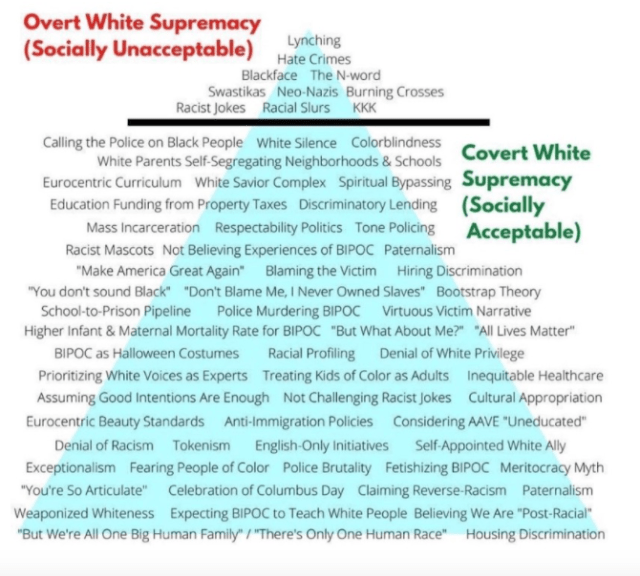
Christ’s admonition is to watch ourselves, to be vigilant of both overt and covert sins against the unseen and forgotten amongst us. The pyramid below concerning racism is just one example of many other forms of causing others to stumble and fall:
Even though I write this warning, dear friends, I am confident of better things in your case—the things that have to do with salvation, deliverance, and liberation for all persons.God is not unjust; he will not forget your work and the love you have shown him as you have helped others and continue to help them.

Continue to show this same diligence so that what you hope for may be fully realized; and, imitate those who through faith and patience are doing good work. May the Lord be with you.

For those deprived of their human needs and their human rights: Just God, may they may be given the dignity by others which you confer on all his people.

For all who are forgotten and unseen, especially the poor, the sick, and the aged: All-seeing God, may you move us to love them as the image of Christ.

For all who are lonely or afraid, for teenagers on the street, the elderly in nursing homes, prisoners with no one to visit them, and all whom the world has forgotten: Lord Christ, may you lead us to them.

For those who suffer mental illness or disorder: Attentive God, may we cherish the gifts you have given them, and in their lives hear the voice of your love.

For each human life: Creator God, may we value every person as you do.
We pray in the name of Jesus Christ, our Savior. Amen.

Daniel 1:1-21 – Cultural Humility

In the third year of the reign of Jehoiakim king of Judah, Nebuchadnezzar king of Babylon came to Jerusalem and besieged it. And the Lord delivered Jehoiakim king of Judah into his hand, along with some of the articles from the temple of God. These he carried off to the temple of his god in Babylonia and put in the treasure house of his god.

Then the king ordered Ashpenaz, chief of his court officials, to bring into the king’s service some of the Israelites from the royal family and the nobility—young men without any physical defect, handsome, showing aptitude for every kind of learning, well informed, quick to understand, and qualified to serve in the king’s palace. He was to teach them the language and literature of the Babylonians. The king assigned them a daily amount of food and wine from the king’s table. They were to be trained for three years, and after that they were to enter the king’s service.

Among those who were chosen were some from Judah: Daniel, Hananiah, Mishael and Azariah. The chief official gave them new names: to Daniel, the name Belteshazzar; to Hananiah, Shadrach; to Mishael, Meshach; and to Azariah, Abednego.

But Daniel resolved not to defile himself with the royal food and wine, and he asked the chief official for permission not to defile himself this way.Now God had caused the official to show favor and compassion to Daniel, but the official told Daniel, “I am afraid of my lord the king, who has assigned your food and drink. Why should he see you looking worse than the other young men your age? The king would then have my head because of you.”

Daniel then said to the guard whom the chief official had appointed over Daniel, Hananiah, Mishael and Azariah, “Please test your servants for ten days: Give us nothing but vegetables to eat and water to drink. Then compare our appearance with that of the young men who eat the royal food and treat your servants in accordance with what you see.” So, he agreed to this and tested them for ten days.

At the end of the ten days, they looked healthier and better nourished than any of the young men who ate the royal food. So, the guard took away their choice food and the wine they were to drink and gave them vegetables instead.

To these four young men God gave knowledge and understanding of all kinds of literature and learning. And Daniel could understand visions and dreams of all kinds.

At the end of the time set by the king to bring them into his service, the chief official presented them to Nebuchadnezzar. The king talked with them, and he found no one equal to Daniel, Hananiah, Mishael and Azariah; so, they entered the king’s service. In every matter of wisdom and understanding about which the king questioned them, he found them ten times better than all the magicians and enchanters in his whole kingdom.

And Daniel remained there until the first year of King Cyrus. (New International Version)

Cultural humility is a humble and respectful attitude toward individuals of other cultures that pushes one to challenge their own cultural biases, realize they cannot possibly know everything about other cultures, and approach learning about other cultures as a lifelong goal and process.

Daniel is a much revered biblical figure. And for good reason. He exhibits the best qualities of humanity.

The mighty Babylonian Empire invaded Judah, tore down the wall of Jerusalem, seized the Temple, and carried off the best and the brightest Jews to Babylonia for service to the powerful King Nebuchadnezzar.

By the king’s orders, the young men were given to Ashpenaz, the head official, to be trained in the cultural ways of the Babylonians. And this is where it gets interesting. The interaction between Daniel and Ashpenaz is a master class in cultural competence and cultural humility.

Cultural competence emphasizes the knowledge of the person in the majority. Cultural humility, however, allows other people to share their own experiences.

Cultural humility is about curiosity. The real discovery, and real competence, is in knowing there’s something you may not understand about another individual or group. Being open to finding out or figuring out what that difference is, is the humble curiosity which can lead to new and good possibilities.

Daniel and the others were forcibly taken from their home. They are in a strange place and are not about to acquiesce in becoming Babylonians instead of a Jews.

Ashpenaz was given a clear task by the king, which was essentially to make Babylonians out of them. This could be an explosive situation. Yet, it wasn’t, because both Ashpenaz and Daniel were willing to have some cultural humility about their situation.

The humility of Daniel, his way of being civil and present, opened the way for Ashpenaz to listen. The young men did not want to go against their religious convictions. At this point, Ashpenaz took the way of humility. He learned something about these Jewish men under his charge. Instead of filing that information away in his head or in some papyrus library, Ashpenaz became open to Daniel’s suggestion.

And, as it turns out, both Ashpenaz and the Babylonians were much better off because of two men’s interactions based in humility. Furthermore, Daniel and the others navigated a dicey situation and came out holding to their integrity, not to mention their lives.

Ashpenaz was not only willing to learn about another culture (cultural competence) but took the next necessary step in letting that knowledge affect how he went about his job. The open discussion about differences is what led to belonging.

Today, we must realize that the idea you can arm yourself with a body of knowledge about a culture and believe that’s all you need to do, doesn’t give anyone or any culture much space to change. In other words, knowledge by itself isn’t being inclusive of another’s perspective or ways. Knowledge alone doesn’t bring connection between differing people.

We need people (you and me!) who are willing to be curious and take the understanding we have about another culture and pursue changing something that isn’t right in our own culture. We must have people who are humble enough to discern that our own cultures have their good practices and their bad approaches.

Daniel wasn’t obnoxious about what he wanted and didn’t decry or verbally attack Ashpenaz and the Babylonian culture. And Ashpenaz didn’t simply ignore Daniel and force cultural colonization on him and the others.

This interaction between two people was the seed which eventually led to the Jews leaving exile and returning to Jerusalem. I doubt that ever would have happened, had Daniel and Ashpenaz held tightly to cultural pride.

Holy God, who sent your only Son Jesus Christ to be crucified for our sins, have mercy upon me. May I follow in his example, leading and loving in great humility, for you oppose the proud but raise up the humble. Help me to be gracious, patient, loving, and kind in every interaction, especially with those who are very different than myself. Amen.