A Reality Check (Hebrews 10:1-4)

The law is only a shadow of the good things that are coming—not the realities themselves. For this reason it can never, by the same sacrifices repeated endlessly year after year, make perfect those who draw near to worship. Otherwise, would they not have stopped being offered? For the worshipers would have been cleansed once for all and would no longer have felt guilty for their sins. But those sacrifices are an annual reminder of sins. It is impossible for the blood of bulls and goats to take away sins. (New International Version)

Sometimes, we silly people confuse the sign for the real deal. It’s important to distinguish between the two. We discern the difference all the time when it comes to more mundane affairs.

People generally know that looking at a movie poster is not watching the actual film; that wearing a string of cheap pearls is only mimicking the real and expensive ones; or that sitting in a doctor’s waiting room isn’t the same thing as being in the appointment.

However, when it comes to our religion, we seem to blur the lines between sign and substance. Praying a “sinners prayer” or making a profession of faith isn’t the same as growing, maturing, following, and living a committed Christianity.

Knowing some Christian lingo and/or going with the flow of cultural Christianity doesn’t necessarily mean that Christ’s words and ways are being followed.

And today’s New Testament lesson is a reminder, and not a guilt trip, that the law points to the actual substance of religious life – and is not life itself.

The laws surrounding the old system of animal sacrifice were never meant to be an end in itself. It pointed forward to the real deal and was, therefore, completely inadequate to bring deliverance from sin, death, and hell to anyone.

The very fact that sacrifices needed to be repeated year and after year demonstrated that they were ineffectual in saving a person. Rather, those sacrifices were designed to cause the worshiper to long for a sacrifice to end all sacrifices – to anticipate that the sin issue would be settled once and for all.

The only thing the sacrifices did was remind people they were sinners in need of a savior. Just as a slap on the hand is grossly inadequate for handling a murderer, so offering an animal was never going to do the trick in taking care of divine justice.

And besides, God has never been pleased with a bunch of sacrifices anyway. So, what is God really pleased with? The Lord is pleased with a heart devoted to obedience and fealty to Jesus Christ; God cares about inner attitudes and dispositions of the spirit which are inclined toward righteousness, holiness, mercy, humility, and justice for all.

Sacrifices, in and of themselves, have no power; they are like a toothless lion who couldn’t bite into you if he tried. The way to set things right is through the once for all mighty sacrifice of the Son – an offering to end all offerings.

God doesn’t want a checklist of daily sacrifices, any more than a spouse only wants supper on the table at night, or a paycheck every month. It’s nice but falls short of the full scope of marital interactions and relations. A marriage built on law won’t stand. It needs real flesh and blood relationship, complete with a devoted heart, sincere attitudes, and loving words and actions.

Since Christ has ably and permanently taken care of the sin issue, what sort of impact ought that to have on the Christian’s life? What kind of people are we to be?

To begin listing things to do is to go back to law and fail to grasp the gospel. And that’s where many churches and believers get tripped up and miss the grace of God altogether. Observing rules of cultural Christian activities or holding to some accepted Christian norms isn’t going to cut it.

Christ’s Sermon on the Mount by Jorge Cocco Santángelo

Jesus described the sort of people who go beyond ritual regulations and rules to embrace the true spirit and end of the law:

“You’re blessed when you’re at the end of your rope. With less of you there is more of God and his rule.

“You’re blessed when you feel you’ve lost what is most dear to you. Only then can you be embraced by the One most dear to you.

“You’re blessed when you’re content with just who you are—no more, no less. That’s the moment you find yourselves proud owners of everything that can’t be bought.

“You’re blessed when you’ve worked up a good appetite for God. He’s food and drink in the best meal you’ll ever eat.

“You’re blessed when you care. At the moment of being ‘care-full,’ you find yourselves cared for.

“You’re blessed when you get your inside world—your mind and heart—put right. Then you can see God in the outside world.

“You’re blessed when you can show people how to cooperate instead of competing or fight. That’s when you discover who you really are, and your place in God’s family.

“You’re blessed when your commitment to God provokes persecution. The persecution drives you even deeper into God’s kingdom. (Matthew 5:3-10, MSG)

That describes folk who have embraced faith as the fulfillment of law. It’s a summary of the law’s intended purpose and end.

So, let’s worship Christ; and not some caricature of him. Maybe carefully reading through the entire book of Hebrews in one sitting will help.

Blessed God, purify your people by your abiding presence. Enlighten the minds of your people with the light of your good news. Bring wandering souls to an awareness and knowledge of Jesus Christ; and those who are walking in the way of life, keep them steadfast to the end. Guard those who are strong and prosperous from forgetting you. Increase in us your many gifts of grace and make us all fruitful in good works for the sake of Christ in the power of the Holy Spirit. Amen.


Believe, Love, and Obey (1 John 5:1-12)

Everyone who believes that Jesus is the Christ is born of God, and everyone who loves the father loves his child as well. This is how we know that we love the children of God: by loving God and carrying out his commands. In fact, this is love for God: to keep his commands. And his commands are not burdensome, for everyone born of God overcomes the world. This is the victory that has overcome the world, even our faith. Who is it that overcomes the world? Only the one who believes that Jesus is the Son of God.

This is the one who came by water and blood—Jesus Christ. He did not come by water only, but by water and blood. And it is the Spirit who testifies because the Spirit is the truth. For there are three that testify: the Spirit, the water and the blood; and the three agree. We accept human testimony, but God’s testimony is greater because it is the testimony of God, which he has given about his Son. 

Whoever believes in the Son of God accepts this testimony. Whoever does not believe God has made him out to be a liar, because they have not believed the testimony God has given about his Son. And this is the testimony: God has given us eternal life, and this life is in his Son. Whoever has the Son has life; whoever does not have the Son of God does not have life. (New International Version)

Faith, love, and obedience are words so tightly woven together, that to pull one of them out, is to unravel the whole bunch. 

To believe, love, and obey are the true marks of a Christian; and they are vital to living the Christian life and overcoming the dark forces of the world.

Let’s talk some grammar – because it will help us better understand the Apostle John’s message….

The main verb is the main thing

One of the dominant main verbs throughout these verses: “is.” And the verb tense is key, grammatically describing a past action of God which people need to receive. In other words, the grammar dictates that God has given us new birth. 

We do not give ourselves spiritual birth any more than we can tell our mothers that it was us who gave birth to ourselves.

The participles describe the main thing

God saves us from sin and grants us forgiveness. The action is from God to us; we are recipients of God’s good grace toward us.

There are three participles connected to the main verb, “is:”

  1. Believe
  2. Love
  3. Obey

A participle is a word which is connected to the verb’s action. 

Our actions are a result of God’s action toward us.

Simply put, a person born from God will believe, love, and obey.

Just as a newborn baby first breathes, then learns to eat, sleeps, grows-up, learns to walk, and over time develops into an adult just like their mother and father, so the Christian who is born again from God exhibits faith, learns to love, and grows up developing the skills of obeying Jesus and following him, learning to walk in his ways, becoming just like him.

Overcoming the world

In the same way a child must grow and mature to have the necessary skills for facing the world in all its trials and temptations, so the Christian must develop the requisite abilities of faith, love, and obedience, to overcome the world.

To “overcome” is to experience the victory the Lord Jesus has achieved on the cross. 

Through being spiritually born again by God, it sets us on a course requiring faith, love, and obedience in overcoming the world. As we learn to apply these three spiritual characteristics to our lives, we experience practical victory over the world.

The term “world” is used by the Apostle John as the patterns, systems, and operations of the world, which are in direct contrast to how God operates. For example:

  • The world engages in revenge and payback when wronged, whereas the Christian learns to believe God will be the Judge, loves the person who has offended them through prayer for their enemy, and obeys God through good works that seeks the welfare of the other. 
  • The world uses other people as either objects of their pleasure or to get ahead in life, whereas the Christian believes God will take care of their needs, will seek to love the other person instead of use them, and would rather obey God by cutting off their right hand off than being selfish. 
  • The world thinks nothing of lying, cheating, and stealing, if they can get away with it, whereas the Christian believes Jesus is the way, the truth, and the life, loves being a person of integrity, and obeys God even when it hurts.

This in no way suggests we avoid or belittle the world. In overcoming the world, we must have principled civility. Using faith, love, and obedience, we respect another’s viewpoint through allowing our spirits to grow in faith, expanding our hearts in love, and learning obedience through interaction with others for whom we disagree.

Faith, love, and obedience

We need faith in God:

Trust in the Lord with all your heart,
    and do not rely on your own insight.
In all your ways acknowledge him,
    and he will make straight your paths. (Proverbs 3:5-6, NRSV)

We need love for God and others:

Don’t love the world’s ways. Don’t love the world’s goods. Love of the world squeezes out love for the Father. Practically everything that goes on in the world—wanting your own way, wanting everything for yourself, wanting to appear important—has nothing to do with the Father. It just isolates you from him. The world and all its wanting, wanting, wanting is on the way out—but whoever does what God wants is set for eternity. (1 John 2:15-17, MSG)

We need obedience to the call of God:

The commandment that God has given us is: “Love God and love each other!” (1 John 4:21, CEV)

When faith, love, and obedience are working together, as intended, we overcome the world and all its crud; and keep ourselves from being polluted and stained by it.

Overcoming the world is a high calling from God. 

Faith means putting aside fear and taking the kind of risk God wants you to take.

Love means putting aside hate and serving others, even when it hurts.

Obedience means putting aside selfishness and choosing to do what is best for another person’s welfare.

Being characterized by these three Christian virtues will have the effect of overcoming the world. It is not a burdensome or heavy way to live. It’s the way of Jesus.

Blessed God – Father, Son, and Spirit – the Lord whom we serve: Sometimes our hearts and minds are flooded with fears. Sometimes we are paralyzed and overwhelmed and feel unable to go on. Yet, we hold onto the victory you have accomplished through the cross of Jesus Christ. You have told us not to fear, for you have overcome the world. In moments of crippling fear, we choose to hold your hand and believe; to love as we have been loved; and, to obey even in the most fearful places because we know that you have risen again.

Holy Spirit, we invite you and all your ministry within us. Holy God of all, we offer you our heart, mind, body, soul, spirit, hopes, plans and dreams. We surrender to you our past, present and future problems, habits, character defects, attitudes, livelihood, resources, finances, medical coverage, occupation and all relationships. We give you our health, physical appearance, disabilities, disorders, family, marriage, children, grandchildren, and friendships.

Loving Lord Jesus, we surrender to you all our hurt, pain, worry, doubt, fear and anxiety, and ask you to wash us clean. We release everything into your compassionate care. Open our ears to hear your voice. Open our hearts to commune with you more deeply. Open the doors that need to be opened and close the doors that need to be closed. Set our feet upon the straight and narrow road that leads to everlasting life. Amen.

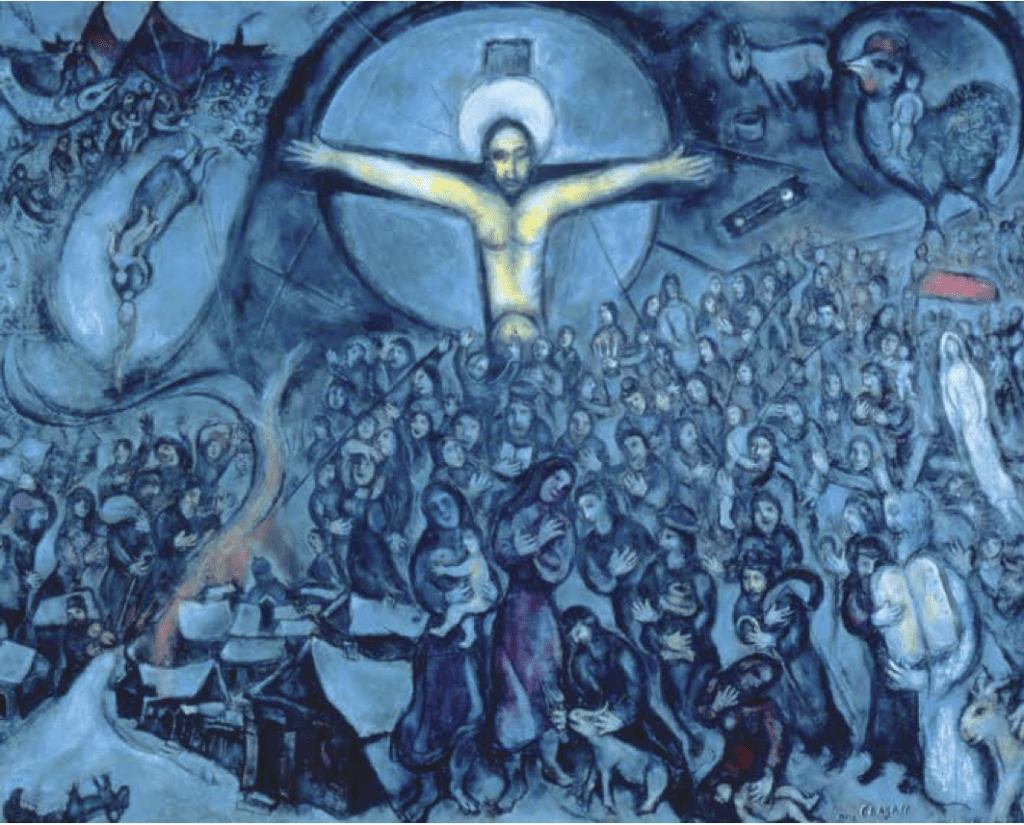
Real Forgiveness (Hebrews 9:23-28)

By Marc Chagall, 1941

It was necessary, then, for the copies of the heavenly things to be purified with these sacrifices, but the heavenly things themselves with better sacrifices than these. For Christ did not enter a sanctuary made with human hands that was only a copy of the true one; he entered heaven itself, now to appear for us in God’s presence. Nor did he enter heaven to offer himself again and again, the way the high priest enters the Most Holy Place every year with blood that is not his own. Otherwise Christ would have had to suffer many times since the creation of the world. 

But he has appeared once for all at the culmination of the ages to do away with sin by the sacrifice of himself. Just as people are destined to die once, and after that to face judgment, so Christ was sacrificed once to take away the sins of many; and he will appear a second time, not to bear sin, but to bring salvation to those who are waiting for him. (New International Version)

In truth, I could preach on the Cross every Sunday and never exhaust the immensely rich implications of Jesus Christ’s death for us. 

Perhaps, for many Christians, today’s New Testament lesson seems like a re-hashing of things we already know. Yet, it is important to keep plumbing the depths of Christ’s once-for-all sacrifice, because, through continual examination of Christ and the Cross:

  • We will know, both intellectually and experientially, that our forgiveness is real. 
  • We will be able, both spiritually and emotionally, to extend real forgiveness to others.

The original recipients of Hebrews were experiencing spiritual fatigue due to their difficult circumstances. The believers were so worn down from swimming upstream of their problems, that they considered throwing in the towel and giving up on Christianity (or at least the Church). 

The author of Hebrews truly believed that the way to combat this tiredness was through a robust understanding of Christ and the Cross. So, he sought to demonstrate that Jesus is superior to the old sacrificial system and has superseded it. 

There are three main distinctions between the old sacrificial system and the new way of Christ so that we will be encouraged to know that our forgiveness is real.

Reality vs. Simulation

The Old Testament sacrificial system, and its worship rituals in dealing with the sin issue, were only a copy and a shadow of the real sacrifice, which is Christ. The Temple sacrifices, in other words, were merely a facsimile of the real thing.

The difference between the old temple sacrifices and the sacrifice of Christ, is like the difference between riding a mechanical horse and an actual horse. Mechanical horses are merely a simulation of real riding.

Since Christ has come as the real sacrifice for sin, we need no longer be content with simulations and copies of the real deal. The Christian’s forgiveness is neither a simulation nor a copy because Christ is the real thing. 

By Marc Chagall, 1952

Jesus did not just mechanically mouth words of forgiveness to us; Christ secured real forgiveness through his death on a cross. This is no cheap imitation of forgiveness. Christ died an actual violent death.

The emphasis in Scripture on blood and sacrifice can be upsetting for many people. Yet, we need to understand that the brokenness of this world is so bad that it requires drastic action. Christ’s death reflects the horrible sin of humanity. Since Jesus has secured forgiveness for us at such a steep price, we are to receive it with great humility and joy, knowing that God loves us that much.

Permanent vs. Temporary

Jesus Christ dealt with the sin issue once and for all through his blood. He came to do away with sin, not just veneer over it. The old sacrificial system was like whitewashing a barn – it took care of the issue for a while, but it would need to be done over and over again.

We are familiar with temporary arrangements. For example, annual fees need to be paid and renewal stickers have to be put on a car’s license plate every year. Christ’s atonement, however, is no temporary arrangement. The forgiveness Jesus offers is permanent.

There is no need to keep offering sacrifices over and over because Christ is the sacrifice to end all sacrifices. The forgiveness we possess is not like paying an annual fee and getting a forgiveness sticker for the year. In Jesus Christ, we are forgiven! And this forgiveness was purchased with Christ’s own blood.

The cross that held Christ’s naked and marred body, exposed the violence and injustice of this world. The Cross revealed what kind of world we have and what kind of God we have: a world of gross unfairness, and a God of sacrificial love. Because Jesus was willing to do this on our behalf, we have a permanent forgiveness, settled once and for all, through his blood.

This old world needs real forgiveness that lasts forever – not a cheap sentimental forgiving that is merely a flash in the pan. 

Salvation vs. Judgment

A lot of religious energy can be spent trying to figure out how to make ourselves acceptable to God.

Part of the good news is that, in Christ, we do not need to fear the future. We have been made right with God through the death of Jesus. Through Christ’s sacrifice, the doors to heaven and earth get flung wide open. The way has been secured, the trail has been blazed, and the road has been made smooth to come to God.

Jesus, unlike any Levitical priest, has entered God’s presence, providing access to the living God. Christ did not need to offer sacrifice for his own sins but offered himself solely on our behalf. Jesus did more than offer the sacrifice; he himself became the sacrifice. It was a sacrifice to bring deliverance to humanity, not judgment.

Either to justify or to judge is God’s business, not ours. Our concern is to believe in the once-for-all sacrifice of Jesus that brings a permanent forgiveness; and, to share that life-giving message with others so that they, too, can experience deliverance from sin, death, and hell.

We can have such a hard time forgiving others because we struggle with experiencing our own forgiveness. The path to extending grace to others is in deepening our knowledge, understanding, and awareness of God’s grace in Christ.

Conclusion

The author of Hebrews meant for the Christian life to be an exciting and abundant adventure of following Jesus, the pioneer of our salvation.

And yet, many Christians do not know anything about this kind of life. They only see the Christian life as a duty and a chore, a kind of cross to bear. We must recognize that it is the Savior, Jesus Christ, the object of our faith, who has delivered us so that we can live a new life of freedom, enjoying our forgiveness and inviting others on the journey.

For he has rescued us from the kingdom of darkness and transferred us into the Kingdom of his dear Son, who purchased our freedom and forgave our sins.

Colossians 1:13-14, NLT

Jesus didn’t die on a cruel cross, then rise from death so that we could live ho-hum Christian lives.

Christ has granted us forgiveness so that we will enjoy the Christian life, appreciate the Word of God; relish in laboring together for the Gospel; and look forward with anticipation to how the Spirit will transform lives through Christ’s forgiveness. 

Real forgiveness opens our minds, hearts, and energies to live for Jesus, the pioneer of our salvation.

Lord Jesus Christ, you stretched out your arms of love on the hard wood of the cross that everyone might come within the reach of your saving embrace. Clothe us in your Spirit that we, reaching forth our hands in love, may bring those who do not know you to the knowledge and love of you; for the honor of your Name. Amen.

Don’t Let Suffering Surprise You (1 Peter 4:12-19)

Dear friends, do not be surprised at the fiery ordeal that has come on you to test you, as though something strange were happening to you. But rejoice inasmuch as you participate in the sufferings of Christ, so that you may be overjoyed when his glory is revealed. 

If you are insulted because of the name of Christ, you are blessed, for the Spirit of glory and of God rests on you. If you suffer, it should not be as a murderer or thief or any other kind of criminal, or even as a meddler. 

However, if you suffer as a Christian, do not be ashamed, but praise God that you bear that name. For it is time for judgment to begin with God’s household; and if it begins with us, what will the outcome be for those who do not obey the gospel of God? And,

“If it is hard for the righteous to be saved,
    what will become of the ungodly and the sinner?”

So then, those who suffer according to God’s will, should commit themselves to their faithful Creator and continue to do good. (New International Version)

In a culture of toxic positivity, we can never quite bring ourselves around to the reality of suffering. Being uncomfortable with the unwanted emotions associated with suffering seems to be the modus operandi of the Western world.

Like it, or not, none of us gets off this fallen planet without experiencing a host of circumstances we neither asked for nor wanted. And no amount of plastic smiles, fake-it-till-you-make-it approaches, and spin doctoring of attitudes will ever take the pain completely away – or even fully understand it’s mystery. In the long run, whitewashing pain only exacerbates the suffering.

Yet, despite all hardship and hurt, joy and the ability to rejoice still remains a necessary part of life, even in the worst of situations. The problem is: We tend to believe that we cannot hold seemingly opposing feelings at the same time – even though we actually do it all the time.

When the youngest child leaves home and the parents are empty nesters, they feel the simultaneous emotions of proud joy and deep sadness.

And when an aging parent or grandparent dies, the family experiences the bittersweet feelings of knowing that suffering is ended, yet also this dear loved one is gone from us.

Or when you are treated unfairly and spoken of unkindly, there is a mix of emotions from anger about what is happening to some sense of peace that this person or group of people have shown their real colors to the world.

I am going to make one of the simplest observations about God’s people in the Bible: they suffered; they were seen.

Whether Abel dying by the hand of his own brother, Noah enduring the ridicule of his neighbors, Abraham facing an uncertain future, Jeremiah weeping over Jerusalem’s calloused destruction, or Paul enduring persecution, everyone who wants to live a godly life will face suffering.

Every New Testament Epistle has a message about how to handle the inevitability of human suffering.

Fifth Station of the Cross, by Candido Portinari, 1953

The Apostle Peter, in his epistle, made it clear that every Christian should neither be surprised nor shocked when they suffer. If our Lord suffered (which he did, even to the extreme) then we, too, will also suffer, as those who follow him. 

Yet, Peter balances the harsh reality of suffering with the need for followers of Jesus to properly interpret that suffering. The Apostle learned the hard way that our means of accepting, coping with, and transcending hardship is by interpreting our personal suffering in light of Christ’s own suffering.

He insisted that the Christian’s suffering is a privilege, even a blessing. It is a mark of belonging – a sign that God’s Spirit is within us. 

If we do stupid things, we face the consequences for our foolishness. But when we do the good, right, and altruistic thing – then suffer some adverse effect – it puts us in solidarity with Christ. We can be glad for the chance to suffer as Christ suffered. It prepares the believer for even greater happiness when Jesus returns to judge the living and the dead.

I’m under no illusions or delusions here. Interpreting our suffering through specifically Christian lenses is no easy task. Sometimes it’s rough and downright hard. And it gets complicated when the suffering doesn’t let up and is compounded daily for weeks, months, even years at a time.

So, what shall we do in such times? Peter says that if your suffering originates in obedience to God, then keep the faith, keep on doing the right, the just, and the good thing.

A bad attitude, giving up, and revenge are not options on the table for the Christian. I believe most followers of Jesus understand that. The greater temptation, however, is a more subtle and insidious approach toward suffering: going with “meh.”

“Meh” is a spiritual, emotional, and mental stance of simply going with the flow, getting along on the surface of things, and hoping all the unpleasantness goes away soon. In facing the adversity with all it’s painful suffering, the “meh” person just shrugs their shoulders and says, “Meh, whatever; what’s a guy to do, anyway?”

Thanks for asking. We persevere. Don’t let suffering surprise you when it shows up at your door like an unwanted guest. Here’s some practical ways of getting through it:

  1. Tell your story to others and don’t go it alone and be the martyr. We already have a Martyr, and his name is Jesus.
  2. Do something that isn’t nothing. Avoid piddly busywork. Instead, when renewal and rest are needed, read a good book or have a stimulating conversation.
  3. Have a support system in place before suffering comes upon you. Trials to faith will happen. It will be overly difficult to face them without a community of persons around you.
  4. Ask for help, for God’s sake! People are hard-wired by their Creator for community. Rugged individualism is a myth; it doesn’t exist and isn’t even possible.
  5. Be comfortable with being uncomfortable. Comfort is not the summum bonum of life. Hedonism only masks pain and does not take it away. Expand your ability to handle diverse situations.
  6. Realize that Christianity is a process of becoming more and more like Jesus Christ. Christianity is not a one-and-done uttering a sinner’s prayer and waiting to cash-in a divine life insurance policy in order to stay out of hellfire. If you actually believe this, I suggest reading the Bible.
  7. Keep living your life. The earth is still spinning on its axis. The sun will still come up in the morning. God’s steadfast and faithful love will still be waiting for you when you wake up.

God sees and will vindicate the godly attitude, the ongoing work, and all the blood, sweat, and tears that go with our commitment to Christ and perseverance in the faith.

You’re already signed-up for suffering just by being a person. Welcome to the human condition. What will you do with your pain?

Saving and sustaining God, it is a small thing for me to suffer in light of your great suffering on my behalf through the cross. Empower me, and all your people everywhere, to do right every day so that praise, glory, and honor for Jesus Christ will always be on my lips through the enablement of the Holy Spirit. Amen.