‘Tis the Season For Praise (Psalm 148)

By Stushie Art

Praise the Lord!
Praise the Lord from the heavens;
    praise him in the heights!
Praise him, all his angels;
    praise him, all his host!

Praise him, sun and moon;
    praise him, all you shining stars!
Praise him, you highest heavens
    and you waters above the heavens!

Let them praise the name of the Lord,
    for he commanded and they were created.
He established them forever and ever;
    he fixed their bounds, which cannot be passed.

Praise the Lord from the earth,
    you sea monsters and all deeps,
fire and hail, snow and frost,
    stormy wind fulfilling his command!

Mountains and all hills,
    fruit trees and all cedars!
Wild animals and all cattle,
    creeping things and flying birds!

Kings of the earth and all peoples,
    princes and all rulers of the earth!
Young men and women alike,
    old and young together!

Let them praise the name of the Lord,
    for his name alone is exalted;
    his glory is above earth and heaven.
He has raised up a horn for his people,
    praise for all his faithful,
    for the people of Israel who are close to him.
Praise the Lord! (New Revised Standard Version)

By Bible Art

God is sovereign – which means that the Lord has complete power, dominion, and authority over everything that exists. God has supremacy because the Lord is the Creator God, the One who brought all things into existence.

Ideally, God and all creation exist harmoniously together. People coexist with God and recognize the Lord’s sovereignty through offering praise, adoration, and thanksgiving to the Lord.

That is what today’s psalm calls us to do, especially in this season of Christmastide. Christians are to offer their praise to God, despite whatever circumstances may be happening in their lives, and around them.

The psalmist was not telling people to simply forget their sorrows. He was exhorting everyone, including all creation, to praise the Lord in the middle of their distress.

When Christ was born, circumstances were not good for the Jews in Judea. Roman occupation had a firm authoritative hold upon them. Throughout their history, Jews have been often marginalized and oppressed. They know what suffering is.

Even though Christianity is a sizable world religion, Christians in many parts of the world today experience ostracization and discrimination. Christians everywhere are not immune to world events with situations like dictators, disasters, and diseases.

Yet, there is always an opportunity for praise to God. And the psalmist summons the faithful to do so. Praise and adoration of God shape us and form us spiritually, so that, even if we do not feel like doing it, the very act of offering the praise trains our spirits to bend in a good direction.

We could simply give-in to the status quo of things through constant complaining; or keep offering our woes. But that doesn’t negate the importance of praise.

Today we have the opportunity (and responsibility) to praise God for the incarnation of Christ. To remember that God loved us enough to become one of us. To adore the Christ child, and choose to give thanks, even though there might be oppression all around us.

We can celebrate, along with all creation, the nature of God and the Lord’s good purposes for humanity and all the earth. Adverse situations may stop us from many things we want to do, yet no circumstance can ever prevent us from praising God for divine attributes and divine sovereignty.

All of creation praises God by being exactly what God created it to be. A tree doesn’t try and be a star in the sky. It simply takes root and grows, branching out and becoming a haven for many creatures. Squirrels do what squirrels do, just like flowers, rocks, wind and weather do what they do.

It’s us people who tend to go rogue and try to be something or someone we’re not.

We can best praise God by living as God created us to live. We were designed to live in a divine/human cooperation of caring for all creation. We best exist alongside God by being good stewards of all that God has given to us – including the earth, our families and neighborhoods, and especially ourselves.

Praise is the job description of everything which exists. We will do that well as we honor our mandate to care, and not to harm; to serve others, and not be self-serving.

All things are connected on this planet. The ecosystems of the earth, and the economies of people, are all meant to live in harmony with each other, so that all of creation is blessed.

You and I have a sacred trust of relating well with each other, and everything around us.

The human condition is one of ongoing ups and downs. We experience a full range of tragedy, division, and hardship; along with joy, wonder, and happiness. In all things, no matter what, we are called to praise the Lord.

Each of us needs to find that place and that way of orienting and reorienting ourselves to what is important and why we are here.

For me, that happens whenever I hug my dear wife. Sometimes, I even go out in my backyard and hug my oak tree. The very act of hugging helps ground me to what is here and real, what is important and necessary.

If we can but touch one another, not just literally, but with well-placed words and helpful actions, then we can recall why harmony with all things is so important.

I’m in no way saying this is easy. It isn’t. There are many days when either the world seems as if it is a big collective ball of grumpy; or you yourself can hardly do the barest of responsibilities.

Yet, we can still find a way to praise, to be grateful, to offer what little care there may be to give.

Because it’s not so much about the amount of what we do, but rather how we are able to do it. A smidge of something done with love is infinitely better than lots of accomplishment without any care behind it.

The holidays are some of the hardest days for some folks. Christmas and the New Year are associated with grief for various reasons. It can bring isolation, not connection. The last thing such a person may want to do is praise the Lord, especially with a community of folks. And yet, that may just be the best activity.

There is no one-dimensional way of praising God; our offerings to the Lord can be multi-faceted. It can be achieved according to what we have to offer, and why we are offering it. It will not look the same for everyone.

Whatever you really need to do for an offering of praise this year, then do it. It’s okay if it’s a bit avant-garde, or off the beaten path. You are, after all, talking to a guy who hugs trees, for God’s sake.

Maybe this is the time to re-establish an old tradition that has fallen by the wayside. It could be the right opportunity to pick up that old musical instrument or to stretch your voice in singing again.

The exhortation we have from the psalmist is to praise. How you go about it, is up to you, my friend.

May almighty God, who sent his Son to take our nature upon him, encourage you in this holy season, scatter the darkness of sin, and brighten your heart with the light of his holiness. And may the blessing of God – Father, Son, and Spirit – be upon you and remain with you forever. Amen.

The Tower of Babel (Genesis 11:1-9)

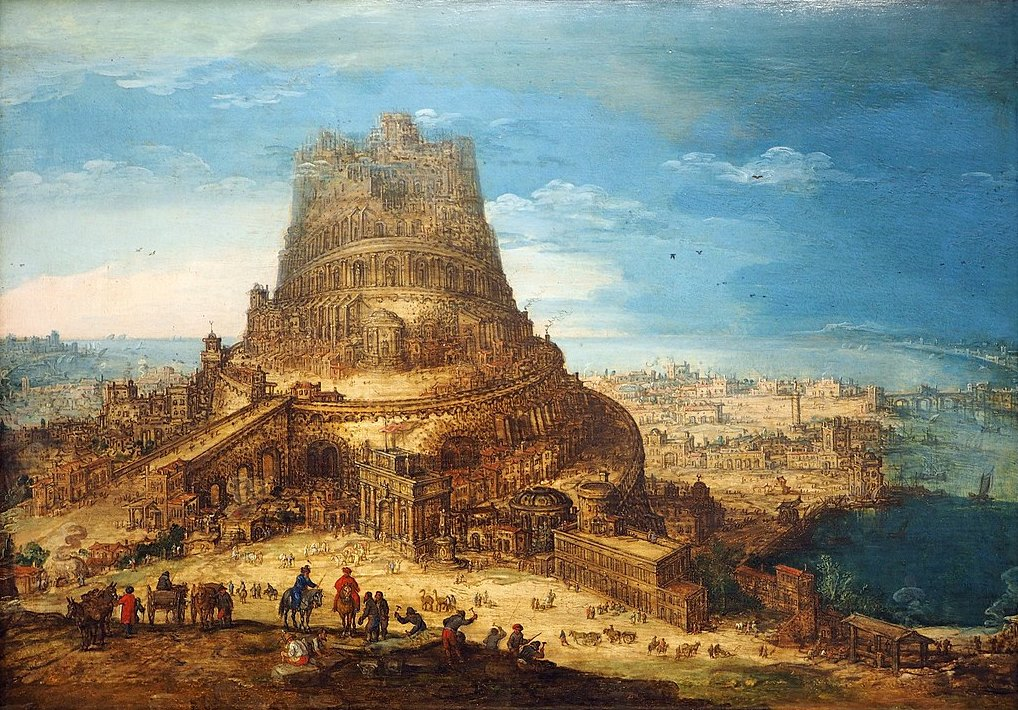
The Tower of Babel, by Hendrick van Cleve III (1525–1589)

At one time, the whole Earth spoke the same language. It so happened that as they moved out of the east, they came upon a plain in the land of Shinar and settled down.

They said to one another, “Come, let’s make bricks and fire them well.” They used brick for stone and tar for mortar.

Then they said, “Come, let’s build ourselves a city and a tower that reaches Heaven. Let’s make ourselves famous so we won’t be scattered here and there across the Earth.”

God came down to look over the city and the tower those people had built.

God took one look and said, “One people, one language; why, this is only a first step. No telling what they’ll come up with next—they’ll stop at nothing! Come, we’ll go down and garble their speech so they won’t understand each other.” Then God scattered them from there all over the world. And they had to quit building the city. That’s how it came to be called Babel, because there God turned their language into “babble.” From there God scattered them all over the world. (The Message)

At first glance, the Bible reader may wonder what the big deal is about people coming together to build a tower.

A mere cursory look at the text might seem as if God is having some sort of divine anal-retentive moment of control. After all, the people are just trying to get some work done; it’s not like they’re going to somehow invade God’s privacy with a very tall tower.

But that’s not what was going on, way back there several millennia ago. Something more subversive was afoot, and the Lord was completely savvy to what was happening.

The previous chapter (Genesis 10) presents a rather orderly spread of the burgeoning humanity across the earth – which is consistent with God’s original blessing and mandate at the creation of people:

“Prosper! Reproduce! Fill Earth! Take charge!
Be responsible for fish in the sea and birds in the air,
    for every living thing that moves on the face of Earth.” (Genesis 1:28, MSG)

Yet, here in Genesis 11, people have intentionally stopped discovering the earth. It appears they are more curious about heaven. So, they amassed themselves together and decided to move vertically rather than horizontally across the world.

There seems to have been a great deal of human ambition that was eyeing an assault and takeover of the divine realm, instead of busying themselves with their God-given human realm. Another way of putting it is that they were irresponsible – not caring for creation – but more concerned about having some leverage on God.

Ambition, in and of itself, is neither good nor bad; it’s where that ambition is aimed. And the early people were directing their sights up rather than out – trusting in their human ingenuity and technological abilities to achieve autonomy for themselves.

Because God created humans in the divine image and likeness, people were (and still are!) amazing creatures who can accomplish incredible feats of achievement in whatever they set their minds and hearts to do. Yet, in the case of constructing a tower (or ziggurat) humanity was ignoring their mandate to care about the earth and its inhabitants. Instead, they were working their own will to build a name for themselves, apart from God.

So, the Lord stepped in by confusing their common language so that they would have difficulty communicating with one another. On the surface, it might seem that God was being capricious. But examining just a bit deeper, we can observe what would happen if people threw off their responsibility to the planet and all of its creatures.

The entire world could be subject to terrible inattention. Much like a backyard garden that becomes overrun with weeds due to neglect, the whole earth was in jeopardy of falling into a system of evil that would care nothing for its abundant life and intricate ecosystems. In short, the earth could be ruined.

If this sounds eerily like what we humans are doing today, its probably because that is precisely what we are doing – putting a collective stiff-arm to God and doing whatever the heck we want in exploiting the earth for our own human purposes.

Never mind that entire species of fish and animals, along with flora and fauna and forests and wetlands and grasslands are being harmed and destroyed by so called human ingenuity and technological advance.

It is our own arrogant pride and hubris of abject selfishness, in setting up ourselves as masters of the universe, that brings us to the edge of an environmental holocaust – not to mention fighting amongst ourselves about who will be in charge and in control of it all. We’ll engage in wars and atrocities if that’s what it will take.

Therefore, the Tower of Babel is a symbol of all that is wrong – not right – with humanity. Until we can unlearn our ancient ways of arrogance and injustice, ignorance and lack of awareness, and recover even older ways of caring for one another and the earth, then we will find ourselves being broken by the divine gravity of judgment which exists whenever people choose to defy the order of the world.

In many ways, primeval history remains alive in our daily current events. Yet, it can change. But it will take a heavy dose of humility and confession of guilt to begin undoing the harm we have imposed on others and on our world. And it will take a return to Eden, to the responsibility of creation care, and of healthy relational connections with both other people and God.

Every one of us is culpable – whether we have been directly involved in systemic evil, or not. We all have participated in and benefited from our privilege as human beings living on this planet – sometimes to the extent of turning a blind eye to the great needs of the earth and its inhabitants.

So, what will you do about it? Who will you turn to? Where does your ultimate trust rest? Are you willing to work for good, to be merciful, just, kind, and loving in a pursuit of right relationships with God, others, and the earth?

Sovereign Lord and Creator, renew our spirits and cleanse our hearts. Renew our minds and transform our lives. Renew our cities and rebuild our ruins. Renew our world, in your name we pray, Amen.

Life (Genesis 1:20-2:4a)

The Creation of Heaven and Earth, by Unknown artist, c.18th century

God said, “Let the waters swarm with living things, and let birds fly above the earth up in the dome of the sky.” God created the great sea animals and all the tiny living things that swarm in the waters, each according to its kind, and all the winged birds, each according to its kind. God saw how good it was. Then God blessed them: “Be fertile and multiply and fill the waters in the seas, and let the birds multiply on the earth.”

There was evening and there was morning: the fifth day.

God said, “Let the earth produce every kind of living thing: livestock, crawling things, and wildlife.” And that’s what happened. God made every kind of wildlife, every kind of livestock, and every kind of creature that crawls on the ground. God saw how good it was. Then God said, “Let us make humanity in our image to resemble us so that they may take charge of the fish of the sea, the birds in the sky, the livestock, all the earth, and all the crawling things on earth.”

God created humanity in God’s own image,
        in the divine image God created them,
            male and female God created them.

God blessed them and said to them, “Be fertile and multiply; fill the earth and master it. Take charge of the fish of the sea, the birds in the sky, and everything crawling on the ground.” Then God said, “I now give to you all the plants on the earth that yield seeds and all the trees whose fruit produces its seeds within it. These will be your food. To all wildlife, to all the birds in the sky, and to everything crawling on the ground—to everything that breathes—I give all the green grasses for food.” And that’s what happened. God saw everything he had made; it was supremely good.

There was evening and there was morning: the sixth day.

The heavens and the earth and all who live in them were completed. On the sixth day God completed all the work that he had done, and on the seventh day God rested from all the work that he had done. God blessed the seventh day and made it holy, because on it God rested from all the work of creation. This is the account of the heavens and the earth when they were created. (Common English Bible)

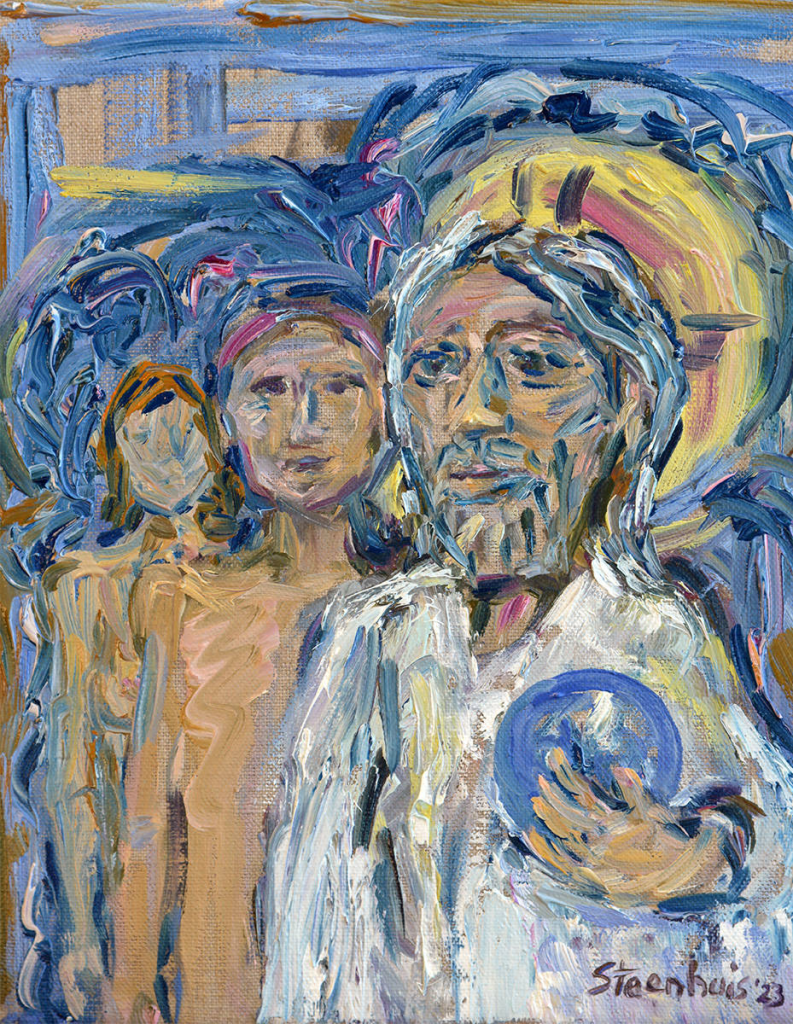
God Created Man in His Image – Male and Female, by Jill Steenhuis

In this Christian season of Eastertide, believers remember and celebrate new life in Jesus Christ. In today’s Old Testament lesson, the lectionary reminds us of original life – when God created the heavens and the earth.

The Beginning of Life

This was the beginning, before there were any words like sin, disobedience, guilt, and shame. This was the time when the original people, Adam and Eve, knew nothing about trying to chase after unconditional love. They had no concept of estrangement or heartache. Everything was fresh and alive and shiny. Disappointment, hurt, and sadness were unknown to them. Everywhere, the earth was teeming with abundant life.

God made it all; and all that was created was very good, supremely reflecting the goodness of the Creator. Life existed everywhere. The predictable and consistent rhythms of the universe were in place. Day and night, work and rest, creation and care, were all woven into the fabric of the world’s sights and seasons. The possibilities for growth were incredible. Life was indeed good.

“New” was simply part of all there was. Without any want or need, every day was an adventure of discovering all the newness which existed.

The Complicated Life

We all, however, know that it did not remain this way. People are now all too familiar with the myriad ways of injustice, and with the film of sin that covers the entire world like a noxious pollutant. And it is this situation, of course, which created the need for a “new” life, because the present life had become a moldy old leftover in the refrigerator of a life that doesn’t keep anything cold nor fresh.

People were created as good human beings. Even though sin has profoundly touched everything in creation, goodness is still within us as God’s image-bearers. The later introduction of human sin into the world in no way whatsoever removes the inherent stamp of the divine image upon us.

Humanity is the only creature who bears this likeness to God. We are related to the animal world, having been created on the same day, and sharing the same blessings of life. Yet, people are distinctive, set above all other creatures.

The Responsible Life

This is why people are given dominion over all other creatures. This is not a claim to privilege; it is, however, very much a claim to responsibility. People have been tasked with being faithful stewards of creation, entrusted with caring for other creatures and the created order.

And humanity was created as both male and female, together expressing the will and character of God in creation as they tend to it and care for it. Together with God, we are relational beings, and not just a race of individuals inhabiting the same earth.

God is a social being, existing as a community within the Godhead. Therefore, to exist as an image-bearer of God means that people are social creatures who need community – with both God and other people.

After God did all the work of creating the world with all its plants and animals and birds and fishes and people, God “rested.” This is why the seventh day is set aside as sacred; its different than the other days, sort of like how people are similar but different from the other creation.

God is clearly separated from the work and the creation itself, that is, God is transcendent and above all things as the Creator. The world is good, but the world is not divine. In the same way, by observing a day of rest, humanity recognizes and affirms and remembers that the work they have done is not divine.

Our human works, good as they may be, are not a thing to be worshiped or equated with God. Therefore, the Sabbath both celebrates the creation and the created order of things, as well as separates us from the idol worship of our hands.

To live into our inherent image of God means that we will work hard and tend to the gardens that are around us. Yet, at the same time, we will understand that in doing our responsible tasks, people are to live in community and love one another, without idolizing any other part of creation or what we creatively build with our own two hands. That is for God alone, who is distinct from all that God has created.

God our Father, you created the world and sent your own Son to live among us, made of the same stuff, breathing the same air, marveling at sunrise and sunset just as we do. Help us to participate in the life around and within us as your life, as you living in us and we living in you and in each other.

God of love and life, restore us to your peace, renew us through your power and teach us to love all that you have created and to care for the earth as your gift and our home. Amen.

Our Place in the World (Psalm 8)

Lord, our Lord,
    how majestic is your name in all the earth!

You have set your glory
    in the heavens.
Through the praise of children and infants
    you have established a stronghold against your enemies,
    to silence the foe and the avenger.
When I consider your heavens,
    the work of your fingers,
the moon and the stars,
    which you have set in place,
what is mankind that you are mindful of them,
    human beings that you care for them?

You have made them a little lower than the angels
    and crowned them with glory and honor.
You made them rulers over the works of your hands;
    you put everything under their feet:
all flocks and herds,
    and the animals of the wild,
the birds in the sky,
    and the fish in the sea,
    all that swim the paths of the seas.

Lord, our Lord,
    how majestic is your name in all the earth! (New International Version)

I adore the psalms. Many years ago, it was the biblical psalter which helped me come to faith. This little psalm for today is illustrative of why I was moved toward embracing a life with God. Psalm 8 grounds us by dealing with the ultimate questions of human existence:

  • Who am I?
  • Why do I exist?
  • What is the purpose of life?

The answers to those questions are supremely important because people throughout history, and now across the world, are asking what meaning their lives really have.

For example, depression is pervasive throughout the world, as well as the church. It’s a huge issue. Peeling back the layers of a person’s life, many have a deep sense of not truly belonging, and of being profoundly misunderstood by others. Many depressed persons are very aware of their own mortality and have a disconnected sense of their personal role in the world.

Put another way, some folks have lost their original purpose of being a person, that they belong to the human family in a way that makes a significant contribution to the world.

Living on such a big planet causes some people to feel small and wonder how they fit in. With such a large universe, which may at times seem cold and capricious, we may ask, along with psalmist, “What is humanity that you are mindful of them?”

That question forms the center of the psalm. Hebrew poetry is typically set up to have the front and the end of the poem point to the middle where the chief focus is found. So then, the psalmist purposely wrote this psalm so we would consider this great question of what God thinks of humanity within the scope of this immense universe.

And it is a staggeringly huge universe! To put it in perspective, if our galaxy, the Milky Way, were the size of the entire continent of North America, our solar system would fit in a coffee cup.

Even now, two Voyager spacecraft are hurtling toward the edge of the solar system at a rate of 100,000 miles per hour. For decades they have been speeding away from Earth, having now traveled billions of miles. When engineers beam a command to the spacecraft at the speed of light, it takes over half a day to arrive.

Yet this vast neighborhood of our sun—in truth, the size of a coffee cup—fits along with several hundred billion other stars and their planets in the Milky Way, one of perhaps 100 billion such galaxies in the universe. To send a light-speed message to the edge of that universe would take 15 billion years.

Out of the billions of galaxies in the universe, what is the planet Earth that God should care about it? 

Even on our planet there are billions of creatures. Yet, of all those bugs, animals, fish, and birds, God has a special relationship with us, humanity, and cares for us deeply. We know that God cares for us, according to this psalm, because he has entrusted us with the responsibility to care for creation.

We are the only creatures who have the charge to steward all that God has created. As people created in the image of God, we have a job that is befitting of a king. We are God’s vice-regents, in charge of tending and caring for all creation. This incredible job is both a duty and a delight.

God has us playing a crucial role in governing and caring for the world he created. Like a parent or grandparent patiently working with a child to teach them responsibility for all that is around them, God teaches us, and has entrusted to us, this large expansive world we live in. Literally everything in all creation is under our stewardship.

People alone have the self-awareness and perspective of the world that is needed to govern the world. Therefore, we can only find our true purpose and belonging in the stewardship of creation. Caregiving is at the heart of being a person.

The only glitch to all this, and why so many lose their way, is that the world is still living under a curse due to the original fall of humanity.

When we allow other dominions to supersede God’s dominion, then we have issues. Whenever the power of money or the significance of a position, job title, or the ability to do certain tasks is our basic identity and place of belonging, then we will likely succumb to anxiety. That’s because other dominions cannot help us find our true God-given majesty as people created in God’s image.

Living a way other than being a proper steward of the world is beneath us because we have inherent dignity as God’s vice-regents over creation.

Mother Teresa once said that there is no such thing as a small thing – only small things which are done with big love. Her sentiment perfectly captures the vision of the psalmist – that all people are crowned with glory and honor and rule with God to do all the small things of life with a love that comes from our Creator.

We continually have possibilities of engaging in good stewardship of all that God has given us. We have the chance to be attentive to all the little things of life, whether gardening, building a bird house, working with diligence and care at our jobs, or keeping our community clean and its citizens healthy and happy – it’s all important. It brings meaning to our existence as human beings.

People, like all creation, are meant for growth. Putting effort into developing our skills and honing our craft, whatever that may be, is what helps us tap into our God-given purpose for being in this big world.

So, may we continually improve what we do, no matter what it is, so that it befits us as God’s people crowned with honor. May we realize joy and contentment – knowing the majesty we share with God in his wondrous world. 

Almighty God, Creator of the heavens and the earth, words are not enough to express your awesome majesty. Our highest expressions of theology are but baby talk next to you.

Grant us awareness through your Spirit that you are here with us. May this awareness lead us to approach life carefully. The words we speak, the songs we sing, the thoughts we think, the joy and sadness we feel – may it all be pleasing to you, O Lord.

For, despite the inadequacy of our words and actions, our life and worship are addressed to you alone. May you make that life complete, whole, and full to overflowing through Jesus Christ, your Son, our Lord, who with you and the Holy Spirit lives and reigns forever.  Amen.