Against Exorbitant Wealth (Amos 3:9-4:5)

Proclaim to the strongholds in Ashdod
    and to the strongholds in the land of Egypt,
and say, “Assemble yourselves on Mount Samaria,
    and see what great tumults are within it
    and what oppressions are in its midst.”
They do not know how to do right, says the Lord,
    those who store up violence and robbery in their strongholds.
Therefore thus says the Lord God:
An adversary shall surround the land
    and strip you of your defense,
    and your strongholds shall be plundered.

Thus says the Lord: As the shepherd rescues from the mouth of the lion two legs or a piece of an ear, so shall the people of Israel who live in Samaria be rescued, with the corner of a couch and part of a bed.

Hear and testify against the house of Jacob,
    says the Lord God, the God of hosts:
On the day I punish Israel for its transgressions,
    I will punish the altars of Bethel,
and the horns of the altar shall be cut off
    and fall to the ground.
I will tear down the winter house as well as the summer house,
    and the houses of ivory shall perish,
and the great houses shall come to an end,
            says the Lord.

Hear this word, you cows of Bashan
    who are on Mount Samaria,
who oppress the poor, who crush the needy,
    who say to their husbands, “Bring something to drink!”
The Lord God has sworn by his holiness:
    The time is surely coming upon you
when they shall take you away with hooks,
    even the last of you with fishhooks.
Through breaches in the wall you shall leave,
    each one straight ahead,
    and you shall be flung out into Harmon,
            says the Lord.
Come to Bethel—and transgress;
    to Gilgal—and multiply transgression;
bring your sacrifices every morning,
    your tithes every three days;
bring a thank offering of leavened bread
    and proclaim freewill offerings, publish them;
    for so you love to do, O people of Israel!
            says the Lord God. (New Revised Standard Version)
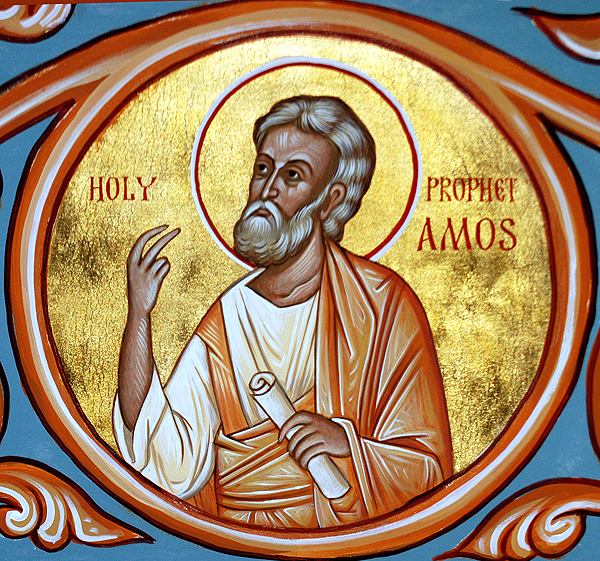
Orthodox icon of the prophet Amos

The prophet Amos sought to leave no stone unturned in exposing the transgressions of God’s wayward people. He went after social injustice; personal sins; religious idolatry; and all aspects of life in which the nation practiced self-indulgent hoarding of wealth and power.

Whenever people become focused on earthly power and control, they fall out of the realm of living in God’s power. If there is ever a personal or corporate sense of losing spiritual power, the problem is never with the Lord. The more one amasses worldly power and authority, the less effective they are with spiritual power.

It is possible for a nation or a church to have great political strength, yet in reality be powerless. Impressive constructed human strongholds are totally defenseless before the all-powerful God of the universe.

It’s always been curious to me why folks who claim the name of Christ, or who make grand confessions of faith, can then turn around and be enamored with obtaining wealth, real estate, resources of all sorts, and high-level positions. Such persons don’t deserve worldly power. It’s like putting a gold ring in a pig’s snout.

Persons with lots of worldly wealth and power will eventually find that their acquisitions fail them. And if their religion is powerless, everything in their life will lack power – no matter how it looks, or what spin they put on their situation.

Ignoring grace and mercy, compassion and kindness, to the poor and needy is a surefire way of experiencing divine condemnation. Treating one’s society and social relationships as mere pawns to get what I want is a prescription for alienation from God.

Whether someone believes in an almighty God, or not, oppressing and gaslighting others breaks down a society, and compromises basic law and order. Being concerned only with one’s constituents, and turning away from the common good of all, brings about injustice for the many.

But the ones in charge simply don’t care – which is why it raises the ire of a holy God. Any person who demeans meekness and gentleness, and clearly evidences a profound lack of humility, you can be sure that person is up to no good – despite any “good” words they might say.

Violence and robbery are the tools of those who care nothing for what their actions do to others. Justifying the rounding up of people into detention centers and robbing them of their lives and livelihood doesn’t fool God.

Those who go after unjust gain through any means possible will find that there is a boomerang effect to their actions. Their violent and unjust ways will turn back on them. They themselves shall be destroyed, and not the powerless and vulnerable.

In ancient Israel at the time of Amos, it was the Gentile nations who would rise up and be their judge. Pagan nations who thought nothing of despising and abusing others were the very ones to stand up and judge Israel. That’s how bad it was, even though there was wild prosperity, exorbitant wealth, and loads of power, that is, only among the upper class.

Living below the level of grace means showing no dignity or respect to one’s fellow humanity. It is unthinkable that such persons could or would ever exercise power in a democratic form of government. Just because they were elected and appointed to office, doesn’t mean they’ll act as civil servants.

Those in power who act only in self-interest will find themselves on the bad side of a holy God:

“Why would God withdraw from such a people? Because there was nothing in their lives corresponding to a heart concern for spiritual things; their character-reference could be written without mentioning God, or prayer, or holiness; their legacy to the future was wholly a testimony to a life lived for the body. And these claimed to be the people of God!” J.A. Motyer

Unchecked covetousness is actually a form of war against the poor. And any worship disconnected from righteousness and justice is an affront to both the needy among us, and God.

Wealth and power, in and of themselves, are neither good nor bad; they just are. But what we do with them is of vital concern. However, exorbitant riches and a lust for power, in and of themselves, are egregious sins.

In Holy Scripture, the poor are never chastised for their poverty and neediness. But the rich are continually exhorted and warned against for any sort of failing to care for the lower classes of people. (Matthew 25:14-30; Luke 12:13-21; 16:19-31)

The psalmist has a reality check for us:

Don’t be overly impressed when someone becomes rich,
    their house swelling to fantastic proportions,
    because when they die, they won’t take any of it with them.
    Their fantastic things won’t accompany them down under.
Though they consider themselves blessed during their lives,
    and even thank you when you deal well with them,
    they too will join the ancestors who’ve gone ahead;
    they too will never see the light again.
Wealthy people? They just don’t understand;
    they’re just like the animals
    that pass away. (Psalm 49:16-20, CEB)

The Teacher gives us some practical wisdom:

If you love money and wealth, you will never be satisfied with what you have. This doesn’t make a bit of sense. (Ecclesiastes 5:10, CEV)

Whoever becomes wealthy through unfair loans and interest collects them for the one who is kind to the poor. (Proverbs 28:8, GW)

And the Lord Jesus said:

“No one can serve two masters. Either you will hate the one and love the other, or you will be devoted to the one and despise the other. You cannot serve both God and money.” (Matthew 6:24, NIV)

“God blesses you who are poor,
    for the Kingdom of God is yours.” (Luke 6:20, NLT)

As for me, I’ll choose to take my cues from Jesus and the prophets, and not from those with earthly influence, riches, and power. How about you?

Almighty God, everything we possess – our time, abilities, resources, money, and material possessions – are gifts from You, and belong to You. Enable me to be a good steward of all that you have provided for me, so that I may be a blessing to the poor and needy; through Jesus Christ my Lord, in the strength of the Holy Spirit. Amen.


The Ways of Wisdom (Proverbs 30:18-33)

There are four things that are too mysterious for me to understand:

an eagle flying in the sky,
a snake moving on a rock,
a ship finding its way over the sea,
and a man and a woman falling in love.

This is how an unfaithful wife acts: she commits adultery, takes a bath, and says, “But I haven’t done anything wrong!”

There are four things that the earth itself cannot tolerate:

a slave who becomes a king,
a fool who has all he wants to eat,
a hateful woman who gets married,
and a servant woman who takes the place of her mistress.

 There are four animals in the world that are small, but very, very clever:

Ants: they are weak, but they store up their food in the summer.
Rock badgers: they are not strong either, but they make their homes among the rocks.
Locusts: they have no king, but they move in formation.
Lizards: you can hold one in your hand, but you can find them in palaces.

There are four things that are impressive to watch as they walk:

lions, strongest of all animals and afraid of none;
goats, strutting roosters,
and kings in front of their people.

If you have been foolish enough to be arrogant and plan evil, stop and think! If you churn milk, you get butter. If you hit someone’s nose, it bleeds. If you stir up anger, you get into trouble. (Good News Translation)

If there is an overall theme in the wise sayings from this chapter in the Book of Proverbs, it is that we ought to renounce arrogant greed; while at the same time, we should uphold and embrace a humble life of contentment.

The four lists of wisdom address four observations of creaturely ways on this earth: mysterious ways, antisocial ways, instinctive ways, and impressive ways. We are meant to observe that each of these four numbered lists contain wisdom that is available to all of us, that is, if we will but apply the observational understanding to our own lived situations.

Mysterious Ways

The first list observes four invisible ways; the way of the eagle, snake, ship, and man, all leave no trace of where they have been and what they are up to. Thus, their ways are mysterious, causing us to wonder what is really going on with them.

Why is the eagle flying, the snake moving over the rock, the ship navigating the water, and the man interacting with the woman?

We are to apply wisdom to our circumstances, and discern that a single act of one being is, in reality, up for interpretation. We simply do not know why each is doing what they’re doing.

As wise persons, we understand that intentions and motivations vary from person to person, and from one observer to another.

The eagle may be enjoying the spread of his wings and the feel of the wind; or he might be the predator surveying the land to attack an unsuspecting fish or squirrel.

The snake may be seeking to warm himself in the sun, or he could be slithering with malevolent intent.

The ship may be hauling needed goods to bring into port; or it might be moving to pirate others and steal.

And the man may be intending to love a fair maiden; or he might be attempting to seduce her for his own advantage.

The point is that we must be wise and discerning, not always having a singular interpretation or belief about what we are seeing and observing. What at first glance may appear innocuous, may in fact come from a place in the heart of covetous greed, and vice versa.

Antisocial Ways

The second list, dealing with general societal roles, cites four instances of role reversal which turns the social order into antisocial ways that cause trouble in society.

A slave who becomes king may believe that he knows better than the ruler. He probably talked about how he could do a better job. Yet, when given such a responsible position, such a person is way out of their expertise and depth. Statecraft is a real thing; and if one hasn’t been duly trained in it, and had some experience in it, things will go south quickly.

A fool who has all he wants to eat is like the person without any self-control. He goes out to eat at an all-you-can-eat buffet; and it will not end well, especially if it’s done a regular basis.

A hateful woman who gets married is a train wreck waiting to happen. I’m not sure I need to comment on this, because likely you are already covering your eyes, imagining what will happen in such a relationship.

And a servant woman who takes the place of her mistress has perhaps had a fantasy about how easy it is to be in charge and simply tell others what to do. Little does she know how stressful it truly is to be in charge and be the administrator of an entire household. Like the slave becoming a king, she will soon learn that the role she coveted is not all it’s cracked up to be.

All four of these persons do not (yet) have the wisdom to fulfill a role; they need training, experience, and a proper character to do the job. Their limited perspectives, and their foolish character, will lead to disaster.

Instinctive Ways

The third list, dealing with natural instincts, cites four creatures who model survival because of their instincts and wisdom, not their strength.

An ant may be small, and not carry near as much as a bigger creature, yet they have sense enough to diligently work and have everything they need when it is needed.

Rock badgers compensate for any lack of strength by making their home a fortress where a much stronger creature cannot penetrate. They have sense enough to know how to live in safety.

Locusts are many. Even though they have no leader, and are small creatures, they know enough to move together and work together in order to accomplish thriving and flourishing on this earth.

And even though lizards are common, and not all that difficult to catch and possess, nevertheless they can be found in high places. They are taken care of by bigger and greater creatures than themselves.

When any creature lives into their true self, and doesn’t try to be something they are not, their needs are cared for. Humanity could take a big lesson from such small creatures about how to get along in life.

Impressive Ways

The fourth list, dealing with displays of majesty, cites four creatures who are stately in their appearance because of their position, design, and context.

Lions are majestic creatures. Their very appearance and the sound of the male’s roar elicits awe and fear in others. This is an important part of how the lion pride gets around in this world and is able to meet their own needs.

Goats and roosters strut around like the own the place. Their sense of presence and confidence is palpable. If you’re ever around them, you’ll need to match or exceed their level of acting in charge.

Which is precisely what a king does within his realm. Each of these four are an example of taking charge and acting the part that you ought to be playing.

Whereas the earlier list had examples of people who were trying to act a role they weren’t ready for, this list of examples are creatures who are living into the role they need to exhibit, no matter whether they feel brave or competent, or not.

Concluding Ways

The wise person takes the time to observe, listen, and learn from a variety of sources, including all of creation. Everything and everyone can teach us, that is, if we will but put ourselves in a position to learn from them.

The first two lists describe people who covet for more, and are discontent with their situation. The last two lists observe creatures who know their limits and weaknesses, yet nevertheless, have found resilient ways to meet their needs – ways that are consistent with who God created them to be.

So, which way will you go?

Almighty God, I humbly ask that You fill me with the Spirit of wisdom and revelation in the knowledge of You. Open the eyes of my heart to see Truth more clearly. Sharpen my spiritual discernment to distinguish good from evil, good from bad, better from best.

Help me not lean merely on my own finite understanding, but trust wholeheartedly in Your infinite wisdom given to me in creation. May divine wisdom from above flow through me each day in thought, word, and action. Amen.

Idolatry Is the Tail Wagging the Dog (Psalm 106:1-6, 19-23)

Praise the Lord!
    O give thanks to the Lord, for he is good,
    for his steadfast love endures forever.
Who can utter the mighty doings of the Lord
    or declare all his praise?
Happy are those who observe justice,
    who do righteousness at all times.

Remember us, O Lord, when you show favor to your people;
    help us when you deliver them,
that we may see the prosperity of your chosen ones,
    that we may rejoice in the gladness of your nation,
    that we may glory in your heritage.

Both we and our ancestors have sinned;
    we have committed iniquity, have done wickedly…

They made a calf at Horeb
    and worshiped a cast image.
They exchanged the glory of God
    for the image of an ox that eats grass.
They forgot God, their Savior,
    who had done great things in Egypt,
wondrous works in the land of Ham,
    and awesome deeds by the Red Sea.
Therefore he said he would destroy them—
    had not Moses, his chosen one,
stood in the breach before him,
    to turn away his wrath from destroying them. (New Revised Standard Version)

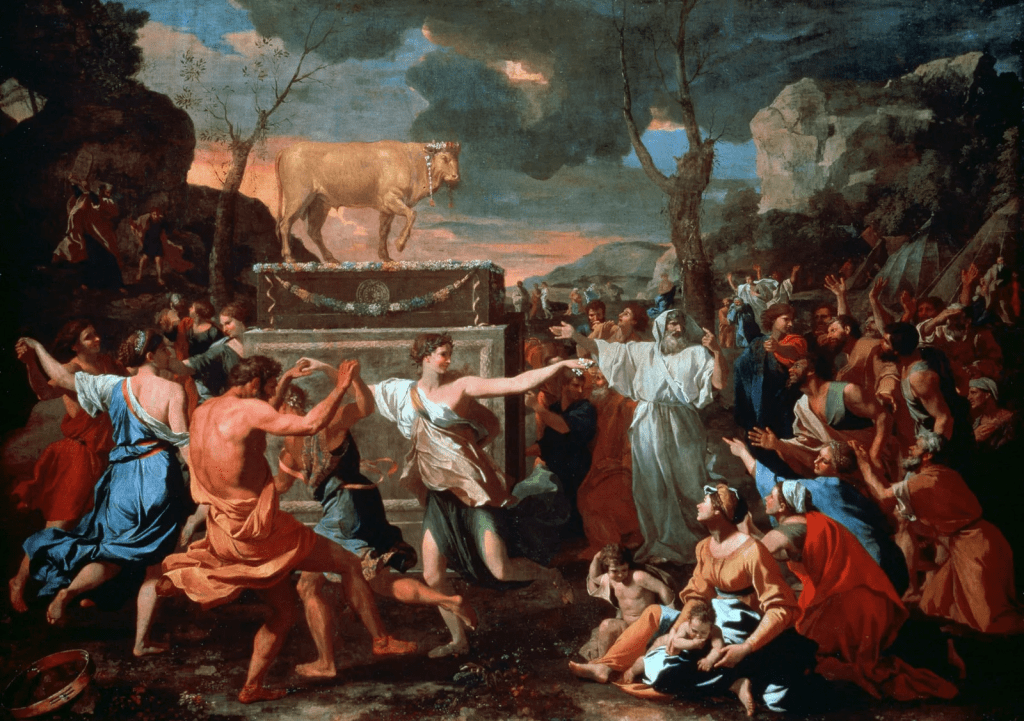
Adoration of the Golden Calf, by Nicolas Poussin (1594-1665)

When it comes to sin, especially the sin of idolatry, it’s imperative that we name it for what it is. It will do no good to fudge on it by saying that so-and-so struggles with it more than me, or that it’s not as bad as assault or murder.

No, we must call sinful idolatry just that, because the problem of idolatry is at the heart of humanity’s spiritual struggle. The first of the Ten Commandments frames it and names it squarely:

“I am the Lord your God who brought you out of slavery; do not worship other gods.” (Exodus 20:2-3, NRSV)

And the second commandment straight up prohibits any manufacturing or worshiping of idols:

“You shall not make for yourself an idol, whether in the form of anything that is in heaven above or that is on the earth beneath or that is in the water under the earth. You shall not bow down to them or serve them….” (Exodus 20:4-5, NRSV)

In the New Testament Gospels, Jesus also drew sharp lines between God and idolatry:

“No one can serve two masters, for a slave will either hate the one and love the other or be devoted to the one and despise the other. You cannot serve God and wealth.” (Matthew 6:24, NRSV)

The early church fathers (and mothers) forsook dependence on anything or anyone other than the one true God. Idolatry is an obsessive and fruitless search to satisfy a legitimate need in an illegitimate manner by giving oneself to someone or something other than the true object of the heart’s longing.

“You have made us for yourself, O Lord, and our heart is restless until it rests in you.”

St. Augustine

None of this means that the material and physical world is somehow bad – that money, possessions, food, books, nature, and other people are objects to avoid – because they are most certainly not! The problem arises whenever we seek to replace God with the things God made, God’s own creation.

By seeking to save our souls and fill the emptiness in our spirits with more and more wealth, or more and better jobs, or more time and expense for reading, or just about any other activity or possession there is, those things which were given for our use and enjoyment and to be stewarded well by us, end up becoming the users and our masters.

Inanimate objects, ideas, and activities begin calling the shots and giving the commands about what we should do and not do. What we own, now owns us. Even the poor can succumb to idolatry through the sin of covetousness by wanting things they do not have in the belief that wealth and possessions will make their lives whole and worthy. But this breaks the tenth commandment:

“You shall not covet your neighbor’s house; you shall not covet your neighbor’s wife, male or female slave, ox, donkey, or anything that belongs to your neighbor.” (Exodus 20:17, NRSV)

Nature and all the earth were formed by the Creator. And, as such, they too, give glory to God and recognize they themselves are not to be worshiped.

The heavens are telling the glory of God,
    and the firmament proclaims his handiwork.
Day to day pours forth speech,
    and night to night declares knowledge. (Psalm 19:1-2, NRSV)

Genuine wealth, prosperity, happiness and peace are found in the Creator of all good things. It is God who will:

  • wipe every tear from our eyes (Isaiah 25:1-9)
  • provide protection and guidance through the hard times of life (Isaiah 54:17)
  • be present with us as we walk through the valley of despair and ascend the mountain of celebration and joy (Psalm 23)

The reason idolatry is so insidious and difficult to name is that our affections are typically on a good thing which God has created and given for us. It’s just that, over time and through an extended process, the tail begins to wag the dog. For example:

  • Humanity serves the Sabbath instead of the Sabbath serving humanity
  • Parishioners venerate a church building instead of the church building being a tool for ministry
  • People are slaves to their hobbies instead of the hobby serving the person
  • Spouses worship one another instead of worshiping the God who brought them together
  • Groups let their traditions hold them with an iron grip, instead of traditions being held loosely by groups

It could (and does) happen to each one of us. And when it does, we need the wisdom and humility to see it for what it has become. Then, confess it as idolatry, and accept the forgiveness which is freely available from the Divine.

Almighty and everlasting God: Not to us, but to your name we give glory, for the sake of your steadfast love and your faithfulness! Yet because of the idolatry in our hearts, we have strayed far from you. We have disobeyed your commandments; we have trusted our own judgement; and we wonder why we feel distant from you. We have worshipped idols of silver and gold—and idols of self and comfort. Forgive us for not loving you as we ought, not obeying you as we were taught, and not trusting that our forgiveness has been bought. Amen.