How To Respond In a Conflict (1 Samuel 19:1-7)

David and Jonathan, by He Qi

Saul told his son Jonathan and all the attendants to kill David. But Jonathan had taken a great liking to David and warned him, “My father Saul is looking for a chance to kill you. Be on your guard tomorrow morning; go into hiding and stay there. I will go out and stand with my father in the field where you are. I’ll speak to him about you and will tell you what I find out.”

Jonathan spoke well of David to Saul his father and said to him, “Let not the king do wrong to his servant David; he has not wronged you, and what he has done has benefited you greatly. He took his life in his hands when he killed the Philistine. The Lord won a great victory for all Israel, and you saw it and were glad. Why then would you do wrong to an innocent man like David by killing him for no reason?”

Saul listened to Jonathan and took this oath: “As surely as the Lord lives, David will not be put to death.”

So Jonathan called David and told him the whole conversation. He brought him to Saul, and David was with Saul as before. (New International Version)

King Saul was a two-faced, fickle, and disintegrated soul who continually had divided loyalties between Israel and himself. Unfortunately, himself usually won out.

In today’s story, Saul was not so far gone into his self-centeredness that he couldn’t hear the voice of reason. Yet, that voice never lasted too long for him.

As for David, he was the runt of the family, the youngest of eight sons. The runt is always given the grunt work in the family. So, David spent a lot of time out with the sheep by himself, tending to their needs, and protecting them from predators. He eventually found himself in the court of King Saul and distinguished himself as an ideal soldier and leader in the Philistine wars with Israel.

Saul and David, by Rembrandt (1606-1669)

But all of David’s success only increased Saul’s jealousy. On several occasions, the paranoid Saul tried to kill David – who was faithful and did not deserve such treatment from the king.

Saul eventually abandoned all pretense and ordered his son Jonathan and the soldiers to put David to death. He went public with his attacks against David. Saul felt driven to desperate measures, feeling that his authority, popularity, and position were threatened.

This situation, of course, created a conflict of loyalties for Jonathan who wanted to honor his father and king, but who also loved David as himself (1 Samuel 18:1-3). Jonathan was that voice of reason, appealing to his father’s rational self, urging him not to go down such a dark path in killing a righteous person.

Jonathan let Saul know that it was in his best interest to let David live. He reminded Saul that David was the Lord’s instrument who had defeated Israel’s enemies and that Saul had rejoiced in his success. What’s more, Jonathan appealed to justice; David’s death would be totally unwarranted.

Saul would prove to be a guy who continually reneged on his promises with impunity. He was Exhibit A of the person with a divided mind who swayed back and forth in his decisions.

King Saul could not accept the fact that God was with David, and not with him. Saul’s initial jealousy came out in subtle plans to diminish David so that he himself would remain the popular one with power and control.

But, as biblical readers and listeners, we know where this sort of attitude is headed. God is concerned with a humble attitude and obedient actions – which David had, and Saul increasingly didn’t.

So, Saul began openly announcing plans for David’s demise. Although he would not be successful, trying again and again to do so, David’s life was turned upside-down.

David did nothing wrong. In fact, he did everything right and actually helped soothe Saul with harp music when he was not doing well. Even though David is exactly who the nation of Israel needed, and precisely the person Saul needed, he was the target of assassination.

Just because we may go about our work, and the way we live our life, with unassuming humility and quiet obedience, does not mean everything will be unicorns and butterflies. There always seems to be a jealous person lurking in the shadows planning for our downfall.
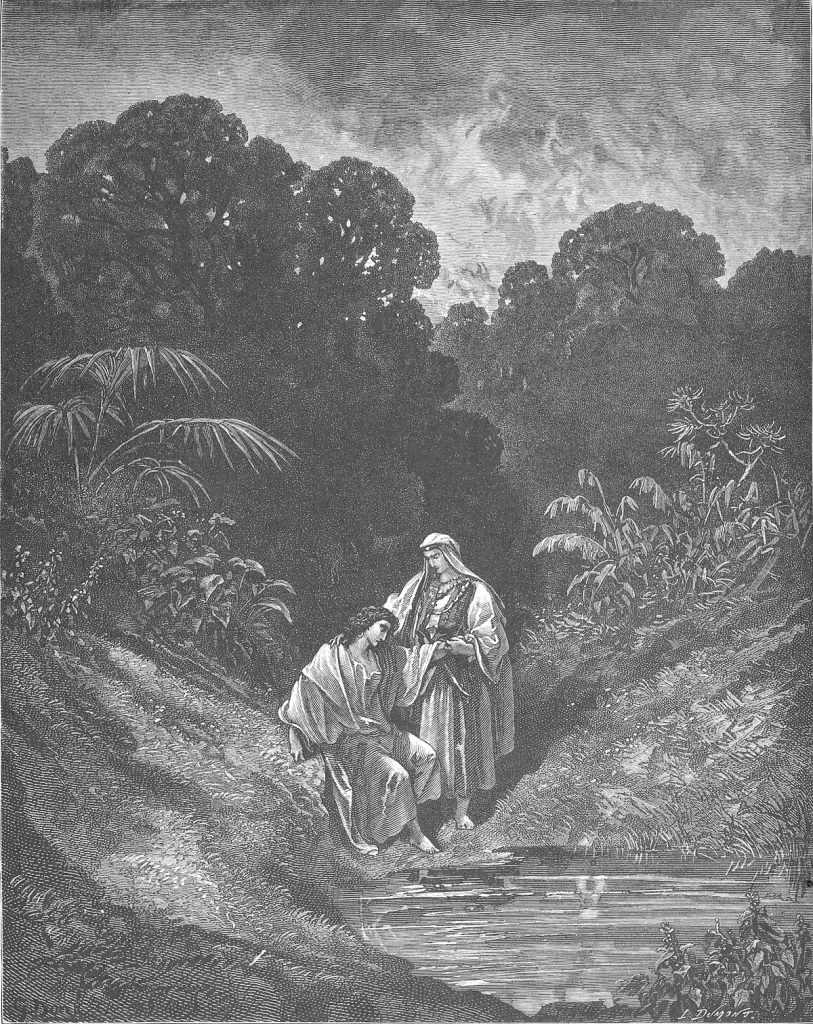
David and Jonathan, by Gustave Doré (1832-1883)

In such times, we are in solidarity with our Lord. And it is of great practical help whenever we have a person like Jonathan in our life who is willing to be a peacemaker.

Jonathan willingly stepped into the situation between his father Saul and his best friend David. Despite the family pressure, Jonathan urged Saul not to sin against an innocent man of integrity. David had risked his life for Israel and Saul’s kingdom.

Saul was persuaded, at least temporarily, to lift the death sentence and restore David to his rightful place in the court – all because of Jonathan’s efforts.

Notice that Jonathan did not exacerbate the situation by taking sides or using harsh language. In truth, we all need a friend who is willing to help us in difficult times, with careful and deft words which brings calm instead of chaos.

A gentle answer turns away wrath, but a harsh word stirs up anger.

Proverbs 15:1, NIV

Conflict only escalates out of control without a non-anxious presence to diffuse things.

For David’s part, he wisely didn’t try to vindicate himself by responding to Saul’s anger with more anger. Instead, he trusted God and let the person who could make the difference, Jonathan, do so.

It is important whenever someone comes to us in order to vent about another person, or makes irrational pronouncements about what they’re going to do to them, to help the situation and not add fuel to the fire.

If we take some relational cues from Jonathan, we will seek to be calm and respond with sensitivity and gentleness to the nonsensical wrath of the person speaking offensive words.

What’s more, when being the target of someone’s verbal assault, we must be careful not to fight fire with fire. Let’s remember that our humble and gentle words put us in good company with the righteous throughout history who have responded with faith and patience to trouble.

O God, the source of all spiritual and emotional health: So fill my heart with faith in your love, that with calm expectancy I may make room for your power to possess me, and gracefully accept your presence to make all the difference in my hardship. Amen.

Inclusion vs. Exclusion (Acts 15:1-21)

Certain people came down from Judea to Antioch and were teaching the believers: “Unless you are circumcised, according to the custom taught by Moses, you cannot be saved.” This brought Paul and Barnabas into sharp dispute and debate with them. So Paul and Barnabas were appointed, along with some other believers, to go up to Jerusalem to see the apostles and elders about this question. The church sent them on their way, and as they traveled through Phoenicia and Samaria, they told how the Gentiles had been converted. This news made all the believers very glad. When they came to Jerusalem, they were welcomed by the church and the apostles and elders, to whom they reported everything God had done through them.

Then some of the believers who belonged to the party of the Pharisees stood up and said, “The Gentiles must be circumcised and required to keep the law of Moses.”

The apostles and elders met to consider this question. After much discussion, Peter got up and addressed them: “Brothers, you know that some time ago God made a choice among you that the Gentiles might hear from my lips the message of the gospel and believe. God, who knows the heart, showed that he accepted them by giving the Holy Spirit to them, just as he did to us. He did not discriminate between us and them, for he purified their hearts by faith. Now then, why do you try to test God by putting on the necks of Gentiles a yoke that neither we nor our ancestors have been able to bear? No! We believe it is through the grace of our Lord Jesus that we are saved, just as they are.”

The whole assembly became silent as they listened to Barnabas and Paul telling about the signs and wonders God had done among the Gentiles through them. When they finished, James spoke up. “Brothers,” he said, “listen to me. Simon has described to us how God first intervened to choose a people for his name from the Gentiles. The words of the prophets agree with this, as it is written:

“‘After this I will return
    and rebuild David’s fallen tent.
Its ruins I will rebuild,
    and I will restore it,
that the rest of mankind may seek the Lord,
    even all the Gentiles who bear my name,
says the Lord, who does these things’—
    things known from long ago.

“It is my judgment, therefore, that we should not make it difficult for the Gentiles who are turning to God. Instead we should write to them, telling them to abstain from food polluted by idols, from sexual immorality, from the meat of strangled animals and from blood. For the law of Moses has been preached in every city from the earliest times and is read in the synagogues on every Sabbath.” (New International Version)

The Council of Jerusalem, by Franz Mayer of Munich, 1883

What happens when new people come into a group who are different? How does any church or faith community deal with long time members alongside new ones? Is there a way to work through differences without becoming like the Borg, trying to make others to be just like me? (“Prepare to be assimilated. Resistance is futile.”)

Differences of thought, opinion, and practice are inevitable. Conflict cannot (and should not) always be avoided. Anyplace there’s people, conflict eventually happens. Put a bunch of sinners together in one place (like in a church), add a few grumpy old people, a few know-it-alls, then sit back and watch the fireworks. 

It seems to me that every church is about one or two good fights away from being non-existent. It’s a miracle that more congregations don’t call it quits every year, especially after their annual congregational meetings! I myself have a long resume of handling ornery folks, family squabbles, and cantankerous curmudgeons that could make your head swim – or just get you downright angry.

What is the source of conflict among you? What is the source of your disputes? Don’t they come from your cravings that are at war in your own lives? You long for something you don’t have, so you commit murder. You are jealous for something you can’t get, so you struggle and fight. You don’t have because you don’t ask. You ask and don’t have because you ask with evil intentions, to waste it on your own cravings. (James 4:1-3, CEB)      

Within the church there are expectations, whether they are reasonable or not. If those expectations are not fulfilled, people feel unfulfilled. So, they look to put unnecessary burdens on those entering the faith – to make them pay their dues by observing rules that they themselves aren’t even able to keep.

Conflict begins with some kind of desire. If unmet, it becomes a demand. And demanding something usually leads to judging other people. After all, if you really care about me and my group, you will meet these demands (desires). If left unchecked and unresolved, the progression ends in trying to punish others by simply withdrawing from a relationship with the intent of hurting another.

A focus on reaching out, on rebuilding and restoring lives, puts our efforts where they need to be – and puts us on the same page together, acting out of a sense of purpose, not preservation.

Today’s New Testament lesson deals with the conflict and debate surrounding gentile inclusion into the family of God. The success of Paul’s missionary journeys in reaching non-Jewish peoples and establishing churches, created tension as to whether these new believers ought to become Jewish in order to be Christian.

This question was at the heart of why the Council at Jerusalem was convened. Those who believed that Gentiles need to become Jews, demanded that the they be circumcised and observe the Law of Moses. Others, including Paul and Barnabas, believed that sort of thinking and approach was contrary to the gospel.

The Apostle Peter was there and gave his own experience of observing God work among Cornelius, a Gentile. Peter’s story was more than personal testimony; it was a powerful theological argument about what God was doing and what God is up to with all people, not just the Jews.

Peter’s story demonstrated that God (and not Paul or anybody else) is responsible for including Gentiles among God’s people without making them Jewish. It was God who called and cleansed Gentiles – making no distinction between them and Jews.

People are justified and made right by God’s grace, and not by human judgments of who can be in or out. The upshot of the whole thing is this: We believe that we will be saved through the grace of the Lord Jesus, both Jew and Gentile. Period.

The only thing needed from Gentiles is to believe, because salvation is an act of God’s grace, and not the result of human effort.

What’s more, the inclusion of non-Jewish persons as the people of God is nothing new; it has always been there in the Old Testament Scriptures. And they were never called to become just like Jews in order to be the people of God. (Amos 9:11-12)

This is instructive for all contemporary faith communities. Our mission is not to make followers of me or you or of a particular faith tradition, but to make disciples of Jesus Christ. Grace brings us in, grace keeps us in, and grace will lead us home.

Our focus is to be on openness, connection, and inclusion, and not in seeking to be closed-minded and closed-hearted – separating from those different from us and practicing exclusion. The following ways may be helpful in fostering a more generous gospel:

Talk less, listen more. Don’t interrupt. Do give focused attention. Use respectful language. Ask how others prefer to be addressed and how they refer to themselves. Asking is a sign of care and respect for the person you are talking to, and is also a way to help them feel safe and comfortable.

Be open. Don’t stereotype. One person doesn’t represent an entire group of people. There are different Christian traditions throughout the world. And there are also different traditions and ways within all major religions, as well as within all people groups, institutions, organizations, communities, races, ethnicities, and genders. Seek to learn, rather than superimpose what you think onto someone else.

Become self-aware. Understand that, although all persons are created in the image of God and are equal before the Lord, there is not equity in human organizations and systems. Being aware of our own privileges is a crucial first step to adopting a more inclusive attitude.

Stay curious. To remain curious means to seek people and situations that allow us to challenge (both in a positive and negative way) our beliefs and our cultural and personal patterns of thinking, worshiping, working, and living.

Generally speaking, exclusion creates conflict, whereas inclusion gives space for others to explore and discover what it means to live into their faith and spirituality.

Loving Lord, give us strength so that we can build places of belonging: To create a community for all to share their gifts, to know that each of us is loved, to help us to see the light of Christ in all that we serve. Help us remember that each of us is loved and important. Amen.

Tussling with Trouble (Matthew 10:24-39)

“The student is not above the teacher, nor a servant above his master. It is enough for students to be like their teachers, and servants like their masters. If the head of the house has been called Beelzebul, how much more the members of his household!

“So do not be afraid of them, for there is nothing concealed that will not be disclosed, or hidden that will not be made known. What I tell you in the dark, speak in the daylight; what is whispered in your ear, proclaim from the roofs. Do not be afraid of those who kill the body but cannot kill the soul. Rather, be afraid of the One who can destroy both soul and body in hell. Are not two sparrows sold for a penny? Yet not one of them will fall to the ground outside your Father’s care. And even the very hairs of your head are all numbered. So don’t be afraid; you are worth more than many sparrows.

“Whoever acknowledges me before others, I will also acknowledge before my Father in heaven. But whoever disowns me before others, I will disown before my Father in heaven.

“Do not suppose that I have come to bring peace to the earth. I did not come to bring peace, but a sword. For I have come to turn

“‘a man against his father,
    a daughter against her mother,
a daughter-in-law against her mother-in-law—
    a man’s enemies will be the members of his own household.’

“Anyone who loves their father or mother more than me is not worthy of me; anyone who loves their son or daughter more than me is not worthy of me. Whoever does not take up their cross and follow me is not worthy of me. Whoever finds their life will lose it, and whoever loses their life for my sake will find it. (New International Version)

We can expect opposition and trouble from the world

Those who follow the words and ways of Jesus will experience hardship at the hands of others, because Christ’s values are often different than how the world’s systems typically operate. 

Being called the Devil (Beelzebul) isn’t exactly a term of endearment. There were those so upset with Jesus that they equated him with Satan. So, since Christ got this kind of verbal treatment, how much more will we be the brunt of false accusations, slander, and gossip? 

We are not above our Lord – we will be treated as he was. We cannot expect that we are above getting into trouble. Believers are promised deliverance from sin, death, and hell – and not from the meanness and ignorance of people in this present life.

Because of this reality, we need to be savvy to our situation of trouble and practice common sense, as well as have a mental disposition that thinks the best of people, and does not immediately judge and condemn others.

All of this requires us to avoid the two extremes of either simple assimilation into the culture, or rejection of the culture as evil. Both the blending into culture, and the separating from it, each share the same preferred outcome of trying to avoid opposition and trouble. 

Instead, there is a third way of being faithful to following the way of Jesus: Interact with and engage the culture as salt and light. (Matthew 5:13-16)

Assimilation causes us to lose our saltiness; and isolation hides our light. So, let’s find wise ways to understand truth and apply it in the concrete situations of life in this world. 

For example, we can discuss life issues about our jobs and school from a Christian perspective, so that we might speak into others’ lives, instead of just standing against something and complaining about it: How might we show both grace and truth in a particular situation? Are there ways we can give support without condoning something we oppose, and how?

We can expect that we are going to disrupt and upset our families and experience opposition from them

14th century fresco of Christ with a sword, in the Sacred Monastery of the Ascension of Christ Church, Kosovo

Unfortunately, opposition does not just come from the world, but within the very families and communities we love and rub shoulders with every day. Most persecution, hardship, and trouble for believers in Jesus come from family and those closet to us. 

Although I grew up in a church-going family, we never really discussed faith or Christianity. When I became serious about walking with Jesus, I faced a lack of support. I was often the brunt of teasing and verbal jabbing. My commitment to Christ had butted up against the family value of never rocking the boat. 

There was once a woman who experienced new life in Christ. When God grabbed ahold of her life, she had been on track to becoming the next Barbara Walters. But her newfound values of embracing the Beatitudes of Jesus rubbed the television broadcast world too much. 

So, she went into radio. Instead of looking toward a lucrative life on screen, she settled for less money and no fame behind the microphone of a Christian radio station. Her family didn’t understand this. And marrying a preacher didn’t help the situation any for her. To this day she still faces hardship and resentment for making decisions that did not get her the American dream.

Jesus said that anyone who wants to take the path of least resistance by not rocking the family boat with Christian love is not worthy of him. Anyone who does not take up their cross and follow Jesus in the way of trouble is not worthy of following him. 

We must die to self – which often means dying to avoidance of conflict – and become alive to the wonder of God’s mercy and love in the world.

We don’t need to be afraid of getting into trouble

Why? Because…

  1. Fear has to do with the unknown. So since we know opposition and trouble is expected, we will not live in dread of what might happen. The early Christians actually rejoiced in their suffering because they considered it a privilege to be walking in the way of Jesus. (Acts 5:27-42)
  2. You will receive special help. In times of persecution, we have a Helper, the Holy Spirit, given to us for such times as these. (John 3:34; 16:1-15)
  3. God isn’t surprised by your hardship. The Lord will eventually deal with all that is wrong in this world.
  4. The wrath of God is to be more feared than the wrath of people.
  5. God is watching over all the details of my life. If God cares for all the small details, how much more will the Lord take care of the big issues in my life?

Conclusion

It is a privilege to follow Jesus into trouble. This is what is called “upside-down” theology: 

  • In giving my life away to Jesus, I find it. 
  • In getting into trouble, I find peace. 
  • In serving and taking up our cross, there is happiness, not depression. 

Sometimes, things in the kingdom of God seem upside-down; and that is as it should be. Facing trouble is really not the worst thing to be experienced – being separated from God is. 

We are to expect opposition from the world, and from family. Yet, we need not be afraid, because tussling with trouble is part of what it means to follow Jesus – it is the way of the cross.

So, count the cost. Give your life away. In doing so, you will certainly not lose your reward from God.

Make Room for Jesus (John 8:39-47)

Christ and Pharisee, by Russian painter Ivan Filichev, 1993

“Abraham is our father,” they [the religious leaders] answered.

“If you were Abraham’s children,” said Jesus, “then you would do what Abraham did. As it is, you are looking for a way to kill me, a man who has told you the truth that I heard from God. Abraham did not do such things. You are doing the works of your own father.”

“We are not illegitimate children,” they protested. “The only Father we have is God himself.”

Jesus said to them, “If God were your Father, you would love me, for I have come here from God. I have not come on my own; God sent me. Why is my language not clear to you? Because you are unable to hear what I say. You belong to your father, the devil, and you want to carry out your father’s desires. He was a murderer from the beginning, not holding to the truth, for there is no truth in him. When he lies, he speaks his native language, for he is a liar and the father of lies. 

Yet because I tell the truth, you do not believe me! Can any of you prove me guilty of sin? If I am telling the truth, why don’t you believe me? Whoever belongs to God hears what God says. The reason you do not hear is that you do not belong to God.” (New International Version)

Glass-half-full or glass-half-empty? I confess I really don’t like those binary categories for people. That’s because I believe it misses a very important aspect of being a human. What’s most necessary is to have glass-fully-empty people.

While the religious leaders of Christ’ day were debating the subject of whether Jesus is of God, or not, they failed to notice something significant about themselves:

Their glasses were so full that they had no room for Messiah, even when he was standing right in front of their faces.

You cannot be full of God and full of yourself at the same time.

Only an empty vessel can be filled. Half-full or half-empty people only end up being in conflict with each other. They cannot find any room for Jesus in their lives.

Jesus had been dealing with these sort of shenanigans even before he was born. His poor parents had a dickens of a time finding a place for him to be born. There was no room in the inn. All the places were full. God was about to break into the world, and everyone was scuttling about as glass-half-full and glass-half-empty people.

In his earthly ministry, the religious leaders viewed Jesus as a competitor, not a compatriot – pitting themselves in conflict with him, even to the extreme.

“You are looking for a way to kill me, because you have no room for my word.” (John 8:37, NIV)

Conflict is inevitable. Put a bunch of sinners together in one place, add a few grumpy curmudgeons, some know-it-alls, then fireworks happens. I’ve always thought that every human institution is about one or two knock-down drag-out fights away from being non-existent.

At the heart of all the conflict is either an inability or an unwillingness to make room for another’s point of view. Where there is no room for mystery, there’s no room for Jesus.

How many settled beliefs and behaviors do you have? So many that your head and hands have no room for Jesus to do the unexpected?

Are you full of thoughts, opinions, and convictions? So much so that your interpretation of everything leaves no room for the contrary, even if it comes from Jesus?

Here’s how we get full of ourselves:

  1. Desire arises within. Options are considered in meeting the want or need.
  2. Conflict enters because there are others with competing desires.
  3. Expectations are formed when the desire is unmet. 
  4. Demands are made because of missed expectations.
  5. Judgment is meted-out to those not complying to the demands.
  6. Separation occurs with the intent of hurting another through a withdrawal of relationship.

You end up not making room for the other in your heart and life. You don’t make room because you’re already full of yourself and don’t want to change.

We, however, are to make room for Jesus and others because Jesus made room for us and expects us to do so for others.

My Father’s house has room to spare. (John 14:2, CEB)

Make room in your hearts for us. (2 Corinthians 7:2, NRSV)

Let the Word of Christ—the Message—have the run of the house. Give it plenty of room in your lives. (Colossians 3:16, MSG)

Finding true and lasting satisfaction in Jesus as the Way is how to realize forgiveness, peace, and reconciliation. There is room at the foot of Christ’s cross for both me and you.

There’s Room at the Cross for You, by Billy Gaines

The cross upon which Jesus died
Is a shelter in which we can hide
And its grace so free is sufficient for me
And deep is its fountain as wide as the sea.

There’s room at the cross for you
Though millions have come, there’s still room for one
Yes there’s room at the cross for you.

Though millions have found him a friend
And have turned from the sins they have sinned
The Savior still waits to open the gates
And welcome a sinner before it’s too late.

The hand of my Savior is strong
And the love of my Savior is long
Through sunshine or rain, through loss or in gain,
The blood flows from Calvary to cleanse every stain.