A Prayer of Confession and Contrition (Nehemiah 9:16-25)

But they—our own ancestors—acted arrogantly.
They became stubborn and wouldn’t obey your commands.
They refused to listen.
They forgot the miracles you performed for them.
They became stubborn and appointed a leader
to take them back to slavery in Egypt.
But you are a forgiving God,
one who is compassionate, merciful, patient,
and always ready to forgive.
You never abandoned them,
even when they made a metal statue of a calf for themselves
and said, ‘This is your god who took you out of Egypt.’
They committed outrageous sins.
But because of your endless compassion,
you didn’t abandon them in the desert.
The column of smoke didn’t leave them during the day,
but it led them on their way.
The column of fire didn’t leave them during the night,
but it gave them light to see the way they should go.
You gave them your good Spirit to teach them.
You didn’t keep your manna to yourself.
You gave them water to quench their thirst.
You provided for them in the desert for 40 years,
and they had everything they needed.
Their clothes didn’t wear out, and their feet didn’t swell.

You gave kingdoms and nations to the Israelites
and assigned them their boundaries.
So they took possession of the land of Sihon,
the land of the king of Heshbon,
and the land of King Og of Bashan.
You made their children as numerous as the stars in the sky.
You brought them into the land you told their parents to enter and possess.
Their children took possession of the land.
You defeated for them the Canaanites, who lived in the land.
You handed the Canaanite kings and their people over to them
to do whatever they wanted with the Canaanites.
The Israelites captured fortified cities and a rich land.
They took possession of houses filled with all sorts of good things,
cisterns, vineyards, olive trees,
and plenty of fruit trees.
So they ate and were satisfied and grew fat.
They enjoyed the vast supply of good things you gave them. (God’s Word Translation)

The Jewish people had experienced the Babylonian Captivity. The walls of Jerusalem had been torn down, and the Temple was ransacked and destroyed.

Years later, the Persians overthrew the Babylonians, and many of the Jewish captives were allowed to return to Judea. One of the returning groups was led by Nehemiah, who was a cupbearer to the king.

Nehemiah engaged in an ambitious project of rebuilding Jerusalem’s wall and securing the city. It was a large undertaking. Yet, even more daunting was restoring the Jewish people’s worship of Yahweh, and following the Torah, God’s law.

Today’s Old Testament lesson takes place in the fifth century B.C.E. Nehemiah, along with the religious leader Ezra the scribe, organized a public assembly. The people listened to the Torah being read, and were fasting, confessing, and repenting of the ways they had neglected God’s law.

A group of Levites (the priests) stood up and said a long prayer of confession. Our verses for today are a part of that extended time of confession of sin and profession of faith. The people’s past history was very much a part of their present circumstances.

The Levities emphasized that it is God’s nature to be full of faithfulness and steadfast love. So, the Lord preserved the Israelites and rescued them out of Egyptian slavery through a series of miraculous wonders.

While their ancestors were out in a desert sojourn, anticipating entry into the Promised Land, God was faithful to provide for the Israelites both physical and spiritual food – Torah and manna.

And yet, despite the incredible rescue from Egypt, and miraculously escaping through the Red Sea, the people were rebellious. Their disobedience to God in the golden calf experience prevented that generation from entering into the promised rest. (Hebrews 3:16-19)

Every generation has its “sinners,” those who seem to have a bent toward selfish behavior, and refuse to see the needs of the entire group. They only serve God if it serves their own self-centered purposes. And they stubbornly refuse to bend to anyone’s wishes, including God’s.

Unfortunately, that sin of pride and arrogance gets passed down to the next generations. It’s not only, in some ways, taught; this sort of stubbornness also appears to have a genetic component, as well. Whenever our minds and hearts are rewired with injustice toward others and disobedience toward God, that wacky wiring gets passed down to the next generations.

It is quite likely that past trauma has a lot to do with skewed minds and hearts.

Epigenetics is a scientific field which investigates how environment influences our genes. Trauma does not alter our actual DNA sequence; but it does impact how that sequence is read and utilized in our body.

When an individual experiences trauma, their body may adapt by adjusting gene expression, and some of these changes can be passed on to their children. It’s like passing on genetic notes to our progeny – which means that these notes can be rewritten (and rewired) by our own life experiences and actions.

I am not a genetic scientist, yet this may be something akin to the divine warning about generational sin, arising from a generation’s trauma experience, after being enslaved and mistreated for 400 years in Egypt. In giving the Law to Moses, God then said:

“The Lord, the Lord, the compassionate and gracious God, slow to anger, abounding in love and faithfulness, maintaining love to thousands, and forgiving wickedness, rebellion and sin. Yet he does not leave the guilty unpunished; he punishes the children and their children for the sin of the parents to the third and fourth generation.” (Exodus 34:6-7, NIV)

Whether any of us knows anything about genetics and epigenetics, or not, there yet remains the need for a prayer of confession. It is necessary to acknowledge our own sins, as well as the sins of our ancestors.

In their prayer of confession, the Levites in Nehemiah’s time acknowledged and confessed their own guilt, and the guilt of their ancestors, of being the following:

  1. Obstinate. They stubbornly presumed God would be with them, then obstinately did whatever the heck they wanted.
  2. Stubborn. They were “stiff-necked” and refused to obey God when they didn’t want to.
  3. Forgetful. Not an accidental forgetting, but a purposeful neglect to remember what God had done for the people.
  4. Idolatrous. It was the people’s impatience with waiting for Moses on Mount Sinai that led to the golden calf idol disaster. Failing to accept God’s timetable will always lead to a bevy of bad behavior.
  5. Disobedient. The most sinister form of this is obeying halfway, and believing that you have completely done your duty for God, i.e. the sin of one person, Achan, affecting the entire community. (Joshua 7:1, 10-12, 20-26)
  6. Complaining. Murmuring and grumbling is the dissatisfying attitude and speech of ingrates. When directed at God, it is a failure of faith, replaced with a belief that God is mean and/or capricious.

Confession and repentance are the remedies to both individual and communal guilt. And that is exactly what Ezra and Nehemiah organized the post-exilic Israelites to do, publicly.

Not only did they offer a prayer of confession and repentance, but they also acknowledged and believed God’s faithfulness and mercy to forgive, renew, and restore.

Indeed, God’s grace is greater than all of our sin.

The Levites were not simply offering a mechanical liturgical formula for corporate confession. They were crying out with heartfelt confession to the God they believed was listening and would respond.

As the Levites led the people in confession and repentance, they pointed to the following attributes and activities of God which they put all of their trust in:

God forgives.

He made known his ways to Moses,
    his deeds to the people of Israel:
The Lord is compassionate and gracious,
    slow to anger, abounding in love.
He will not always accuse,
    nor will he harbor his anger forever;
he does not treat us as our sins deserve
    or repay us according to our iniquities.
For as high as the heavens are above the earth,
    so great is his love for those who fear him;
as far as the east is from the west,
    so far has he removed our transgressions from us. (Psalm 103:7-12, NIV)

God guides.

He guides me along the right paths
    for his name’s sake. (Psalm 23:3, NIV)

God provides.

He has caused his wonders to be remembered;
    the Lord is gracious and compassionate.
He provides food for those who fear him;
    he remembers his covenant forever. (Psalm 111:4-5, NIV)

God sustains.

I lie down and sleep;
    I wake again, because the Lord sustains me. (Psalm 3:5, NIV)

When all is said and done, the centrality of God is humanity’s ballast. As we orient all of life around the Lord, this is what makes all the difference in coming to grips with our past, present, and future.

May it be so, to the glory of God.

Jesus Shows Up (John 20:19-31)

Jesus shows himself to Thomas, by Rowan and Irene LeCompte

On the evening of that first day of the week, when the disciples were together, with the doors locked for fear of the Jewish leaders, Jesus came and stood among them and said, “Peace be with you!” After he said this, he showed them his hands and side. The disciples were overjoyed when they saw the Lord.

Again Jesus said, “Peace be with you! As the Father has sent me, I am sending you.” And with that he breathed on them and said, “Receive the Holy Spirit. If you forgive anyone’s sins, their sins are forgiven; if you do not forgive them, they are not forgiven.”

Now Thomas (also known as Didymus), one of the Twelve, was not with the disciples when Jesus came. So the other disciples told him, “We have seen the Lord!”

But he said to them, “Unless I see the nail marks in his hands and put my finger where the nails were, and put my hand into his side, I will not believe.”

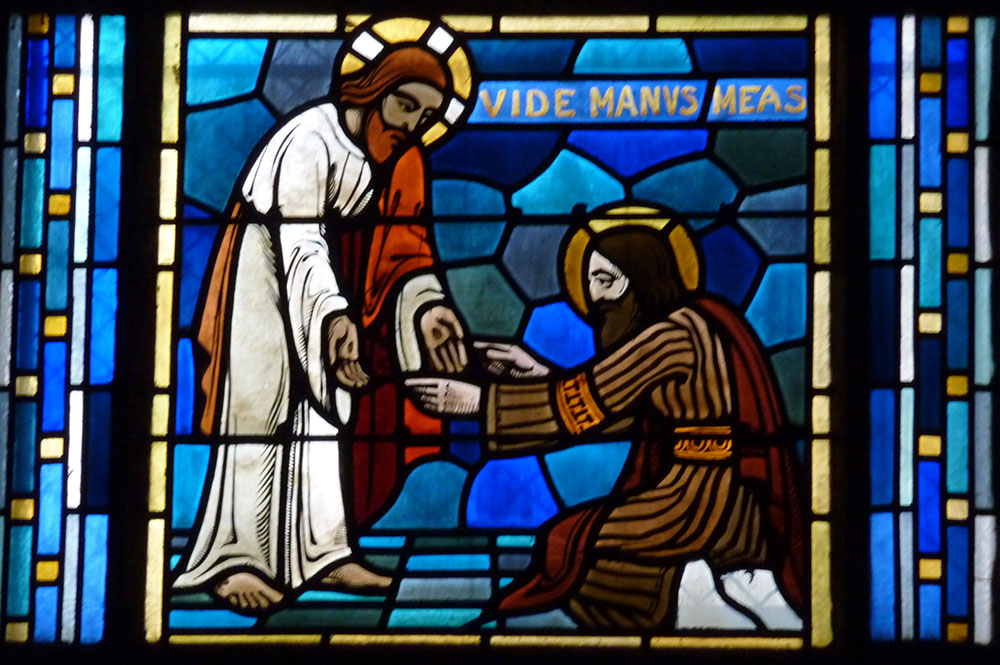
A week later his disciples were in the house again, and Thomas was with them. Though the doors were locked, Jesus came and stood among them and said, “Peace be with you!” Then he said to Thomas, “Put your finger here; see my hands. Reach out your hand and put it into my side. Stop doubting and believe.”

Thomas said to him, “My Lord and my God!”

Then Jesus told him, “Because you have seen me, you have believed; blessed are those who have not seen and yet have believed.”

Jesus performed many other signs in the presence of his disciples, which are not recorded in this book. But these are written that you may believe that Jesus is the Messiah, the Son of God, and that by believing you may have life in his name. (New International Version)

When Jesus shows up, there is peace. Wherever Jesus goes, the Spirit of God is there. When Jesus appears, people believe.

The Meeting

After the crucifixion of Christ, the disciples were huddled together, mostly in fear of being found out and put out by the religious authorities. Out of nowhere, Jesus showed up, smack in the middle of the anxious group of men.

Christ in the center makes all the difference. From this central place, Jesus bestowed to the disciples his peace. The very first word the risen Christ spoke to his disciples was neither a command to stop being afraid, nor a rebuke for sitting around and doing nothing, or disappointment that they all ran away in the final hour of need at the crucifixion; instead, the first word of Christ was a gift of peace.

The presence and peace of Christ melted the disciples’ fear. Christ-centered peace is graciously given; so let us gratefully receive it.

The Reality

Jesus showed up, then showed off his hands and his side. He was not fabricated out of the disciples’ imagination; he was not some ghostly apparition. Rather, Christ was standing in the middle of them, very real, very physical, and very alive.

Christ gave his disciples real truth: actual wounded hands and side on a real body. Christ is risen and alive – not just spiritually, but physically. Since the resurrection of Jesus really happened, then nothing else matters; our joy is complete. We have what we need.

The Mission

As Jesus was sent by the Father, so Jesus sent his disciples; and is still sending us out into the world. And as Jesus came not to condemn the world but to save it, so we go out with words of grace and peace. The church exists for the life of the world – to bless it with the presence and peace of Christ.

“Whoever believes in me does not believe in me only, but in the one who sent me. The one who looks at me is seeing the one who sent me. I have come into the world as a light, so that no one who believes in me should stay in darkness.” (John 12:44-46, NIV)

Our spiritual DNA makes us little Christ’s walking around, doing the will of God, for the benefit of a world in darkness. We bear the name of Christ: Christians, proclaiming a message of life, delighting in God and creation; and not destroying the earth and its inhabitants.

The Gift

Right now, we are not alone. The Holy Spirit has been graciously given to us by Jesus. Although our mission is a big one, our resource for accomplishing it is even bigger. Jesus gives the Spirit in the same way he gives himself – as a sheer gift with no strings attached. Just as God breathed life into the very first people on earth, so Jesus breathes on the disciples and gives them new life and a new heart.

I will give you a new heart and put a new spirit in you; I will remove from you your heart of stone and give you a heart of flesh. And I will put my Spirit in you and move you to follow my decrees and be careful to keep my laws… and you will be my people, and I will be your God. (Ezekiel 36:26-28, NIV)

The Privilege

Christ has redeemed us, forgave us of our guilt and shame. Now, we have the privilege of passing the forgiveness to others. The special mission of the Church is giving Jesus to others with grace and peace, so that they may believe he is truly the risen Lord; and so, receive Jesus, the Spirit, forgiveness, and purpose in life, with Christ at the center of all things.

For the one whom God has sent speaks the words of God, for God gives the Spirit without limit. The Father loves the Son and has placed everything in his hands. Whoever believes in the Son has eternal life, but whoever rejects the Son will not see life, for God’s wrath remains on them.” (John 3:34-36, NIV)

The Risen Lord, by He Qi

The Appearance

When Jesus appears, its good if we also show up to see him. It seems Thomas was late for church and missed the beginning of the service. He wasn’t with the other gathered disciples. Nobody knows where he was or what he was doing. But the important thing is that he did eventually show up, because showing up is the beginning of a changed life.

The Witness

After Jesus showed up, the disciples bore witness to what they saw and heard to Thomas. Yet Thomas, bless his doubting heart, wasn’t having it. He’s a realist. He wants proof, some actual physical evidence. Thomas was clearly a tactile learner because he needs some touch to believe any of this crazy talk of his disciple brothers.

Sometimes Thomas gets a bad rap, but he is really our Everyman. Doubt and skepticism are an important part of a full-orbed and honest faith. Jesus gave Thomas some space, time, and respect to begin wrapping his head and heart around this new reality of resurrection. I wonder if we all can do the same with others.

The Middle

A second time, Jesus shows up in the middle of the disciples. The Word became flesh and dwelt among us – and didn’t become a ghost and hang out in secret places. Once again, peace is given by Jesus to his followers.

Both appearances happen on a Sunday (which is why Christians have always worshiped on Sundays); and both meetings are literally Christ-centered (which every Christian meeting is supposed to be). Every Sunday. Christ always in the middle. Keep those two, and keep them together, and you can’t go wrong.

Jesus appears to Thomas with the Latin words, “See my hands,” in Notre-Dame-du-Rosaire Church, Saint-Ouen, France 

The Invitation

There’s no beating around the bush with Jesus. He immediately engaged Thomas and invited him to touch the wounds on his very real body. Christ knew Thomas’ hang-up, and went right to it. Thomas wanted evidence; Jesus offered it. If we get anything out of this encounter, it is that risen Christ honors honest doubt.

The evidence is here. Now believe it, and stop disbelieving. We have documentary evidence of the Old and New Testaments; the Church’s witness in Creeds, Confessions, and contemporary narratives of changed lives; and the internal testimony of the Holy Spirit. Therefore, look into them carefully and draw a sound conclusion.

The Confession

“My Lord and my God!” That’s the confession and the conclusion Thomas drew from the evidence – not only that Jesus is real, alive, existed, a good teacher; or other people’s Lord and God – but that he is my Lord and my God.

Jesus cared enough for Thomas to specifically meet him personally at his point of need. The grace of God keeps coming and never runs out. Jesus is filled up to the full in both grace and truth.

The Believer

Thomas had the physical evidence. But it doesn’t take that to truly believe. God blesses those who’ve never seen nor touched, but still believe. Jesus was thinking of you and me, and not only the people in front of him at the time. The Lord Jesus blesses us with the gift of peace, grace, and faith.

Though you have not seen him, you love him; and even though you do not see him now, you believe in him and are filled with an inexpressible and glorious joy, for you are receiving the end result of your faith, the salvation of your souls. (1 Peter 1:8-9, NIV)

The Conclusion

All this is for our benefit, so that we, too, may believe that Jesus is the Christ, the Son of the living God. Since Jesus is alive, he continues to bless us with his presence, power, and peace.

Jesus is with us:

  • through the Word of God, giving us his peace, showing up and meeting needs people.
  • at the Table in the sacrament of communion, bringing grace and forgiveness
  • in the person of the Holy Spirit, enabling and energizing us for mission and ministry to the world

It’s a life worth living, a Christ-centered life, full of God’s blessing.

O God and Father of our Lord Jesus Christ, in whom we receive the legacy of a living hope, born again not only from his death but also from his resurrection. May we who have received forgiveness of sins, set others free, until we enter the inheritance that is imperishable and unfading, where Christ lives and reigns with you and the Holy Spirit, one God, now and forever. Amen.

Luke 1:26-38 – The Holy Spirit Will Come on You

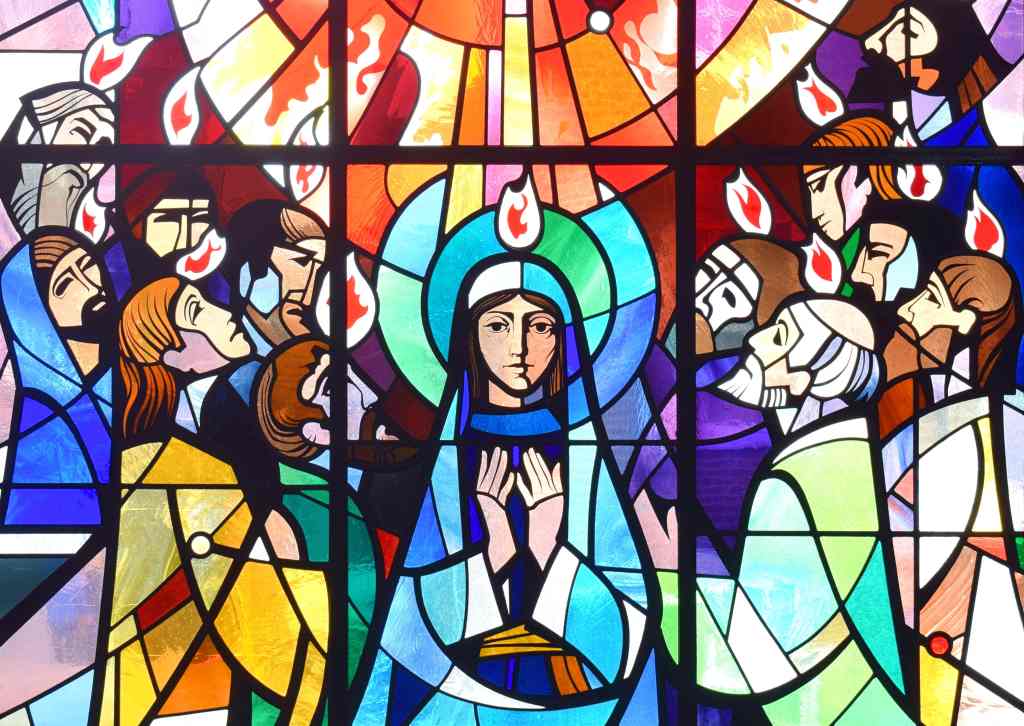
Pentecost by Jen Norton

In the sixth month of Elizabeth’s pregnancy, God sent the angel Gabriel to Nazareth, a town in Galilee, to a virgin pledged to be married to a man named Joseph, a descendant of David. The virgin’s name was Mary. The angel went to her and said, “Greetings, you who are highly favored! The Lord is with you.”

Mary was greatly troubled at his words and wondered what kind of greeting this might be.But the angel said to her, “Do not be afraid, Mary; you have found favor with God. You will conceive and give birth to a son, and you are to call him Jesus. He will be great and will be called the Son of the Most High. The Lord God will give him the throne of his father David,and he will reign over Jacob’s descendants forever; his kingdom will never end.”

“How will this be,” Mary asked the angel, “since I am a virgin?”

The angel answered, “The Holy Spirit will come on you, and the power of the Most High will overshadow you. So, the holy one to be born will be called the Son of God. Even Elizabeth your relative is going to have a child in her old age, and she who was said to be unable to conceive is in her sixth month. For no word from God will ever fail.”

“I am the Lord’s servant,” Mary answered. “May your word to me be fulfilled.” Then the angel left her. (New International Version)

It is good that the Daily Lectionary has us considering these verses of Scripture outside of the Advent season. In this time of year, in which we focus on the Spirit, we need to remember that these stories, and our faith, are meant to be held throughout the entire year.

Most of life is lived in the mundane, even in times of uncertainty. For the most part, our everyday lives involve going about our business and dealing with the daily grind. That’s because we are common ordinary people. So, we can especially relate to Mary because she is rather plain. 

To put Mary’s life in our contemporary vernacular, at the time of this encounter with the angel, she is of junior high age but has never attended school. She wears mostly clothes from Goodwill, and occasionally can get some from Wal-Mart. She cannot read because girls of her day rarely did.

Her parents make all the decisions that affect her life, including the one that she should be married to an older man named Joseph. We don’t know if she even liked him. Mary lives in a small town that most people cannot even point to on a map. 

One night, into the bedroom of this young girl comes the brightly beaming divine messenger Gabriel whose name means, “God has shown himself mighty.” Mary stands there in her ratty old flannel nightgown, her life very quickly moving from the ordinary to the extraordinary.

The juxtaposition could not be more pronounced: a mighty angel and a plain teen-ager; a messenger of the Most High God and a girl barely past puberty; a holy angelic light which beams in a simple candlelit bedroom; an awesome power encountering complete vulnerability.

Mary, compared to Gabriel, is defenseless, fragile, and overwhelmed. She’s in way over her head. That’s why we can relate to her. We can get our human arms around Mary. She is like us. She has faced life with little power to make it turn out the way she planned. Forces beyond her have rearranged her life and altered it forever.

Descent of the Holy Spirit by John Lawson

Mary is the Matron Saint of the Ordinary. We can totally understand why Mary responds the way she does. Mary’s initial reaction to the angel Gabriel was to be greatly troubled. She was disturbed and shaking in her hand-me-down slippers.

The angel confidently told Mary that she had found favor with God. This scenario didn’t happen because Mary had some extreme spirituality. Instead, God simply chose her to be the mother of Jesus.

Mary needed to come to grips with what was happening to her. This was well beyond anything she could have expected.  Becoming pregnant with the Savior of the world was not even remotely on her radar. 

She immediately sensed the crazy disconnect between what was being told to her and who she was. After all, she was a plain ordinary girl from the hick town of Nazareth and was being told that she would raise a king.  Maybe somebody in heaven screwed up. Maybe Gabriel got the wrong girl. Maybe his Google map sent Gabriel on a wild goose chase.

Relating to Mary, we can totally understand that she would question how in the world all this was going to happen. Not only is Mary ordinary and far from royalty, but she is also very much a virgin. Nothing about any of this made any sense.

But, then again, this is the very sort of thing that the wild and seemingly reckless Holy Spirit would do.

The angel let Mary know that God specializes in the impossible. There is nothing outside of God’s power. There’s nowhere we can go, no place on earth, no situation whatsoever, that is beyond God’s ability and reach to affect divine power.

We very rarely get straightforward answers to our questions about God. Yet, Mary asked a question and got a straight answer: She really can be pregnant with Jesus because the Holy Spirit will come upon her, will overshadow her with power.

If the story were to end there it would be a great story. However, the Spirit’s work goes well beyond effecting the miraculous. The Spirit also brings about faith.

God has poured out his love into our hearts by means of the Holy Spirit, who is God’s gift to us.

Romans 5:5, GNT

Mary believed the message and submitted herself completely to God’s will. We may completely understand if Mary simply said in her plain ordinary way that she was not prepared for this. We would totally “get it” if Mary pushed back on what the angel said to her. We could relate if Mary just dismissed the angel’s presence as a hallucination from using some bad chickpeas to make the hummus.

Yet, Mary not only believed; she also humbly submitted herself to what was happening. And this is what I believe we need to relate to most about Mary – not her being just a plain ordinary person in a non-descript village but stepping up to the calling she received.

We, too, have received a calling in our lives. We, too, have been given the power of the Holy Spirit. We, too, are ordinary people who have been given a very extraordinary task. 

Our response today can be the same as Mary all those centuries earlier: “I am the Lord’s servant; may it be to me as you have said.”

The Church is pregnant with possibilities because of the Holy Spirit.

We know the end of Mary’s story. She gave birth to Jesus and raised him in her plain ordinary way. She watched him grow up and embark on a ministry to proclaim that the kingdom of God is near. Mary didn’t always understand what Jesus said or what he was doing. And she experienced every mother’s nightmare in seeing her beloved son killed in a terribly gruesome manner right in front of her eyes. 

Yet, just as the Holy Spirit was with the birth of Jesus, so the Spirit was with Jesus at his resurrection from the dead. Jesus lived an ordinary life in a very extraordinary way. Furthermore, today Jesus invites us to do the same.

“You will receive power when the Holy Spirit has come upon you, and you will be my witnesses in Jerusalem, in all Judea and Samaria, and to the end of the earth.”

Jesus (Acts 1:8, CEB)

Because Christ accomplished his mission of saving people from their sins and establishing a kingdom that will never end, he has given us the same Holy Spirit to follow him forever and call other people to follow him, too. 

To trust and obey is God’s only way to live into the life of Jesus. The Christian life may often be difficult, but it isn’t complicated. It’s rather simple, just like Mary.

Mary responded to God’s revelation with faith, choosing to fully participate in what God was doing. “I am the Lord’s servant” is our confession, as well. Along with Mary we declare, “May it be to me as you have said.”

Good and gracious God, thank you for giving us your Son, the Lord Jesus. Draw us into the mystery of your love. Join our voices with the heavenly host, that we may sing your glory on high. Give us a place amongst all of your saints so that we may experience your Word made flesh, who lives and reigns with you in the unity of the Holy Spirit, in the splendor of eternal light, God forever and ever. Amen.

Psalm 27 – Wait…

Psalm 27:4 painting by Marguerite Moreau McCarthy

The Lord is my light and my salvation;
    whom shall I fear?
The Lord is the stronghold of my life;
    of whom shall I be afraid?

When evildoers assail me
    to devour my flesh—
my adversaries and foes—
    they shall stumble and fall.

Though an army encamp against me,
    my heart shall not fear;
though war rise up against me,
    yet I will be confident.

One thing I asked of the Lord,
    that will I seek after:
to live in the house of the Lord
    all the days of my life,
to behold the beauty of the Lord,
    and to inquire in his temple.

For he will hide me in his shelter
    in the day of trouble;
he will conceal me under the cover of his tent;
    he will set me high on a rock.

Now my head is lifted up
    above my enemies all around me,
and I will offer in his tent
    sacrifices with shouts of joy;
I will sing and make melody to the Lord.

Hear, O Lord, when I cry aloud,
    be gracious to me and answer me!
“Come,” my heart says, “seek his face!”
    Your face, Lord, do I seek.
    Do not hide your face from me.

Do not turn your servant away in anger,
    you who have been my help.
Do not cast me off, do not forsake me,
    O God of my salvation!
If my father and mother forsake me,
    the Lord will take me up.

Teach me your way, O Lord,
    and lead me on a level path
    because of my enemies.
Do not give me up to the will of my adversaries,
    for false witnesses have risen against me,
    and they are breathing out violence.

I believe that I shall see the goodness of the Lord
    in the land of the living.
Wait for the Lord;
    be strong and let your heart take courage;
    wait for the Lord! (New Revised Standard Version)

“The key to everything is patience. You get the chicken by hatching the egg, not by smashing it.”

Arnold H. Glasow

The Christian season of Lent is a time of waiting…. Believers patiently wait for Easter and the resurrection of the Lord. But there must be a crucifixion before there is a resurrection. There must be suffering before there is glory. Truncating the process of spiritual development, including the hard circumstances of life, will stunt our growth.

So, we need to wait for the Lord….

But, dang it, waiting is hard! Patience is especially difficult whenever we are experiencing hardship and difficulty. We already know that praying for patience is problematic; we end up getting plenty of opportunities to exercise patience and may feel like we’re worse off than before. So, what do we do?

The way to wait patiently is through hope. And hope is a reality which needs to be continually fortified.

Whatever we long to see realized…

the return of a wayward son or daughter…

revitalization and revival within the church…

courage to face the high wall of adversity…

protection and deliverance from mean-spirited people…

an end to pandemic…

freedom from racism and injustice…

healing from chronic pain…

enough finances to make our budget budge…

whatever the situation we long for, patience is to be our breakfast every morning to help us through each day, living one day at a time, putting one foot forward.

Apart from patience, faith, and hope in God, we will lose our spiritual zeal and settle for a mediocre existence with tepid relationships and lukewarm engagement of the world. 

God desires more for us…

than simply having a marriage in which two people only exist under the same roof…

for church to be more than buildings, budgets, and butts in the pews…

for our work to be more than a necessary evil to make a living…

for our lives to be more than fear, worry, and anxiety…

for much more than broken dreams, messed up relationships, and situations gone sideways.

The confident expectation of hope neither eliminates trouble from our lives nor magically makes everything better.

Deep faith, like the psalmist expressed, does not change or alter reality – but it does change us.

The way in which we view and handle our troubles is understood differently through the filter of faith and the lens of hope.

The mammoth adversity in our lives is no longer feared because of settled trust in God; the danger which lurks about has no teeth to hold us when we are secure in the Lord.

The actions believers take toward God amidst the fallen nature of this world are to wait and hope, to be strong and take courage. It is precisely when we are totally discombobulated that faith and confident expectation kick in and take effect.

Our faith leads us to confess:

I believe the Lord is the Light which keeps me safe and illumines my path.

I believe the Lord is my Fortress, a castle to protect me.

I believe the Lord is an Army surrounding me, defending my life.

I believe the Lord is the Rock of my salvation, keeping me secure.

I believe the Lord is a Parent who holds me close and does not let go.

I believe the Lord is the right and good Judge, always extending grace and mercy to me.

I believe the Lord is Healer, oftentimes healing me from the need to be healed.

Therefore:

I have confidence and courage to engage the world, knowing God has my back.

I have confidence God will handle malevolent persons, systemic evil, and sinister forces on my behalf.

I have confidence I can approach God, since God’s character is always gracious and loving.

I have confidence to pray with authority, understanding God is the Sovereign of the universe.

I have confidence better days are ahead, that the Christ is soon coming.

I have confidence God bends to attentively listen to me praying.

I have confidence God is neither angry at me nor hidden from me.

I have confidence God shall lead me, guide me, and teach me in the way I ought to go.

I have confidence knowing that God has my best interests in mind.

Rather than losing heart, we can be strengthened with solid theology. Making daily affirmations of faith, persevering in hope, and performing small acts of love are our daily tasks while we wait and watch….

Almighty and everlasting God, the One who sees, knows, and protects, by the power of your Holy Spirit, you are refining us, purifying our discipleship, pulling us into following Jesus in this scary new world of uncertainty. Grant us mercy and grace to trust you more deeply, for the only secure place is with you, our light and our salvation, the stronghold of our life. We pray in the name of Jesus, the first-born of your new creation, and our hope, our life. Amen.