Romans 2:1-11 – Against Condemning Others

You, therefore, have no excuse, you who pass judgment on someone else, for at whatever point you judge another, you are condemning yourself, because you who pass judgment do the same things. Now we know that God’s judgment against those who do such things is based on truth. So, when you, a mere human being, pass judgment on them and yet do the same things, do you think you will escape God’s judgment? Or do you show contempt for the riches of his kindness, forbearance, and patience, not realizing that God’s kindness is intended to lead you to repentance?

But because of your stubbornness and your unrepentant heart, you are storing up wrath against yourself for the day of God’s wrath, when his righteous judgment will be revealed. God “will repay each person according to what they have done.” To those who by persistence in doing good seek glory, honor, and immortality, he will give eternal life. But for those who are self-seeking and who reject the truth and follow evil, there will be wrath and anger. There will be trouble and distress for every human being who does evil: first for the Jew, then for the Gentile; but glory, honor and peace for everyone who does good: first for the Jew, then for the Gentile. For God does not show favoritism. (NIV)

The Apostle Paul, writing to the Church at Rome, merely upheld the teaching of his Lord Jesus, who said:

“Do not judge, so that you may not be judged. For with the judgment you make you will be judged, and the measure you give will be the measure you get.” (Matthew 7:1-2, NRSV)

Although most people would affirm that showing favoritism is a bad thing, in practice we have a difficult time avoiding it – especially in an election season, like the one in the United States. Political mudslinging is (unfortunately) a time-honored American tradition. And so is religious judgmentalism.

Some of the most emotionally laden vitriol comes from folks who are so heavily entrenched in their religious convictions that they believe any deviation from their way of belief is worthy of scathing criticism.

People, however, do not change because someone criticizes or judges them. They experience transformation through basic divine and human kindness. As a hospital chaplain in a behavioral health unit, I affirm this to be true. Many patients have been told repeatedly by family or friends to stop doing something, get with it, move on, wake up, etc. – all with the condescending edge of judgment. Yet, when someone takes notice, is curious about them, offers helpful encouragement and a listening ear without trying to fix, souls become open to receiving the healing grace of love and truth.

God shows no partiality, and neither should we. God is right, just, and fair in all dealings with everyone. The Lord judges according to divine standards of righteousness and mercy, no matter one’s race, ethnicity, gender, economic status, or social standing. And it is all laced with the love and compassion of Christ.

Christians are not exempt or given a pass on being judgmental. Our own unhealthy practices, bad habits, and angry outbursts will be treated just like any non-Christian by God. In a time when decrying the moral condition of our world is nearly a spectator sport, the New Testament lesson for today reminds us that we must first be concerned for the condition of our own hearts before we can point the finger at another.

We all equally stand in need of God’s grace in Jesus.  There is a symbiotic relationship between our actions and the state of our hearts.  A soft and tender heart toward God leads to obedience; disobedience hardens the heart and leads to God’s wrath, no matter the individual.

So, it will help if we all faithfully engage in daily spiritual practices which keep our hearts attentive and alert to God’s will and way.  No matter how busy we are, or how we feel, to forego or ignore the Word of God and prayer on a regular basis will slowly calcify our hearts and render them unable to respond rightly to grace.  Instead, we can drink deeply of the gospel throughout every day so that we may experience peace.

Judgmentalism, favoritism, and cronyism all begin to melt away when we pick up the tools of empathy, compassion, understanding, and acceptance – using them to forge connections and supportive encouragement. It takes little to no practice to bludgeon someone with condemning criticism. However, it takes repeated practice to speak and act with grace, mercy, and peace, especially when we are stressed and/or anxious about our surrounding circumstances.

Instead of judgment, observe and be curious. Seek more information. Expand the gap between observation and conclusion. The ability to have an awareness of one’s own emotions, to be mindful of self and surroundings, and to do it all with neither criticism nor judgment is perhaps the highest form of intelligence and spirituality.

It is kindness which leads others to repentance, not condemnation. Grace has the final word, not judgment. So, let us be blessed through a gentle spirit which spreads the goodness of God throughout the world.

O God, thank you for the gift of prayer and the grace of your Word.  May it seep deep down into my heart so that I am compassionate and kind, just like Jesus.  Amen.

Matthew 23:29-36 – “Woe Is Me!”

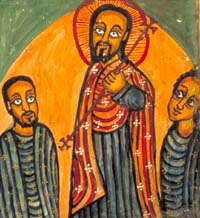
Ethiopian Jesus
Jesus, from an Ethiopian Orthodox Church, c.1750 C.E.

“Woe to you, teachers of the law and Pharisees, you hypocrites! You build tombs for the prophets and decorate the graves of the righteous. And you say, ‘If we had lived in the days of our ancestors, we would not have taken part with them in shedding the blood of the prophets.’ So, you testify against yourselves that you are the descendants of those who murdered the prophets. Go ahead, then, and complete what your ancestors started! 

“You snakes! You brood of vipers! How will you escape being condemned to hell? Therefore, I am sending you prophets and sages and teachers. Some of them you will kill and crucify; others you will flog in your synagogues and pursue from town to town. And so upon you will come all the righteous blood that has been shed on earth, from the blood of righteous Abel to the blood of Zechariah son of Berekiah, whom you murdered between the temple and the altar. Truly I tell you; all this will come on this generation. (NIV) 

I almost feel the need to place a warning label on this blog post: “The writer has determined that a careful reading of this Scripture is dangerous to those who think their current state of Christianity is just fine.”  Jesus stands in a long line of Old Testament prophets as the ultimate prophesier calling the people to see things as they really are and come back to the God of all, not the God of their own making. 

I feel yet another warning is warranted, knowing from years of experience that there is an Enemy of our souls: The dark forces of this world will try every which way to get us to believe these words of Jesus are for other people, not me or you – that you and I are okay and that this is for “those” people [probably ones we don’t like] who are clearly deluded. We, however, are simply fine.   

We all need these words from Jesus and to let them speak to us. Christ’s scathing and damning critique was leveled against a distorted spirituality, a false Christianity, a controlling leadership that stifled and snuffed-out the true worship of God. Jesus pronounced seven woes on the religiously pious spiritual brokers of his day. Today’s Gospel lectionary contains only the seventh woe. This woe, along with the rest, are not directed toward the irreligious or the spiritually lackadaisical folks among us – the woes are aimed squarely at the religiously committed. 

Ethiopian Orthodox Jesus
Ethiopian Orthodox Church depiction of Jesus

The word “woe” literally means “disaster” “calamity” and “misery.” Jesus pronounced a woe against ultra-religious persons who were obsessed with respecting the tombs and the graves of the ancient prophets. It was considered a terrible travesty to walk on such a grave, even accidentally. The concern about it would be something like today’s respect given to the American flag by many people. 

Here is what Jesus is getting at with his woe on those being so concerned with the tombs of the prophets: Honoring dead people and inanimate objects like graves while ignoring live people is not good. Respecting dead people of the past means nothing if we simultaneously ignore the live people right in front of us. For Jesus, one of the surest ways to hell is to give credence to Christian leaders long dead while flippantly disregarding the prophet or pastor presently in our lives who is taking pains to communicate God’s will and care for God’s people right now. 

Jesus knew quite well the telltale signs of hypocrisy: 1) hypocrites don’t practice what they preach; 2) hypocrites keep other people out of God’s kingdom; 3) hypocrites focus on externals; and, 4) hypocrites major on the minors. Hypocrisy, however, never has the last word – grace does. The final word to everything is God’s grace.  

For all of Christ’s severe words, his heart was filled with a love and a longing for his wayward people. Jesus died for the ungodly with deep concern, intention, and hope that everyone would come to know the true worship of God – filled with an abundance of mercy for the penitent sinner. 

When the prophet Isaiah experienced a vision of God his response was “woe is me!” (Isaiah 6:1-5). The appropriate response to today’s Gospel lesson is repentance – to see and turn from our own propensity toward spiritual and/or religious pride and the tendency to view the “other” as needing to repent, but not me.  

Let us, then, come to the cross of Jesus Christ and there find the grace which absolves us from such sin. Let us approach the empty tomb and find Christ’s resurrecting power of transformation. Let us approach the ascended Christ on the throne with both humility and confidence. Let us intercede for a world which desperately needs the peace of Christ. 

Lord Jesus Christ, you prayed that we would be one as you and your Father are one. We confess our resistance to your prayer. We have failed to maintain the unity of the Spirit. We have broken the bond of peace. For the times we have not listened to each other, when we have spoken in anger, haste, or fear, we are sorry. For the times we have not loved each other, when we have competed, or insulted or judged each other, we are sorry. For the harm that our disunity has done to our witness to the Gospel, we are sorry. Have mercy on us, we pray. Restore us to friendship with you and with one another, through the power of your Spirit. Lord, grant your grace for repentance to spiritual charlatans and victimizers; and, give your power to those distressed and victimized for forgiveness of their abusers, so that all of us together may strive to break the chains of oppression and show the peace of Christ in the world. Amen. 

Matthew 11:20-24 – “C’mon, Man!”

Jesus angry
“Christ in Majesty” by Polish artist Jan Henryk de Rosen at the National Shrine of the Immaculate Conception

Then Jesus began to denounce the towns in which most of his miracles had been performed, because they did not repent. “Woe to you, Chorazin! Woe to you, Bethsaida! For if the miracles that were performed in you had been performed in Tyre and Sidon, they would have repented long ago in sackcloth and ashes. But I tell you, it will be more bearable for Tyre and Sidon on the day of judgment than for you. And you, Capernaum, will you be lifted to the heavens? No, you will go down to Hades. For if the miracles that were performed in you had been performed in Sodom, it would have remained to this day. But I tell you that it will be more bearable for Sodom on the day of judgment than for you.” (NIV)

Today’s New Testament lesson from the Gospel of Matthew, recounting the words of Jesus, are not filled with unicorns and butterflies, to say the least. We might be somewhat unfamiliar with these not so famous, maybe even infamous, words from our Lord. Before Jesus tells who is accepted in the kingdom of God (Matthew 11:28-30) he tells us who is not accepted. These scathing words are specifically leveled to the towns in which Christ had performed his ministry of healing and miracles.

We need to hear the hard words of Jesus. Up to this point in Matthew’s Gospel, he has laid out the birth narrative of incarnation in chapters 1-2; the preparation for Christ’s ministry in baptism and being sent to the desert in chapters 3-4; Christ’s teaching on what constitutes a genuine follower of God, the Sermon on the Mount, chapters 5-7; and, chapters 8-10, recording ten miracles which were meant to demonstrate that the kingdom of God has broken into history in the person of Jesus Christ. In chapter 11, Jesus begins leveling a rebuke to the crowd who had observed his ministry and did nothing in response to his works.

For Jesus, the height of hubris was to simply ignore his righteous works of gracious teaching and benevolent healing.

If you are not a fan of Monday Night Football, let me explain a pre-game segment each week during the season called, “C’mon, man!” Each commentator picks out a bonehead play from the previous week that would cause someone to shake their head in dismay and say “c’mon, man!” They are typically situations where the player’s head just was not in the game and they ended up, in some cases, costing their team points or even the game.

Cmon man

Reading Christ’s words sounds a lot like Jesus picking out the towns in which he performed his miracles, and saying to them: “C’mon, man!”  “You saw me cleanse a man from leprosy, heal paralyzed people and a woman with a chronic disease, calm a great storm, exorcise demons from people, give sight to the blind and speech to the mute. You saw all of this, but it has not changed you one bit. You still live the same way you always have and have not come to me as the source of your deliverance… “C’mon, man!”

Notice that Jesus’ denunciation comes not because he was experiencing opposition or persecution; he was denouncing them for their bonehead lack of response and refusal to change their lives to conform to what they were seeing right in front of their faces. The crowd heard his teaching and saw his miracles, and it had no effect on them. So, Jesus gave them a great big “C’mon, man!” Judgment becomes the lot of someone who is unaffected and unresponsive to the vast sea of human need around them, viewing Jesus as just another voice, and living a life of mediocrity in the face of opportunity.

So, what would the segment “C’mon, man!” look like today? What would Jesus say to us? Keep in mind we are people with access to Christ’s teaching. We have the Sermon on the Mount to read, study, meditate upon, and live by – yet, too many [Christians] don’t take the time to examine it with the intent of seeing Jesus and allowing him to change their lives… “C’mon, man!”

The Holy Spirit has been provided, who is the power source of the Christian life. We possess all the resources of grace necessary to step into this world and make a difference, yet so many do nothing but occupy a place in the pew [or couch] because they are too afraid to sacrifice their time in meaningful ministry… “C’mon, man!”

There are neighbors, relatives, and co-workers who are lost and lonely, in need of the kind of grace Jesus gives, yet too many of us are oblivious to them and instead are constantly worried about things that, in the end, don’t really matter at all… “C’mon, man!”

We have opportunities to grow in the grace and knowledge of Jesus Christ through a vast array of available ministries, yet many do not take the chance to change and be spiritually stretched… “C’mon, man!”

Today the words of Jesus are right in front of our faces, and some of us will have the audacity to read them and remain unchanged, unchallenged, and unresponsive… “C’mon, man!”

If our highest values in life are sameness, stability, and security, we may very well, at the least, miss Jesus altogether, and, at worst, find ourselves under his condemnation. These verses are for those whom Jesus has become all too familiar, as if he is just another piece of furniture in the living room – the coffee table with a dusty Bible resting on it.

Perhaps this post may seem a bit out of place on a website which promotes itself as caring. I would like to think of it as obnoxiously caring. I trust you will accept today’s writing and the words of Jesus as caring enough to confront. There are times when Mid-West nice gets us nowhere and we must have hard conversations. Yes, conversations, and not verbal rockets launched from one group to another. Jesus did not denounce from a distance; he did it up close and personal. Furthermore, he was specific and not generic about why he was speaking in the way he did.

So, may you be able to pray this prayer of repentance today with heartfelt conviction:

Almighty God, Father of our Lord Jesus Christ, Sovereign Lord of the universe, Creator of humanity, we, your unfaithful children, are sorry for our sins and the lives that we have lived apart from your grace. We sincerely believe and confess in our hearts that only through the precious blood of our Lord Jesus Christ on the cross, can we obtain your forgiveness.

We repent that: in thought, word, and deed, we have committed serious offences against you and our neighbors. Through spiritual laziness and prideful lust for power, we have provoked hatred, division, despair, and hurt within our communities.

Through our greed, deceit, and indifference, we have inflicted serious damage, unnecessary conflict, and aggravated destruction to those different than us.

Through our selfishness, insensitivity, and bias (both conscious and unconscious) we have encouraged and emboldened those who inflict hurt, pain, and sorrow on those who are already oppressed and poor.

In the name of religion, doctrine, and even of Christ himself, we have wounded fellow believers and those who genuinely pursue a faith different than ours. In stubbornness, pride, and arrogance, we have caused division and strife within your church and among your people.

Mercifully send your Holy Spirit, the Spirit of order and comfort, to cleanse us from all unrighteousness; to restore in us true faith in Christ which brings truth, peace and harmony; and, to help us walk together with our brothers and sisters in the peace of our Lord Jesus Christ, to the glory of your name. Amen.