
Idolatry Is the Tail Wagging the Dog (Psalm 106:1-6, 19-23)

Praise the Lord!
    O give thanks to the Lord, for he is good,
    for his steadfast love endures forever.
Who can utter the mighty doings of the Lord
    or declare all his praise?
Happy are those who observe justice,
    who do righteousness at all times.

Remember us, O Lord, when you show favor to your people;
    help us when you deliver them,
that we may see the prosperity of your chosen ones,
    that we may rejoice in the gladness of your nation,
    that we may glory in your heritage.

Both we and our ancestors have sinned;
    we have committed iniquity, have done wickedly…

They made a calf at Horeb
    and worshiped a cast image.
They exchanged the glory of God
    for the image of an ox that eats grass.
They forgot God, their Savior,
    who had done great things in Egypt,
wondrous works in the land of Ham,
    and awesome deeds by the Red Sea.
Therefore he said he would destroy them—
    had not Moses, his chosen one,
stood in the breach before him,
    to turn away his wrath from destroying them. (New Revised Standard Version)
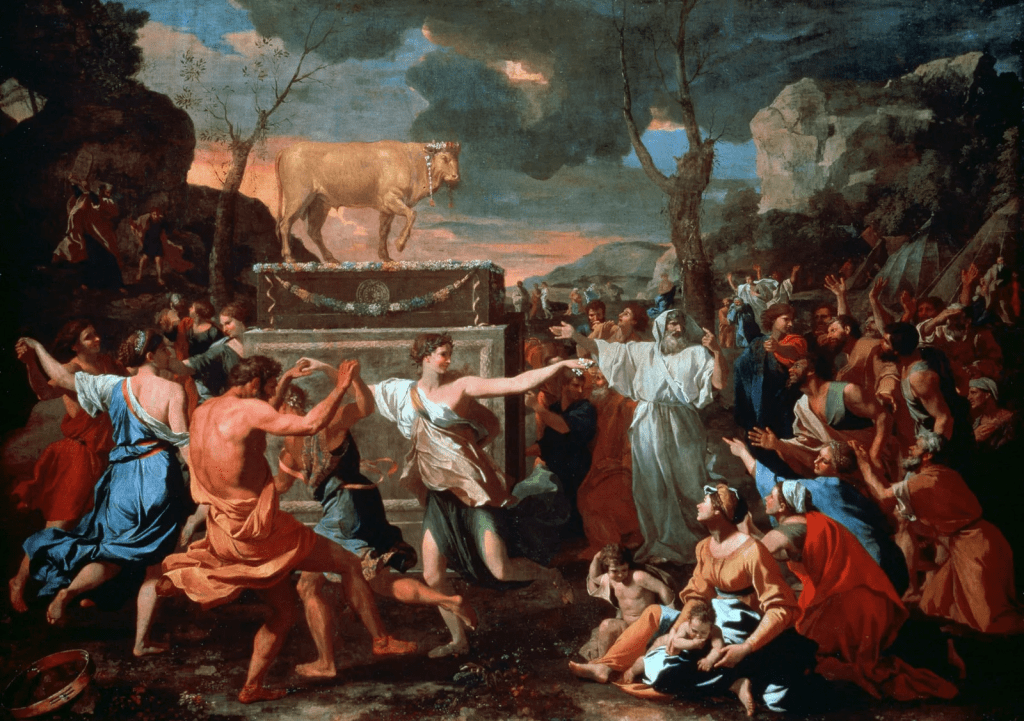
Adoration of the Golden Calf, by Nicolas Poussin (1594-1665)

When it comes to sin, especially the sin of idolatry, it’s imperative that we name it for what it is. It will do no good to fudge on it by saying that so-and-so struggles with it more than me, or that it’s not as bad as assault or murder.

No, we must call sinful idolatry just that, because the problem of idolatry is at the heart of humanity’s spiritual struggle. The first of the Ten Commandments frames it and names it squarely:

“I am the Lord your God who brought you out of slavery; do not worship other gods.” (Exodus 20:2-3, NRSV)

And the second commandment straight up prohibits any manufacturing or worshiping of idols:

“You shall not make for yourself an idol, whether in the form of anything that is in heaven above or that is on the earth beneath or that is in the water under the earth. You shall not bow down to them or serve them….” (Exodus 20:4-5, NRSV)

In the New Testament Gospels, Jesus also drew sharp lines between God and idolatry:

“No one can serve two masters, for a slave will either hate the one and love the other or be devoted to the one and despise the other. You cannot serve God and wealth.” (Matthew 6:24, NRSV)

The early church fathers (and mothers) forsook dependence on anything or anyone other than the one true God. Idolatry is an obsessive and fruitless search to satisfy a legitimate need in an illegitimate manner by giving oneself to someone or something other than the true object of the heart’s longing.

“You have made us for yourself, O Lord, and our heart is restless until it rests in you.”

St. Augustine

None of this means that the material and physical world is somehow bad – that money, possessions, food, books, nature, and other people are objects to avoid – because they are most certainly not! The problem arises whenever we seek to replace God with the things God made, God’s own creation.

By seeking to save our souls and fill the emptiness in our spirits with more and more wealth, or more and better jobs, or more time and expense for reading, or just about any other activity or possession there is, those things which were given for our use and enjoyment and to be stewarded well by us, end up becoming the users and our masters.

Inanimate objects, ideas, and activities begin calling the shots and giving the commands about what we should do and not do. What we own, now owns us. Even the poor can succumb to idolatry through the sin of covetousness by wanting things they do not have in the belief that wealth and possessions will make their lives whole and worthy. But this breaks the tenth commandment:

“You shall not covet your neighbor’s house; you shall not covet your neighbor’s wife, male or female slave, ox, donkey, or anything that belongs to your neighbor.” (Exodus 20:17, NRSV)

Nature and all the earth were formed by the Creator. And, as such, they too, give glory to God and recognize they themselves are not to be worshiped.

The heavens are telling the glory of God,
    and the firmament proclaims his handiwork.
Day to day pours forth speech,
    and night to night declares knowledge. (Psalm 19:1-2, NRSV)

Genuine wealth, prosperity, happiness and peace are found in the Creator of all good things. It is God who will:

  • wipe every tear from our eyes (Isaiah 25:1-9)
  • provide protection and guidance through the hard times of life (Isaiah 54:17)
  • be present with us as we walk through the valley of despair and ascend the mountain of celebration and joy (Psalm 23)

The reason idolatry is so insidious and difficult to name is that our affections are typically on a good thing which God has created and given for us. It’s just that, over time and through an extended process, the tail begins to wag the dog. For example:

  • Humanity serves the Sabbath instead of the Sabbath serving humanity
  • Parishioners venerate a church building instead of the church building being a tool for ministry
  • People are slaves to their hobbies instead of the hobby serving the person
  • Spouses worship one another instead of worshiping the God who brought them together
  • Groups let their traditions hold them with an iron grip, instead of traditions being held loosely by groups

It could (and does) happen to each one of us. And when it does, we need the wisdom and humility to see it for what it has become. Then, confess it as idolatry, and accept the forgiveness which is freely available from the Divine.

Almighty and everlasting God: Not to us, but to your name we give glory, for the sake of your steadfast love and your faithfulness! Yet because of the idolatry in our hearts, we have strayed far from you. We have disobeyed your commandments; we have trusted our own judgement; and we wonder why we feel distant from you. We have worshipped idols of silver and gold—and idols of self and comfort. Forgive us for not loving you as we ought, not obeying you as we were taught, and not trusting that our forgiveness has been bought. Amen.

Jesus Intervenes (Matthew 19:23-30)

Orthodox depiction of Jesus and the rich young ruler

Then Jesus said to his disciples, “I assure you that it will be very hard for a rich person to enter the kingdom of heaven. In fact, it’s easier for a camel to squeeze through the eye of a needle than for a rich person to enter God’s kingdom.”

When his disciples heard this, they were stunned. “Then who can be saved?” they asked.

Jesus looked at them carefully and said, “It’s impossible for human beings. But all things are possible for God.”

Then Peter replied, “Look, we’ve left everything and followed you. What will we have?”

Jesus said to them, “I assure you who have followed me that, when everything is made new, when the Human One sits on his magnificent throne, you also will sit on twelve thrones overseeing the twelve tribes of Israel. And all who have left houses, brothers, sisters, father, mother, children, or farms because of my name will receive one hundred times more and will inherit eternal life. But many who are first will be last. And many who are last will be first. (Common English Bible)

We all have a chronic struggle and relapse with some besetting shortcomings. And we compulsively do them even though they harm us.

Whether it’s an addiction (alcohol, illicit drugs, etc.) or things we don’t readily notice as addictive (gossip, food, shopping) we need to be weaned off our damaging obsessions. In Holy Scripture, the most pervasive and compulsive vice is the addiction to wealth and money.

Everyone has their own unique tussle with money. If our initial knee-jerk reactions to money issues is to think of someone else (“I don’t have as much money as…” or, “So-and-so really has a problem with this…”) then this is what we call denial. Truth be told, all of us offer some disclaimer about how our trust is not in paychecks, bank accounts, and material stuff. For me, money buys books, of which my voracious appetite is never satiated.

Even people who truly have little money and scant resources can have an addiction to money. They think about money and wish for it to an unhealthy degree, as if wealth is the thing that will make them happy. Folks in denial rarely have any idea how much they harm others, themselves, and even God. In fact, the consistent witness of the early church fathers is that the sheer accumulation of stuff is the same as stealing from the poor.

Sometimes, because of denial, people need an intervention – and to be jolted back to their senses. Intervention is a gift. Someone cares enough to intervene. Yet, many interventions don’t work because the person can walk away and refuse to change.

Jesus performed an intervention with a rich young man (literally, a twenty-something). The young man was obsessed with wealth and money, but didn’t see it. He thought of himself as godly and spiritual. It’s really a sad story because the rich man walked away unchanged by his encounter with Jesus. He failed to see himself as desperately needing to change. He held to his denial. (Matthew 19:16-22)

Jesus and the Rich Young Man by Chinese artist, 1879

Jesus exposed the rich young man’s divided loyalties of trying to serve both God and money. He would have to choose between the two masters. And this is our choice, as well.

God wants an undivided heart and loyal allegiance. Jesus is looking for those who are poor in spirit and recognize their great need for God, rather than believing they are okay and just need to add a little Jesus to their lives. God wants spiritual beggars who understand their desperate situation and do not practice denial by sugar-coating their actual spiritual state.

Just like an addict who either cannot or will not give up the addiction, the rich young man would not give up his disordered love for money and possessions. So, Jesus intervened. Christ doesn’t ask everybody to do exactly as he called the rich young man to do. For example, Jesus asked neither the wealthy Zacchaeus to do it, nor the disciple Peter to sell his fishing business.

However, Jesus does ask all of us to do what seems impossible and let God meet our needs.

Christ had the original come-to-Jesus-meeting with his disciples in debriefing about his conversation with the rich man. If it is so impossible and so difficult for a rich person to be saved because his wealth gets in the way, who then can be saved, the disciples wondered? We cannot save or redeem ourselves. We need grace. We need help.

So serious is Jesus about this business of genuine discipleship, about what it really takes to follow God, that he repeated himself using a colorful illustration: It’s easier for a camel to go through the eye of a needle than for a rich man to enter the kingdom of God. 

Jesus wants us, who have lots of stuff, bank accounts, and money to see ourselves in the illustration. Only the discouraged, the hopeless, and the helpless will see their absolute need for grace and will seek the miracle of salvation Jesus offers.

Peter, always the big mouthpiece for the disciples, blurts out that they have left everything to follow Jesus. So, what then will there be for the disciples? What’s in it for me?

We may avoid the idol of money only to find ourselves with the idol of pride. Twentieth-century theologian, Reinhold Niebuhr, once said that a person had to achieve a great deal of good to be able to commit the sin of pride.

Yet, grace always has the last word. Jesus gives grace and assures us of reward even when we are stinkers by asking prideful questions. 

“The promise of a hundredfold recompense does not seem to square with experience. Usually those who for the testimony of Christ are deprived of parents or children and other relatives, or their marriage partners, or have lost all their money, do not recover but struggle out their life in lonely and deserted exile and in poverty. But I reply that if anyone rightly assesses God’s grace by which he alleviates the miseries of His children he will confess that is to be preferred to all the riches of this world.”

John Calvin

The first step in facing any harmful compulsion is to be honest about it – without telling our story in a way that makes us look surprisingly good so that others are pleased with us.

Life is about following Jesus. To follow Jesus, we must not be in denial. Perhaps the best way to express our faith is to tell someone about our obsessions to compulsively work in order to feel better and pad our savings; or that we are afraid to charitably give because we worry about the future; or that we love to buy things we don’t really need, so that we’ll feel better.

An honest awareness of our compulsions sometimes causes us to feel awful about ourselves. We may disparage ourselves for always screwing up, never saying “no” to others, or feeling unable to stop the anxiety.

Yet, grace abundantly overwhelms any and all addictions, shortcomings, and pride when it comes money or anything else. God has unlimited patience with people; Jesus never tires of inviting us to follow him. God’s love and acceptance is not based on our screw-ups, but on Christ’s forgiveness through the cross.

Allow the words of Jesus to sink deep into your life so that you ooze the grace of God in your life.

Camels cannot pass through the needle’s eye by means of dieting, positive thoughts, or luck. It happens not because the camel can squeeze through the narrowness of the needle’s eye but because there is a wideness in God’s mercy.

God’s grace will pull you through. Unlike the rich young man, once you hear and understand that piece of delightful news, you do not walk away sad but with boundless joy.

God of wisdom, help me in the mess of my finances; in my fear of taking charge of the resources entrusted to my care; in my preference for ignorance  over honest acknowledgment of the ways I use and fail to use my wealth; in my anxiety over debt, and in all the pressures of my financial life.  

Help me to take one step at a time toward honoring you through my use of money and honoring others from whom I buy and borrow. Make me humble to seek counsel, grateful for my abundance, prudent with my limited means, and patient with myself as I seek to be a better steward of all you have given me. Amen.

Cyber-Monday Is (Not) My Master (Romans 6:1-11)

What shall we say, then? Shall we go on sinning so that grace may increase? By no means! We are those who have died to sin; how can we live in it any longer? Or don’t you know that all of us who were baptized into Christ Jesus were baptized into his death? We were therefore buried with him through baptism into death in order that, just as Christ was raised from the dead through the glory of the Father, we too may live a new life.

For if we have been united with him in a death like his, we will certainly also be united with him in a resurrection like his. For we know that our old self was crucified with him so that the body ruled by sin might be done away with, that we should no longer be slaves to sin— because anyone who has died has been set free from sin.

Now if we died with Christ, we believe that we will also live with him. For we know that since Christ was raised from the dead, he cannot die again; death no longer has mastery over him. The death he died, he died to sin once for all; but the life he lives, he lives to God.

In the same way, count yourselves dead to sin but alive to God in Christ Jesus. (New International Version)

Not many Christians can quote these verses of the Apostle Paul to the Romans, even though they encapsulate the heart of Christian theology about God, humanity, and sin. Maybe that’s why so many people have their own alternative story:

So what do we do? We get on-line and do some shopping, that’s what we do!

Should we keep on missing out on sales so that the great market economy keeps on slashing prices, so I have to compete for what I want? I should hope not! If we’ve left Black Friday, where sales is sovereign, how can we avoid Cyber-Monday? Or didn’t you realize what kind of price cuts are going on?

You were baptized into the ultimate deal. When you signed up for those holiday sale alerts, you left that old country of brick and mortar sales behind; you’ve entered into the new country of one touch shopping—a new life in a new cyber world!

That’s what baptism into the market economy means. When we are immersed into the ways of the savvy shopper, we are raised up with a whole new credit line! Each of us is raised into a light-filled computer screen world so that we can see where we’re going in our new sales-sovereign country.

Could it be any clearer? Our old way of a newspaper coupon clipping life was nailed to that old printing press, a decisive end to that miserable life—no longer captive to the mail carrier’s showing up at the mailbox!

If we get included in the on-line list, we also get included in those life-saving sales. We know that when the price drops it will eventually rise again. But never again will the end of the sale have the last word. The sale’s been brought to us; we don’t have to go to it. Think of it this way: physical stores and newspapers speak a dead language that means nothing to you; Cyber-Monday speaks your mother tongue, and you hang on every word.

Cyber-Monday. It’s no wonder Americans keep creating new holidays centered in sales events. After all, the impulse to shop runs high in most Westerners. Shopping can quite easily move from necessity to compulsion. Before you know it, we can be consuming without much restraint. 

On-line shopping, especially, is just so darn easy and can trigger the brain just as much as any addiction. There is often a very thin line between justified shopping and sinful rationalization of consumption. So, how do we say “no” in the face of competing choices? Whatever besetting sin is in our lives, how do we put it aside and rid ourselves of it? 

One of the practical ways of approaching this answer is to read Romans 6, not from a generic standpoint, but make it very personal. In other words, it could be quite helpful to make all of the pronouns personal and name the specific sin when sin is mentioned. For example, it could look something like this:

“What shall I say, then? Shall I go on shopping so that grace may increase? By no means! I died to shopping; how can I live in it any longer?  Or don’t I know that I am baptized into Christ Jesus and, so, am baptized into his death? I am therefore buried with him through baptism into death in order that, just as Christ was raised from the dead through the glory of the Father, I, too, may live a new life.”

You can put your own besetting sin or struggle into the text: 

“If I have been united with him like this in his death, I will certainly also be united with him in his resurrection. For I know that my old self was crucified with him so that shopping or gossiping or lying or overeating or alcoholism or legalism, etc. might be done away with, that I should no longer be a slave to shopping – because I have died and have been freed from the compulsive and obsessive need to shop.”

I think you get the idea. We are to count ourselves dead to all the addictions, compulsions, and activities that we use to replace the finished work of Christ. Instead, we are to reckon ourselves dead to it but alive to God in Christ. 

The struggle against sin comes down to daily affirmations of faith that we belong to God through Jesus – and not to some other master. Yes, the daily work of spiritually affirming our identity might seem mundane, but it is quite necessary to achieving practical victory.

Lord God, as we begin this season of Advent, grant us grace for seeking your kingdom first; and our fiefdom of self, last. Rather than spending more money and expending more worry, help us invest our time and treasures, talent and tears into your just and right way of life. Free us to love and serve others with joy, with the same generous love and sacrificial care you lavish on us. Amen.

Leviticus 23:1-8 – There’s More to Life Than Work

The Lord said to Moses: Speak to the Israelites and say to them: These are my appointed times, the Lord’s appointed times, which you will declare to be holy occasions: Work can be done for six days, but the seventh day is a Sabbath of special rest, a holy occasion. You must not do any work on it; wherever you live, it is a Sabbath to the Lord. These are the Lord’s appointed times, holy occasions, which you will celebrate at their appointed times:

The Lord’s Passover is on the fourteenth day of the first month at twilight. The Lord’s Festival of Unleavened Bread is on the fifteenth day of the same month. You must eat unleavened bread for seven days. On the first day you will hold a holy occasion and must not do any job-related work. You will offer food gifts to the Lord for seven days. The seventh day will be a holy occasion; you must not do any job-related work. (Common English Bible)

When I was kid, watching the cartoon The Jetsons was a Saturday morning ritual. The futuristic family featured George the husband and father, an employee of Spacely Sprockets. 

In one episode, George comes home and is met by his dog, Astro, and wife, Jane, looking tired and haggard from a day’s work. George’s comment when he entered on the treadmill through the door was, “Jane, these 3-hour work-days are killing me!”

Indeed, the technological progress of post-World War II America had led to the common belief among many that with so many advancements, workdays would become smaller, with leisure time growing. In the 1960’s, it seemed a foregone conclusion that technology would provide the masses with unprecedented amounts of discretionary time for whatever they would want to do.

Sixty years removed from The Jetsons, and we now know what Americans and people across the world would do with time-saving devices: We simply work a lot more. 

Just the opposite has occurred from having loads of leisure time. People discovered that greater efficiency with technology has brought an equal competition for business and making more money. Time saved has translated into accomplishing more work, and not in taking vacations or indulging in new hobbies and ventures.

The fourth command of God’s Ten Commandments is needed today more than ever. It is high time that we come back to this basic instruction of the Lord and engraft its wise counsel into our lives. 

The point of God’s command for a Sabbath-rest is neither to squash commerce, nor to be a curmudgeon about fencing one day a week of doing nothing. Instead, the Sabbath command is designed to be a life-giving day where we discover that: There is more to life than work.

The word “Sabbath” literally means “to rest.” God built into creation a rhythm of rest and work. God rested, not because of being tired but so that there was enjoyment of the earth and everything in it. 

Everything in life is done in rhythm. We walk in rhythm, talk in rhythm, and our hearts beat in a rhythm. The earth cycles in rhythmic seasons of the year, and the animal kingdom mates and lives in annual rhythms. All creation is rhythmic.

Whenever we keep going and do not live according to the rhythm laid out for all of God’s creatures, we break. Therefore: Rest from work is needed.

Even machinery needs a break. I find it more than ironic that we treat our cars and vehicles with the regular maintenance and care that we don’t even extend to ourselves. We care for our cars because we don’t want to experience a breakdown on the highway. Yet, much more important is the care of our souls and our bodies. 

Without regular intervals of work and rest, in a consistent rhythmic pattern, we breakdown, burnout, and, like little children who have missed a nap, we have epic meltdowns of anger, frustration, and passive-aggressive behavior because we simply ignored God’s fourth command.

“Each person deserves a day away in which no problems are confronted, no solutions searched for. Each of us needs to withdraw from the cares which will not withdraw from us.”

Maya Angelou

Legalistic observances of the Sabbath miss the point through a continual, “Don’t do this, don’t do that, can’t do anything fun on Sunday,” as if God were some divine curmudgeon who frowns with a deeply furrowed brow at anything happy on the Sabbath. (Mark 2:23-3:6) 

To rest means to have a change of pace from the regular weekday activity of work. To rest and enjoy the difference of a Sabbath’s day is avoided by so many people because it brings this question to the forefront of our minds: Who am I if I’m not working?

Our identities can be so tied to our jobs that we compulsively check our multiple e-mail accounts on a day off; tie ourselves to our smart phones and iPhones on vacation; and allow work to bleed into our time away from the job. 

God has wisely placed loving boundaries around us. But like Adam and Eve, who were not content with enjoying the entire garden, we obsessively pluck the forbidden fruit from the one tree that is off limits.

Work brings money, influence, power, relationships, industry, and a host of good things. The problem is not work; the problem is that we humans can create an idol of it.

Whenever work and all that comes with it, consumes our attention, we are on a one-way road to nowhere. I have heard many deathbed confessions. I’ve yet to hear anyone wish they had worked more.

No, the confessions typically involve something out of rhythm and out of whack – that they let their jobs and their ambitions surrounding work call the shots in life, without stopping to enjoy the vast creation, the gifts of God, and the emotional wealth that can come from relationships.

“If we only stop when we are finished with all our work, we will never stop, because our work is never completely done… Sabbath… liberates us from the need to be finished.”

Wayne Muller

Because we aren’t sure who we are if we’re not working, we just keep working. If we feel bad, we work harder.  If things are tough at home, we just put more hours in at work. If we need more money, we pick up a part-time job. 

When work becomes the catch-all answer to our many problems, it has become our god and we will worship at the altar of money and activity… until we can learn to stop and rest. 

One day out of seven. Just one-seventh of your life is needed to allow a divine rhythm into your existence. 

The temptation, however, is to take a day off from work so that you can do other work at home. So, the challenge, for many people, is to allow the one day of the weekend to be the time you get stuff done, and another day to truly rest.

This is not easy. For me, it is terribly hard. I can easily slide into working seven days a week for weeks, even months, at a time. Few people bat an eye at my constant working, except my wife and a few friends. In fact, many people seem impressed when I work all the time. But what gets lost in all this is God’s grace to us through rest.

God wants enjoyment, not avoidance – for us to be still and know God. The Lord longs for us to connect with the Divine. This means we must plan and prepare for it. Maybe we need to put God on our calendars, to make an appointment with God like we would anyone else. That will often involve being out in God’s big creation.

Whenever we get down to practicing the Sabbath, we find that the world didn’t stop. Then, when we return to work, we discover that the earth is still spinning on its axis. 

Life doesn’t cease when we submit to a Sabbath rest; it’s just that we cease from participating in it for a short time. Our delusions of grandeur dissipate and disappear when we finally come around to consistently obeying a good old Sabbath rest.

Work is noble. But there is nothing noble about working without rest. 

We are still human beings when we aren’t making money, and still valuable when we don’t have jobs. Folks in healthcare facilities aren’t any less important because they no longer hold a job. Work doesn’t define us – God’s image within us does. 

It’s unlikely that we’ll ever see a George Jetson 3-hour workday, and that’s probably a good thing. Work’s inherent goodness can only be truly appreciated when we plan and prepare to live and enjoy a Sabbath’s day rest. 

Because I belong to you, God, and not to myself,
I will rest from worrying about the future
and rest in your never-ending divine presence;
I will rest from frustration at things not working out as I want them to;
I will rest from fear
and rest in my experience of courage when days are hard.
I will rest from complaining
and rest in the beauty and pleasure all around me.
For the Lord’s yoke is easy and his burden is light,
and I will find rest for my soul. Amen.