Increase Our Faith? (Luke 17:5-10)

The apostles said to the Lord, “Increase our faith!” The Lord replied, “If you had faith the size of a mustard seed, you could say to this mulberry tree, ‘Be uprooted and planted in the sea,’ and it would obey you.

“Who among you would say to your slave who has just come in from plowing or tending sheep in the field, ‘Come here at once and take your place at the table’? Would you not rather say to him, ‘Prepare supper for me; put on your apron and serve me while I eat and drink; later you may eat and drink’? Do you thank the slave for doing what was commanded? So you also, when you have done all that you were ordered to do, say, ‘We are worthless slaves; we have done only what we ought to have done!’ ” (New Revised Standard Version)

Here’s a simple observation of today’s Gospel text: Because Christ’s apostles said to the Lord, “Increase our faith!” they were acknowledging that they did not have enough faith.

But is that really true? Did the apostles – or do any of us – lack the faith we need to live the sort of life Jesus wants us to live?

I know that I sometimes feel like I have such little faith that it prevents me from being the person I want to be, and to do the good things I want to do. Yet, if I’m honest with myself, I truly don’t lack for anything in living out my faith. For God has already given me what I need.

God is good, all the time. Divine resources are always present. The Spirit dwells within us.

I’m reminded of Peter’s encouragement:

His divine power has given us everything we need for a godly life through our knowledge of him who called us by his own glory and goodness. (2 Peter 1:3, NIV)

Jesus gave his disciples a hard answer to their request for faith. Perhaps hearing a bit of exasperation in the Lord’s voice, Christ communicated to them that they already have all the faith they need.

It’s never about the amount of faith. That’s because we already have enough faith. It doesn’t take much faith to radically change things. It’s much more an issue of accessing the faith which has already been provided for us.

Indeed, even if we have faith the size of a tiny little mustard seed, we could command a tree to be uprooted and throw itself into the sea. (Matthew 17:20; Mark 11:20-25)

Therefore, the apparently weakest of people in the world actually have the power to move mountains and uproot trees.

For example, when a sinful woman poured out expensive ointment on Jesus and applied it with her hair, Christ responded with a resounding “Your faith has saved you.” (Luke 7:50)

Furthermore, when a blind beggar longed to see again…

When a Samaritan leper looked for healing…

When a woman reached out and touched a tassel of the Lord’s garment…

When and a Gentile Roman Centurion came to Jesus on behalf of his ailing servant…

Christ affirmed the existing faith which was present with them – and each one of them therefore experienced the healing they so expected to realize. (Luke 3:48; 7:9; 18:42; 17:19)

In God’s economy, there is no distinction between basic trust in God and the faith that uproots trees. There is absolutely no need to try and manipulate spiritual forces in order to access a special kind of supernatural power. That’s what the pagans of old were always trying to do with their religion.

Getting a right or particular formula for a healing or a miracle is the stuff of other religions, not Christianity. For the Christian, something else is going on with faith.

What is impossible for us is possible with God. The issue with faith is where it is placed, and not with how much or how little you have. Any amount of faith that is directed to Jesus is more than enough. Even a mustard-seed-sized faith.

When participating in the sacrament of communion, you may wonder why a quarter-sized communion wafer is supposed to feed you anything. But this is communicating something important about our faith: Even a tiny portion of bread can fill and satiate the Christian’s need for spiritual sustenance.

A little bit of Jesus goes a very long way, no matter how many are gathered around the Table.

Having faith involves possessing thoughts, feelings, and actions which are thoroughly transformed by God. In other words, it involves being a “slave” of God, being a person who is devoted to engaging in God’s purposes for this world.

Whenever we engage in our work as servants of God, there’s no need for medals and accolades; we are simply doing what is expected of us. Our faith is quite enough to sustain us in doing our normal work in the world. Nothing added or unique is needed.

So, how do we access the faith needed to live the Christian life, in order to please God and bless the world? We do the work which is expected of us.

Then, we will find and see that the faith is there to do and to say what is needed. We need not wait for it; the faith is already there. But we will have to act if we want to see faith in action.

God of all ages, you have revealed your grace to us in the Savior, Jesus Christ our Lord. As we actively live into your mercy, strengthen us to do justice, to love mercy, and to walk humbly with You. May we accomplish Your divine will and live by the faith You have so graciously provided for us; through Christ, who lights the way to everlasting life. Amen.

Telling a Story of Faith (Deuteronomy 26:5-10)

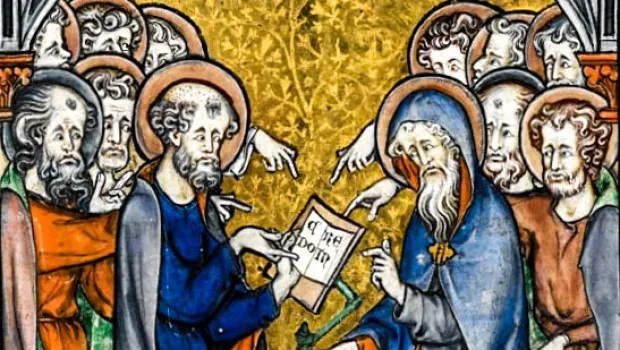
A 13th century artwork depicting the Apostles writing the Creed

Then, standing there in front of the place of worship, you must pray:

My ancestor was homeless,
an Aramean who went to live
    in Egypt.
There were only a few
    in his family then,
but they became great
and powerful,
    a nation of many people.

The Egyptians were cruel
    and had no pity on us.
They mistreated our people
    and forced us into slavery.
We called out for help
to you, the Lord God
    of our ancestors.
You heard our cries;
you knew we were in trouble
    and abused.
Then you terrified the Egyptians
with your mighty miracles
    and rescued us from Egypt.
You brought us here
and gave us this land
    rich with milk and honey.
Now, Lord, I bring to you
the best of the crops
    that you have given me.

After you say these things, place the basket in front of the Lord’s altar and bow down to worship him. (Contemporary English Version)

Forty years of wandering throughout the desert, in the backside of the wilderness. Having been delivered out of Egypt by the mighty hand of God, the Israelites were on a very circuitous journey to the Promised Land.

The Book of Deuteronomy is a restatement of the people’s history and God’s law for the generation about to enter the land of Canaan. Moses told the people that when they enter the land and have their first harvest of crops, they are to remember and give thanks for all their blessings.

People need to be reminded of important things. Sometimes, in the middle of success and good fortune, we can forget to savor the moment, neglect to appreciate what it took to get to this place, and fail to celebrate with others the God who has made good things happen.

Interestingly, in appreciation for the abundance of a harvest, Moses did not tell the people to give thanks for the weather or the crops themselves. Rather, they were exhorted to recall and retell the story of Israel and their ancestors.

Through historical narrative, the Israelites tethered themselves to their present reality. They located themselves in the past, as contemporary links in a holy chain that stretched generations, all the way back to the patriarch Jacob.

This sort of relational and generational gratitude is in stark contrast to what current cultural appreciation and thanksgiving is, for cars, homes, jobs, resources, and stuff. Although thankfulness is appropriate and necessary for those things, none of it is lasting and sustainable.

Beneath all of the purchased things and electronic devices is a longing for connection, a desire to know who we are, where we came from, and what our true roots are.

Greater emotional health comes from knowing where we came from. Our connections to family, friends, church, and community are a vital and essential piece of living a good life with satisfaction and contentment.

Healthy roots enable us to respond well to the challenges of life with strength and resilience.

One way to recall and remember is to recite a creed. Sadly, many churches today recoil at reciting creeds and confessions, as if this were a bad thing. But there is significance and power to a group of people who stand and recite an ancient creed together.

The Christian ecumenical church creeds, including the Apostles’ Creed, Nicene Creed, and Athanasian Creed, capture the settled convictions of early believers in Jesus as they struggled to express their faith in the church and the world.

Those creeds are a part of us, and of our collective spiritual history as the people of God. There are yet other kinds of creeds, as well. We have an even more ancient creed expressed in today’s Old Testament lesson – the sort of creed that tells a story.

Moses gave the Israelites some parting instructions to follow for their future worship in the Promised Land. When they enter the land a bring in their harvest, they were to bring the first-fruits of their crops to the priest, and then profess a creed, which is really a story, a historical narrative of God’s people.

Every Jewish farmer and worshiper who brought their crop to the priest would recite the creed about their ancestors suffering in Egypt and being redeemed by God through a great deliverance. God granted them the gift of land, a promised place to call their own.

We as the people of God must discern the importance of embracing the story of redemption, of crying out and being delivered from the shackles of sin, death, and hell. We receive this salvation with thanksgiving and joy.

Christians tell their story of deliverance not only through the ancient ecumenical creeds, but also through the sacramental means of communion. The Table proclaims the life and death of Christ, given for us, and for our salvation. It is a story with deep roots in the life of Israel.

Believers in Jesus are invited to participate is something bigger than themselves. The Christian’s story begins not at Pentecost in the New Testament, but in the promise to Abraham way back in the Old Testament.

The blessing given to Abraham was a blessing for all nations, not just Israel (Genesis 12:1-3). Knowing the roots of our spiritual life and Christian faith helps inform us how we are to live out that faith and life in this present time.

Within Christianity, our history and story is much bigger than Europe and Western civilization. The earliest church began in the Middle East. Ancient Christian traditions and churches still exist, and worship today in places like Egypt and Ethiopia. There are presently large numbers of Christians in every part of the world, especially in Latin America, Asia, and Africa.

Essentially, we are the lost, the last, the forgotten, the outsiders who cried out to God. And the Lord rescued us, blessed us with every spiritual blessing in Christ, and gave us the privilege of being ambassadors for Christ in the world.

We belong to God. Along with believers throughout the ages, and across the world, we declare:

I believe in God, the Father almighty,
creator of heaven and earth.

I believe in Jesus Christ, his only Son, our Lord.
He was conceived by the power of the Holy Spirit
and born of the Virgin Mary.
He suffered under Pontius Pilate,
was crucified, died, and was buried.
He descended to the dead.
On the third day he rose again.
He ascended into heaven,
and is seated at the right hand of the Father.
He will come again to judge the living and the dead.

I believe in the Holy Spirit,
the holy catholic Church,
the communion of saints,
the forgiveness of sins,
the resurrection of the body,
and the life everlasting. Amen.

I Am Among You As One Who Serves (Luke 22:24-30)

The Last Supper, by Mamdouh Kashlan (1929-2022)

A dispute also arose among them as to which one of them was to be regarded as the greatest. But he said to them, “The kings of the Gentiles lord it over them; and those in authority over them are called benefactors. But not so with you; rather the greatest among you must become like the youngest, and the leader like one who serves. For who is greater, the one who is at the table or the one who serves? Is it not the one at the table? But I am among you as one who serves.

“You are those who have stood by me in my trials; and I confer on you, just as my Father has conferred on me, a kingdom, so that you may eat and drink at my table in my kingdom, and you will sit on thrones judging the twelve tribes of Israel. (New Revised Standard Version)

Jesus and his disciples had prepared for the Passover meal. They ate and drank together. Christ gave them words which have endured throughout Christian history as the Lord’s Supper. He spoke of the bread as his body, and the cup as the new covenant in his blood. Jesus communed with them and communicated about his impending death.

It was a moving experience for all. The disciples received from their Lord an intense act of love; and a new humanity around Christ’s body and blood. Indeed, the essence of new life is self-sacrificial love.

And then… the disciples began quarreling with each other about positions, and titles, and honors, and who was better, and who would be top dog in God’s kingdom….

It was a moment that I think every parent can relate to, at some level. Sitting around a dinner table, enjoying a rich conversation, becoming close with one another as a family… and then the kids begin bickering with each other about the most mundane of things.

Just a minute ago, you believed you were getting somewhere, and experiencing a shared family bond of love, commitment, and purpose… and then, in a matter of seconds, it all crashes down in a ridiculous display of posturing and positioning of one sibling over another….

I admit, this has happened to me more than once, when my own kids were growing up. And I also admit that I lost my sanctification on more than one occasion, watching this crazy schizophrenic scene play out in front of me.

Which is why I have a lot of respect for Jesus in responding to his disciples with humility, calmness, and a forthright spirit. He addressed their puny questions in a way that rebuked them without making them feel like they just got a Dad lecture.

In the sort of table fellowship that Jesus practiced with his disciples throughout his earthly ministry, he consistently sought to undermine the existing systems of domination in all levels of society. Even the religious system of Christ’s day had a distinct stratifying of persons in an inequitable structure of power.

The kingdom of God, however, is different. God’s economy is characterized by equality, mutuality, diversity, and shared power. It’s all based in a communal, as well as individual, relational connection with the Creator God.

God almighty, Creator of heaven and earth, is gracious, merciful, and kind. The Lord brings rain on both the righteous and the wicked. Thus, any sort of claim to being greater or superior or better than another person or group of people, has no place around the table of Christ’s body and blood.

Catholics are no better than Protestants. Evangelical Christians have no superiority over Progressive Christians. The Coptic Church doesn’t have the high ground on Eastern Orthodoxy. Christians who observe the Lord’s Supper as a remembrance are not greater than those who discern the Table as a sacrament.

And if one has the ears to hear it, Christians really ought to know better than to believe they should have greater control over the world and its systems than Buddhists, Muslims, or Jews.

Puffing up one’s chest and insisting that “My Dad is better than your Dad” is the stuff of childish preoccupations, and not of God’s kingdom.

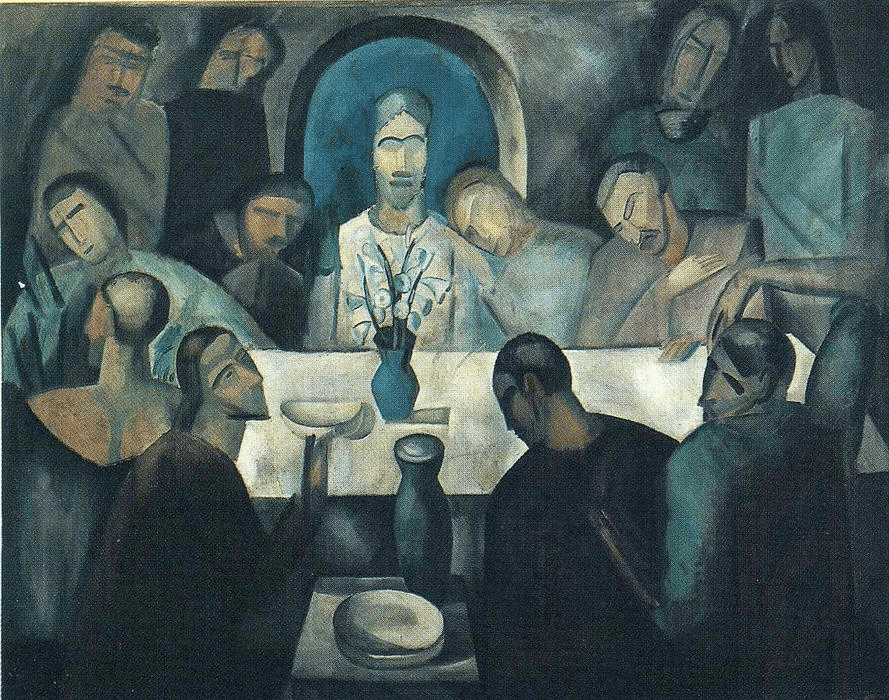
The Last Supper of Jesus, by André Derain (1880-1954)

There are plenty of people in this old messed-up world who lord their power and authority over others. If we take the words of Jesus seriously, Christians are not to be part of that structure and system.

And yet, here we are, in this contemporary time and place in history, having a chunk of the population thinking Christendom is the way to go, that a form of Christian Nationalism should be the political system – as if the kingdom of God and the kingdom of this world are what’s on the ballot.

Christians are the very folks who need to insist on serving, not leading; building up, not tearing down; loving, not hating; being integrated and connected, not fragmented and disconnected from others, as well as from reality.

Any sort of earthly power and authority the Christian has, must be used to include, help, and support, instead of excluding, ignoring, and destroying. The greatest among us must become like the youngest, and the leader like one who serves.

Christians must support and promote the idea of political office as a public service; and the concept of being a citizen as serving the common good of all persons, not just some persons.

Jesus came to this earth to serve. Therefore, his followers are also to serve. The words and ways of Christ centered in humble service, merciful justice, and prayer for one’s enemies. His followers must do no less.

Jesus Christ came to usher in a moral and ethical kingdom in which God’s gracious and benevolent will is done on this earth, as it is always done in heaven. He did not come to make sure Christians have lots of political power and authority over all the non-Christians.

Yes, indeed, we will be given power and authority – but not to baptize existing earthly structures so that the system serves the interests of Christians. We receive so that we can give. We give so that we might serve. And we serve because our Lord is a servant.

So, if Christians truly desire to bring change and transformation to this world, it will be through a compassionate and caring system of service to our fellow humanity – and not by imposing our beliefs and will upon others in a modern day form of the Inquisition.

Let us then, traffic in love; aspire to meekness; practice servanthood; and become the wait staff for the world’s needs.

That is what it really means to stand with Jesus in this time of trial.

Gracious and loving God, you work everywhere reconciling, loving, and healing your creatures and your creation. In your Son, and through the power of your Holy Spirit, you invite each of us to join you in your work.

I ask you to form me more and more in your image and likeness, through my prayers and worship of you; and through the study of Holy Scripture, so that my eyes will be fully opened to your mission in the world.

Send me into my family, church, community, workplace, and world to serve Christ with faith, hope, and love, through the power of the Holy Spirit. Amen.

The Lord of Life (John 6:56-69)

Bread of Life, by Kennedy Paizs

“Those who eat my flesh and drink my blood abide in me and I in them. Just as the living Father sent me and I live because of the Father, so whoever eats me will live because of me. This is the bread that came down from heaven, not like that which the ancestors ate, and they died. But the one who eats this bread will live forever.” Jesus said these things while he was teaching in a synagogue at Capernaum.

When many of his disciples heard it, they said, “This teaching is difficult; who can accept it?” But Jesus, being aware that his disciples were complaining about it, said to them, “Does this offend you? Then what if you were to see the Son of Man ascending to where he was before? It is the spirit that gives life; the flesh is useless. The words that I have spoken to you are spirit and life. But among you there are some who do not believe.”

For Jesus knew from the beginning who were the ones who did not believe and who was the one who would betray him. And he said, “For this reason I have told you that no one can come to me unless it is granted by the Father.”

Because of this many of his disciples turned back and no longer went about with him. So Jesus asked the twelve, “Do you also wish to go away?” Simon Peter answered him, “Lord, to whom can we go? You have the words of eternal life. We have come to believe and know that you are the Holy One of God.” (New Revised Standard Version)

This is a hard teaching – which is why a fair number of Christ’s disciples unfollowed him, literally, and not just socially and virtually.

Perhaps they believed they were following a great moral teacher, only to find Jesus prattling-on about being bread from heaven and divinely related to God.

The late great C.S. Lewis commented on Jesus, saying this:

“I am trying here to prevent anyone saying the really foolish thing that people often say about Him: I’m ready to accept Jesus as a great moral teacher, but I don’t accept his claim to be God. That is the one thing we must not say. A man who was merely a man and said the sort of things Jesus said would not be a great moral teacher. He would either be a lunatic — on the level with the man who says he is a poached egg — or else he would be the Devil of Hell. You must make your choice. Either this man was, and is, the Son of God, or else a madman or something worse. You can shut him up for a fool, you can spit at him and kill him as a demon or you can fall at his feet and call him Lord and God, but let us not come with any patronizing nonsense about his being a great human teacher. He has not left that open to us. He did not intend to.” C.S. Lewis, Mere Christianity

It seems Jesus cares little about whether we think of him as a moral teacher or some monstrosity. But he does care about moving people to a spirit-filled confession, a settled claim of faith, and a bold proclamation of his person and work.

Indeed, Jesus Christ, Son of Humanity, Son of God, leads us to hear his own confession, claim, and proclamation: “I Am.”

The crowd of people listening to Jesus were having a hard time wrapping their heads around his message. There were simply no existing categories of thought to which they could put Jesus neatly into. Everyone was rather puzzled with Christ’s words.

Jesus was in the Capernaum synagogue, a village on the Sea of Galilee, 30 miles from where he grew up in Nazareth. Any talk of eating and drinking and religion within any faith community is likely to be a charged discussion. Typically the politics of faith is not for the faint of heart.

We are to abide in Christ, to be in vital union with him. To have Jesus close, to have his words and ways within us, is akin to eating a satisfying meal that goes throughout our entire body and effects our being. Connecting and remaining with Jesus is true living and abundant life.

But the synagogue crowd wasn’t having any of this crazy talk of eating flesh and drinking blood. The lines between meat and metaphor were severely blurred for them. They did not accept the wedding of the spiritual and the material, of word and flesh, of God and Jesus together as Father and Son.

Jesus was causing the men to fold their arms in disgust, and the ladies to squirm in their pews with agitation. They looked upon this Jesus in front of them as causing a religious scandal of the first degree.

Rather than back off the scandalous words, Jesus stuck with them. Furthermore, he intensified what he was saying. At the heart of it was a claim to be the ladder between heaven and earth, the one who is manna from above, given for the life of the people.

His flesh is bread, and his blood is drink. He is life itself. He is even spirit, the one who breathes new life into people. At this point, Jesus was being as scandalous as it gets for his audience in the synagogue.

All of Christ’s talk is meant to bring people to consider him, to contemplate God, and to come to a point of response. Because nobody encountered Jesus without deciding if he is a liar, a lunatic, or the Lord who is life itself.

Many of Christ’s own disciples bailed on him. The scandal was too much. They didn’t sign up for this. To stay with Jesus means to really stay, to abide, to believe and know who he is.

Throughout the New Testament Gospels, Jesus honors people with questions and choices – and does not simply bypass human dignity and worth. He asked his closest twelve disciples if they also wanted to retreat from the scandalous message and messenger they’d been following.

Peter, of course, still had to learn this lesson of respect; he answered for the entire group. Jesus is where, and in whom, he found life, along with the rest of them. They didn’t know how all of the scandalous talk was going to shake-out specifically, although I think each of them had a pretty good idea.

But it didn’t matter. The twelve disciples were stuck on Jesus. Or, to be more accurate, the eleven disciples. Perhaps it was at this point that Judas Iscariot no longer had to wonder what was going to happen, and what exactly Jesus was up to.

Abiding in a movement that did not include a Roman takeover and a glorious wealthy kingdom was something Judas was unwilling to invest in. Maybe it was here that he began considering his exit plan.

Recognizing Jesus as Son of Humanity, Son of God, and the Word made flesh for us, requires both belief and knowledge – because you must have the one to have the other. C.S. Lewis discovered this. So did I. And may you, as well, my friend. For Jesus is the Lord of life.

Gracious God, although we once were strangers, you receive us as friends and draw us home to you. Set your living bread before us so that, feasting around your table, we may be strengthened to continue the work to which your Son commissioned us. Amen.