God’s Glory Is Everywhere (Psalm 19)

The heavens declare the glory of God,
and the sky displays what his hands have made.
One day tells a story to the next.
One night shares knowledge with the next
without talking,
without words,
without their voices being heard.
Yet, their sound has gone out into the entire world,
their message to the ends of the earth.
He has set up a tent in the heavens for the sun,
which comes out of its chamber like a bridegroom.
Like a champion, it is eager to run its course.
It rises from one end of the heavens.
It circles around to the other.
Nothing is hidden from its heat.

The teachings of the Lord are perfect.
They renew the soul.
The testimony of the Lord is dependable.
It makes gullible people wise.
The instructions of the Lord are correct.
They make the heart rejoice.
The command of the Lord is radiant.
It makes the eyes shine.
The fear of the Lord is pure.
It endures forever.
The decisions of the Lord are true.
They are completely fair.
They are more desirable than gold, even the finest gold.
They are sweeter than honey, even the drippings from a honeycomb.
As your servant I am warned by them.
There is a great reward in following them.

Who can notice every mistake?
Forgive my hidden faults.
Keep me from sinning.
Do not let anyone gain control over me.
Then I will be blameless,
and I will be free from any great offense.

May the words from my mouth and the thoughts from my heart
be acceptable to you, O Lord, my rock and my defender. (God’s Word Translation)

Today’s psalm is a celebration of God’s self-revelation. Through both nature and law, the Lord has graciously made the divine life known to humanity. What’s more, God’s moral and ethical teachings provide insight for living a good life. All of this is for the common good of everyone.

The vision of the psalm is of a personal God, not an abstract deity who is aloof from creation. Through both land and law, there is the Lord of life, desiring humanity to know the divinity which infuses it all and has people’s best interests continually at the forefront of providence and goodwill.

The created world witnesses to God. Creation manifests the glory of its Creator. Each creature and every created thing have the capacity to acknowledge and declare their Originator. That which has no mouth can speak. Those with no vocal cords have a voice. We can hear them, that is, if our ears are open to listen.

The creation is not God. Yet the created world and order knows the Lord so intimately that it sometimes seems as if the sun, the trees, the mountains, and the meadows are divine. The divine stamp is there, testifying with mysterious unspoken words to a glorious God who desires to be known.

So, the Lord graciously gave us law. God’s righteous and good law flows seamlessly from God’s good character. Law is the divine medium for humanity, a guide for human life toward thriving and flourishing on God’s good earth.

We were put on this planet with instructions on how to get along on it. It is when we throw out the rulebook and improvise that we tend to get into all kinds of trouble.

Yet, even when we go our own way and dig our own grave, and end up falling into it, God is there. Grace is available for the asking, redeeming the wayward life.

Deliverance is a real possibility, to set us aright again, and restore us to our full luster as people created in the image of God. Law and land converge to guide us into grateful living, into the wisdom of dealing rightly in all things.

Wisdom in the Old Testament is the combination of knowledge and practice. It is the application of God’s self-revelation to concrete situations in life. We live wisely when we get to know the sovereign God of creation and use the Lord’s revealed mores and ethos as our guide in daily experiences.

We need God’s gracious revealed law. It’s not just for theology nerds or spiritual eggheads; God’s law is for everyone – the learned and the unlearned. Every one of us needs the guidance and direction of God’s Holy Word, and the careful application of it to all our circumstances. That’s wisdom.

You and I are shaped and formed as godly people as we allow God’s Word to awash us and seep into our souls.  Reading this psalm out loud slowly and contemplatively more than once is an opportunity to let our common ordinary experiences transform into divine appointments.

God’s glory is everywhere. We just need the deep spirituality given to us to help us see divine glory in all the myriad ways it comes to us every day.

Clean the slate, God, so we can start the day fresh! Keep me from stupid and idiotic sins, from thinking I can take over your work. Then I can start each day sun-washed, scrubbed clean of sin’s awful grime. Let me not be found in the dominion of darkness but bask in the glorious light of your glory. Accept both my words and my life when I place them on the morning altar, O God, my Rock, my Deliverer, my Redeemer, my All. Amen.

With Great Power Comes Great Responsibility (1 Kings 16:1-7)

This message from the Lord was delivered to King Baasha by the prophet Jehu son of Hanani: “I lifted you out of the dust to make you ruler of my people Israel, but you have followed the evil example of Jeroboam. You have provoked my anger by causing my people Israel to sin. So now I will destroy you and your family, just as I destroyed the descendants of Jeroboam son of Nebat. The members of Baasha’s family who die in the city will be eaten by dogs, and those who die in the field will be eaten by vultures.”

The rest of the events in Baasha’s reign and the extent of his power are recorded in The Book of the History of the Kings of Israel. When Baasha died, he was buried in Tirzah. Then his son Elah became the next king.

The message from the Lord against Baasha and his family came through the prophet Jehu son of Hanani. It was delivered because Baasha had done what was evil in the Lord’s sight (just as the family of Jeroboam had done), and also because Baasha had destroyed the family of Jeroboam. The Lord’s anger was provoked by Baasha’s sins. (New Living Translation)

“With great power there must also come great responsibility.” Uncle Ben to Peter Parker, Spiderman

That’s one of those popular modern proverbs that resonate with us because we readily acknowledge the truth of it. No matter the culture, ethnicity, or place, we all have an inherent sense of justice and what is right.

And that makes sense to me, since we are created in the image of the Lord who is a God of justice and cares about what is right and good. So, whenever a person or a people buck their conscience, and practice injustice, it will raise the ire of both other people, as well as God.

Anger, at its core, is a response to injustice. Whenever we are treated unfairly in some way and are denied what we need to survive and thrive in this life, it makes us mad! Not only that, but it also makes God mad, too.

The use and abuse of power is a vital issue. Power must not be accumulated simply for someone (or a particular group of people) to enjoy its privileges. Power is given by God to individuals and groups so that they will use their position and authority for the common good of everyone.

To possess power is to possess a great moral responsibility for making good and just decisions. If the people in power fail to do this, then they shall be held accountable by a sovereign God who has ultimate authority over everyone and everything.

King Baasha of Israel was given a solemn responsibility by God to ensure the proper worship of God and to provide for the needs of everyone in the kingdom. In a theocratic society such as ancient Israel, the king served as the person who was responsible for knowing the commands of God and making sure that they were fulfilled. And that meant that justice for all should be ensconced throughout the land, and injustice should be eradicated wherever it is found.

By discarding the proper worship of God, and instead following other gods who engaged in injustice, Baasha was shirking his responsibility and setting up the nation for the misuse and abuse of power. So, God was determined to uproot the evil so that it didn’t destroy the whole nation.

“Whoever has been given much will be responsible for much. Much more will be expected from the one who has been given more.”

Jesus (Luke 12:48, ERV)

We all possess some level of power – whether it be small or great. Everyone is held responsible for what they have. If we have been blessed with talent, wealth, knowledge, time, position – or whatever it is – it’s expected that we benefit others. With whatever we have received, we are, in turn, to give for the sake of another.

Each of you has been blessed with one of God’s many wonderful gifts to be used in the service of others. So use your gift well. (1 Peter 4:10, CEV)

It’s not a matter of how much or how little power you have been given, but how faithful you are with the power you actually possess. Those who are trusted with something valuable must show they are worthy of that trust by stewarding their resources and their decision-making well. (1 Corinthians 4:2)

God’s anger serves the purpose of fueling God’s great purposes in justice for all people everywhere. And if we channel our own anger into love for all humanity, then we are rightly ordering our own power in good, redemptive, and responsible ways.

Almighty and eternal God, empower us all by your Spirit to be good, just, and faithful stewards of the power and authority you have given to us. Help us to live conscientiously, to bless others graciously and generously with the grace and generosity given to us by your goodness. May the very life of Christ be manifested in us and through us to your glory and honor. Amen.

Make Good Choices (1 Kings 14:1-8)

At that time Abijah son of Jeroboam became ill, and Jeroboam said to his wife, “Go, disguise yourself, so you won’t be recognized as the wife of Jeroboam. Then go to Shiloh. Ahijah the prophet is there—the one who told me I would be king over this people. Take ten loaves of bread with you, some cakes and a jar of honey, and go to him. He will tell you what will happen to the boy.” So Jeroboam’s wife did what he said and went to Ahijah’s house in Shiloh.

Now Ahijah could not see; his sight was gone because of his age. But the Lord had told Ahijah, “Jeroboam’s wife is coming to ask you about her son, for he is ill, and you are to give her such and such an answer. When she arrives, she will pretend to be someone else.”

So when Ahijah heard the sound of her footsteps at the door, he said, “Come in, wife of Jeroboam. Why this pretense? I have been sent to you with bad news. Go, tell Jeroboam that this is what the Lord, the God of Israel, says: ‘I raised you up from among the people and appointed you ruler over my people Israel. I tore the kingdom away from the house of David and gave it to you, but you have not been like my servant David, who kept my commands and followed me with all his heart, doing only what was right in my eyes. You have done more evil than all who lived before you. You have made for yourself other gods, idols made of metal; you have aroused my anger and turned your back on me.

“‘Because of this, I am going to bring disaster on the house of Jeroboam. I will cut off from Jeroboam every last male in Israel—slave or free. I will burn up the house of Jeroboam as one burns dung, until it is all gone. Dogs will eat those belonging to Jeroboam who die in the city, and the birds will feed on those who die in the country. The Lord has spoken!’

“As for you, go back home. When you set foot in your city, the boy will die. All Israel will mourn for him and bury him. He is the only one belonging to Jeroboam who will be buried, because he is the only one in the house of Jeroboam in whom the Lord, the God of Israel, has found anything good.

“The Lord will raise up for himself a king over Israel who will cut off the family of Jeroboam. Even now this is beginning to happen. And the Lord will strike Israel, so that it will be like a reed swaying in the water. He will uproot Israel from this good land that he gave to their ancestors and scatter them beyond the Euphrates River, because they aroused the Lord’s anger by making Asherah poles. And he will give Israel up because of the sins Jeroboam has committed and has caused Israel to commit.”

Then Jeroboam’s wife got up and left and went to Tirzah. As soon as she stepped over the threshold of the house, the boy died. They buried him, and all Israel mourned for him, as the Lord had said through his servant the prophet Ahijah. (New International Version)

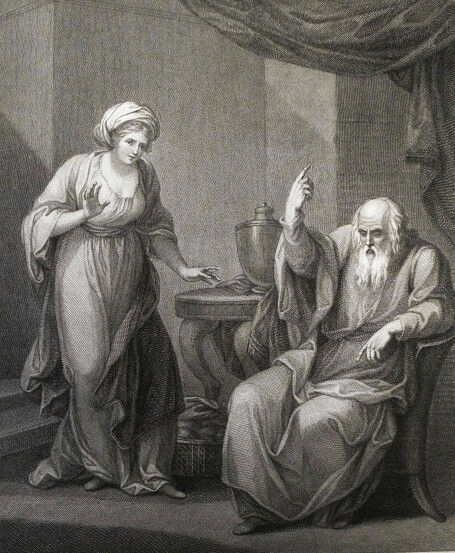
The prophet Ahijah and the wife of Jeroboam, 1853

It’s a sad reality that whenever we make choices to live against the grain of who are meant to be as humans, we not only harm ourselves, but other people also end up as collateral damage. Our own individual decisions may be independent, but the ramifications of those choices are always interdependent in scope and complexity.

The very same prophet who prophesied the rise of Jeroboam and his reign also prophesied his calamitous ending. Along with the establishment of a monarchy in Israel, there was also an ascension of divine prophets to the royal kings whenever things were going awry.

The prophet Ahijah had let King Jeroboam know, at the outset of his reign, that his longevity would depend upon his own faithfulness and attentiveness to God’s law (1 Kings 11:38). But Jeroboam failed to do this, and it doomed him and his family. The immediate death of Jeroboam’s young son was the confirmation of the divine judgment that would eventually come.

It behooves us all to consider the Apostle Paul’s words concerning fidelity toward God and our decisions as persons:

Make no mistake, God is not mocked. A person will harvest what they plant. Those who plant only for their own benefit will harvest devastation from their selfishness, but those who plant for the benefit of the Spirit will harvest eternal life from the Spirit. Let’s not get tired of doing good, because in time we’ll have a harvest if we don’t give up. So then, let’s work for the good of all whenever we have an opportunity, and especially for those in the household of faith. (Galatians 6:7-10, CEB)

Jeroboam turned his back on God, in favor of going with his own ingenuity and pragmatic actions to secure his rule and reign in Israel. No matter who we are – whether king or commoner, rich or poor – it is our personal and collective responsibility to ensure that sound, wise, and good decisions are being made with an eye toward the benefit of all persons.

This then, begs the question: What are our priorities and practices?

Prophetic utterances in Holy Scripture typically center in human arrogance and mistreatment of other people. And this is why following the commands of God are to be supremely important to the believer – because the instructions given to humanity from the Lord are meant for humility and justice toward others.

I believe that if we seek to live into the spirit of God’s law, we will continually labor to make good choices for the common good of everyone. Important social, economic, and political policies and practices won’t just spring up from nowhere to benefit humanity; they must be intentionally cultivated by people who make it a priority to pay attention to such matters and follow through with the right, the just, and the good.

Let’s persevere in doing good; and not succumb to the pragmatic, just to get something done that we want.

Almighty God our heavenly Father, you declare your glory and show forth your handiwork in the heavens and in the earth: Deliver us in our various occupations from the service of self alone, that we may do the work you give us to do in truth and beauty and for the common good; for the sake of him who came among us as one who serves, your Son Jesus Christ our Lord, who lives and reigns with you and the Holy Spirit, one God, for ever and ever. Amen.

Take Responsibility (Deuteronomy 3:23-29)

It was also at that same time that I begged the Lord: Please, Lord God! You have only begun to show your servant your greatness and your mighty hand. What god in heaven or on earth can act as you do or can perform your deeds and powerful acts? Please let me cross over the Jordan River so I can see the wonderful land that lies beyond it: those beautiful highlands, even the Lebanon region.

But the Lord was angry with me because of you! He wouldn’t listen to me. He said to me: That’s enough from you! Don’t ever ask me about this again! Go up to the top of Mount Pisgah. Look west, north, south, and east. Have a good look, but you will not cross the Jordan River. Instead, command Joshua, strengthen him, and encourage him because he’s the one who will cross the river before this people. He’s the one who will make sure they inherit the land you will see.

After that, we stayed in the valley across from Beth-peor. (Common English Bible)

I wonder if God ever feels like the parents of elementary aged children. “Please, please, puh-leeeze let me have it!” It’s a good thing God is spirit, because there may be some divine eye rolling happening with certain people’s requests.

When Moses pleaded God to allow him to cross the Jordan River into the Promised Land, the Lord forbade him to do so. The reason God gave is that Moses had to bear the brunt of the Lord’s anger on behalf of the community.

But you [Israel] had no faith in the Lord your God about this matter, even though he went ahead of you, scouting places where you should camp, in fire by night, so you could see the road you were taking, and in cloud during the daytime.

The Lord heard what you said. He was angry and he swore: Not even one of these people—this wicked generation!—will see the wonderful land that I promised to give to your ancestors… (The Lord was even angry with me [Moses] because of what you did. “You won’t enter the land either,” God said. “But Nun’s son Joshua, your assistant, will enter it. Strengthen him because he’s the one who will help Israel inherit the land.”) (Deuteronomy 1:32-38, CEB)

Not allowing Moses to enter the land may seem strange to us whose culture prizes individualism and self-reliance. But that was not the culture of ancient Israel. There was a common core belief in corporate responsibility. The leader acted as the representative of the people, and so, Moses was answerable for the community’s sins.

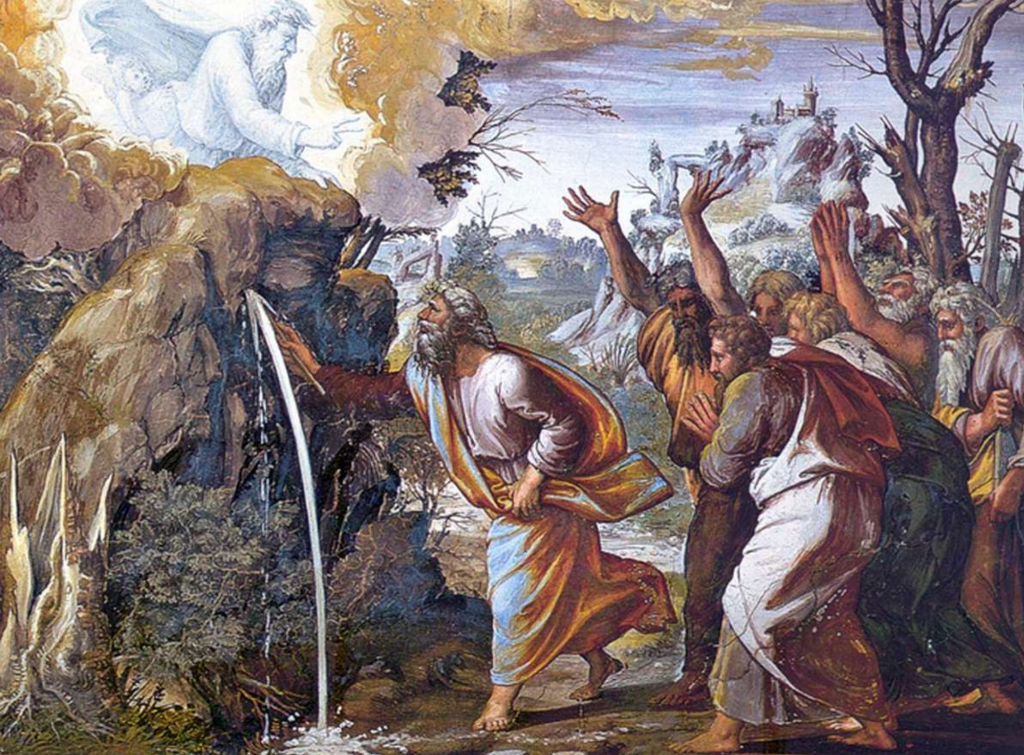
Fresco of Moses and water from the rock, by Raffaello Sanzio da Urbino (Raphael), 1519

Lest we still don’t like what’s going on here, elsewhere in scripture we get a perspective that it was also the lack of faith by Moses that caused him to lose privilege in entering the land:

Moses and Aaron gathered the assembly before the rock. He said to them, “Listen, you rebels! Should we produce water from the rock for you?” Then Moses raised his hand and struck the rock with his staff twice. Out flooded water so that the community and their animals could drink.

The Lord said to Moses and Aaron, “Because you didn’t trust me to show my holiness before the Israelites, you will not bring this assembly into the land that I am giving them.” These were the waters of Meribah, where the Israelites confronted the Lord with controversy and he showed his holiness to them. (Numbers 20:10-13, CEB)

The fact of the matter is that we are responsible for both our personal selves and the entire community of people we are a part of. Indeed, we truly are our brother’s and sister’s keeper.

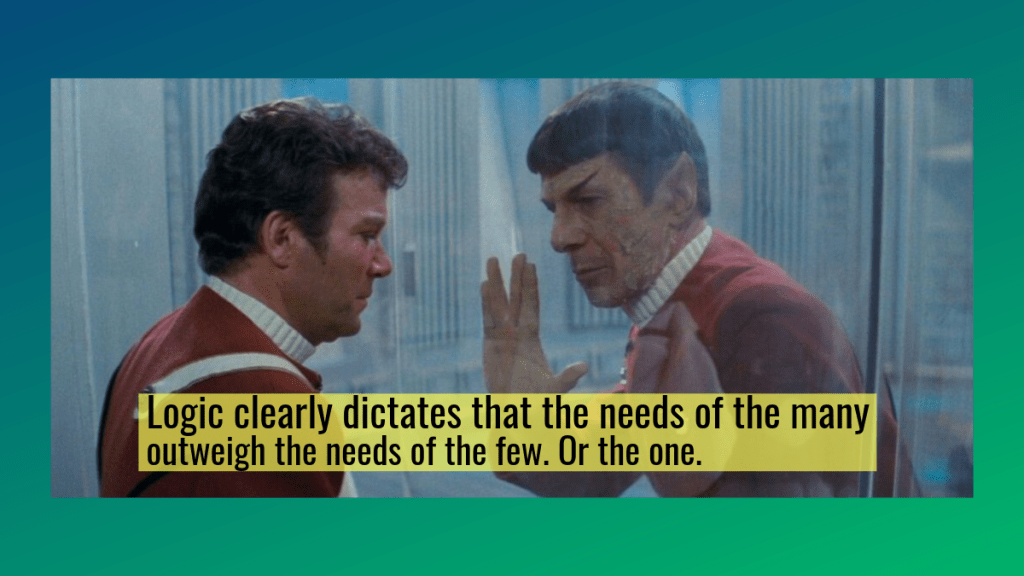
It’s important that everyone considers what the Lord’s will is – not only personally – but for the common good of all the people. Perhaps this idea is captured best in the fictitious Star Trek adage of the alien Vulcans who would logically examine a decision and say, “The needs of the many outweigh the needs of the few (or the one).”

What’s more, believers in God are meant to consider what is pleasing to the Lord, and not only to one’s personal or communal pleasure. The Lord is God and we are not. Sovereignty belongs to God. Servanthood belongs to us; and our ultimate service is to the Lord.

The bottom line for me is believing that the Lord God is good, all the time, and truly has our best interests at mind and at heart. Since God did not allow Moses into the land, I reason that it was for a greater good that transcended the individual request of Moses to enter.

Maybe that’s a difficult perspective to find whenever we are in the middle of strong desires for something, but it is one that we must struggle to find. Since the Lord is high and holy above everyone and everything, God is able to see the big picture and every angle of a situation.

We, however, only see a very small slice of the total view. So, it only makes sound spiritual sense that we learn to entrust ourselves to the One who sees all and acts according to what is right, just, and good.

Gracious and generous God, Creator and Giver of all that is good, we thank you for our many blessings. We acknowledge that all that we have is from you. We offer you thanks and praise for the beauty of the earth, our work, our family, our loved ones, and all the gifts we have been given.

You are with us always. In each dark hour, you are here. In each bright hour, you are here. Blessed by your grace, may we show gratitude by sharing what we have been given. For by serving our brothers and sisters, we serve you.

We remain ever grateful for your constant love, the gift of your Son Jesus, and the presence of your Holy Spirit with us. Protect and guide us on our personal and collective journeys, as we seek to be your faithful stewards. Amen.