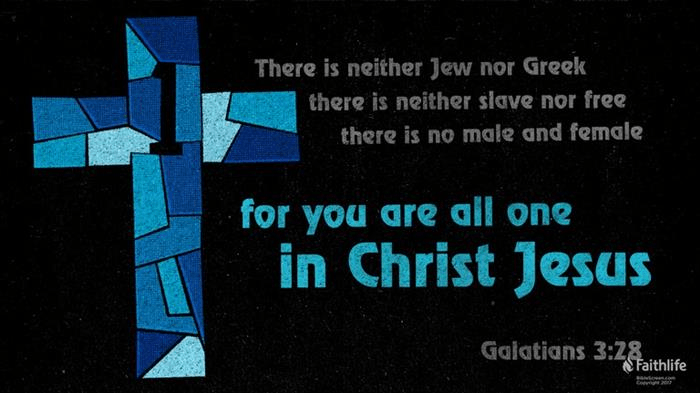
Inclusion vs. Exclusion (Acts 15:1-21)

Certain people came down from Judea to Antioch and were teaching the believers: “Unless you are circumcised, according to the custom taught by Moses, you cannot be saved.” This brought Paul and Barnabas into sharp dispute and debate with them. So Paul and Barnabas were appointed, along with some other believers, to go up to Jerusalem to see the apostles and elders about this question. The church sent them on their way, and as they traveled through Phoenicia and Samaria, they told how the Gentiles had been converted. This news made all the believers very glad. When they came to Jerusalem, they were welcomed by the church and the apostles and elders, to whom they reported everything God had done through them.

Then some of the believers who belonged to the party of the Pharisees stood up and said, “The Gentiles must be circumcised and required to keep the law of Moses.”

The apostles and elders met to consider this question. After much discussion, Peter got up and addressed them: “Brothers, you know that some time ago God made a choice among you that the Gentiles might hear from my lips the message of the gospel and believe. God, who knows the heart, showed that he accepted them by giving the Holy Spirit to them, just as he did to us. He did not discriminate between us and them, for he purified their hearts by faith. Now then, why do you try to test God by putting on the necks of Gentiles a yoke that neither we nor our ancestors have been able to bear? No! We believe it is through the grace of our Lord Jesus that we are saved, just as they are.”

The whole assembly became silent as they listened to Barnabas and Paul telling about the signs and wonders God had done among the Gentiles through them. When they finished, James spoke up. “Brothers,” he said, “listen to me. Simon has described to us how God first intervened to choose a people for his name from the Gentiles. The words of the prophets agree with this, as it is written:

“‘After this I will return
    and rebuild David’s fallen tent.
Its ruins I will rebuild,
    and I will restore it,
that the rest of mankind may seek the Lord,
    even all the Gentiles who bear my name,
says the Lord, who does these things’—
    things known from long ago.

“It is my judgment, therefore, that we should not make it difficult for the Gentiles who are turning to God. Instead we should write to them, telling them to abstain from food polluted by idols, from sexual immorality, from the meat of strangled animals and from blood. For the law of Moses has been preached in every city from the earliest times and is read in the synagogues on every Sabbath.” (New International Version)

The Council of Jerusalem, by Franz Mayer of Munich, 1883

What happens when new people come into a group who are different? How does any church or faith community deal with long time members alongside new ones? Is there a way to work through differences without becoming like the Borg, trying to make others to be just like me? (“Prepare to be assimilated. Resistance is futile.”)

Differences of thought, opinion, and practice are inevitable. Conflict cannot (and should not) always be avoided. Anyplace there’s people, conflict eventually happens. Put a bunch of sinners together in one place (like in a church), add a few grumpy old people, a few know-it-alls, then sit back and watch the fireworks. 

It seems to me that every church is about one or two good fights away from being non-existent. It’s a miracle that more congregations don’t call it quits every year, especially after their annual congregational meetings! I myself have a long resume of handling ornery folks, family squabbles, and cantankerous curmudgeons that could make your head swim – or just get you downright angry.

What is the source of conflict among you? What is the source of your disputes? Don’t they come from your cravings that are at war in your own lives? You long for something you don’t have, so you commit murder. You are jealous for something you can’t get, so you struggle and fight. You don’t have because you don’t ask. You ask and don’t have because you ask with evil intentions, to waste it on your own cravings. (James 4:1-3, CEB)      

Within the church there are expectations, whether they are reasonable or not. If those expectations are not fulfilled, people feel unfulfilled. So, they look to put unnecessary burdens on those entering the faith – to make them pay their dues by observing rules that they themselves aren’t even able to keep.

Conflict begins with some kind of desire. If unmet, it becomes a demand. And demanding something usually leads to judging other people. After all, if you really care about me and my group, you will meet these demands (desires). If left unchecked and unresolved, the progression ends in trying to punish others by simply withdrawing from a relationship with the intent of hurting another.

A focus on reaching out, on rebuilding and restoring lives, puts our efforts where they need to be – and puts us on the same page together, acting out of a sense of purpose, not preservation.

Today’s New Testament lesson deals with the conflict and debate surrounding gentile inclusion into the family of God. The success of Paul’s missionary journeys in reaching non-Jewish peoples and establishing churches, created tension as to whether these new believers ought to become Jewish in order to be Christian.

This question was at the heart of why the Council at Jerusalem was convened. Those who believed that Gentiles need to become Jews, demanded that the they be circumcised and observe the Law of Moses. Others, including Paul and Barnabas, believed that sort of thinking and approach was contrary to the gospel.

The Apostle Peter was there and gave his own experience of observing God work among Cornelius, a Gentile. Peter’s story was more than personal testimony; it was a powerful theological argument about what God was doing and what God is up to with all people, not just the Jews.

Peter’s story demonstrated that God (and not Paul or anybody else) is responsible for including Gentiles among God’s people without making them Jewish. It was God who called and cleansed Gentiles – making no distinction between them and Jews.

People are justified and made right by God’s grace, and not by human judgments of who can be in or out. The upshot of the whole thing is this: We believe that we will be saved through the grace of the Lord Jesus, both Jew and Gentile. Period.

The only thing needed from Gentiles is to believe, because salvation is an act of God’s grace, and not the result of human effort.

What’s more, the inclusion of non-Jewish persons as the people of God is nothing new; it has always been there in the Old Testament Scriptures. And they were never called to become just like Jews in order to be the people of God. (Amos 9:11-12)

This is instructive for all contemporary faith communities. Our mission is not to make followers of me or you or of a particular faith tradition, but to make disciples of Jesus Christ. Grace brings us in, grace keeps us in, and grace will lead us home.

Our focus is to be on openness, connection, and inclusion, and not in seeking to be closed-minded and closed-hearted – separating from those different from us and practicing exclusion. The following ways may be helpful in fostering a more generous gospel:

Talk less, listen more. Don’t interrupt. Do give focused attention. Use respectful language. Ask how others prefer to be addressed and how they refer to themselves. Asking is a sign of care and respect for the person you are talking to, and is also a way to help them feel safe and comfortable.

Be open. Don’t stereotype. One person doesn’t represent an entire group of people. There are different Christian traditions throughout the world. And there are also different traditions and ways within all major religions, as well as within all people groups, institutions, organizations, communities, races, ethnicities, and genders. Seek to learn, rather than superimpose what you think onto someone else.

Become self-aware. Understand that, although all persons are created in the image of God and are equal before the Lord, there is not equity in human organizations and systems. Being aware of our own privileges is a crucial first step to adopting a more inclusive attitude.

Stay curious. To remain curious means to seek people and situations that allow us to challenge (both in a positive and negative way) our beliefs and our cultural and personal patterns of thinking, worshiping, working, and living.

Generally speaking, exclusion creates conflict, whereas inclusion gives space for others to explore and discover what it means to live into their faith and spirituality.

Loving Lord, give us strength so that we can build places of belonging: To create a community for all to share their gifts, to know that each of us is loved, to help us to see the light of Christ in all that we serve. Help us remember that each of us is loved and important. Amen.

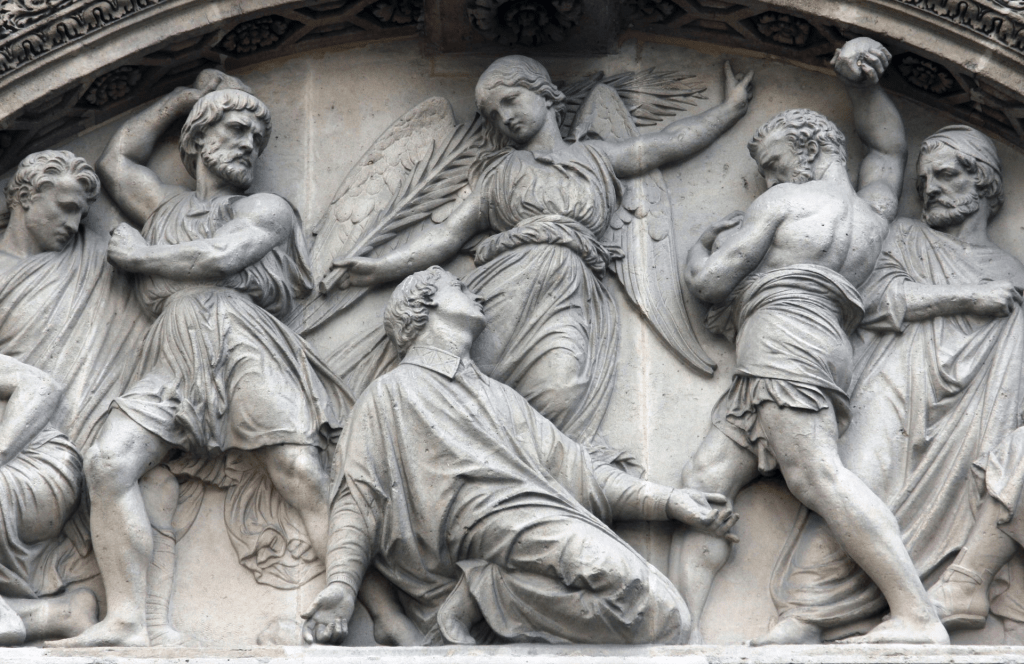
Put To Death (Acts 7:55-60)

The Martyrdom of Stephen, by sculptor Gabriel-Jules Thomas (1824-1905)

But Stephen, full of the Holy Spirit, looked up to heaven and saw the glory of God, and Jesus standing at the right hand of God. “Look,” he said, “I see heaven open and the Son of Man standing at the right hand of God.”

At this they covered their ears and, yelling at the top of their voices, they all rushed at him, dragged him out of the city and began to stone him. Meanwhile, the witnesses laid their coats at the feet of a young man named Saul.

While they were stoning him, Stephen prayed, “Lord Jesus, receive my spirit.” Then he fell on his knees and cried out, “Lord, do not hold this sin against them.” When he had said this, he fell asleep. (New International Version)

Although I am a trained in biblical exegesis and hermeneutics (interpreting Scripture) I believe that most insights come from making simple observations about the text. So, I want to point out: Stephen was not martyred by the Romans, a religiously pagan group, nor Gentile people; he was martyred by those of his own ethnicity, by “God’s people.”

The religious authorities were more than just unhappy with Stephen. The Sanhedrin (the Jewish ruling council) were incensed with him, so mad that they were grinding their teeth at him. The council sincerely believed Stephen was a blasphemer of God, that what he was saying was so subversive and religiously radical, they could stone him to death with a clear conscience, as if this act were upholding God’s honor and God’s Law.

The result was not only the death of a humble man; it also sparked an intense persecution against the church which caused a new Christian diaspora (Acts 8:1-3). Many believers in Jesus found themselves as Christian refugees trying to eke out a living and worshiping Christ in foreign places.

I wish I could say the greatest opposition I’ve ever experienced as a Christian came from non-Christians who simply misunderstood and misinterpreted me. However, my most hurtful wounds have come from the hands of church folk, believing they were acting on God’s behalf by exacting an emotional martyrdom upon me with the stones of gossip, slander, backbiting, blame-shifting, and outright lying (and a few threats of violence).

Whenever I encounter persons who no longer attend church and have no intention of ever returning to any local congregation, I get it. I understand. Yet, although the church is sometimes like a woman of disrepute, I still love her, and will do whatever I can to edify her and not repay evil with evil.

Stoning a believer, either actually with physical rocks or virtually with verbal stones, is akin to persecuting Jesus himself. That’s because Christ so closely identifies with his people that it is as if he is a head, and his followers are a body – joined together in a vital union.

So, when Christ’s Body is subjected to what I call, “hermeneutical hubris,” in which one group of people insists there is only one way to interpret Scripture, and then uses their authority and structures of power to force compliance on another group, the result is persecution.

And that is precisely why Christians can abuse other Christians.

Rather than discerning that all Christians belong to God, one narrow-minded and small-hearted group excludes all other groups who disagree with them as blaspheming the name of Christ.

For example, insisting that a literal interpretation in the only means of understanding the Bible’s authority is to ignore and abuse the actual and real authority which exists with the Bible. I am in no way encouraging an “anything goes” type of approach to Holy Scripture that lets it say whatever you want it to say. 

What I am saying is that the biblical writers themselves employed different methods of interpretation, as well as the early church fathers (which is one reason I hold to the interpretive guides of the ancient Christian creeds, i.e. The Apostles’ Creed and Nicene Creed).

Far too often, churches stick to a particular interpretation because they believe they are keeping biblical fidelity. This is many times born of a fear that Christendom will be lost, and society will sink into an abyss of egregious sin. The irony is that many churches are sinking into forms of abusive and ungracious behavior by fighting battles that Scripture does not call them to fight.

The binary thinking of “I’m right and you’re wrong” is not an approach you’ll find in God’s Holy Word.

Even if the Sanhedrin in Stephen’s day intended on upholding the holiness of their God and the rightness of their cause, the impact it had on the church was martyrdom, death, and diaspora.

Unfortunately, throughout Christian history, the tables have too often turned with Christians persecuting Jews. I myself would like to avoid being the persecutor. If I kill anything, may it be putting to death my own sin – because that is what the Bible calls me to do.

Dear brothers and sisters, you have no obligation to do what your sinful nature urges you to do. For if you live by its dictates, you will die. But if through the power of the Spirit you put to death the deeds of your sinful nature, you will live.

The Apostle Paul (Romans 8:12-13, NLT)

Since, then, you have been raised with Christ, set your hearts on things above, where Christ is, seated at the right hand of God. Set your minds on things above, not on earthly things. For you died, and your life is now hidden with Christ in God. When Christ, who is your life, appears, then you also will appear with him in glory.

Put to death, therefore, whatever belongs to your earthly nature: sexual immorality, impurity, lust, evil desires and greed, which is idolatry. Because of these, the wrath of God is coming.You used to walk in these ways, in the life you once lived. But now you must also rid yourselves of all such things as these: anger, rage, malice, slander, and filthy language from your lips. 

Do not lie to each other, since you have taken off your old self with its practices and have put on the new self, which is being renewed in knowledge in the image of its Creator. Here there is no Gentile or Jew, circumcised or uncircumcised, barbarian, Scythian, slave or free, but Christ is all, and is in all.

Therefore, as God’s chosen people, holy and dearly loved, clothe yourselves with compassion, kindness, humility, gentleness and patience. Bear with each other and forgive one another if any of you has a grievance against someone. Forgive as the Lord forgave you. And over all these virtues put on love, which binds them all together in perfect unity.

Let the peace of Christ rule in your hearts, since as members of one body you were called to peace. And be thankful. Let the message of Christ dwell among you richly as you teach and admonish one another with all wisdom through psalms, hymns, and songs from the Spirit, singing to God with gratitude in your hearts. And whatever you do, whether in word or deed, do it all in the name of the Lord Jesus, giving thanks to God the Father through him. (Colossians 3:1-17, NIV)

Gracious God, as your Son humbled himself on this earth, so may your church walk continually in such humility that believers everywhere work together in unity for the sake of gospel of grace as a blessing to the world in the power of your Holy Spirit. Amen.

To the Family of God (2 John 1:1-16)

St. John the Apostle, by sculptor Thomas Ball (1819-1911)

From the Elder—

To the dear Lady and to her children, whom I truly love. And I am not the only one, but all who know the truth love you, because the truth remains in us and will be with us forever.

May God the Father and Jesus Christ, the Father’s Son, give us grace, mercy, and peace; may they be ours in truth and love.

How happy I was to find that some of your children live in the truth, just as the Father commanded us. And so I ask you, dear Lady: let us all love one another. This is no new command I am writing you; it is the command which we have had from the beginning. This love I speak of means that we must live in obedience to God’s commands. The command, as you have all heard from the beginning, is that you must all live in love.

Many deceivers have gone out over the world, people who do not acknowledge that Jesus Christ came as a human being. Such a person is a deceiver and the Enemy of Christ. Be on your guard, then, so that you will not lose what we have worked for but will receive your reward in full.

Anyone who does not stay with the teaching of Christ, but goes beyond it, does not have God. Whoever does stay with the teaching has both the Father and the Son. So then, if some come to you who do not bring this teaching, do not welcome them in your homes; do not even say, “Peace be with you.” For anyone who wishes them peace becomes their partner in the evil things they do.

I have so much to tell you, but I would rather not do it with paper and ink; instead, I hope to visit you and talk with you personally, so that we shall be completely happy.

The children of your dear Sister send you their greetings. (Good News Translation)

The Pastor

Tucked away near the back of the Bible is a short little letter from the Apostle John, identifying himself as “The Elder.” This is meant to convey both his venerable leadership and his affectionate relation as the grandfatherly old man who has something important to say. In other words, John was, in our terms, a Pastor responsible for shepherding the church with care.

The Church and Christians

“The dear Lady” is a metaphor for the church. Through personifying the church, John was assigning worth, respect, and dignity to the mother with spiritual progeny.

“Her children” are the believers within the church, spiritual offspring with the church as their mother. This has been an important motif for most of Christian history – an understanding that has gotten lost over the centuries in much of the Protestant world. Yet, one of the magisterial reformers, John Calvin, retained this view of the church and its members:

“The Church is the bosom which God is pleased to gather his children… who are guided by her motherly care until they mature and at last reach the goal of faith…. How useful, indeed how necessary, it is that we should know her. For there is no other way to enter into life unless this mother conceive us in her womb, give us birth, nourish us at her breast, and keep us under her care and guidance… Our weakness does not allow us to be dismissed from her school until we have been pupils all our lives.”

(Institutes of the Christian Religion, 4.1, 4)

Indeed, Calvin was merely upholding the words of St. Cyprian, Bishop of Carthage (c.200-258, C.E.)  who stated 1,300 years earlier than the reformer:

“No one can have God as Father who does not have the church as Mother.”

St. Cyprian (On the Unity of the Catholic Church, ch.vi)

Love and Truth

The relationship between the mother and her children is to be always characterized by familial love. Everything within Christianity rises and falls with love because God is love.

God extends loving words and actions because love is the stuff that God is made up of. The very character of God is love, through and through. There is never a time when God is not loving.

In fact, God’s anger and wrath are expressions of love – for God is opposed to all which is unloving. Therefore, God extends justice and confronts sin so that love will freely flow once again amongst humanity and all creation.

God is not okay with deceit, not at all alright with errant understandings of his Son, Jesus Christ, being made out as a mere phantom without a real flesh-and-blood body. He had to be made like us in every way. Otherwise, there is no deliverance from the deceitfulness of sin, the sting of death, and the agony of hell.

John, as the Apostle of love, consistently espoused the primacy and permanence of love whenever he had the chance. Truth and love go together, always, insisted John. Love is only really possible when there is truth in the heart.

The true muster of mother church and of individual believing children is their love. No matter what is done – whether outreach, fellowship, or worship – it is all to be done in love and in truth. It’s not enough to be right; the rightness must be applied with the generosity, grace, and liberality of love.

The telltale sign of the deceiver, the false teacher, is that he proclaims only one without the other, either truth or love, but never both together.  

A profound lack of love is the litmus test that belies a faulty and heretical doctrine of Jesus. The absence of love is a red flag that impure teaching is happening. The real enemy of Christ is the one who claims Christianity but does not love, neither in word nor deed. If we really want to love God, we will love one another, and vice-versa.

Love and truth always go together. A mother is a mother because of her children; and a child is a child because of the mother. You cannot have one without the other.

To embrace truth is to love a group of people wherever they are. It is to see them, listen to them, then act on their behalf. Far too often Christians are known for their hubris in superimposing on others what those others need – believing they already know the truth of both Bible and them.

Love abides with the truth of a people. Genuine love seeks the truth and responds accordingly. Love is willing to find out what the issues are of a people. Assuming others need our money, our plans, our service, or our solutions, assumes we already understand their situation without hearing from them.

Love is longsuffering. It is willing to sit with folks for as long as it takes. Love finds itself by carefully applying biblical truth to the truth of a people. And that takes a great deal of time and effort. There are no shortcuts to love.

Love must have its way, or it isn’t love.

Since God is love, God must have his way in us first.

Hope and Happiness

Hope is a confident expectation that promises will be kept and realized.

Happiness is the result.

Hope and happiness go together like bacon and eggs, Tom and Jerry, the moonwalk and Michael Jackson, Friday and fish fry, Harry Potter and Hogwarts, salt and pepper, Adam and Eve, Jesus and the Spirit, and well, I think you get the picture.

Unhappiness is the inevitable result of feeling hopeless. Hope and happiness are both relational terms. They come from having good relations based in love and truth.

Love and truth are very much relational terms, being realized because of mother church’s nurturing.

And the chosen mother came into being because of the Father’s gracious will.

So, tell me, what is your takeaway from this quite brief reflection on John’s little letter?…

Get Along with Each Other (Romans 3:1-8)

So, what difference does it make who’s a Jew and who isn’t, who has been trained in God’s ways and who hasn’t? As it turns out, it makes a lot of difference—but not the difference so many have assumed.

First, there’s the matter of being put in charge of writing down and caring for God’s revelation, these Holy Scriptures. So, what if, in the course of doing that, some of those Jews abandoned their post? God didn’t abandon them. Do you think their faithlessness cancels out his faithfulness? Not on your life! Depend on it: God keeps his word even when the whole world is lying through its teeth. Scripture says the same:

Your words stand fast and true;
Rejection doesn’t faze you.

But if our wrongdoing only underlines and confirms God’s right-doing, shouldn’t we be commended for helping out? Since our lies don’t even make a dent in his truth, isn’t it wrong of God to back us to the wall and hold us to our word? These questions come up. The answer to such questions is no, a most emphatic No! How else would things ever get straightened out if God didn’t do the straightening?

It’s simply perverse to say, “If my lies serve to show off God’s truth all the more gloriously, why blame me? I’m doing God a favor.” Some people are actually trying to put such words in our mouths, claiming that we go around saying, “The more evil we do, the more good God does, so let’s just do it!” That’s pure slander, as I’m sure you’ll agree. (The Message)

The Apostle Paul’s letter to the Roman Church is a hefty sixteen chapters of dense material and extended arguments of intense reasoning. Likely,

Likely, Paul felt compelled to be so verbose because of the church’s situation.

The Roman Church, at the time of Paul’s writing, was made up of both Jewish and Gentile believers in Jesus. Jews and Gentiles have a complicated history together, to say the least.

The Roman Empire was firmly in control of Palestine and did not always treat the Jewish people well. In addition, the religious backgrounds of Jew and Gentile were as different as you can get.

Whereas the Jewish Christians had a long and rich history with God and the Old Testament, the Gentile Christians were green believers, fresh from centuries of paganism and esoteric rituals. Now, the two of them were together in one place, worshiping Jesus together.

Jews and Gentiles together made for a potentially combustible situation.

Throughout the letter to the Romans, Paul goes back and forth addressing the two groups of Jews and Gentiles. The overarching problem was this:

  • The Jewish believers tended to look down on the Gentile Christians and thought they needed to become Jewish to really be the kind of Christians God was looking for.
  • The Gentile believers tended to dismiss their Jewish brothers and sisters as backward and stuck in tradition.

Each group thought the other must become like them. So, Paul, bless his apostolic heart, had a hot mess in the making with these believers.

In our New Testament lesson for today, Paul is directing his comments toward the Gentile Christians. He wanted them to gain some appreciation for the Jewish people. After all, they were chosen by God to become a nation of priests and prophets for the world. Discounting that history would be to neglect and even invalidate their shared salvation.

For Paul, to have two churches, one Jew and the other Gentile, would be a complete travesty of Christ’s redemption for humanity.

Jesus sought to bring disparate peoples together and not keep them divided. The cross freed us by eliminating the barriers which separate us. The Roman Church needed to work together at being one people under the lordship of Christ.

There was to be no ethnic, religious, or political one-upmanship on Paul’s watch.

Truth be told, both Jew and Gentile did not always do so well with their respective histories. So, there is no ground for boasting or trying to argue for their own way. In fact, the unfaithfulness of people simply shows the incredible faithfulness of God in greater relief. 

If there were no sin, grace would not be needed; no cross would have existed. Just because the foulness and degradation of sin brings out the gracious, faithful, and forgiving character of God in Christ, does not mean that sin is okay or that we can flippantly wave it off with uttering some mumbo-jumbo cheap grace which devalues the majesty of God.

For example, when antebellum southern slaveholders in nineteenth-century America argued for their peculiar institution by saying that snatching black Africans from their homes was a good thing so that they could get out of their religious animistic worldview and be exposed to Christianity, I am positively sure that the Apostle Paul rolled over in his grave and begged Jesus to resurrect him early and send him to tackle such an affront to the cross of Christ!

Sin is never to be excused through twisted human mental gymnastics.

Paul worked laboriously to unite the churches he established and bring differing people groups together under Christ.

  • This does not mean is that all cultural and personal distinctions are ignored or erased.
  • This does mean that we value one another’s differences and gather around the shared value of knowing Jesus Christ.

The Church was neither going to become Jewish nor Gentile but something altogether new – one new people out of the two. Paul framed the matter this way to the Ephesian Church:

Therefore, remember that formerly you who are Gentiles by birth and called “uncircumcised” by those who call themselves “the circumcision” (which is done in the body by human hands)— remember that at that time you were separate from Christ, excluded from citizenship in Israel and foreigners to the covenants of the promise, without hope and without God in the world. But now in Christ Jesus you who once were far away have been brought near by the blood of Christ.

For he himself is our peace, who has made the two groups one and has destroyed the barrier, the dividing wall of hostility, by setting aside in his flesh the law with its commands and regulations. His purpose was to create in himself one new humanity out of the two, thus making peace, 16 and in one body to reconcile both of them to God through the cross, by which he put to death their hostility. He came and preached peace to you who were far away and peace to those who were near. For through him we both have access to the Father by one Spirit. (Ephesians 2:11-18, NIV)

Solitary righteousness is an oxymoron. Righteousness can only be truly lived and expressed with other people.

Yes, there is freedom in Christ. Yet, that freedom must be continually applied through making every effort to keep the unity of the Spirit through the bond of peace.

So, get along with one another.

O God, the Father of our Lord Jesus Christ, our only Savior, the Prince of Peace: Give us grace to seriously lay aside all unhappy divisions. Take away all hatred and prejudice, and whatsoever else may hinder us from godly union and harmony: that, as there is but one Body, and one Spirit, and one hope of our calling, one Lord, one faith, one baptism, one God and Father of us all; so, may we be forever all of one heart, and of one soul, united in one holy bond of truth and peace, faith and love, with one mind and one mouth, glorify Jesus Christ our Lord. Amen.