Never a Dull Moment (Acts 28:1-10)

Miracle of St. Paul on the Island of Malta, by David Teniers, c.1620

Once safely on shore, we found out that the island was called Malta. The islanders showed us unusual kindness. They built a fire and welcomed us all because it was raining and cold. Paul gathered a pile of brushwood and, as he put it on the fire, a viper, driven out by the heat, fastened itself on his hand. When the islanders saw the snake hanging from his hand, they said to each other, “This man must be a murderer; for though he escaped from the sea, the goddess Justice has not allowed him to live.” But Paul shook the snake off into the fire and suffered no ill effects. The people expected him to swell up or suddenly fall dead; but after waiting a long time and seeing nothing unusual happen to him, they changed their minds and said he was a god.

There was an estate nearby that belonged to Publius, the chief official of the island. He welcomed us to his home and showed us generous hospitality for three days. His father was sick in bed, suffering from fever and dysentery. Paul went in to see him and, after prayer, placed his hands on him and healed him. When this had happened, the rest of the sick on the island came and were cured. They honored us in many ways; and when we were ready to sail, they furnished us with the supplies we needed. (New International Version)

There never seemed to be a dull moment in the life of the Apostle Paul. Throughout his life, he experienced all sorts of extreme circumstances, having survived as if he had the nine lives of a cat.

Once, when in the town of Lystra, Paul had such an impact on the people through his gift of healing, that the crowd believed he must be one of the gods; and they tried to worship him. But when Paul resisted, and a rival group from another town came along and turned the crowd, Paul was stoned and left for dead by the very people who tried to venerate him. (Acts 14:8-20)

So, it’s almost as if today’s New Testament lesson was just another day at the office for the Apostle Paul. After a suspenseful sea voyage, and then the wreck of a Roman prison ship, the drama of Paul’s life just kept going.

One minute, the people on the island in which Paul was shipwrecked were convinced that he’s a murderer, and the next minute they’re ready to assign him as a god. Nobody I’ve ever known can elicit such opposite reactions in such a short period of time – more than once. But that’s our Apostle Paul for you.

Circumstances are circumstances. But the way in which we interpret them is another thing. Take, for instance, the word “change.” For some, change is a wonderful word which brings thoughts of healing and hope. For others, change is a dirty word to be resisted, conjuring up feelings of fear and anxiety.

For one group, never-a-dull-moment is exciting and adventurous. For another group, never-a-dull-moment is nerve wracking and to be avoided at all costs.

Opposite reactions of a group of people comes from the different perspectives of change they see. It isn’t helpful to talk about who is right and who is wrong; the real trick is in how we choose to look at a thing.

I had only one grandparent when I was growing up. My Grandma was seventy-nine years old when I was born, and she lived to be ninety-seven. Even though I always knew her as an old lady, she had a lot of spunk in all ninety-five pounds of her. 

She had an old wooden cutting board in her kitchen. I’m not sure how old it was, but it was likely purchased from Methuselah’s Kitchen Outlet. It was cracked and falling apart. The board had deep furrows in it from the thousands of cuts made on it. Grandma liked her cutting board.

For Mother’s Day one year, my Dad bought her a nice brand new cutting board. And what did my Grandma do?  She put the new board in the back of her cupboard and continued using her nasty old cutting board. 

Whenever my Mom or sisters were in her house and helped her in the kitchen, they were not about to touch that old board; the thing was a bacteria trap. But Grandma didn’t care about bacteria or that it was falling apart. 

My Dad asked her why she did not use her new cutting board. She simply answered, “Oh, it’s much too nice to use.” But we all knew that was Grandma’s way of saying that she liked her nasty old cutting board, didn’t think it was all that bad, and wasn’t getting rid of it.

It seems we all have a bit of Grandma in us, bless her stubborn old heart. We like the way they do things, and really don’t see what another person sees. We don’t see that no one else has an emotional attachment to our cutting board. Sometimes we don’t realize how overwhelming and even intimidating our ways can be for someone else. 

Just imagine being in a new place with people you don’t know. Are you nervous? Does it help to have someone you know bring you and introduce you to people? Is it beneficial to have someone let you know what is happening and what is going on? 

Many years ago, I remember walking into a beautiful new church building, sitting down, and seeing a huge old pulpit that was literally falling apart. Since I’ve been around a lot of churches, I quickly discerned it was likely the old pulpit from the old church building. And, I discovered, it was. But, honestly, I had zero emotional attachment to that pulpit, and it was a distraction because it just looked like a big old ratty collar on a new puppy.

The point is thisOur view of change – whether to do it, or not, to embrace or resist – must be motivated by a solid set of values and a worthy purpose.

Paul put up with a lot, experienced a lot, and never had a dull moment. And he did it without bellyaching. That’s because he was continually focused on his ultimate purpose and values.

Our purpose, like Paul’s, is the Great Commission, to make disciples. (Matthew 28:18-20)

Our values, likewise, are the Great Commandment, to love God and neighbor. (Matthew 22:36-40)

Since our purpose is disciple-making, then we are always to make decisions based upon that standard. Since our values are loving others, then we always know how to go about our purpose.

If any faith community is helping people grow spiritually, then there is no need to change. But if a Christian community has not seen a person come to faith in Christ in the last year, that’s a significant reason to change. If a church has not seen anyone come to Christ in the last five years, then that church is eating meat prepared on a cutting board full of bacteria, and it’s making everyone sick.

Have we taken the old cutting board for granted, and just expect other people to use it if they are in our kitchen? Or do we have a vision, a motivation, and a driving desire to see all sorts of people find new life in Jesus Christ? 

If you don’t like empty seats, or the way things are, then the biblical solution is to change – specifically to change practices, speech, and daily behavior to reach others with the good news of grace. Change, or the lack thereof, for any other reason, is a bad reason to change.

Just so you know, after about a year of sitting in my Grandma’s cupboard, my Dad took out the new cutting board, put it on the kitchen counter and threw away the old board. 

It was about time. Never a dull moment with Grandma around.

Gracious God, we thank you that in love and mercy, you reached out to us. When we were dead in our sins, you sent Jesus to die in our place. Thank you that he humbled himself, even to death on a cross. And thank you that you have a heart that seeks the lost. 

Merciful Lord, please give us hearts that care for people in darkness. Teach us to care for them as you do. Thank you for including us in the mission of reaching other people for your name. Grow us to care for humanity, for the people who haven’t yet come to know and trust in you. Amen.

A Call for Unity (1 Corinthians 10:1-4)

For I do not want you to be ignorant of the fact, brothers and sisters, that our ancestors were all under the cloud and that they all passed through the sea. They were all baptized into Moses in the cloud and in the sea. They all ate the same spiritual food and drank the same spiritual drink; for they drank from the spiritual rock that accompanied them, and that rock was Christ. (New International Version)

We are all on spaceship earth together. Everyone has the similar experiences of birth, life, death, and the joys and sorrows of it all.

But what we don’t all share is our individual responses to all those events. Some folks do better than others with the ups and downs of life in this world.

So there are two pledges that are most helpful to make to God and to each other, especially when it comes to Christ’s Church:

  1. I will be a unifying person.
  2. I will not make everything about my personal preferences.

Christians need to get along and work together; and that cannot happen if all we want is what we want. 

“Love one another. As I have loved you, so you must love one another. By this everyone will know that you are my disciples if you love one another.” Jesus (John 13:34-35, NIV) 

Unity, forgiveness, reconciliation, love, and communicating the gospel message of forgiveness happens by people being gracious to each other so that a watching world can see the validity of Christ within us.

Followers of Jesus have a responsibility to be a source of unity, not division. 

Make every effort to keep the unity of the Spirit through the bond of peace. There is one body and one Spirit, just as you were called to one hope when you were called; one Lord, one faith, one baptism; one God and Father of all, who is over all and through all and in all. (Ephesians 4:3-6, NIV) 

Unity doesn’t merely happen; it must be pursued and be a common value of all. 

As God’s chosen people, holy and dearly loved, clothe yourselves with compassion, kindness, humility, gentleness and patience. Bear with each other and forgive one another if any of you has a grievance against someone. Forgive as the Lord forgave you. And over all these virtues put on love, which binds them all together in perfect unity. (Colossians 3:12-14, NIV) 

We are to be like-minded, having the same love for one another that we have for Jesus, being united in spirit and purpose. 

Do nothing out of selfish ambition or vain conceit. Rather, in humility value others above yourselves, not looking to your own interests but each of you to the interests of the others. (Philippians 2:3-4, NIV) 

The specific problem in the Corinthian Church was their allegiance to different individuals; each person and clique had their favorite preacher. And they grouped themselves around how that particular pastor taught and ministered. 

The situation was a classic case of church folk saying to each other, “That’s not how so-and-so did it!” But that approach of following pet preachers ends up in division – the focus becomes on the methods of ministry rather than the substance of the ministry itself. 

Christians must keep in mind that the heart of all Christian ministry is the cross of Christ that saves us from our pettiness and transforms us into forgiven people who spread forgiveness and healing. Therefore, our primary loyalty is to Christ and the message of the cross, and not to particular personalities or programs.

The sin of the Corinthians was misguided loyalties; and the answer to wrong priorities is to have Jesus and the cross as our central and guiding allegiance. 

The Corinthian believers were emotionally tied to the leader who baptized them and who was a significant force for good in their lives. Its more than understandable to have a special relationship with someone who was there for you. However, what’s not okay is following that person as if they’re Jesus himself, and then insisting that everything be done the way my favorite does it. 

Christian unity means to agree with one another about the good news of Christ, and let everything else be a matter of lesser importance. Can you live with that?

A sobering reality is this: Not everyone in every church is there to follow Jesus. And as long as that’s a reality, there will be schisms, factions, cliques, divisions and disunity. The visible church always has a mix of righteous and unrighteous people within it, concerned more about power politics than humbly following Jesus and spreading the gospel. 

At the same time, yet another reality is that the church has taken unity and purity seriously throughout its history and sought to preserve the collective integrity of its fellowship. Sin was discerned as the community’s responsibility to address. It’s only been in the past 300 years that sin has been viewed as something which is only a matter between the individual and God. 

In the early centuries of the Church, believers desiring to repent of their sins would typically spend a period of time fasting and praying, then appearing before the entire church to make a public confession. 

Don’t freak out. I’m not necessarily endorsing that method for us, but nevertheless, the message remains essential: Agree with one another, make peace, and bring spiritual healing to all. The power of Christianity is in the blood of Jesus to forgive sins, and not by trying to ensure things get done, the way we think they ought to get done, in the way our favorite people do them.

Maybe you recognize or can relate to some of these common behavior patterns in many churches:

  1. Worship wars. One or more factions in the church want the music and the liturgy just the way they like it. Any deviation is met with anger and complaining.
  2. Preservation of the church building as of the highest priority (above spiritual growth and maturity).
  3. Protection of programs and ministries held in such high regard that, even if they are not effective, the church keeps doing them.
  4. Attitudes of entitlement. A sense of deserving special treatment and attention.
  5. Concerns about changing things, and yet, no real concern about changing lives.
  6. Apathy and avarice. A lack of motivation and energy to build relationships with outsiders and share the gospel; and hoarding spiritual resources for the insiders.

There is to be unity around the things most important to God. 

Christian unity isn’t about keeping everyone happy; it’s about the good news of Jesus and being anchored to the Rock of our salvation, Christ. All the practical and important stuff of human life must be shaped and governed by the cross of Jesus, because that’s where God’s power saved the world, and where hope is found. 

Lord Jesus, you prayed that we might all be one. We pray for the unity of Christians everywhere, according to your will and your methods. May your Spirit enable us to experience the suffering caused by division, to see our sin for what it is, and to hope beyond all hope. Amen.

To the Family of God (2 John 1:1-16)

St. John the Apostle, by sculptor Thomas Ball (1819-1911)

From the Elder—

To the dear Lady and to her children, whom I truly love. And I am not the only one, but all who know the truth love you, because the truth remains in us and will be with us forever.

May God the Father and Jesus Christ, the Father’s Son, give us grace, mercy, and peace; may they be ours in truth and love.

How happy I was to find that some of your children live in the truth, just as the Father commanded us. And so I ask you, dear Lady: let us all love one another. This is no new command I am writing you; it is the command which we have had from the beginning. This love I speak of means that we must live in obedience to God’s commands. The command, as you have all heard from the beginning, is that you must all live in love.

Many deceivers have gone out over the world, people who do not acknowledge that Jesus Christ came as a human being. Such a person is a deceiver and the Enemy of Christ. Be on your guard, then, so that you will not lose what we have worked for but will receive your reward in full.

Anyone who does not stay with the teaching of Christ, but goes beyond it, does not have God. Whoever does stay with the teaching has both the Father and the Son. So then, if some come to you who do not bring this teaching, do not welcome them in your homes; do not even say, “Peace be with you.” For anyone who wishes them peace becomes their partner in the evil things they do.

I have so much to tell you, but I would rather not do it with paper and ink; instead, I hope to visit you and talk with you personally, so that we shall be completely happy.

The children of your dear Sister send you their greetings. (Good News Translation)

The Pastor

Tucked away near the back of the Bible is a short little letter from the Apostle John, identifying himself as “The Elder.” This is meant to convey both his venerable leadership and his affectionate relation as the grandfatherly old man who has something important to say. In other words, John was, in our terms, a Pastor responsible for shepherding the church with care.

The Church and Christians

“The dear Lady” is a metaphor for the church. Through personifying the church, John was assigning worth, respect, and dignity to the mother with spiritual progeny.

“Her children” are the believers within the church, spiritual offspring with the church as their mother. This has been an important motif for most of Christian history – an understanding that has gotten lost over the centuries in much of the Protestant world. Yet, one of the magisterial reformers, John Calvin, retained this view of the church and its members:

“The Church is the bosom which God is pleased to gather his children… who are guided by her motherly care until they mature and at last reach the goal of faith…. How useful, indeed how necessary, it is that we should know her. For there is no other way to enter into life unless this mother conceive us in her womb, give us birth, nourish us at her breast, and keep us under her care and guidance… Our weakness does not allow us to be dismissed from her school until we have been pupils all our lives.”

(Institutes of the Christian Religion, 4.1, 4)

Indeed, Calvin was merely upholding the words of St. Cyprian, Bishop of Carthage (c.200-258, C.E.)  who stated 1,300 years earlier than the reformer:

“No one can have God as Father who does not have the church as Mother.”

St. Cyprian (On the Unity of the Catholic Church, ch.vi)

Love and Truth

The relationship between the mother and her children is to be always characterized by familial love. Everything within Christianity rises and falls with love because God is love.

God extends loving words and actions because love is the stuff that God is made up of. The very character of God is love, through and through. There is never a time when God is not loving.

In fact, God’s anger and wrath are expressions of love – for God is opposed to all which is unloving. Therefore, God extends justice and confronts sin so that love will freely flow once again amongst humanity and all creation.

God is not okay with deceit, not at all alright with errant understandings of his Son, Jesus Christ, being made out as a mere phantom without a real flesh-and-blood body. He had to be made like us in every way. Otherwise, there is no deliverance from the deceitfulness of sin, the sting of death, and the agony of hell.

John, as the Apostle of love, consistently espoused the primacy and permanence of love whenever he had the chance. Truth and love go together, always, insisted John. Love is only really possible when there is truth in the heart.

The true muster of mother church and of individual believing children is their love. No matter what is done – whether outreach, fellowship, or worship – it is all to be done in love and in truth. It’s not enough to be right; the rightness must be applied with the generosity, grace, and liberality of love.

The telltale sign of the deceiver, the false teacher, is that he proclaims only one without the other, either truth or love, but never both together.  

A profound lack of love is the litmus test that belies a faulty and heretical doctrine of Jesus. The absence of love is a red flag that impure teaching is happening. The real enemy of Christ is the one who claims Christianity but does not love, neither in word nor deed. If we really want to love God, we will love one another, and vice-versa.

Love and truth always go together. A mother is a mother because of her children; and a child is a child because of the mother. You cannot have one without the other.

To embrace truth is to love a group of people wherever they are. It is to see them, listen to them, then act on their behalf. Far too often Christians are known for their hubris in superimposing on others what those others need – believing they already know the truth of both Bible and them.

Love abides with the truth of a people. Genuine love seeks the truth and responds accordingly. Love is willing to find out what the issues are of a people. Assuming others need our money, our plans, our service, or our solutions, assumes we already understand their situation without hearing from them.

Love is longsuffering. It is willing to sit with folks for as long as it takes. Love finds itself by carefully applying biblical truth to the truth of a people. And that takes a great deal of time and effort. There are no shortcuts to love.

Love must have its way, or it isn’t love.

Since God is love, God must have his way in us first.

Hope and Happiness

Hope is a confident expectation that promises will be kept and realized.

Happiness is the result.

Hope and happiness go together like bacon and eggs, Tom and Jerry, the moonwalk and Michael Jackson, Friday and fish fry, Harry Potter and Hogwarts, salt and pepper, Adam and Eve, Jesus and the Spirit, and well, I think you get the picture.

Unhappiness is the inevitable result of feeling hopeless. Hope and happiness are both relational terms. They come from having good relations based in love and truth.

Love and truth are very much relational terms, being realized because of mother church’s nurturing.

And the chosen mother came into being because of the Father’s gracious will.

So, tell me, what is your takeaway from this quite brief reflection on John’s little letter?…

Get Rid of Sin (1 Corinthians 6:1-11)

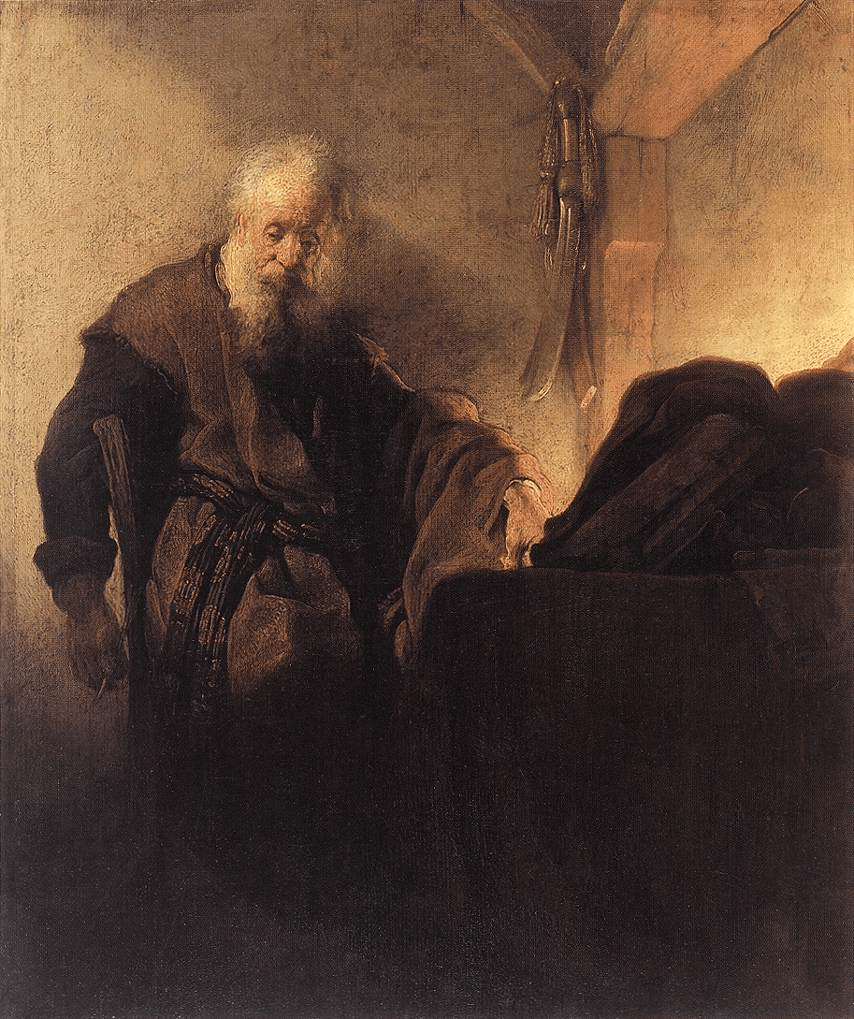
The Apostle Paul at his Desk, by Rembrandt, 1657

When any of you has a grievance against another, do you dare to take it to court before the unrighteous, instead of taking it before the saints? Do you not know that the saints will judge the world? And if the world is to be judged by you, are you incompetent to try trivial cases? Do you not know that we are to judge angels, to say nothing of ordinary matters? If you have ordinary cases, then, do you appoint as judges those who have no standing in the church? I say this to your shame. Can it be that there is no one person wise enough to decide between brothers and sisters? Instead, brothers and sisters go to court against one another, and this before the unbelievers.

In fact, to have lawsuits at all with one another is already a defeat for you. Why not rather be wronged? Why not rather be defrauded? But you yourselves wrong and defraud—and brothers and sisters at that.

Do you not know that wrongdoers will not inherit the kingdom of God? Do not be deceived! The sexually immoral, idolaters, adulterers, male prostitutes, men who engage in illicit sex, thieves, the greedy, drunkards, revilers, swindlers—none of these will inherit the kingdom of God. And this is what some of you used to be. But you were washed, you were sanctified, you were justified in the name of the Lord Jesus Christ and in the Spirit of our God. (New Revised Standard Version)

The one constant which every Church and each Christian will have to deal with until Jesus returns is the ever-present reality of sin

“Sin” isn’t a word that is much used anymore, even among many Christians. This is both good and bad. It’s good in the sense that we have expanded our vocabulary to better understand the concept and reality; and it’s bad because we sometimes label something as different than what it really is.

The Apostle Paul’s letter to the Corinthian Church confronts the presence of sin within the congregation. The reason why the letter is so long is that Paul painstakingly deals with every sin that had taken root in the community.

St. Paul at His Writing Desk by Rembrandt, 1630

In our New Testament lesson for today, Paul mentions some of those sins, especially tackling the unhealthy way the Christians were dealing with their internal strained relations of each other. One of the ways sin manifests itself is through confronting another’s sin with our own sin. Yeah, it gets complicated pretty quickly when that happens.

In other words, we too often try to meet a legitimate need through illegitimate means. That sort of practice is at the core of many a sinful attitude and action.

So then, there were those in the Corinthian Church who had legitimate grievances but sought to rectify the situation using secular means to handle a sacred need. Instead of focusing on restoration and relationship, utilizing the spiritual implements of gentleness and humility, they gave into the temptation for retribution through unrighteous persons who would level judgment.

None of this is intended for Christians to avoid the established court systems of the land. Rather, it is a warning not to punch somebody in the face when they slap you on the cheek. Seeking punishment isn’t the way of Christ. Reconciliation and restoration has been achieved through the cross of Christ – and Paul expected the Church to live as a new community based in mutual encouragement and accountability.

Paul clearly saw the shadowy places of the human heart and understood that light needed to come to those hidden areas. And he wasn’t about to sit back and let bitterness spread like gangrene in the Body of Christ.

Sin is both things we do (1 John 3:4), as well as things we leave undone (James 4:17). Sin is both the breaking of God’s commands, and the lack of conforming to the teachings of Jesus. 

Christians throughout the ages have generally understood that the Ten Commandments (Exodus 20:1-17) and Christ’s law of love (Luke 10:27) constitute a brief summary of God’s holy and moral instruction for humanity.  This is all based in the character of God as a holy and loving Being. 

Sin, then, may be defined as anything in a person which does not express, or is contrary to, the basic character of God. All sin, whether in our actions or inactions, is rooted in an attitude and activity of self-centeredness, of thinking about ourselves as the center of the universe, rather than God. 

The Apostle Paul, by Rembrandt, 1633

The consequence of this sin brings about an obsession with lust (1 John 8:34; Galatians 5:16); a broken relationship with God (Romans 3:23; Galatians 5:17); bondage to Satan (1 Timothy 3:6-7; 2 Timothy 2:26); death (Romans 6:23; 8:6); hardening of the heart (Hebrews 3:13); and deception (1 Corinthians 3:18; James 1:22, 26) just to a name a few.

This means that we are guilty of transgressing basic morality; we fail to live into being ethically virtuous people on any sort of consistent basis. Yes, I know this all sounds like a total Debbie-Downer. Well, actually, it’s total depravity. But being depraved doesn’t mean we are never capable of doing good; it just means that sin has profoundly touched everything in our lives, without exception.

The ironic paradox is that experiencing true joy and satisfaction comes through knowing how great our sin is. We live above sin by being set free from it through the grace of God in Jesus Christ. 

In order to be redeemed from sin, a provision must be made – and sin has been dealt with, once and for all, through the person and work of Jesus. Christ is our representative, taking our place with the retribution we deserved (Galatians 4:4-5; Ephesians 2:5-6; Colossians 2:9-15; Hebrews 2:17-18; 1 John 2:1).

Jesus Christ is our ultimate substitute (Romans 5:8); which resulted in our redemption (Galatians 5:13); which resulted in his sacrifice for sin satisfying all justice (Romans 3:25); which resulted in our reconciliation to God (Romans 5:10). 

Therefore the believer in Jesus is forgiven of sin because Christ’s sacrifice is sufficient to deal with all the effects, consequences, and origin of sin. The sin issue has been handled decisively and definitively; the Christian is now complete in Christ (Colossians 2:10).

Sin is awful. It ruins relationships and destroys everything it touches. Sin leaves terrible consequences in its wake and a bad aftertaste. Yet, sin does not have the last word; grace does. 

Christ’s crucifixion and resurrection is the decisive blow to sin’s power. The Church is built on this foundation of grace and reconciliation between God and people. Anything less is neither Christian nor a Church but a country club of people plotting to get back at others while eating tartlets and talking gossip. 

The bad news is that sin is really bad; but the good news is that Christ is really good, and overcomes the worst that sin can throw at him. Thank you, Jesus. Amen.