Paul the Missionary (Acts 13:1-12)

Elymas the sorcerer is struck blind by Paul, before Sergius Paulus. painting by Raphael (1483-1520)

Now in the church at Antioch there were prophets and teachers: Barnabas, Simeon called Niger, Lucius of Cyrene, Manaen (who had been brought up with Herod the tetrarch) and Saul. While they were worshiping the Lord and fasting, the Holy Spirit said, “Set apart for me Barnabas and Saul for the work to which I have called them.” So after they had fasted and prayed, they placed their hands on them and sent them off.

The two of them, sent on their way by the Holy Spirit, went down to Seleucia and sailed from there to Cyprus. When they arrived at Salamis, they proclaimed the word of God in the Jewish synagogues. John was with them as their helper.

They traveled through the whole island until they came to Paphos. There they met a Jewish sorcerer and false prophet named Bar-Jesus, who was an attendant of the proconsul, Sergius Paulus. The proconsul, an intelligent man, sent for Barnabas and Saul because he wanted to hear the word of God. But Elymas the sorcerer (for that is what his name means) opposed them and tried to turn the proconsul from the faith. Then Saul, who was also called Paul, filled with the Holy Spirit, looked straight at Elymas and said, “You are a child of the devil and an enemy of everything that is right! You are full of all kinds of deceit and trickery. Will you never stop perverting the right ways of the Lord? Now the hand of the Lord is against you. You are going to be blind for a time, not even able to see the light of the sun.”

Immediately mist and darkness came over him, and he groped about, seeking someone to lead him by the hand. When the proconsul saw what had happened, he believed, for he was amazed at the teaching about the Lord. (New International Version)

Most, if not every, follower of Jesus wants to hear the voice of God’s Spirit. Yet, many don’t. Why? Because they have not yet put themselves in a position to listen and learn.

We can only hear if we are attentive. We cannot hear if we are distracted doing other things.

The Antioch Church heard the Holy Spirit speak to them because they deliberately arranged their Christian lives so that they could learn God’s Word and clearly hear God’s voice. Notice what helped them:

  1. A diversity of leaders. The Church purposely had Christians from various backgrounds, races, ethnicities, and cultures, including Barnabas, a Jewish Levite from the island of Cyprus; Simeon, a Black man from sub-Saharan Africa; Lucius, a Roman from North Africa; and Manaen, an upper class Jew from Judea. They knew that the Spirit’s voice was not limited to one particular group of people, and could come to anyone.
  2. Worship and fasting. Together, the prophets and teachers worshipped the Lord and committed themselves to the spiritual practice of fasting. They knew that focusing on God by abstaining from food for a time, and using that time for prayer, would help them be ready to hear and respond to the Spirit.

As a result, the Church heard the Holy Spirit’s instructions for them to send Barnabas and Saul [Paul] as missionaries to the Gentiles. The Christians obeyed God, blessed the team, and sent them off to do their work.

It was the missionaries practice to find the Jewish synagogues wherever they went. There they would proclaim the good news of God’s grace in Jesus Christ as the fulfillment of divine promises to the people. Early on, Barnabas and Paul encountered Elymas, an esoteric individual who had the ear of the Roman authority in Paphos, a city in Cyprus.

Elymas was, frankly, a spiritual pest who kept interfering with Paul’s ministry to the Roman official. Paul, having many gifts of the Spirit, saw exactly who Elymas was – a windbag who deceived and cheated people for his own advantage.

Paul got down to it with Elymas, bluntly informing him that he has finally come up against God himself, and his trickery is over. Paul declared that Elymas was about to go blind for a good long time. And sure enough, the supposed magician was plunged immediately into a shadowy mist; he stumbled around, begging people to take his hand and show him the way.

It was only fitting that a person who promoted dark ways and crooked paths should be subject to that darkness and have to grope around for a time.

When the Roman official saw what happened, he became a believer on the spot, full of enthusiasm over what Barnabas and Paul were saying about Jesus.

So began years of ministry for the Apostle Paul, missionary to the Gentiles. There never seemed to be a dull moment with him around, making gracious waves of good news for those coming to God; and a tsunami of judgment for people, like Elymas, who were stuck in their selfish ways.

Paul, like Jesus, demonstrated his authority over the forces of darkness. He thus proved himself in Christian mission. The conversion experience and the commissioning of Paul became real and complete at the beginning of this missionary journey.

It is from this point on that the former Saul is now consistently referred to as Paul – signifying his change of status as a person who once opposed Christ to one who is dedicated to serving Christ and making him known throughout the Roman Empire.

Years of mature learning, spiritual growth, and discovering Jesus went into Saul’s life before he then became the missionary Paul. Although Paul was an extremely gifted person with a large intellect, he still needed to go through what we all must go through in the Christian life – put the time and effort into spiritual growth and maturity needed within the church, in order to go out and change the world with the good news of Jesus.

Gracious and almighty God, you have given pastors and teachers to equip us to do your work and to build up the church, the Body of Christ. Help us all together to realize unity in the faith, and knowledge of your Son, so that we will be spiritually mature in Christ, in whose name we are bold to pray. Amen.

Insiders and Outsiders (Romans 11:13-29)

But I don’t want to go on about them [the Jews]. It’s you, the outsiders, that I’m concerned with now. Because my personal assignment is focused on the so-called outsiders, I make as much of this as I can when I’m among my Israelite kin, the so-called insiders, hoping they’ll realize what they’re missing and want to get in on what God is doing. If their falling out initiated this worldwide coming together, their recovery is going to set off something even better: mass homecoming! If the first thing the Jews did, even though it was wrong for them, turned out for your good, just think what’s going to happen when they get it right!

Behind and underneath all this there is a holy, God-planted, God-tended root. If the primary root of the tree is holy, there’s bound to be some holy fruit. Some of the tree’s branches were pruned and you wild olive shoots were grafted in. Yet the fact that you are now fed by that rich and holy root gives you no cause to gloat over the pruned branches. Remember, you aren’t feeding the root; the root is feeding you.

It’s certainly possible to say, “Other branches were pruned so that I could be grafted in!” Well and good. But they were pruned because they were deadwood, no longer connected by belief and commitment to the root. The only reason you’re on the tree is because your graft “took” when you believed, and because you’re connected to that belief-nurturing root. So don’t get cocky and strut your branch. Be humbly mindful of the root that keeps you lithe and green.

If God didn’t think twice about taking pruning shears to the natural branches, why would he hesitate over you? He wouldn’t give it a second thought. Make sure you stay alert to these qualities of gentle kindness and ruthless severity that exist side by side in God—ruthless with the deadwood, gentle with the grafted shoot. But don’t presume on this gentleness. The moment you become deadwood, it’s game over.

And don’t get to feeling superior to those pruned branches down on the ground. If they don’t persist in remaining deadwood, they could very well get grafted back in. God can do that. He can perform miracle grafts. Why, if he could graft you—branches cut from a tree out in the wild—into an orchard tree, he certainly isn’t going to have any trouble grafting branches back into the tree they grew from in the first place. Just be glad you’re in the tree, and hope for the best for the others.

I want to lay all this out on the table as clearly as I can, friends. This is complicated. It would be easy to misinterpret what’s going on and arrogantly assume that you’re royalty and they’re just rabble, out on their ears for good. But that’s not it at all. This hardness on the part of insider Israel toward God is temporary. Its effect is to open things up to all the outsiders so that we end up with a full house. Before it’s all over, there will be a complete Israel. As it is written,

A champion will stride down from the mountain of Zion;
    he’ll clean house in Jacob.
And this is my commitment to my people:
    removal of their sins.

From your point of view as you hear and embrace the good news of the Message, it looks like the Jews are God’s enemies. But looked at from the long-range perspective of God’s overall purpose, they remain God’s oldest friends. God’s gifts and God’s call are under full warranty—never canceled, never rescinded. (The Message)

A big reason a lot of people don’t go to church anymore, is that they can’t stand the bickering, backbiting, and belligerence amongst the people. It’s sad that so many have had a bad experience of Christians squabbling with each other. It’s not supposed to be this way.

Paul disputing with both Gentiles and Jews, c.1175 C.E., (Victoria and Albert Museum, London)

The letter to the Romans reminds me of two siblings going at it, always at odds with each other. Gentile and Jew both together in one church, constantly arguing, and never stopping to listen to the other. The Apostle Paul, their spiritual parent, had enough of it. So, he wrote a lengthy tome, often alternating between speaking directly to Brother Gentile and then to Brother Jew.

Wisely, Paul never took sides and avoided favoritism even though he himself was Jewish. In today’s New Testament lesson, Paul speaks pointedly and forthrightly to the Gentiles in the church. He gets to the issue of Brother Gentile’s attitude and view toward Brother Jew. Father Paul’s instruction to Brother Gentile is also instructive for us, as we navigate a pluralistic world and a diverse church.

Brother Gentile tended to look down on Brother Jew as stuck in the past, too concerned for tradition, and unwilling to change. Brother Gentile thought it was high time Brother Jew understood that all that Jewish stuff is no longer needed; Gentiles were the future of the church.

For Brother Gentile, God has accepted him, and Brother Jew has been rejected as an unwanted anachronism. But Father Paul would have none of it; he was not going to allow Brother Gentile to eviscerate Brother Jew of his identity.

Notice Father Paul’s reasoning to his son, Brother Gentile, utilizing the lesser to the greater argument:

  • Brother Jew’s stumbling and bumbling has already caused Brother Gentile to come to faith in Christ.
  • Brother Gentile’s deliverance and acceptance will cause Brother Jew’s jealousy to kick in.
  • Brother Jew’s response will bring even greater spiritual blessing to the world.

Paul insisted that Brother Jew still has a prominent place in the family, and that a time is coming when the entire human family will have their socks blessed off because of him. Just as an olive tree is pruned and has branches grafted in, Brother Gentile needs to understand he’s a graft, and not part of the original tree.

Therefore, there is no place for arrogant pride. Grafted branches get broken off and pruned, too! And pruned branches can also be grafted back on the tree.

So, Father Paul wanted his sons to understand and appreciate one another as the one tree in God’s family. There is room for neither Brother Gentile’s complacency nor Brother Jew’s despair. Both brothers share together in one equitable tree of life, enjoying the blessings of renewal and restoration.

Let us take these lessons to heart in our interactions with folks who are different from ourselves! There is no room in God’s benevolent kingdom for simpletons who fail to see beyond the end of their noses. Instead, we are to appreciate our brother who looks, thinks, and lives differently than us.

God is only intolerant about intolerance. The Lord desires mercy and justice toward those distinctly offbeat from our own path. Just because Jesus is the way, the truth, and the life does not give any follower of Christ a license to misinterpret, misrepresent, and mistreat another group of people who subscribe to various jots and tittles other than me.

Neither you nor I are the Gardener. We do not get to do the pruning and grafting. That is God’s job, not ours. Love is our business, while the Lord will show both his kindness and sternness when and to whom he will.

Simply assuming we are always on the right side of things only produces a lack of listening, a lack of like-mindedness, and a lack of love. It creates a worldly system of demagoguery, inattention to suffering, and narrow policies, procedures, and laws which benefit only one brother, and not all the siblings.

Father Paul said earlier in his letter, “God doesn’t have any favorites!” (Romans 2:11, CEV)

Father James said in his letter, “Don’t treat some people better than others.” (James 2:1, ERV)

Father Peter said, “I really am learning that God doesn’t show partiality to one group of people over another. Rather, in every nation, whoever worships him and does what is right is acceptable to him.” (Acts 10:34-35, CEB)

And the witness of the Old Testament says, “Cut away the thick calluses from your heart and stop being so willfully hardheaded. God, your God, is the God of all gods, he is the Master of all masters, a God immense and powerful and awesome. He doesn’t play favorites, takes no bribes, makes sure orphans and widows are treated fairly, takes loving care of foreigners by seeing that they get food and clothing.” (Deuteronomy 10:17-18, MSG)

For our failure to realize that the whole world is a family, that Christ is all and in all: O Lord, forgive.

For our prejudice and self-consciousness of race, color, or language: O Lord, forgive.

For our indifference and lack of concern for our neighbors living in poverty and unemployment and for children who are ill-clothed, illiterate, and ill: O Lord, forgive.

For our unwillingness to understand the needs and problems of other people, the bitterness of those without power, and the groans of the oppressed: O Lord, forgive.

For our readiness to acquiesce in the ways of the majority, to seek the path of least resistance, and to prefer popularity to fairness: O Lord, forgive. Christ have mercy on us all. Amen.

The Day of Pentecost (Acts 2:1-21)

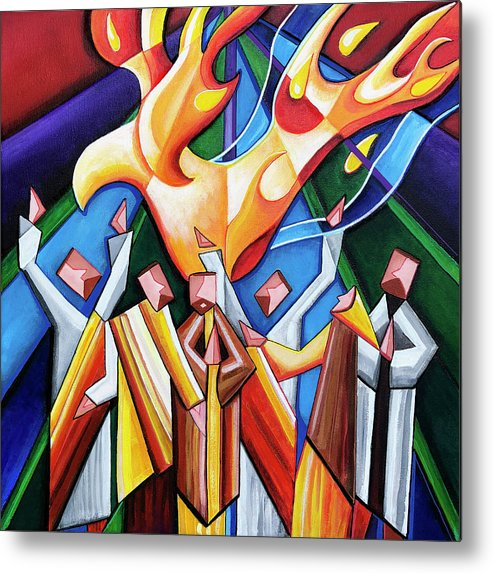
Pentecost, by Jennifer Allison

Now when the day of Pentecost had come, they were all together in one place. Suddenly a sound like a violent wind blowing came from heaven and filled the entire house where they were sitting. And tongues spreading out like a fire appeared to them and came to rest on each one of them. All of them were filled with the Holy Spirit, and they began to speak in other languages as the Spirit enabled them.

Now there were devout Jews from every nation under heaven residing in Jerusalem. When this sound occurred, a crowd gathered and was in confusion, because each one heard them speaking in his own language. 

Completely baffled, they said, “Aren’t all these who are speaking Galileans? And how is it that each one of us hears them in our own native language? Parthians, Medes, Elamites, and residents of Mesopotamia, Judea and Cappadocia, Pontus and the province of Asia, Phrygia and Pamphylia, Egypt and the parts of Libya near Cyrene, and visitors from Rome, both Jews and proselytes, Cretans and Arabs—we hear them speaking in our own languages about the great deeds God has done!”

All were astounded and greatly confused, saying to one another, “What does this mean?” But others jeered at the speakers, saying, “They are drunk on new wine!”

But Peter stood up with the eleven, raised his voice, and addressed them: “You men of Judea and all you who live in Jerusalem, know this and listen carefully to what I say. In spite of what you think, these men are not drunk, for it is only nine o’clock in the morning. But this is what was spoken about through the prophet Joel:

And in the last days it will be,’ God says,
that I will pour out my Spirit on all people,
and your sons and your daughters will prophesy,
and your young men will see visions,
and your old men will dream dreams.

Even on my servants, both men and women,
I will pour out my Spirit in those days, and they will prophesy.
And I will perform wonders in the sky above
and miraculous signs on the earth below,
blood and fire and clouds of smoke.

The sun will be changed to darkness
and the moon to blood
before the great and glorious day of the Lord comes.
And then everyone who calls on the name of the Lord will be saved.’ (New English Translation)

The Coming of the Holy Spirit, by Soichi Watanabe, 1996

Tornadoes are powerful. So is fire. They both have an immense potential for awe and destruction.  It’s interesting that when the little band of Christ’s followers experienced the Holy Spirit for the very first time, they likened what they encountered as wind and as fire. 

There is power in the Spirit – for both life and in destruction. It is the Spirit of God who dismantles and rearranges lives to make something different or new altogether. Most certainly, when the Spirit gets involved, nothing is going to be the same again.

On the Day of Pentecost, the Spirit upset the status quo and formed a new band of believers into the community of the redeemed (the Church). The presence of God’s Holy Spirit brings energy, strength, and ability to spread the good news of Jesus, heal broken lives, and bring an egalitarian way of life that sees no distinction based on race, class, gender, or ethnicity. 

The giving of the Spirit to the people of God is a whole lot more than a day set aside on a calendar, or a by-gone ancient thing that happened and has no significance for today. In fact, it is more than true to say that an authentic follower of Jesus Christ is a Pentecostal believer.  The New Testament knows nothing of a Christian who isn’t given the Spirit to accomplish the will of God on this earth.

Therefore, this time of the year is hugely significant when we attune ourselves to Holy Time because it is the age of the Spirit, the time of Pentecostal life and power. 

Ten days after recognizing Christ’s Ascension, and fifty days after our Lord’s resurrection from death, the Christian Calendar observes the day of Pentecost (which literally means “fifty” in Greek).  The day coincides with an established Jewish festival, the Feast of Weeks. Back in the day, Jerusalem would be filled with all kinds of different nationalities and ethnicities during the festival.

“There Appeared To Them Separated Tongues,” by Salvador Dali, 1967

Pentecost is often known as the birthday of the Church. It marks the time when the Holy Spirit came upon the fledgling believers in power. The disciple Peter, once a flaky up-and-down follower, was filled with the Spirit and spoke the Word of God boldly. His bold proclamation of repentance and faith in Jesus led directly to three-thousand persons added to the little band of one-hundred twenty.

And it didn’t stop there.

We live in an age where all believers in Jesus have the same Holy Spirit as our spiritual ancestors did. It’s an era of spiritual empowerment. The Church is called to reach the world with good news of forgiveness and grace through the person and work of Christ. 

So, then, the Church possesses confidence and security in knowing that the Spirit’s enablement and power is available for mission and spiritual care to the nations. It’s an immense calling that befits the bigness of God.

There are a wide range of Christian celebrations of Pentecost. Some churches do not recognize the holiday at all. Most churches at least mention it in prayer, song, or sermon. Other churches go all out, with worship focused on remembering the first Pentecost and praying for a similar outpouring of divine power. Churches that employ liturgical colors generally use red on Pentecost as a symbol of fiery spiritual power.

Pentecost reminds us that Christians are meant to live in the presence and power of the Holy Spirit, all the time. This day is a chance to confess our shortcomings and failures because of fear, apathy, and selfishness; and to ask for a fresh infusing and infilling of God’s wonderful Spirit. 

The Day of Pentecost flings every single believer into a congregational whole, the Church, and lets us know that we are not to be rugged individualists acting alone but are part of the Body of Christ. Therefore, we must renew our commitment to the Church for whom Christ died. 

The Spirit is ready to use us in forging spiritual bonds of kinship and solidarity. Pentecost throws disparate people together in a unified whole, made up of every kind of language, nationality, ethnicity, gender, and race.  We are all to use the gifts of the Spirit given to us for the benefit of building up one another.

We exist because of the Holy Spirit. Without the Spirit, there is no power source because the Spirit is the battery, the generator of the Christian life. We are to do all life and ministry through the power of the Spirit, equipping and encouraging each other, displaying the fruit of the Spirit, and worshiping the person of the Spirit in always being present with us.

Pentecost was (and is!) a watershed event. Worship, community, and outreach are the logical and collective responsibilities of each believer and every church around the globe.

Let us, then, recognize Pentecost and observe this day with heartfelt thanksgiving and a renewed impulse to exercise our spiritual abilities – graciously given to us by the Holy Spirit. Amen.

Galatians 3:23-29 – A Ministry of Equals

Before the coming of this faith, we were held in custody under the law, locked up until the faith that was to come would be revealed. So, the law was our guardian until Christ came that we might be justified by faith. Now that this faith has come, we are no longer under a guardian.

So, in Christ Jesus you are all children of God through faith, for all of you who were baptized into Christ have clothed yourselves with Christ. There is neither Jew nor Gentile, neither slave nor free, nor is there male and female, for you are all one in Christ Jesus. If you belong to Christ, then you are Abraham’s seed, and heirs according to the promise. (New International Version)

So far, this year…

we have journeyed through Advent to see the Christ child…

followed the light of Epiphany with Jesus as the light of the world…

traveled in Lent to see ourselves in the light of Christ…

experienced Holy Week with the crucifixion, death, and resurrection of Jesus Christ…

exulted in the spiritual victory of Easter(tide)…

observed the Lord’s ascension to heaven…

and celebrated the incredible giving of the Holy Spirit to us as believers in and followers of Jesus.

Now…

we have entered the longest Christian season of the year: Ordinary Time or Proper Time.

Armed with the redemptive events of Jesus and with the Spirit as our Teacher, Guide, and Advocate, it is the ordinary ministry and proper life of every Christian to utilize our identity and belonging to spiritually grow and mature in Christ – and spread the seeds of the Gospel everywhere we go. This is simply the normative behavior of every Christian.

We are to bring…

faith, hope, and love to a world in need of God’s grace and peace – a world so often characterized by the chaos of hate, conflict, war, and unrest…

connection where there is disconnection, restoration where there is fragmentation, and inclusion wherever there is exclusion.

Ever since…

the fall of humanity, people have had the predilection to organize themselves in groups that keep them distinct from other groups. Whether it is high school peer groups or office politics; whether class warfare or church cliques; there has always existed a tendency to think better about the groups we identify with, and to look down and believe the worst about those we don’t understand or just don’t like.

But Jesus…

is the person who changes it all. Faith in Christ makes each of us equal with each other, whether Jew or a Greek, in bondage or in freedom, a man or a woman. The cross of Christ not only brought deliverance from sin, death, and hell; the work of Jesus Christ ushered-in a new egalitarian society.

I’m not sure the English translations of the Apostle Paul’s phrasing to the Galatian Church truly capture his passion about this issue. For Paul, Christ’s cross has done so much more than bring personal salvation; it has completely eradicated prejudice, discrimination, and division. 

Therefore…

the Church is to be the one place on earth where divisions no longer exist. It is to be a foretaste of heaven. The Church is to be a new society, a community of the redeemed, based in equity, diversity, and inclusion, from every people group, race, ethnicity, and gender.

Together as one, just as God is One, the Church lives the kingdom values of Christ’s words and ways in a fragmented and chaotic world.

Since then…

the ground is level at the cross, we are to live into our Christian unity with humble attitudes and loving actions. To do otherwise is to be immature. We (hopefully) expect kids to be kids and not be like adults. They need teaching, training, and tutoring to learn. When kids grow up and get into adulthood, we then expect them act like an adult. If they continue in childish behavior, they are immature.

Many adult Christians are still stuck in spiritual childhood. The evidence of this is seen in trying to stratify church society into insiders and outsiders, those who have always been in the church and newcomers who haven’t, or the committed servants and the lax pew sitters, or the givers and the takers, or the theological conservatives and theological liberals.

Rather than…

all of that dividing of people, our spiritual energy, powerfully given to us by the Spirit, is to be placed with living into the egalitarian society inaugurated by Jesus (and Paul). Not taking women’s leadership seriously, or avoiding relationships with the poor, or being xenophobic, or excluding gays, all come from a place of immaturity. It is childish behavior. And Jesus expects better.

Embracing an egalitarian society neither means we are all the same nor should act alike. The diverse backgrounds and experiences of people help make a rich mosaic of support for one another in the Body of Christ.

Being egalitarian means…

all people are created in the image and likeness of God – no exceptions. All persons, therefore, deserve morally equal treatment, respect, and justice. A just and good Christian ethic ensures all believers are handled with love, given sound instruction, and are free to explore their gifts and abilities within the church.

Pursuing equality means more than acknowledging our differences and saying we include others. We need the further step of becoming curious about other cultures, ethnicities, races, and peoples of all kinds.

We need curiosity…

about class differences, health disparities, and political views. It is good for us to actively seek to learn about things like gerrymandering and why its so important; or about what white privilege is and why that’s a big deal; or about mental illness or poverty or crime or any issue that impacts the human condition around us.

In other words, we become curious simply because, as Christians, we care about people.

The Church is…

at its heart, is a community of equals. Thus, the Church, as an egalitarian community, must actively reject racism, sexism, and all forms of discrimination while purposefully seeking ways to create and maintain a unified community without divisions.

Jesus reached out…

to the misfits and marginalized in society who were suffering from political, cultural, gender, and religious oppression and discrimination. The community of persons Christ formed included people of all ages and backgrounds. Children were welcome. Women sat down with men to learn and became active participants alongside one another.

Christ’s conversation with the Samaritan woman at the well, the parable of the good Samaritan, and the healing of the Canaanite woman’s daughter, all illustrate that ministry is to reach beyond our own familiar group. In short, Jesus practiced a radical hospitality. He loved and welcomed the stranger.

We Christians…

would do well to emulate our Lord, as well as take our cues on ministry from Paul, who grounded both his theory and practice of Christian mission and service in a Trinitarian theology of equals.

Gracious God, you have abolished barriers through the redemption of Christ. Prevent me from erecting walls that would divide and use me to be a bridge so that others may experience equality in Jesus. Amen.