Seek the Least and the Lost (Matthew 18:1-14)

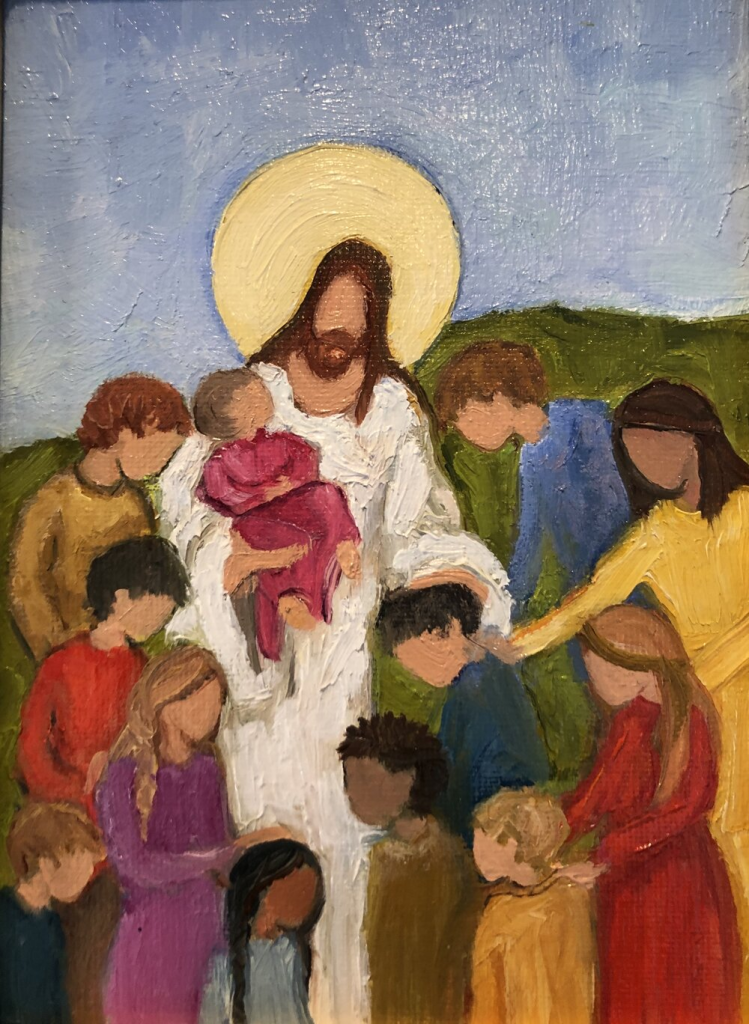
Child of God by Suzi Olson

At that time the disciples came to Jesus and asked, “Who, then, is the greatest in the kingdom of heaven?”

He called a little child to him and placed the child among them. And he said: “Truly I tell you, unless you change and become like little children, you will never enter the kingdom of heaven. Therefore, whoever takes the lowly position of this child is the greatest in the kingdom of heaven. And whoever welcomes one such child in my name welcomes me.

“If anyone causes one of these little ones—those who believe in me—to stumble, it would be better for them to have a large millstone hung around their neck and to be drowned in the depths of the sea. Woe to the world because of the things that cause people to stumble! Such things must come, but woe to the person through whom they come! If your hand or your foot causes you to stumble, cut it off and throw it away. It is better for you to enter life maimed or crippled than to have two hands or two feet and be thrown into eternal fire. And if your eye causes you to stumble, gouge it out and throw it away. It is better for you to enter life with one eye than to have two eyes and be thrown into the fire of hell.

“See that you do not despise one of these little ones. For I tell you that their angels in heaven always see the face of my Father in heaven.

“What do you think? If a man owns a hundred sheep, and one of them wanders away, will he not leave the ninety-nine on the hills and go to look for the one that wandered off? And if he finds it, truly I tell you, he is happier about that one sheep than about the ninety-nine that did not wander off. In the same way your Father in heaven is not willing that any of these little ones should perish. (New International Version)

“A person’s a person no matter how small.”

Horton Hears a Who! By Dr. Seuss

Jesus sees, honors, and protects little people. 

Horton the elephant spoke to people completely unconcerned for all the residents of Who Ville that lived on a clover. Dr. Seuss chose to make Horton an elephant, a large creature able to hear with big ears and be attentive to the small. Bigness can only come from becoming small.

Little people, the ones others fail to notice, matter to Jesus. And so, they ought to matter to us, too. Since Jesus sees and hears them, we should, too. 

Jesus often mingled with little people – children, women who had no rights, social misfits like lepers, the chronically ill, religious outsiders, tax collectors, and prostitutes. 

Our world is filled with similar people – angry adolescents, unwanted babies, forgotten old people, the mentally ill, moral failures, immigrants and refugees. If we have eyes to see and big ears to hear, we will notice the poor whom no one else hears. They are around us, even if they are invisible to us.

We’re all just little people before God. So, let’s be humble enough to see the little people around us. 

Who’s the greatest in the kingdom of heaven?

That question drips with a desire to position and posture oneself in a place of prominence and power. In other words, the questions really is, “How do I climb the ladder in God’s kingdom to be the most important person?”

In response, Jesus graciously and calmly called a child to him and answered that unless we become like a little child, we have no future with God. There’s only one way to have what you want, and it’s through humility.

Children had no status or rights in the ancient world. Ancient culture was not remotely youth or kid oriented. Kids were generally viewed as just potential adults. They were seen as weak, small, and unable to contribute much of anything until they grew up. 

Disciples of Jesus are to become like children, that is, lowly. Followers of Christ must give up their status and desire to be important. They can only be big if they become small.

Only by getting on the same level as little people can we ever welcome Jesus.

Why become like a little child?

Because a person who is attentive to the lowly is actually attentive to Jesus himself. 

We are not to welcome people because they are great, wise, rich, powerful, good-looking, and just like you and me – but because they are noticed by Jesus.

The proud person who seeks prominence is always looking for greener pastures and things to do that will impress people who will help advance them up the ladder of success. They do not care who gets stepped on along the way. 

The Christian, however, is to give all people, including the little ones and the marginal ones, the time of day and treat them as important.

How does one become humble and avoid sin?

Those who receive these little ones receive Jesus; those who reject these little ones reject Jesus, and by their lack of loving them cause them to sin. This, according to Jesus, is damnable behavior, and, so, must be dealt with in a radical manner because hell is worth avoiding at any cost. 

So then, the proud person must hack off part of themselves because it is better to be maimed for the rest of your life than enter hell. This is just one reason why a lot of folks stopped following Jesus.

Yet, Jesus insists that if, for example, your pursuit of money consumes you and you hold onto it and avoid the poor, give it away! If you hold onto your time like a clock miser and let it become your “precious” then you must get rid of it, you must give it away! It is better for you to have nothing than to have plenty of time and money and be thrown into hell fire!

In short, we should seek the lost.  

Instead of waiting for them to show up, or to seek us out, we must go get them.

The lost matter to God.

Those who are on the fence and are half-hearted in their devotion to Jesus and the mission of the church, matter to God. So are the spiritually indifferent and the not very committed. 
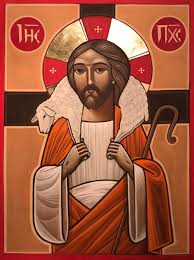
Coptic Church icon of Jesus the Good Shepherd

The temptation for spiritually serious persons is to look down on these lukewarm people. Jesus knew how easy it is to berate and despise such persons in our hearts:

To some who were confident of their own righteousness and looked down on everyone else, Jesus told this parable: “Two men went up to the temple to pray, one a Pharisee and the other a tax collector. The Pharisee stood by himself and prayed: ‘God, I thank you that I am not like other people—robbers, evildoers, adulterers—or even like this tax collector. I fast twice a week and give a tenth of all I get.’

“But the tax collector stood at a distance. He would not even look up to heaven, but beat his breast and said, ‘God, have mercy on me, a sinner.’

“I tell you that this man, rather than the other, went home justified before God. For all those who exalt themselves will be humbled, and those who humble themselves will be exalted.” (Luke 18:9-14, NIV)

If we are willing to humble ourselves, we can learn the hard practice of not hating others for what we hate in ourselves. 

We hate it when we are lax in our devotion to Christ; fail to accomplish what we want; miss opportunities to do good; and neglect to pray, give, or serve. So, when we see this as a pattern in someone else’s life, we may easily despise them in our hearts.

Turns out that many serious Christians must be converted as well – to seeing God’s heart for these despised little people.

What should be done about lost people?

Human reasoning might say, “Ah, let that one go; we have 99.” But God’s reasoning is, “I really care for that one.” Jesus wants to convert us to the statistically unimportant. 

If a person does not contribute to the life of the flock, do we care?

The parable contained within today’s Gospel lesson has become so familiar that it no longer shocks us. What kind of shepherd would be so stupid to abandon the entire flock and expose them to the dangers of wild animals and the harsh environment in order to search, maybe even unsuccessfully for one stinky, messed up, knurly, ugly, eats-too-much, sheep? 

And then, what’s more, when finding such a sheep, that shepherd rejoices more about this one sheep found than over the more dependable and attractive members of the flock? 

Only such a “foolish” shepherd can represent God’s concern for each one straying child.

Our Father in heaven is not willing that any of these little people should be lost. Therefore, we are to seek the lost.

Conclusion

Antonio Stradivarius (1644-1737) was an Italian violin maker. His violins are now the most prized violins ever made because of the rich and resonating sound they produce. The unique sound of a Stradivarius violin cannot be duplicated.

Surprisingly, these prized violins were not made from treasured pieces of wood, but instead were carved from discarded lumber. Stradivarius, who was very poor and could not afford fine materials like his contemporaries, got much of his wood from the dirty harbors where he lived. He would take those waterlogged pieces of wood to his shop, clean them up, and from those pieces of trashed lumber, he created instruments of rare beauty.

It has since been discovered that while the wood floated in those dirty harbors, microbes went into the wood and ate out the center of those cells. This left just the fibrous infrastructure of the wood that created resonating chambers for the music. From wood that nobody wanted, Stradivarius produced violins that everybody wants.

God has a plan. It is a plan to build a benevolent realm using not just the big and important, but the lowly and despised. 

May we all participate with the Lord and humble ourselves for kingdom purposes.

The Heart of Words (Matthew 12:33-37)

A good tree produces good fruit, and a bad tree produces bad fruit. You can tell what a tree is like by the fruit it produces. You are a bunch of evil snakes, so how can you say anything good? Your words show what is in your hearts. Good people bring good things out of their hearts, but evil people bring evil things out of their hearts. I promise you on the day of judgment, everyone will have to account for every careless word they have spoken. On that day they will be told they are either innocent or guilty because of the things they have said. (Contemporary English Version)

Words are important. They have meaning and power.

Our speech is the outward demonstration of what is really within the heart. There really isn’t any room to believe that a constant stream of gossip, backbiting, slander, and negative comments is anything but coming from a heart of evil. The person who speaks such words is not a loving, gracious, merciful person. Conversely, the person who continually encourages, uplifts, and seeks to be positive, reflects a deep heart of love for others.

Therefore, simply altering our speech when we’re around particular people is not the point; and it does no good. That kind of talking only breeds hypocrisy and is two-faced. Instead, the place to aim is the heart because that’s where the words come from. And the way to truly renovate a heart is to sub-contract the project to Jesus.

The people we typically hang-out with the most are the people that most influence our attitudes and our speech. 

So, if we spend copious amounts of time with Jesus, it’s inevitable that our hearts will become more like his heart, and thus, our words will be in alignment with the words and ways of Christ. Be rooted in Christ and the fruit of the tree will demonstrate it.

I always find public confessions on TV to be a rather disingenuous affair. Typically, celebrity apologies only take shape when one has been caught saying something and are called on the carpet. Then, when the apology comes, it’s predictably odd and incongruent, with the person saying something to the tune of, “I’m sorry if I hurt anybody by what I said. Saying that really wasn’t me. I’m not really like that.”

Well, apparently you are. It came out of your mouth. Jesus said that out of the overflow of the heart the mouth speaks. The words we say out loud betray what is truly inside us.

Jesus used the metaphor of a tree to illustrate his point. If the roots, the trunk, and the branches are good and healthy, then you can be sure the tree will produce good healthy fruit. However, if the tree is diseased, or infested with insects and rotting from the inside out, then no one can expect anything other than bad fruit, not fit to consume.

If the fruit is bad, the tree is bad. If the words are hateful, sarcastic, passive-aggressive, manipulative, conniving, racist, hurtful, ignorant, mean, unjust, foolish, and either subtly or overtly abusive, then the person has a dark heart and is need of redemption, not excuses.

Conversely, if the words are affirming, encouraging, loving, compassionate, gentle, caring, direct, helpful, peaceful, kind, giving hope and life, then there is a good heart behind it.

Yes, bad hearts can parrot good words. However, those words are not genuine but mere rote recitations to achieve some sort of personal agenda. And, of course, good people will occasionally say dumb or hurtful words. In such times, let it be a reminder that we all have some shadowy places within our hearts – and that we must depend on God’s grace to enlighten those dark spaces.

Let’s observe patterns, rather than focusing on isolated events where either good or bad words were said. A consistent pattern of invalidating another’s experiences or feelings; intimidating or threatening others; dismissing or discounting someone’s input; or being unnecessarily blunt, are all major red flags pointing to a severe heart issue.

Evil exists in the world. And if we are not vigilant to the power of language, wickedness can easily smack us upside the head when we aren’t looking.

The heart cannot be concealed forever. Eventually, the virtuous person will be shown as such by the stream of gracious speech which pours forth from the heart, as if it were living water for others to drink and enjoy. Their words reflect their good character.

The wicked person, however, cannot keep the bad words down. Those vile words sit in the soul, poisoning and making the person ill. Then, all of a sudden, the evil words come up and out with a great vomitous heave and spew impurity and unholiness all over the innocent. Their words betray their foolish and poor character.

Every tree that does not bear good fruit will be cut down and thrown into the fire. The wicked heart will not be able to speak ill of others with impunity forever. They will be called to account for their abusive words, whether overtly violent, or subtly undermining.

The righteous heart, however, shall experience divine pleasure and reward, as if the careful construction of helpful and building up words wins first-prize at the great heavenly fair.

The good person loves and does not hate. They are so far from harming anyone that they even pray and wish well for their enemies. They pray for blessings on those who curse them. There is an honest striving to speak good words to everyone, regardless of who they are.

The upright heart thinks the best of everyone and holds nothing over someone else’s head. Such a good heart condemns no one, leaving all judgment to God alone. It is patient with the most exasperating of people, praying they might come to their senses and become spiritually healthy.

The righteous are able to use their speech to admonish their neighbor with care and affection. They freely forgive, happily give, liberally encourage, and use their tongue to speak words of life. Indeed, their speech is wise, humble, full of grace, and above all, loving.

Almighty God, to you all hearts are open, all desires known, and from you no secrets are hid: Cleanse the thoughts of our hearts by the inspiration of your Holy Spirit so that we may perfectly love you, and worthily magnify your holy Name; through Christ our Lord. Amen.

Learn the Lesson of Christ’s Coming (Matthew 24:23-35)

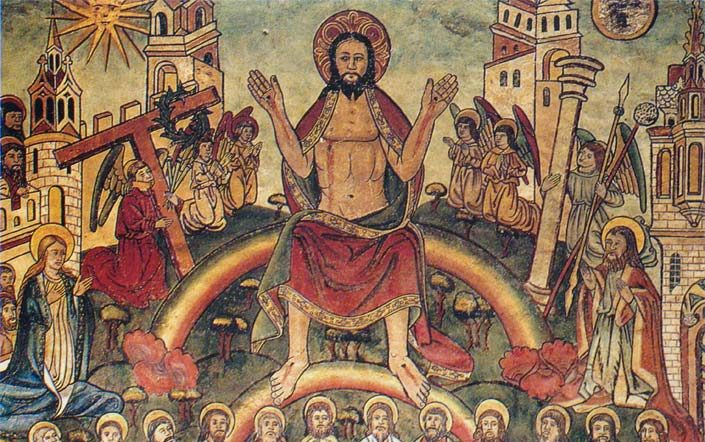
“He ascended to heaven and is seated at the right hand of God the Father almighty. From there he will come to judge the living and the dead.” Apostles’ Creed

Then if anyone says to you, ‘Look! Here is the Messiah!’ or ‘There he is!’—do not believe it. For false messiahs and false prophets will appear and produce great signs and wonders, to lead astray, if possible, even the elect. Take note, I have told you beforehand. So, if they say to you, ‘Look! He is in the wilderness,’ do not go out. If they say, ‘Look! He is in the inner rooms,’ do not believe it. For as the lightning comes from the east and flashes as far as the west, so will be the coming of the Son of Man. Wherever the corpse is, there the eagles will gather.

“Immediately after the suffering of those days

the sun will be darkened,
    and the moon will not give its light;
the stars will fall from heaven,
    and the powers of heaven will be shaken.

“Then the sign of the Son of Man will appear in heaven, and then all the tribes of the earth will mourn, and they will see ‘the Son of Man coming on the clouds of heaven’ with power and great glory. And he will send out his angels with a loud trumpet call, and they will gather his elect from the four winds, from one end of heaven to the other.

“From the fig tree learn its lesson: as soon as its branch becomes tender and puts forth its leaves, you know that summer is near. So also, when you see all these things, you know that he is near, at the very gates. Truly I tell you, this generation will not pass away until all these things have taken place. Heaven and earth will pass away, but my words will not pass away. (New Revised Standard Version)

I live in the upper Midwest of the United States. The summers can be brutally hot and humid. The winters can be incredibly frigid and full of snow. Having worked with college students for many years, every Fall there’s always at least one international student, or a student from the South, that has never experienced a Midwest winter and snow. 

I can tell them over and over again that they need a sturdy winter coat before the snow flies. But, having never known sub-zero and sub-freezing temperatures, it’s difficult to imagine such cold when the weather is currently warm. I, or someone else, usually have to help them get a suitable coat. And even then, they shake all winter and never take their scarves off.

It might be difficult to imagine that someday Jesus is coming back to judge the living and the dead. Having never been through an apocalypse, it’s hard to imagine that everything will change.

That’s why Jesus told his disciples to learn a lesson from the fig tree (fig trees were abundant in ancient Palestine). When you see the tree beginning to change, know that something is about to happen. The tree will become altogether different than how you see it now. 

Sometimes, even for myself who has lived through so many hard winters, it is incredible to know that the weather and landscape as it is right now will be completely different in January and February.

The trees, the grass, the mountains, the valleys, the waterways, the oceans, the sky, and the earth won’t last forever – as it now exists. Yet, the words of Jesus Christ will endure for all time. 

Whenever circumstances are a particular way for so long, of course it’s hard to believe that seeing everything as it is right now is not how it is going to be forever. However, know that a time is coming when it will all cataclysmically change. If we are attentive and alert, we will be ready. And we won’t be left out in the cold with no warm winter coat. 

We are to be ready for Christ’s return. That means taking off the old clothes of fear, insecurity, hopelessness, and hate, and putting on the new clothes of righteousness, peace, and love in the Holy Spirit. 

You were taught, with regard to your former way of life, to put off your old self, which is being corrupted by its deceitful desires; to be made new in the attitude of your minds; and to put on the new self, created to be like God in true righteousness and holiness. Therefore each of you must put off falsehood and speak truthfully to your neighbor, for we are all members of one body. (Ephesians 4:22-25, NIV)

Concerning the great change that is about to occur with the entire earth changing…

Since everything will be destroyed in this way, what kind of people ought you to be? You ought to live holy and godly lives as you look forward to the day of God and speed its coming. That day will bring about the destruction of the heavens by fire, and the elements will melt in the heat.But in keeping with his promise we are looking forward to a new heaven and a new earth, where righteousness dwells. (2 Peter 3:11-13, NIV)

Learn the lesson of Christ’s coming. Winter is nearly here. Are you ready?

O God our King, by the crucifixion, death, and resurrection of your Son Jesus Christ, you conquered sin, put death to flight, and gave us the hope of everlasting life. Redeem all our days by this victory; forgive our sins, banish our fears, make us bold to praise you and to do your will; and steel us to wait for the consummation of your kingdom on the last great Judgment Day, through Jesus Christ our Lord. Amen.

Are You Ready for Advent? (Matthew 24:36-44)

Advent Starry Night #5 by Virginia Wieringa

Jesus said, “But about that [judgment] day or hour no one knows, not even the angels in heaven, nor the Son, but only the Father. As it was in the days of Noah, so it will be at the coming of the Son of Man. For in the days before the flood, people were eating and drinking, marrying and giving in marriage, up to the day Noah entered the ark; and they knew nothing about what would happen until the flood came and took them all away. That is how it will be at the coming of the Son of Man. Two men will be in the field; one will be taken and the other left. Two women will be grinding with a hand mill; one will be taken and the other left.

“Therefore keep watch because you do not know on what day your Lord will come. But understand this: If the owner of the house had known at what time of night the thief was coming, he would have kept watch and would not have let his house be broken into. So you also must be ready, because the Son of Man will come at an hour when you do not expect him. (New International Version)

The best way of observing the first advent of Christ, his incarnation, is by preparing ourselves for his second advent, his return to the earth.

Just because there is sun today doesn’t mean everyday will be that way. The storm clouds are gathering; the Day of the Lord is at hand. Will you be ready?

Satan once called to him some demons of hell and said he wanted to send one of them to earth to aid women and men in the ruination of their souls. He asked which one would want to go.

One creature came forward and said, “I will go.” Satan said, “If I send you, what will you tell the children of men?” He said, “I will tell the children of men that there is no heaven.” Satan said, “They will not believe you, for there is a bit of heaven in every human heart. In the end everyone knows that right and good must have the victory. You may not go.” 

Then another came forward, darker and fouler than the first. Satan said, “If I send you, what will you tell the children of men?” He said, “I will tell them there is no hell.” Satan looked at him and said, “Oh, no; they will not believe you, for in every human heart there’s a thing called conscience, an inner voice which testifies to the truth that not only will good be triumphant, but that evil will be defeated. You may not go.” 

Then one last creature came forward, this one from the darkest place of all. Satan said to him, “And if I send you, what will you say to women and men to aid them in the destruction of their souls?” He said, “I will tell them there is no hurry.” Satan said, “Go!” (C.S. Lewis, The Screwtape Letters)

Most people’s crime in not some gross sin, but indifference, without much thought to a coming judgment. It seems we are all spiritual procrastinators. Why do today what we can put off till tomorrow? 

But the spiritually indifferent won’t know what hit them. 

So we need to be deeply concerned for the coming Day of the Lord, which may be very soon. 

The question for us is not, “When will Christ return?” Rather, the question is, “Are you ready for Christ’s return?” We must:

  • Keep watch, stay alert, and be ready, like a watchman on an ancient city wall scanning the horizon for an advancing army.
  • Remain vigilant and not forget that Jesus is coming again. 
  • Live every moment of our lives in light of the promise of Christ’s return. 
  • Be busy (not busybodies) because we don’t know the day of Christ’s second advent.

What does it mean to keep watch, be ready, and stay alert? 

In between these two advents of Christ, believers are to bear witness to a world going about their merry way unaware of the judgment that is about to overtake them. Like Noah, we actively build the ark of the church instead of living as if Jesus weren’t coming.

Noah was a preacher of righteousness in both word and deed, building an ark in a place and around a people who had never seen rain. What’s more, constructing the massive ark took a solid one-hundred years. This was no easy feat.

Like Noah, we must plug away and be faithful stewards, doing the tedious and patient work given to us. We aren’t supposed to be like the irresponsible teenager who, when given the responsibility of watching over the house while the parents are gone for the weekend, throws a big party and trashes the place. The parents will come home at a time that the teenager does not expect, and then there will certainly be weeping and gnashing of teeth. 

When the Lord returns, we don’t know who will be taken and who will be left. Two different people might look the same on the outside, doing the same work, but each of those persons working side by side can really be very different on the inside. So, let us be patient as we await the coming of Christ and avoid losing sight of what is truly important.

One day a man named Denis Waitley was trying to catch a flight but running late. So he literally ran through the airport terminal and got to the gate the split second the flight attendant closed the door. Denis explained his situation, that he had a speaking engagement and needed to be on that flight, but the attendant didn’t budge. 

Denis stormed out of the boarding area and back to the ticket counter to register a complaint and reschedule his flight. His anger intensified as he waited for more than twenty minutes in a line that barely moved. Just before he got to the counter an announcement over the intercom changed his life. 

The plane he missed getting on, Flight 191 from Chicago to Los Angeles, crashed on takeoff and killed every person on board the plane. Denis Waitley never registered his complaint. In fact, he never returned his invalidated ticket.

He took the ticket home and pinned it on a bulletin board in his office to remind him whenever he got frustrated or upset that life is more than day to day impatience and worry and complaints. It’s about serving a lost world destined to slide away from God apart from the grace that can turn judgment into blessing.

It could be today. Every day we must live with the reality that Christ’s return is imminent. Until that happens, we are to be faithful servants of God by serving a world that is tremendous need of getting on the ark and being saved from the judgment that will come. 

Almighty God, give us grace to cast away the works of darkness, and put on the armor of light, now in the time of this mortal life in which your Son Jesus Christ came to visit us in great humility; that in the last day, when he shall come again in his glorious majesty to judge both the living and the dead, we may rise to the life immortal; through him who lives and reigns with you and the Holy Spirit, one God, now and forever. Amen.