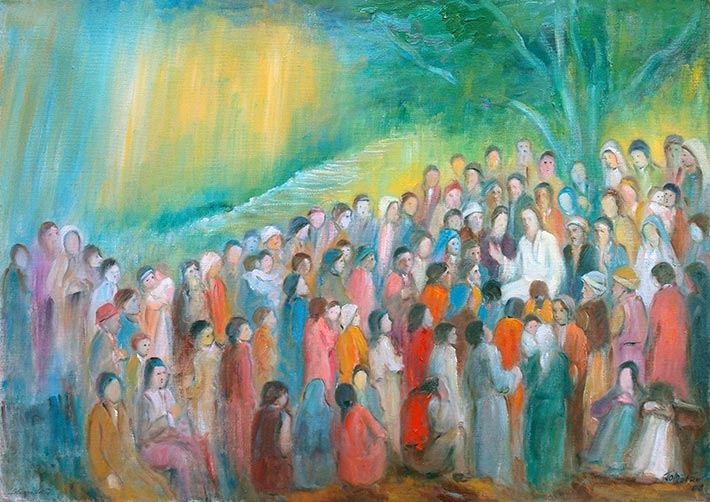
What Must Come (Mark 9:9-13)

As they were coming down the mountain, Jesus gave them orders not to tell anyone what they had seen until the Son of Man had risen from the dead. They kept the matter to themselves, discussing what “rising from the dead” meant.

And they asked him, “Why do the teachers of the law say that Elijah must come first?”

Jesus replied, “To be sure, Elijah does come first, and restores all things. Why then is it written that the Son of Man must suffer much and be rejected? But I tell you, Elijah has come, and they have done to him everything they wished, just as it is written about him.” (New International Version)

Christ’s disciples, bless their wondering hearts, always seemed to be a few steps behind in following Jesus. And, truth be told, so are we, much of the time.

Since we know the end of the story, it’s easy for us to observe how clueless the original disciples of Jesus were, and how slow to the uptick they were on what their Lord was telling them.

The disciples were confused about Christ’s transfiguration on the mountain; puzzled about why they needed to keep their mouths shut about it; and betwixt about what the heck “rising from the dead” even means.

As they scratched their heads, trying to get a handle on things, they ended up asking about something they thought they knew about: Elijah. After all, if you don’t understand something, like a student in class, maybe you can ask about something else in order to get the teacher diverted from the thing you don’t understand. But bringing up Elijah only muddled their spiritual distraction.

The beauty of Christ is that he takes any discussion, any question, and turns it toward what must happen, what we must come to grips with.

What goes up, must come down

The disciples had the incredible experience of seeing a glorified Christ on the Mount of Transfiguration. There is a time for bright illumined mountain top encounters, but there is also a time to come down off the mountain and walk through the shadowy dark valley.

Christ’s exhortation to stay silent about the mountain top meeting may be a reminder that following Jesus is not all glory; it also involves the hard slog of dealing with adversity because of one’s spiritual commitment.

A fundamental truth about the nature of God is consistency and constancy, much like a mountain. And we can always look up, remember, and find strength in our time of need.

I raise my eyes toward the mountains.
    Where will my help come from?
My help comes from the Lord,
    the maker of heaven and earth.
God won’t let your foot slip.
    Your protector won’t fall asleep on the job. (Psalm 121:1-3, CEB)

What goes down, must come up

Just as life is not all mountain experiences, so it is not all about the valley. Jesus was letting his disciples know that they were about to face the darkest time of their lives. He would be rejected and suffer much – to the point of death. But the grave would not be able to hold him. A resurrection was coming; Christ would rise from death.

There cannot be a resurrection without a crucifixion – and the agony of the cross is not the final word. Resurrection, ascension, and glorification all result from the terrible suffering and ignominy of death. And since we have died with Christ, we will also be raised to life, as well.

For if we have been united with him in a death like his, we will certainly be united with him in a resurrection like his. (Romans 6:5, NRSV)

What goes first, must come last

Jesus linked the Old Testament prophet Elijah with John the Baptist. Just as Elijah put the Lord first and was God’s servant, so also John considered Jesus as first, and himself as last.

John testified concerning him [Jesus]. He cried out, saying, “This is the one I spoke about when I said, ‘He who comes after me has surpassed me because he was before me…

I baptize with water,” John replied, “but among you stands one you do not know. He is the one who comes after me, the straps of whose sandals I am not worthy to untie….”

The next day John saw Jesus coming toward him and said, “Look, the Lamb of God, who takes away the sin of the world! This is the one I meant when I said, ‘A man who comes after me has surpassed me because he was before me.” (John 1:15, 26-27, 29-30, NIV)

What goes around, must come around

I’m not referring to karma, nor to a circular view of history, but to the reality that suffering and death is a result of life, and paradoxically, glory and life come from death.

Christianity is, I believe, inherently paradoxical. The way up is down; in order to save our lives we must give them up; to be great is to be a servant; and the last shall be first, and the first, last.

We neither need to understand every jot and tittle of the Bible, nor have every word of Jesus fully comprehended in order to be a Christian and serve Christ’s Church. There is a great deal of mystery to faith, and so much yet to discover and learn. We will spend an eternity getting to know God and never plumb the breadth and depth of comprehending the Lord.

So, we need to learn to enjoy this awesome God and embrace the paradox of divine sovereignty and human responsibility so that we may worship, fellowship, and live in grace and freedom. In doing so, we are witnesses to a faith that transcends understanding, and allows us to serve within our churches, families, and communities without having every loci of theology nailed down.

All things shall eventually come back around to the Garden – a place of unhindered fellowship with God and one another without any sin or deceit to get in the way. Disaster, disease, and death are temporary; Love is permanent and shall come around to being the overwhelming and only force in this big universe.

We bless you, O God, for our creation, preservation, and all the blessings of this life; but above all for your immeasurable love in the redemption of the world by our Lord Jesus Christ; for the means of grace, and for the hope of glory.

Give us such an awareness of your mercies, that with truly thankful hearts, we may show forth your praise, not only with our lips, but in our lives, by giving up ourselves to your service, and by walking before you in holiness and righteousness all our days; through Jesus Christ our Lord, to whom, with you and the Holy Spirit, be honor and glory forever. Amen.

On Divorce (Matthew 19:1-12)

When Jesus had finished saying these things, he left Galilee and went into the region of Judea to the other side of the Jordan. Large crowds followed him, and he healed them there.

Some Pharisees came to him to test him. They asked, “Is it lawful for a man to divorce his wife for any and every reason?”

“Haven’t you read,” he replied, “that at the beginning the Creator ‘made them male and female,’and said, ‘For this reason a man will leave his father and mother and be united to his wife, and the two will become one flesh’? So they are no longer two, but one flesh. Therefore what God has joined together, let no one separate.”

“Why then,” they asked, “did Moses command that a man give his wife a certificate of divorce and send her away?”

Jesus replied, “Moses permitted you to divorce your wives because your hearts were hard. But it was not this way from the beginning. I tell you that anyone who divorces his wife, except for sexual immorality, and marries another woman commits adultery.”

The disciples said to him, “If this is the situation between a husband and wife, it is better not to marry.”

Jesus replied, “Not everyone can accept this word, but only those to whom it has been given. For there are eunuchs who were born that way, and there are eunuchs who have been made eunuchs by others—and there are those who choose to live like eunuchs for the sake of the kingdom of heaven. The one who can accept this should accept it.” (New International Version)

It’s interesting that the compilers of the Revised Common Lectionary chose this Gospel lesson the day after Valentine’s Day. Not sure I would do that, but here we are, so let’s deal with it….

I grew up in an era in which not many couples divorced. Frankly, that probably was a bad thing, because there was plenty of hanky-panky going on, and far too much domestic violence that didn’t get dealt with. Women, mostly, tended to put up with an awful lot from abusive men.

Today, of course, divorce is common. And that’s probably a bad thing, too. A whole lot of couples aren’t working through their communication issues – and that’s because many individual persons have done precious little in addressing their own background experiences of trauma and/or abuse.

In short, divorce is not the ideal – but it’s necessary. And Jesus understood this more than most people of his day. It isn’t supposed to be this way, all this interpersonal crud, heartache, and pain. Yet here we are, having to navigate broken relationships, busted marriages, and bewildered children.

No married couple, on their wedding day, anticipates a divorce in their future. Nobody anticipates having a debilitating illness or to be locked into poverty. Instead, we are optimistic, believing that we’ll fall more on the side of better than worse, richer than poorer, healthier than sick, and cherishing the other more than irked by them.

As of this writing, my dear wife and I have been married nearly 38 years. A lot of blood, sweat, and tears have gone into being together for all that time. We have weathered many experiences with one another. Yet, I’m under no illusions; there’s nothing particularly special about me or my spouse. There are plenty of couples who have put in as much work as we have, and their marriages still dissolved in an ocean of disappointment.

I’d like to think I am not speaking as one above others, but as a fellow guy just trying to do his best with what he currently knows – and grateful that I have a partner and friend who sticks with me and lives life alongside me.

The last thing any divorced folks need is a bunch of condescending gobbledygook from a pious simpleton who likely doesn’t have a clue about what’s going on.

God heals the brokenhearted
    and bandages their wounds.

Psalm 147:3, CEB

The truth is that we all need to continually come back to what Jesus encouraged us to do: Avoid hardness of heart, embrace humility, and seek oneness and unity above all else. A marriage that has two people living under the same roof like roommates, isn’t really a marriage, at all; they may have the legal document to prove it, but they don’t have the relational practices to back it up.

Divorce is a major change of life. Put that together with the reality that life is always progressing and never stays the same, we all undergo many new beginnings throughout the course of our lives. 

Thankfully, there is another reality that will forever stay the same: You were created in the image of God, both male and female, and that divine likeness can never be taken from you. Wherever you go, whatever you do, God is with us. One is never outside the Lord’s reach.

The self-righteous person who belittles any and all divorcees is unaware that even God has experienced divorce and knows precisely what it feels like:

I [God] gave faithless Israel her certificate of divorce and sent her away because of all her adulteries. Yet I saw that her unfaithful sister Judah had no fear; she also went out and committed adultery. Because Israel’s immorality mattered so little to her, she defiled the land and committed adultery with stone and wood. (Jeremiah 3:8-9, NIV)

Perhaps your frame of mind right now is that you can barely see beyond today and cannot even imagine what will happen tomorrow. No matter the circumstance, regardless of who you are, where you have been, or where you are going, there is a God who exists on heaven and earth who completely knows and understands your situation. 

And the Lord stands ready to help you begin again and start something new.

Where hearts are broken, grant your healing.
Where trust is eroded, restore good faith.
Where bitterness has taken root, plant seeds of forgiveness.
Do not let anger destroy us, O God,
but teach us to love as Christ loved us. Amen.

Lynching, Lusting, Liquidating, and Lying (Matthew 5:21-37)

A Bengali depiction of Christ’s Sermon on the Mount

“You have heard that it was said to the people long ago, ‘You shall not murder, and anyone who murders will be subject to judgment.’ But I tell you that anyone who is angry with a brother or sister will be subject to judgment. Again, anyone who says to a brother or sister, ‘Raca,’ is answerable to the court. And anyone who says, ‘You fool!’ will be in danger of the fire of hell.

“Therefore, if you are offering your gift at the altar and there remember that your brother or sister has something against you, leave your gift there in front of the altar. First go and be reconciled to them; then come and offer your gift.

“Settle matters quickly with your adversary who is taking you to court. Do it while you are still together on the way, or your adversary may hand you over to the judge, and the judge may hand you over to the officer, and you may be thrown into prison. Truly I tell you; you will not get out until you have paid the last penny.

“You have heard that it was said, ‘You shall not commit adultery.’ But I tell you that anyone who looks at a woman lustfully has already committed adultery with her in his heart. If your right eye causes you to stumble, gouge it out and throw it away. It is better for you to lose one part of your body than for your whole body to be thrown into hell. And if your right hand causes you to stumble, cut it off and throw it away. It is better for you to lose one part of your body than for your whole body to go into hell.

“It has been said, ‘Anyone who divorces his wife must give her a certificate of divorce.’ But I tell you that anyone who divorces his wife, except for sexual immorality, makes her the victim of adultery, and anyone who marries a divorced woman commits adultery.

“Again, you have heard that it was said to the people long ago, ‘Do not break your oath, but fulfill to the Lord the vows you have made.’ But I tell you, do not swear an oath at all: either by heaven, for it is God’s throne; or by the earth, for it is his footstool; or by Jerusalem, for it is the city of the Great King. And do not swear by your head, for you cannot make even one hair white or black. All you need to say is simply ‘Yes’ or ‘No’; anything beyond this comes from the evil one. (New International Version)

Christ’s Sermon on the Mount by Joseph Matar

Relationships are important to God (and us!); we need one another because we are created in the image of a relational God. So, God wants us to have good relations with each other.

Murder, adultery, divorce, and oaths all have to do with interpersonal relations. These are topics from the Ten Commandments (6, 7, 9, and 10) that Jesus wanted to uphold.

Murder

Just because no blood is spilled doesn’t mean a killing hasn’t taken place. At the heart of the killing is angry contempt – which makes us all mass-murderers. The sort of anger Jesus refers to is nursing a grudge that morphs into hatred. It’s the deliberate decision to let anger sit in the pit of the gut and slow cook into deep resentment. Once that resentment is well done, murder becomes the meal.

Name-calling is the outward expression of resentful grudge bearing. “Raca” is an “airhead.” It means to be empty or stupid. The word “fool” is literally a “moron” – one who lacks both brains and morality. Both names hurt deeply, which is the expressed aim of the name caller. To have our intelligence and character questioned, cuts to the heart.

Jesus insists that harboring internal resentment comes out in external name-calling, verbally lynching people without a trial. Whenever we string a person up, divine judgment is coming to town. 

No one has a right to nurse a grudge. Repaying hatred with hatred is a highway to the grave. If you have ever wished someone dead, hated anyone, or belittled another; then, you have assassinated that person in your heart and are under the judgment of a holy God.

So, what to do in overcoming the resentment? Seek reconciliation immediately. Jesus used two illustrations to illumine the need for reconciliation with others when there are sour relations: an example of worship and an example with the court.

If you are worshiping, and remember that someone else is nursing a grudge against you, it is your responsibility to go and make things right. The Lord does not want to talk to anyone who won’t talk to their sister or brother.

Forgive us our debts, as we also have forgiven our debtors… For if you forgive other people when they sin against you, your heavenly Father will also forgive you. But if you do not forgive others their sins, your Father will not forgive your sins. (Matthew 6:12, 14-15, NIV)

None of this is meant to minimize the hurt or trauma that has taken place. Many people have faced hell in the shape of a human. Yet, because Jesus takes your hurt seriously, he calls for forgiveness and reconciliation. Without it, the pain unnecessarily continues and there is no healing.

In the illustration of court, we are to settle matters quickly and make things right so that judgment won’t happen. Let’s avoid living with the regret of vengeance because of destroying someone’s life. Forgiveness and reconciliation are always options on the table.

See to it that no one falls short of the grace of God and that no bitter root grows up to cause trouble and defile many.

Hebrews 12:15, NIV

Adultery

Adultery has its origins in mental sexual activity with another person. Jesus is not against normal gender attraction, nor sex itself (which is a gift of God). Rather, Jesus condemns the leering upon another with sexual fantasy. All adulterous relationships and inappropriate sexual relations start with the “look.”

“Lust” is to intensely desire something, to seek mastery over another. The reason people stare, and lust, is not because of the other person’s manner or dress; it’s because they already have an adulterous heart.

Managing adultery with a band aid is like trying to contain a nuclear meltdown with some duct tape; it’s an amputation we need. Jesus leaves no room to think it’s okay to lust in the heart because “I’m not hurting anybody.” Mental adultery demeans and degrades women.

Our lustful desires are powerful; yet God’s grace is more powerful. There’s no need to be burdened with shame and guilt when the cross of Christ has already taken care of it. There is a multi-billion dollar industry of pornography because our hearts are black. Now is the time for forgiveness, grace, and healing in Jesus Christ.

Sermon on the Mount by Jorge Cocco Santiago

Divorce

Today in America, more than one-third of all adults have experienced divorce. Jesus condemns the cavalier divorce, the thought of having a better spouse, even though there is no marital unfaithfulness. This is yet another form of mental adultery which believes someone else can better meet my needs. 

Jesus makes provision for divorce to occur in certain circumstances. Yet, he doesn’t bend to liquidating a marriage over unhappiness with what God has joined together. The intent of Old Testament legislation on divorce is to avoid a casual stance toward marriage (Deuteronomy 24:1-4). Over the centuries, people found creative ways of getting around the law. Although a divorce may be legal, it might not be ethical. Jesus wanted divorce practiced with concern for the woman, so that her rights and needs were considered.

For most of human history, if a husband did not like his wife (e.g. for continually burning his supper) he could divorce her. Jesus, however, insisted divorce must not happen because of a hard time getting along; or don’t love your spouse anymore; or that your spouse keeps irritating you. 

Being frustrated or unhappy are not biblical grounds for divorce. The answer to most marital problems does not lie in a new spouse, but in the hard work of identifying the idols of our hearts, overthrowing them, and re-connecting.

Christ sought to defend women who are victims. In biblical times, if a wife was given a certificate of divorce, she had four options: 1) return to her family of origin; 2) become a beggar; 3) become a prostitute to make ends meet; or, 4) marry again, which was extremely difficult to do. 

In reality, divorce is a legal testimony verifying that a separation has already occurred. It’s a recognition that disunity and division is already present, that a terrible break already happened, damaging the people involved.   

If God found it necessary to divorce his own covenant people, then it’s inevitable that divorce will happen among couples (Jeremiah 3:1-8). So, let’s be discerning in how we handle each individual situation of marital difficulty.

Oaths

“I swear on a stack of Bibles I won’t…” “I will, if I get around to it….” These are a few of the caveats we give when making a promise or oath. Oaths communicate our level or ability of getting something done, or not.

That’s fine. What isn’t fine is making excuses or false promises with no intention of doing what you say you will do. Jesus takes all that extraneous language out. Say “yes” or “no” and then follow through; if you don’t, you’re a liar.

We often lie because we don’t want to do something to begin with. “Yes” and “no” are clear boundary words. Boundaries define where I end and someone else begins, leading me to a sense of ownership. Knowing what I am to take and not take responsibility for gives me freedom.

Jesus wants us to clarify our values; make wise decisions; identify what we will accept and reject; and follow through on what we say we will do, period.

Murder, adultery, divorce, and oaths are all related. They have to do with how we relate to others, especially those closest to us and to God. We are to live responsibly by keeping our hearts large and soft.

Exposing Hypocrisy (Mark 7:1-8)

Old Men and Christ by Ivan Filichev, 1992

The Pharisees and some of the teachers of the law who had come from Jerusalem gathered around Jesus and saw some of his disciples eating food with hands that were defiled, that is, unwashed. (The Pharisees and all the Jews do not eat unless they give their hands a ceremonial washing, holding to the tradition of the elders. When they come from the marketplace they do not eat unless they wash. And they observe many other traditions, such as the washing of cups, pitchers and kettles.)

So the Pharisees and teachers of the law asked Jesus, “Why don’t your disciples live according to the tradition of the elders instead of eating their food with defiled hands?”

He replied, “Isaiah was right when he prophesied about you hypocrites; as it is written:

“‘These people honor me with their lips,
    but their hearts are far from me.
They worship me in vain;
    their teachings are merely human rules.’

You have let go of the commands of God and are holding on to human traditions.” (New International Version)

Reading the Gospel text for today, I try to imagine what emotions Jesus might have experienced when confronted by some religious leaders about his lack of attention to traditional and ritual hand washings – maybe frustration, anger, sadness, exasperation, disappointment, irritation, aggravation, or discouragement.

Perhaps Christ felt all those emotions. Whatever Jesus was feeling at the time, I can easily see him taking a deep breath and exhaling a great big *sigh* over the hypocrisy displayed in front of him.

Hypocrisy is a disconnect between espoused values and actual behavior. Whenever there is an incongruence between what we say is important and how we really live, this is being two-faced and duplicitous.

The men who came to see Jesus were plain old insincere hacks who practiced religious quackery. And Jesus saw right through their fake pretention of righteousness.

First off, this narrative is neither a blanket condemnation of Pharisees nor a dig on rituals themselves. Instead, Christ’s words were directed to specific persons using their rituals to leverage an appearance of religious superiority over others.

That type of motivation for engaging traditional rituals completely ignores the ethical and moral intention of those practices.

Sometimes folks can get so doggone wrapped up in how faith is represented that they lose sight of the faith itself.

Jesus and Old Men by Ivan Filichev, 1993

Hypocrisy has to do with our motives – not so much what we do but why we do it. Rituals themselves are good. Why we do them, or not, or how we go about doing them, gets at the heart of our objectives for engaging religious practices.

We need to ask ourselves:

Are our spiritual practices truly a worship offering to God, or are they merely mechanisms for keeping up the appearance of holiness?

Hypocrisy is acting a part which is not our true self. It is, instead, to live from the false self through the attempt of providing an idealized person to the public. What we ought to be doing is embracing the true self and realizing our common humanity with one another in genuine devotion to God and service to others.

Religious hypocrisy is particularly insidious because it uses what is sacred for selfish purposes. It damages the credibility of the religion, creates idolatry, and papers over hate with a veneer of pretentious piety.

The hypocrite is one who is a bundle of disparate parts. They have a massive need of integration to a whole and real self. The cost to facing this is the vulnerability of exposing oneself as flawed, imperfect, even ugly. Many persons have no willingness to be viewed by others as such, and so they maintain their play-acting and continue to seek the attention and accolades as a model religious person.

We all must come to grips with the reality that God cares a whole lot about why we do what we do.

If and when the forms of faith become tools of oppression to place heavy burdens upon others backs, then those forms have supplanted the faith itself.

Out of the overflow of the heart the mouth speaks, and from the heart the hands and feet move. Whenever we care more about being and appearing right than getting it right and becoming better, then we have a heart problem. The heart of the issue is the heart itself. Clean up the heart, and everything else follows – not the other way around.

The probity of today’s Gospel lesson is that we might misinterpret what is important to God. We may be playing the hypocrite yet have the belief we are genuine. The capacity for our hearts to enlarge with love is in direct relation to an awareness of the hidden motives buried within those hearts.

Evil intentions and motivations are what separate us from God – not our race, class, age, gender, religion, ethnicity, behavior, rituals, or anything else on the outside.

If we find ourselves being nit-picky of others, this is usually a clue that the unconscious self is trying to protect us from facing the pain of our own sins by projecting and focusing on another’s supposed missteps with tradition or ritual.

Fortunately, Jesus came to this earth full of grace and truth. There were times that Christ set aside niceness and decorum to go for the heart. In shining a light on the motives behind the deeds of people, some repented and received the good news of the kingdom of God; and others resisted to maintain their illusion of control and superiority.

Nobody could ride the fence with Jesus around. You either loved him or hated him.

The beauty of grace is that when we squarely and uncompromisingly face our sins and let go of the things we consider so important, and turn to God with authenticity, we are welcome at his Table.

Most holy and merciful Father, we acknowledge and confess before you our sinful nature, prone to evil and slow to do good, and all our shortcomings, offenses, and malevolent motives. You alone know how often we have sinned in wandering from Christ’s way of grace and truth, in wasting your gifts of compassion and justice, and in forgetting your love.

O Lord have mercy on us. We are ashamed and sorry for all the ways we have displeased you. Teach us to hate our errors; cleanse us from our secret faults; and forgive us our sins; for the sake of your dear Son, our Lord, Jesus Christ. Amen.