Welcome friends. Simply click the video below and let us celebrate the Lord Jesus Christ’s victory over sin, death, and hell by means of a mighty resurrection.
To extend our recognition of this glorious day, here are two links for you:
I’ve Just Seen Jesus sung by Larnelle Harris and Sandi Patty is an oldie, but still a wondrous goodie.
Hallelujah Chorus arranged by Quincy Jones is one of the most celebratory arrangements you’ll find on this classic Handel song. Sung by the Singin’ Black and White choir, if this doesn’t bring you to life, you still think Jesus is a gardener.
Finally, here is the full version of the original hymn written by Carolyn Gillette (sung at the beginning of the video):
This Easter Celebration (to the tune of “The Church’s One Foundation”)
This Easter celebration is not like ones we’ve known.
We pray in isolation, we sing the hymns alone.
We’re distant from our neighbors — from worship leaders, too.
No flowers grace the chancel to set a festive mood.
No gathered choirs are singing; no banners lead the way.
O God of love and promise, where’s joy this Easter Day?
With sanctuaries empty, may homes become the place
we ponder resurrection and celebrate your grace.
Our joy won’t come from worship that’s in a crowded room
but from the news of women who saw the empty tomb.
Our joy comes from disciples who ran with haste to see —
who heard that Christ is risen, and then, by grace, believed.
In all the grief and suffering, may we remember well:
Christ suffered crucifixion and faced the powers of hell.
Each Easter bears the promise: Christ rose that glorious day!
Now nothing in creation can keep your love away.
We thank you that on Easter, your church is blessed to be
a scattered, faithful body that’s doing ministry.
In homes and in the places of help and healing, too,
we live the Easter message by gladly serving you.
Tune: Samuel Sebastian Wesley, 1864 (“The Church’s One Foundation”) (MIDI)
This new hymn is a prayer to be used in Easter 2020 worship services, while most churches are closed and people are remaining in their homes because of the pandemic. It can be used for online worship or in online written communications from a church to its members. Permission is given for free use.
Early on the first day of the week, while it was still dark, Mary Magdalene went to the tomb and saw that the stone had been removed from the entrance. So she came running to Simon Peter and the other disciple, the one Jesus loved, and said, “They have taken the Lord out of the tomb, and we don’t know where they have put him!”
So Peter and the other disciple started for the tomb. Both were running, but the other disciple outran Peter and reached the tomb first. He bent over and looked in at the strips of linen lying there but did not go in. Then Simon Peter, who was behind him, arrived and went into the tomb. He saw the strips of linen lying there, as well as the burial cloth that had been around Jesus’ head. The cloth was folded up by itself, separate from the linen. Finally, the other disciple, who had reached the tomb first, also went inside. He saw and believed. (They still did not understand from Scripture that Jesus had to rise from the dead.)
Then the disciples went back to their homes, but Mary stood outside the tomb crying. As she wept, she bent over to look into the tomb and saw two angels in white, seated where Jesus’ body had been, one at the head and the other at the foot.
They asked her, “Woman, why are you crying?”
“They have taken my Lord away,” she said, “and I don’t know where they have put him.” At this, she turned around and saw Jesus standing there, but she did not realize that it was Jesus.
“Woman,” he said, “why are you crying? Who is it you are looking for?”
Thinking he was the gardener, she said, “Sir, if you have carried him away, tell me where you have carried him, and I will get him.”
Jesus said to her, “Mary.”
She turned toward him and cried out in Aramaic, “Rabboni!” (which means Teacher).
Jesus said, “Do not hold on to me, for I have not yet returned to the Father. Go instead to my brothers and tell them, ‘I am returning to my Father and your Father, to my God and your God.’”
Mary Magdalene went to the disciples with the news: “I have seen the Lord!” and she told them that he had said these things to her.
Although Peter and John have a role in this story about Christ’s resurrection, the main character is Mary Magdalene. This is significant and symbolic of the fact that it was Mary who experienced one of the most profound and deep changes of life due to the ministry of Jesus. Mary had been an immoral woman and spiritually enslaved to the machinations of seven demons. It was Jesus who thoroughly delivered her from her personal hell. Mary was forever thankful to him for changing her life, and so, she followed Jesus and supported him in any way she could. Mary was at the foot of the cross when Jesus died. While other disciples were keeping their distance out of fear, Mary was bold in standing with the other women for all to see that they were completely devoted to Jesus. Mary never turned her back on Jesus. It was Mary who was there on the Sunday morning of Christ’s resurrection. Whereas the other followers were nowhere to be found, Mary came to the grave, still with a heart given to Jesus and grieving over his death.
Because Mary had been given a new chance at life, she was deeply thankful and everything she had belonged to Jesus. Mary Magdalene was forgiven much, and, so she loved much. Here she is, after her Lord’s crucifixion, death, and burial, at the grave of Jesus. Mary came to the tomb on Easter Sunday still living in a Good Friday world – grieving, sad, and discouraged. She soon discovered, however, that Christ is risen!
In the midst of your days of disappointment, loss, or sadness, how have you been surprised by joy and the presence of the risen Christ? How has your grief been turned to gratitude? Have you seen the risen Lord?
One day, 33 years ago, I was down sick with the flu and in bed. I barely remember my wife coming into the bedroom after a doctor’s appointment upset and crying. She was trying to rouse me with a mix of good and bad news. Mary had gone to the doctor thinking that she probably had picked up my flu. Instead, the doctor gave her the news that she was pregnant with our first child. But there was more….
After the examination the doctor had reason to believe that our little baby might be in the wrong place – that she was not where she should be and may very well be in the fallopian tube and not the womb. So, here I am – barely able to move getting out of bed – driving my wife to the hospital for an ultrasound with such a range of emotions within me that all I can do is weep, feeling, much like Mary Magdalene, that my Lord has been taken away from me. It just felt like I didn’t know where Jesus was at that moment and why I was going through this surreal craziness.
I will never forget the words and even the tone of voice of the ultrasound technician as we anxiously stared at a screen we didn’t understand. The technician said, “She is right where she is supposed to be!” The tears turned to complete joy. And the words were prophetic. There was no way that the technician could know at six weeks in the womb that we were having a little girl, yet she referred to the peanut within my wife as “she.” And we immediately knew what her name was: “Sarah,” which is the Hebrew name for “Princess.” God had graced us with a precious gift of royalty, coming from the grace of King Jesus.
I want us to know this morning, on this great Day of Resurrection, that we are right where we are supposed to be. It might seem out of place spending so much time at home; not working in ways we’re used to, or even working at all; wondering where God is or how the divine fits into this topsy-turvy situation of pandemic and economic instability. The truth of matter is this: You are right where you are supposed to be. God has you precisely where he wants you. This morning, right now, you are a witness to the resurrection of Jesus. Along with Mary Magdalene there is the astonished declaration, “I have seen Jesus.”
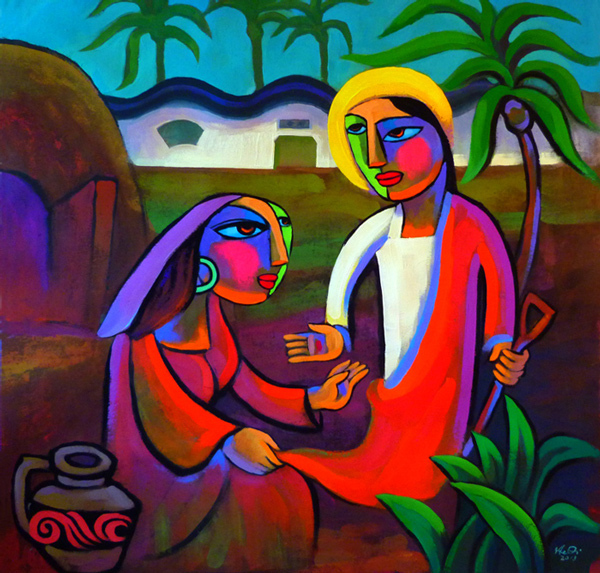
“Do Not Hold On to Me,” by He Qi, 2013. Jesus and Mary Magdalene
Let Mary Magdalene’s experience be of encouragement to you. Mary had been given a new life and was transformed by the Lord. Yet, on Easter Sunday she did not immediately get what the heck was going on. Jesus rising from death was not anywhere on her radar. The empty tomb and the angels did not immediately lead her to faith – not until she saw Jesus, and even then, she did not recognize him. Only when Jesus called her name did Mary recognize him and respond, believing it was her Lord. And Jesus is still calling out names. He is calling your name. Jesus had said to his disciples that the sheep listen to the shepherd’s voice; he calls his own sheep by name and leads them out (John 10:3-4). One little word can change our lives forever: our name.
Easter opens a whole new world for us, as it did for Mary – a future of announcing good news and proclaiming resurrection. There is a simple reason why the grave clothes were left in the tomb just lying there – they were not needed anymore! We no longer need the grave clothes of discouragement, defeat, and despair. We no longer need to weep and wonder, because Christ is risen! He has called our name and we hear his voice.
The 20th century Swiss theologian, Karl Barth, said that what brings people to worship God – not just on Easter, but any day – is an unspoken question clinging to our minds and hearts: Is it true? Is it true that God lives? Is it true that Jesus is alive? Could it be true that I can live a new life in Christ? Is it true that I can rebuild my life? Is it all true? Mary Magdalene approached the tomb and found that it was true.
All over the world, this very day, followers of Jesus are testifying that this is all real: Christ is risen, and there is new life in Jesus our Lord. Right now, believers across the globe are worshiping the risen Lord because they declare along with us, “I have seen the Lord!”
God has always been in the business of changing lives. British author A. N. Wilson, used to be known for his scathing attacks on Christianity and proclaimed the death of God… celebrated Easter in 2009 at a church with a group of other church members, proclaiming that that the story of the Jesus of the Gospels is the only story that makes sense out of life and its challenges. Wilson said, “My own return to faith has surprised none more than myself …. My belief has come about in large measure because of the lives and examples of people I have known—not the famous, not saints, but friends and relations who have lived, and faced death, in light of the resurrection story, and in the quiet acceptance that they have a future after they die.”
The moment Jesus calls a person’s name, the power of the resurrection is enabled—the same power that raised Jesus from the dead. See what you consider as immovable slabs of stone in your life—maybe it’s bitterness, insecurity, fear, self-doubt or cynicism. Those immense rocks can be rolled away. To know Jesus is to know the power of the resurrection. We don’t need to merely hear testimonies of changed lives like Mary Magdalene’s; we can experience new life ourselves.
There is one word, one name, which has forever changed the world: “Jesus.” And Jesus wants to change the world by uttering one simple word, one name: your name, so that you can exclaim with great joy, “I have seen the Lord!”
Mighty God, as Christ burst forth from the grave, may new life explode from us and show itself in acts of love and healing to a hurting world. May your ever-living Son, Jesus our Lord, keep our hearts rejoicing and grant us peace this day and always in resurrection power. Amen.
We all face circumstances and seasons of life that stretch our faith and press the limits of what we can handle. We have no promise from Scripture that we will avoid trouble. Instead, Jesus promises trouble to his followers (John 15:18-20; 1 John 3:13; 2 Timothy 2:12). The pressures of life can sometimes be so overwhelming that we might lapse into losing heart by either blaming ourselves for the adversity we experience and wish things were different, or by blaming others for our troubles and believing that if they would just get their act together all would be well with my soul. No matter the source or nature of the problem, the church needs a point of focus to direct their troubled hearts. We all need to be reminded of the grace we possess in Jesus Christ.
The resurrection of Jesus from the dead is both a spiritual and a physical reality. If we believe this truth in our hearts we will be raised both spiritually and physically (Romans 10:9-10). This faith in Christ gives shape to the hope that, although we might be experiencing the effects of mortality and the fall of humanity, we are, at the same time, being spiritually renewed day by day. The very same afflictions that cause our bodies to degenerate and dispirit us are the means to achieving a glorious resurrected existence (2 Corinthians 4:13-18). There cannot be the glory of spiritual and bodily resurrection without a shameful death. The way of Jesus was to absorb the shame of the world’s violent ways on the cross so that we might be raised with him in his resurrection.
However, this does not mean that the church will never experience difficulty in this present life. In fact, daily spiritual renewal can and does happen through adverse circumstances. There must be suffering before glory, both for Jesus and for us. Just because we are saved does not mean we are inoculated from daily stress and pressure because it is the troubles of this life that teach us to trust in God and weans us from all that we have previously trusted in to deal with those troubles.
The truth of God using adversity and trouble in our lives begs several questions for each believer and every local church:
ØDo we give inordinate attention to either the tangibly physical or the intangible spiritual?
ØHow does Christ’s resurrection impact us today?
ØHow do we interpret our earthly troubles?
ØWhat place does faith in God have in our daily decisions?
ØThe older we get, are we being renewed in Christ?
ØDoes the Lord’s Table, as a tangible sign and seal of our intangible faith, shape our hope?
When I think of a person who is outwardly wasting away, yet inwardly being renewed, I think of Joni Eareckson Tada. She has been a paraplegic for forty-five years after an accident as a teenager in which she dove into shallow water and broke her neck. After the accident, lying in the hospital for months unable to move, she had completely lost heart to the point of being suicidal. But she could not even kill herself since she could not physically move. Finally, in her darkest moment she cried out to God with what she says to this day was the most significant prayer she ever prayed: “Lord, if I can’t die, show me how to live.” And he did. Joni’s faith is as strong and robust as anyone’s, despite her infirmity and her handicaps. She has learned to embrace her troubles as the means of growing her faith.
We cannot accept, cope, and transcend our troubles and afflictions if we do not acknowledge them. They only have power over us for ill if we ignore them or put up a false front to hide them. Paul was open with others about his life: We do not want you to be uninformed about the hardships we suffered…. We were under great pressure, far beyond our ability to endure, so that we despaired even of life. Indeed, in our hearts we felt the sentence of death. But this happened that we might not rely on ourselves but on God, who raises the dead (2 Corinthians 1:8-9). Paul faced whippings and beatings, stoning and shipwreck, hunger and poverty, danger and trouble, not to mention all the pressures of his concern for all the churches he established. Through it all Paul was transparent and named his troubles so he could apply the poultice of God’s grace to his afflictions. It is our brokenness and not the pretension of having it all together that shows the grace of God to others.
Over and over again Paul described his life and ministry in apparent paradoxes: strength in weakness; glory through shame; life through death; riches through poverty. Although we experience the fallen nature of the world, God bends each situation for his own purposes so that what seems to be our downfall becomes the means to our spiritual renewal. Every church is inherently paradoxical, a strange amalgam of victory and defeat, faith and doubt, full of sorrow and joy. Let us all embrace this reality and allow God to use whatever means he so desires to shape his church for kingdom purposes. Soli Deo Gloria.
“Who will roll away the stone for us from the entrance of the tomb?” So asked the three women on Resurrection Sunday when they came to anoint Jesus’ dead body. But they did not find a dead body. He was not there – he was risen!
I sometimes find myself asking the same kind of question that the women were asking each other. Who will move this huge object (or objection!) to church revitalization? How can I get to Jesus so that I can do something for him? Who will take care of the immovable obstacles that stand in my way? These are questions born more of a small faith and a limited understanding of God than of knowing his great power.
The women were not expecting a risen Lord. They did not anticipate that their question would end up being completely irrelevant. Maybe as believers and lovers of Jesus we are asking the wrong kind of questions. Perhaps we are not grasping what God’s power has already accomplished and/or what God already has up his sleeve. It could just be that all we really need to realize is that God is going before us, clearing all impediments so that people can see and experience the risen Christ. Methinks our expectations are far too low for a God who has the power and will to raise people from death.
The way has been opened to a new and vital relationship with the Lord Christ because the stone is rolled away and Jesus is alive. We can now encounter and explore a fresh reality with Jesus as the Author and Pioneer of our faith. We need only listen and follow him and leave the moving of big rocks to God.
Mighty God, I not only recognize your power but trust in it for my entire life’s work and activity. Help me to trust you so fully that I can be an eyewitness to your mighty works among your people. Amen.









 Rev. Tim Ehrhardt