First Sunday after Christmas Day – Where Is Jesus? (Luke 2:41-52)

The Boy Jesus In the Temple, by He Qi

Now every year his parents went to Jerusalem for the festival of the Passover. And when he was twelve years old, they went up as usual for the festival. When the festival was ended and they started to return, the boy Jesus stayed behind in Jerusalem, but his parents were unaware of this. Assuming that he was in the group of travelers, they went a day’s journey.

Then they started to look for him among their relatives and friends. When they did not find him, they returned to Jerusalem to search for him. After three days they found him in the temple, sitting among the teachers, listening to them and asking them questions. And all who heard him were amazed at his understanding and his answers. 

When his parents saw him they were astonished, and his mother said to him, “Child, why have you treated us like this? Your father and I have been anxiously looking for you.” 

He said to them, “Why were you searching for me? Did you not know that I must be in my Father’s house?” But they did not understand what he said to them. 

Then he went down with them and came to Nazareth and was obedient to them, and his mother treasured all these things in her heart.

And Jesus increased in wisdom and in years and in divine and human favor. (New Revised Standard Version)

Luke is the only New Testament Evangelist who included a story of Jesus’s childhood. It provides us some interesting biographical information. Yet, more importantly, the story gives us a sense of Christ’s destiny, of why Jesus grew up to  engage in his unique earthly ministry.

In many ways, Jesus was a typical Jewish boy, in a non-descript pious Jewish family. The family was careful to be observant, and annually made their pilgrimage to Jerusalem for Passover.

Joseph and his family traveled in a large caravan of people, which was common for that day. They were on their camels an entire day before they discovered Jesus was missing.

Mary likely assumed Jesus was riding on the other camel with Uncle Zechariah and his cousin John. 

But Jesus was neither with them nor with Aunt Elizabeth. So, the second day, Joseph and Mary backtracked to Jerusalem, hoping and praying they wouldn’t find Jesus in the ditch, like in the story of the Good Samaritan.

Having not found their son along the road, Joseph and Mary spent the third day scouring Jerusalem in search of Jesus. 

It seems to me that far too many people go about their daily lives without realizing Jesus is even missing. They simply assume he’s here. But he isn’t.

So, let’s search for him. And in finding him, may we see Jesus as we have never seen him before, so that our faith in God might be strengthened, and so that we do not end up losing him yet again.

Turns out, the entire time, Jesus was at the temple. As a parent and grandparent myself, I’m not a bit surprised that a twelve-year-old stayed behind and thought nothing of it. 

Jesus was curious and inquisitive with the rabbis at the temple. Those ancient teachers taught in a different way than Christians preachers today. They gave instruction more like a modern day counselor or therapist.

The rabbis didn’t just impart information; they asked questions to help people discover truth for themselves. And the rabbis were amazed at Jesus’s ability to discover truth.

Keep in mind that Jesus was not a thirty-year-old adult in a twelve-year-old body. Christ was sinless, indeed; but still immature.

The human experience involves growth and maturation. Jesus shared fully in our humanity, not partially. When Christ was born, he was not a fully aware adult looking through the eyes of a baby.

Because Jesus is fully human, he had to grow up just like us and learn in every way, just like us. (Hebrews 4:15; 5:8)

Staying in Jerusalem was not a rebellious act by Jesus. It was typical. Twelve-year-old’s do all kinds of things without saying anything to their parents.

There’s a world of difference between defiant rebellion, and just plain old garden variety immaturity. It’s unwise for adults to expect adult behavior from adolescent kids.

Jesus felt a deep need to stay and talk with the rabbis. As a human boy, he had to go through the process of self-discovery… of finding out that he was the Son of God… of reading the scriptures for himself and learning… and finding that he was reading about himself! 

To say that Jesus simply knew everything because he was God is to fall into a heresy the early church condemned at the Council of Nicaea called Docetism – a belief that Jesus is fully God and only appeared to be human.

No, the Nicaean Council said, Jesus is really a human being and did not simply appear to be one. He is like us, in every way, except sin.

Well, of course, Joseph and Mary finally found Jesus. And Jesus got the third degree from his mother: “What do you mean putting your father and I through this? I gave you birth, and you treat us like this?  What were you thinking?  What part of meeting at the two-humped camel at 9:00 don’t you understand!?”

Since Jesus grew in wisdom and stature and in favor with God and others, how much more do we need to put ourselves in a position to grow and learn and develop and mature? 

There is no spiritual machine in which God miraculously zaps into our brains all the wisdom and knowledge we need.

Rather, emulating our Lord, we must learn, grow, read, pray, ask questions, struggle, and dialogue about the good news of Jesus Christ with each other. In short, we must discover the truth of God.

Perhaps Jesus is asking us, as he did to Mary and Joseph, “Why were you searching for me?  Didn’t you know that I had to be in my Father’s house?” 

The answer of Jesus to his parents’ anxious searching of him points to Christ’s growing self-awareness about his messianic mission. The story centers around Jesus, as all stories do in the Gospel narratives, and not so much around the others.

Since Christ is the proper middle to everything for the Christian, we will, like Joseph and Mary, struggle to know where in the heck Jesus is, and why he is where he is, whenever we find him.

But it isn’t really all that hard to find Jesus, at least, once you know where to look, and where he typically hangs out.

When looking for Jesus, he will be doing the things of his Father. In the Gospel of Luke, those things are clearly connected to the prophet Isaiah’s description:

“The Spirit of the Lord is upon me,
    because he has anointed me
        to bring good news to the poor.
He has sent me to proclaim release to the captives
    and recovery of sight to the blind,
        to set free those who are oppressed,
to proclaim the year of the Lord’s favor.” (Luke 4:18-19, NRSV; cf. Isaiah 61:1-2)

The ones rejoicing at Christ’s birth, and why they were filled with such joy, is very much connected to the messianic mission of Jesus. They understood that freedom and deliverance had just been born.

O God, from our mother’s womb you have known us. You call us to follow you every single day of our lives. And you seek us out whenever we wander from you. As we grow up and grow older, clothe us with your love, so that we may mature in grace and find favor in your sight; through Jesus Christ our Savior and Lord. Amen.

Follow Me (Mark 1:14-20)

Come Follow Me, by Jorge Cocco Santángelo 

Now after John was arrested, Jesus came to Galilee proclaiming the good news of God and saying, “The time is fulfilled, and the kingdom of God has come near; repent, and believe in the good news.”

As Jesus passed along the Sea of Galilee, he saw Simon and his brother Andrew casting a net into the sea, for they were fishers. And Jesus said to them, “Follow me, and I will make you fishers of people.” And immediately they left their nets and followed him. As he went a little farther, he saw James son of Zebedee and his brother John, who were in their boat mending the nets. Immediately he called them, and they left their father Zebedee in the boat with the hired men and followed him. (New Revised Standard Version)

For all the talk of leadership, developing leaders, and being a leader, there is precious little conversation these days about becoming a follower. Perhaps we have such a dearth of leadership for this very reason, because one can only become a good leader if they experientially know what being a follower is.

The Call of Jesus

The call of Jesus is to pursue him, and he will develop us. Follow Jesus, and he’ll show you how to fish for people. All of Christ’s original disciples listened to Jesus, dropped everything they were doing, and immediately followed him.

I am wondering what would make you drop literally everything you are presently doing to pursue an entirely new life. I am curious what would cause you to follow Jesus without any conditions attached whatsoever. 

I am impressed that Peter and Andrew immediately responded to Jesus. They didn’t question Jesus as to whether this was a short term project or a long term assignment he was calling them to. They did not seek a contract with Jesus or ask how he would impact their stock portfolio. 

The first disciples simply dropped everything and left with Jesus.

I suspect they followed Jesus for the same reason I originally decided to follow him – because Jesus is such a compelling person, so gracious, interesting, and loving, that it was really no decision at all. Everything else pales in comparison with Jesus.

Read all four Gospels and the book of Acts and you will find that believers in Jesus follow Jesus; and those who do not follow Jesus are not believers. Followers follow, and those who do not follow are not Christ’s followers.

Jesus still calls people. He calls us to follow him and he will make us fishers of humanity. Maybe you are concerned about this and say, “I have no idea how to fish for people.” The good news is that Jesus said he would make us fishers of people. Jesus is not looking for people with skills he can use; instead, he calls, then develops people into fishers.

Christ always forms people with the ability to follow his call. Jesus will train us; we only need to answer the call to follow. 

When I was five years old my Dad took the training wheels off my bike and told me to ride it. I told him I couldn’t. He told me to get on the bike and he would run beside me. I got on the bike and started to ride with him holding it. When I began to panic, approaching a tree, I started talking to my Dad. But he didn’t answer… because he wasn’t beside me. He dropped out from shagging me a long way back.

We are not called to follow Jesus based on our skills, but on the lack of them so that Jesus will do in us a work of total allegiance and loyalty to the kingdom of God. 

Jesus will make sure to develop the skills we need in order to do what he has called us to do. We only need to hear and answer the call of Jesus to follow. The following is a parable about the church and being fishers of people: 

“Now it came to pass that a group existed who called themselves fishermen. Week after week those who called themselves fishermen met in meetings and talked about their call to fish, the abundance of fish, and how they might go about fishing. They discussed the importance of fishing and that fishing is the task of every fisherman.  They listened to special speakers talk about fishing and they promoted fishing and looked at all the latest equipment for fishing. They built large buildings called ‘Fishing Headquarters’ so that they could tell as many people as possible about fishing. They organized boards of people to send out fishermen to other places. They offered teaching and classes on how to fish and the best and latest fishing methods. With much training a good many persons got their fishing licenses and became upstanding members of Fishing Headquarters. There was just one thing that they did not do: They didn’t fish. When one person dared to suggest that those who do not catch fish are really not fishermen, the group became angry and kicked that crazy person out their group.”

The Message of Jesus

Jesus said the kingdom of God is near, so repent and believe the good news. For Jesus, the word “kingdom” means God’s intentions and will for this world to come true. Jesus was saying that he is creating a new society – which meant Caesar was not Lord and that people’s loyalty was not ultimately to the Roman Empire. 

The kingdom of heaven, God’s dream society, will eventually spread across the entire earth so that the whole world is God’s sacred space, devoted to love, shaped by justice, living in peace, and abounding with wisdom.  Jesus encouraged us to pray consistent with this idea saying, “May your kingdom come and your will be done on earth as it is in heaven.” (Matthew 6:10)

If we find ourselves not really working toward Christ’s idea of kingdom, then we need to “repent and believe the good news” that God is working toward restoring all things to their original beauty and luster. The word “repent” means a change of mind which leads to a change of behavior. And “believe” means to put all your eggs in God’s kingdom basket.

None of this is a suggestion, but is rather a straightforward call to follow Jesus in his kingdom building enterprise on this earth. It would, therefore, be a travesty to simply think about the message for a while and follow Jesus if we feel like it, or get around to it.

Jesus wants to make fishers within family systems, workplaces, neighborhoods, and all the places within a typical sphere of living: This requires the following:

  1. Go where the fish are. Fishing would be easy if we could put a basket by the water and have the fish jump into them! But that is not how it works. Rather, it takes intentional activities that connect people together.
  2. Cast the nets. Peter and Andrew did more than take their boat out to the middle of the lake. To catch fish, they threw their nets into the water. Here is what I believe this means for us: We do what is fair and just to our neighbors. We extend compassion to them and are steadfast in our love, even when others are unlovely. And we do not take ourselves too seriously.
  3. Obey Jesus and walk with him. After Christ’s resurrection, Jesus came to some of the disciples, who had fished unsuccessfully all night. He told them to throw their nets on the other side of the boat – which seemed like nonsense, but they did it anyway. It resulted in a great catch (John 21:1-14). During the three years of Christ’s earthly ministry, the disciples did everything with him – they walked, talked, and ate with Jesus. And when he ascended to heaven, they acted on the Great Commission given to them by Jesus to make other disciples.

May God cleanse our lips and our lives so that we might proclaim the good news of Christ’s kingdom with glad and sincere hearts to the glory of Father, Son, and Spirit.

Eternal God, the refuge and help of all your children, we praise you for all you have given us, for all you have done for us, for all that you are to us. In our weakness, you are strength, in our darkness, you are light, in our sorrow, you are comfort and peace. We cannot number your blessings; we cannot declare your love: For all your blessings we bless you. May we live as in your presence, and love the things that you love, and serve you in our daily lives, through Jesus Christ our Lord. Amen.

Justice for All (Matthew 12:15-21)

When Jesus became aware of this [a plot to kill him] he departed. Many followed him, and he cured all of them, and he ordered them not to make him known. This was to fulfill what had been spoken through the prophet Isaiah:

“Here is my servant, whom I have chosen,
    my beloved, with whom my soul is well pleased.
I will put my Spirit upon him,
    and he will proclaim justice to the gentiles.
He will not wrangle or cry aloud,
    nor will anyone hear his voice in the streets.
He will not break a bruised reed
    or quench a smoldering wick
until he brings justice to victory.
    And in his name the gentiles will hope.” (New Revised Standard Version)

Saying the words, “I love you” is important. And it’s also significant how we say it. If our tone of voice is monotone and our affect flat, then the incongruence between the words and the manner in which they are said will leave our love unrequited. If, however, our tone is soothing and excited and our face beaming as if starstruck, then the love expressed will likely be received, and stick.

Christians have a message of love to the world. It’s a message of Jesus Christ and his love for humanity. Both the content of our message and the way we communicate it are vitally significant.

For if the words we don’t match our tone of voice and affect, then love is not what we convey. Yet, if we have been profoundly and meaningfully touched by the love of God in Christ, then that love will not be constrained; it shall find a way to express itself with appropriate mannerisms.

The way in which Christ proclaimed his message, testified that he was, indeed, the promised Savior and the rightful Ruler for God’s world.

The message of Jesus was proclaiming justice to the nations. The disciple Matthew used a quote from the prophet Isaiah to explain the reason why Jesus withdrew, and told people not to make him known. This was a curious act for a Messiah, to say the least. 

After all, we might believe Jesus should loudly proclaim who he is and what he is doing. Human ingenuity might say he ought to be advancing, not retreating – getting his name out with some notoriety in a slick marketing message so that people will come running into the kingdom of God! 

But Jesus goes a different direction. Matthew (quoting the prophet Isaiah) made it clear who Jesus is and what he is all about. Jesus is God’s servant. Jesus is God’s beloved Son with whom he is well-pleased. The Holy Spirit came on him in his baptism. Jesus became a teacher of justice to the nations, that is, to gentiles, to all kinds of people – even the ones we do not like. 

I personally find it strange that some Christian folk think justice is something which is not part of the Gospel, as if it were nice, but optional. They might believe it’s important to engage in some sort of social justice toward the downtrodden, but want to put it on a secondary shelf. Speaking the message is primary to them, as if we could or should separate the message from the messenger.

Yet, we can no more divide the good news of forgiveness in Christ from social justice any more than we can neatly separate the cross and resurrection. All of it is redeeming work; it all goes together.

In the kingdom of God, all things and all people are to be redeemed and come under the Lordship of Christ. And the practice of justice is central to making redemption a reality for humanity.

He has told you, O mortal, what is good,
    and what does the Lord require of you
but to do justice and to love kindness
    and to walk humbly with your God? (Micah 6:8, NRSV)

Mercy and justice go together like corn on the cob and butter, and like pork ribs with barbeque sauce (I’m from Iowa, after all!). Kindness and mercy refers to God’s unconditional grace and compassion. Justice treats all people with equity, without any favoritism.

Biblical justice is not primarily punishment for wrongdoing; it gives people their rights – and this concept is overwhelmingly taught in Holy Scripture – over 200 times in the Old Testament alone. Jesus Christ’s back to the Bible movement rightly emphasized justice.

God loves and defends the weak, the poor, and the powerless:

He gives justice to the oppressed
    and food to the hungry.
The Lord frees the prisoners.
    The Lord opens the eyes of the blind.
The Lord lifts up those who are weighed down.
    The Lord loves the godly.
The Lord protects the foreigners among us.
    He cares for the orphans and widows,
    but he frustrates the plans of the wicked. (Psalm 146:7-9, NLT)

We, as God’s people, are to share the Lord’s passion for justice:

Speak out on behalf of the voiceless,
    and for the rights of all who are vulnerable. (Proverbs 31:8, CEB)

“Cursed is anyone who obstructs the legal rights of immigrants, orphans, or widows.” All the people will reply: “We agree!” (Deuteronomy 27:19, CEB)

Since believers are justified by faith in Christ, we bring justice to our communities, in both word and deed, by advocating for the least, the lost, the last, and anyone else without social or economic power in this world.

We are to use our voice for both us and for those who have no voice. The voice of justice is the voice of action.  To be concerned for the justice of God is to actively work for God’s rule and reign to enter every inch of this world, to penetrate every nook and cranny of our homes, neighborhoods, and schools. 

“If you are a Christian, and you refrain from committing adultery or using profanity or missing church, but you don’t do the hard work of thinking through how to do justice in every area of your life – you are failing to live justly and righteously” Tim Keller, Generous Justice

The Christian life is much more than avoiding sin; it’s about actively pursuing God’s will through words and acts of justice on behalf of the needy. Jesus came to this earth to proclaim justice, and, as his followers, he expects us to do it, too. For this to happen, we must overcome our prejudices toward anybody unlike us so that we will stand with the weak, the poor, the oppressed, the lowly, and the pained, all around us.

The probing question for all of us is: Am I able to see the image of God in someone different from me?

Jesus did. Christ will not quarrel or cry out; no one will hear his voice. That is, Jesus is gentle, humble, and meek. He did not look for dramatic confrontations with others, but instead went quietly about his Father’s business. 

Jesus was no bullhorn guy, loudly proclaiming his message on a street corner. Instead he interacted with and ministered to the lowliest people of society who had no power and nothing to give in return. Jesus did everything to connect with them, and not to avoid them.

Along the Jordan River in Israel, reeds grew by the millions, in Christ’s day. They had little value because there were so many of them. Reeds were used to make baskets, pens, flutes, and a variety of other things. A perfect reed is fragile, and a bruised one is useless. 

The reference that God’s servant will not break a bruised reed, means that Jesus will treat the weak with sensitivity. A smoldering wick is also not worth much; if it’s damaged, you just get another one. A contemporary example might be a paper clip; it’s not worth much to us, and a damaged one we simply discard and use another. 

The point is: Jesus handles hurting people with care. Society’s poor, disadvantaged, and struggling will not be callously overlooked and tossed aside by Jesus.

Jesus Christ discovered his own island of misfit toys. He then demonstrated to the world that are a needed part of society. Small wonder, then, that droves of the lowliest people throughout history have come to Jesus, placing their hope in him.

For we do not have a high priest who is unable to sympathize with our weaknesses, but we have one who has been tempted in every way, just as we are – yet was without sin.  Let us then approach the throne of grace with confidence, so that we may receive mercy and find grace to help us in our time of need. (Hebrews 4:15-16, NIV)

Our help is in the name of Lord who made heaven and earth. May you find Christ, God’s servant, as your anchor and hope in the world. Amen.

Let the Little Children Come (Luke 18:15-17)

People were also bringing babies to Jesus for him to place his hands on them. When the disciples saw this, they rebuked them. But Jesus called the children to him and said, “Let the little children come to me, and do not hinder them, for the kingdom of God belongs to such as these. Truly I tell you, anyone who will not receive the kingdom of God like a little child will never enter it.” (New International Version)

I happen to believe that kids are closer to the kingdom of God than most adults.

Us big people have developed a lot of baggage over the years. And all that stuff tends to obscure God’s kingdom and the light of Christ within us.

Kids, however, especially small children, still haven’t discerned any veil between the seen and unseen worlds. They freely move between them both without any problem.

So, of course, Jesus wanted to be around children. If he had any homesickness at all, I’m sure the presence of kids made him feel at home more than anywhere else on this earth.

Jesus is our Immanuel, God with us.

The kingdom of God is here within us.

The disciples of Jesus had some difficulty with Christ’s branding of the message because it was not exclusive enough for them. They wanted limits on the us part.

Kids are part of that mass of people that God is with. Children deserve as much or more attention than adults. More than simply saying that we care about kids, we need to be like Jesus. He let the children come to him and was intolerant of anyone preventing kids from doing so.

Since the disciples were, ironically, still living in a small world, they rebuked those who brought little children to Jesus.

We aren’t specifically told why the disciples rebuked the adults bringing children to Jesus. Maybe the children were making a lot of noise and were being a nuisance in the middle of Jesus’ teaching. Perhaps the disciples had Jesus on a tight time schedule and this bringing kids to Christ thing was causing a delay. It could be that the disciples simply saw children as an interruption to the “important” work of ministry. 

I tend to think that the disciples simply failed to appreciate the children. The dominate view of kids in the ancient world was to see them as potential adults. Kids were pretty low on the ladder of society. The disciples likely saw no reason for children to be involved in what was happening.

The babies and toddlers and small children were brought so that Jesus might place his hands on them and pray for them. That still seems to me to be the best reason to bring kids to Jesus. 

“This story teaches us that Christ does not receive only those who voluntarily come to Him of a holy desire and moved by faith, but also those who might not yet be old enough to realize how much they need His grace….  From this we gather that His grace reaches to this age of life also….  It would be cruel to exclude that age from the grace of redemption.”

John Calvin

“Jesus does not only save repentant adults; he also saves dependent children and all those whom we think are incompetent to respond to Jesus.”

Frederick Dale Bruner

Jesus flat out rebuked his disciples for hindering the little children from coming to him. He wanted just the opposite of what was taking place. Why? Because the kingdom of heaven belongs to such little people as these. 

As mentioned, children were at the bottom of the societal pecking order in the ancient world. Their place in that society was to be respectful and quiet, to speak only when spoken to, and to never interrupt an adult.

Yet, Jesus took the time to touch them and pray for them. He invited this interruption to his schedule. Christ bluntly told his disciples that they were the ones being the hindrance, not the kids.

I baptize all sorts of people, including kids and babies. Why? Because in baptism, I recognize that the smallest ones among us can come to this holy sacrament. I understand that in baptism the Holy Spirit begins and initiates the process of salvation that will take that little one from infancy to adulthood and eventual death. I discern that, ideally, the child grows to live into their baptism by recognizing by faith that Jesus died and rose from the dead and grants grace and forgiveness to all who come to him. 

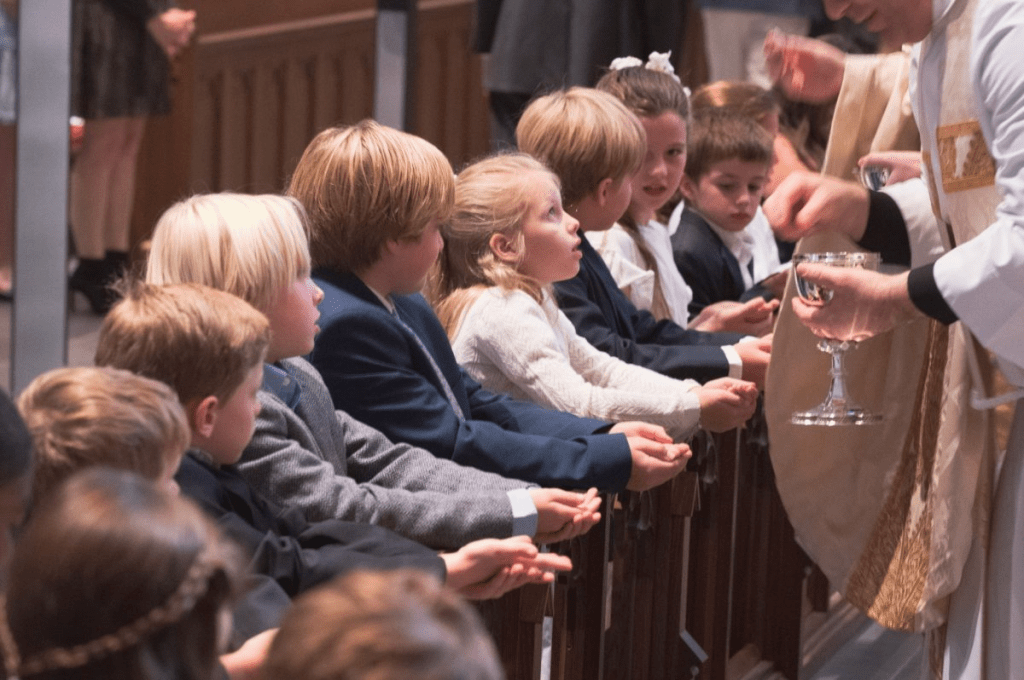
In that process of salvation, of coming to know Jesus, we have the sacrament of the Lord’s Table to strengthen our faith and demonstrate to us that the saving work of Jesus that has been accomplished. It is a Table of grace for all the members of Christ’s Church. 

In my Reformed Christian tradition, we believe that Jesus is not physically, but spiritually present at the Table.  Because Jesus is present, we are able to receive the grace available to us as Christ’s members. So why, in light of this reality, and the words and practice of Jesus toward children, would we ever hinder and prevent the smallest members among us from participating at the Table?

Here’s a thought: If Jesus himself were serving communion in a church, and a group of 2-year-old children came toddling up to the Table to see Jesus, would you stop them from doing so? Or much like the disciples, would you rebuke those bringing children to Jesus?

As for me, I’d rather not be rebuked by my Lord.

Jesus gave children the three gifts they most need: time, touch, and prayer. Parenting and teaching are holy vocations, and we have the wonderful privilege of bestowing these same gifts on our children, grandchildren, and students.

Time, touch, and prayer are ways we bless children. And, what’s more, as God’s children, we are all to approach Jesus and spend time with him, allow him to touch us, and interact with him through prayer. 

May we all have the humility to bend down at eye level to the littlest among us so that we and others will know that the kingdom of God is among us.