The Time Is Ripe (Galatians 4:1-7)

What I am saying is that as long as an heir is underage, he is no different from a slave, although he owns the whole estate. The heir is subject to guardians and trustees until the time set by his father. So also, when we were underage, we were in slavery under the elemental spiritual forces of the world. 

But when the set time had fully come, God sent his Son, born of a woman, born under the law, to redeem those under the law, that we might receive adoption to sonship. Because you are his sons, God sent the Spirit of his Son into our hearts, the Spirit who calls out, “Abba, Father.” So you are no longer a slave, but God’s child; and since you are his child, God has made you also an heir. (New International Version)

The three greatest persons in biblical history – Abraham, Moses, and Jesus – are connected. God entered into a covenant with Abraham and promised to bless everyone on the earth through his progeny. God gave Moses the Law as a sort of school teacher and guide, alongside Abraham’s covenant. God fulfilled the covenant promise in Jesus. Thus, everyone who is led and tutored toward Christ, inherits all of God’s promises.

Under the Law

The Apostle Paul, speaking to a group of new believers who were confused about the relation between the Law and Christ, helped them understand with a metaphor. It’s like a boy who is the heir to a great estate. Someday, it will all be his. But now, he’s too young to possess it. So, during his childhood, he’s subject to trustees who oversee the estate, and teachers who instruct him in how to actually use the wealth once he actually inherits it.

While the boy is in the middle of the guidance, he’s not in control of much, just like the servants on the estate. The child will remain in this state until his time comes, until the date in which his father says he can take possession of the inheritance.

Before Christ, people were under the Law. They were heirs to God’s great kingdom promises. Yet, they needed the Law to guide and instruct them until it was time for them to receive the inheritance. Much like a present day kid in school, they see themselves in a sort of bondage, even though it’s a necessary part of their lives.

It’s bondage in the sense that the Law, the schoolmaster, has no power or ability to give the inheritance nor to save them from their current condition. In other words, the Law is good, yet lacks the potency to actually deliver one from sin, death, and hell.

What’s more, the elemental spirits of the age, namely Satan and his wicked spirits, wormed their way into the process of guidance and twisted the Law for their own advantage, to keep people in bondage. Just as the guardian of the boy may mistreat him in ways his father never intended, so the devil has exploited the Law in order to have it be a tyrannical presence over people.

Whereas God intended the Law to reveal humanity’s sin and drive them to a Savior, evil uses the Law to shame people and drive them to despair. The Law was meant for good, to be a gracious leading of people to the Messiah; yet Satan co-opted the Law to bring condemnation to folks and keep them under his insidious thumb.

In Christ

But when the time was ripe, God sent the Son so that people would be done with their guardians and inherit divine promises. To use yet another metaphor, when the scaffolding on a building has served it’s intended purpose in construction, it’s taken down; it’s no longer needed. It would be weird if the shiny new building were erected, and the owner decided to keep the scaffolding beside the structure.

The Law of Moses had done its work of preparing people for Christ. So, God sent Jesus, the Son, to redeem humanity, to transform slaves into sons and daughters. The Lord adopted us and granted us full rights as children of the King.

Christ redeemed us from the curse of the Law by becoming a curse for us—because it is written, Everyone who is hung on a tree is cursed.

Galatians 3:13, CEB

Jesus is uniquely qualified to be such a Redeemer of humanity. He is God’s Son, born of a human mother. Therefore, as both divine and human – the God Man – Jesus is the person for whom all the covenant promises of God have their fulfillment.

In the past God spoke to our ancestors many times and in many ways through the prophets, but in these last days he has spoken to us through his Son. He is the one through whom God created the universe, the one whom God has chosen to possess all things at the end. He reflects the brightness of God’s glory and is the exact likeness of God’s own being, sustaining the universe with his powerful word. After achieving forgiveness for the sins of all human beings, he sat down in heaven at the right side of God, the Supreme Power. (Hebrews 1:1-3, GNT)

In Christian trinitarian theology, God is Three in One, the Holy Trinity. God sent the Son into the world, of which believers celebrate the incarnation of Christ each year at Christmas. God sent the Spirit into our hearts; and from that place we cry “Abba! Father!” The Spirit testifies with our own spirit that we are truly adopted children of God. (Romans 8:15-16)
The Spirit is like the seal on a document, proving that our inheritance papers are all in order. And, much more than that, the Spirit also does this sealing work with affection. Christianity is not merely a legal transaction; it’s an experience of grace and love in which we enter into a new life, free from bondage, and alive to all the possibilities that humanity was originally meant for.

Both our status and our sensibilities are changed. It happens because of God’s good grace and purpose, fulfilled in Christ and impressed on us by the Spirit.

Conclusion

The French philosopher and writer, Blaise Pascal (1623-1662), once said that there is a God-shaped vacuum in the heart of each person which needs to be filled:

“There was once in man a true happiness, of which all that now remains is the empty print and trace. This he tries in vain to fill with everything around him, seeking in things that are not there the help he cannot find in those that are, though none can help, since this infinite abyss can be filled only with an infinite and immutable object; in other words by God himself.” Blaise Pascal, Pensées

If we want to find happiness, satisfaction, and goodwill, then the empty void within us creatures and within the systems and the cultures we create, needs to be filled with our Creator.

The Christian season of Advent is an appropriate time to reconnect with the infinite and the immutable. The time is ripe to be filled not only with love and goodness, but with the very source of Love itself.

May it be so, to the glory of God.

Future Hope (Isaiah 29:17-24)

Soon the forest of Lebanon
will become a field with crops,
    thick as a forest.
The deaf will be able to hear
    whatever is read to them;
the blind will be freed
    from a life of darkness.
The poor and the needy
    will celebrate and shout
because of the Lord,
    the holy God of Israel.

All who are cruel and arrogant
    will be gone forever.
Those who live by crime
    will disappear,
together with everyone
    who tells lies in court
and keeps innocent people
    from getting a fair trial.

The Lord who rescued Abraham
has this to say
    about Jacob’s descendants:
“They will no longer
    be ashamed and disgraced.
When they see how great
    I have made their nation,
they will praise and honor me,
    the holy God of Israel.
Everyone who is confused
    will understand,
and all who have complained
    will obey my teaching.” (Contemporary English Version)

We, who have the first fruits of the Spirit, groan inwardly as we wait eagerly for our adoption to sonship, the redemption of our bodies. For in this hope we were saved. But hope that is seen is no hope at all. Who hopes for what they already have? But if we hope for what we do not yet have, we wait for it patiently.

Romans 8:23-25, NIV

There are better days ahead. And it is this hope which is to help sustain us in present – because the current reality for many people is hard and unforgiving. Malevolent and heartless people exist, and they wreak physical, mental, emotional, and even spiritual havoc on those around them.

When in the throes of difficulty, it is good to be reminded that basic human kindness will once again be exalted and valued. Yet, meanwhile, we must endure the evil of dehumanizing behavior. Until then, we must do our best to connect heaven and earth by rehumanizing every space and place within our sphere on influence. We are to be agents of hope for ourselves and for others.

Every person (and I do mean every person) on planet earth is created in the image and likeness of God. Each individual human being is worthy of basic human kindness and deserving of respect. 

Unfortunately, people do and say terrible things every day. Yet this never means that God’s image has left or has taken a vacation, or that someone deserves a pejorative label which stigmatizes and ostracizes them from the human family. 

For the Christian, the supreme ethic of life is love. We hold to the Great Commandment: Love God and neighbor; all other commands of Holy Scripture hang on these two bedrock commands, upheld by Jesus himself.

Therefore we must all ask ourselves if we are living our lives and loving others in this world as intended by our Creator and Redeemer. Hate speech, unsafe working conditions, political gerrymandering, apathy toward another’s injustice, a lack of empathy, and vilifying particular people groups are just a few examples of dehumanizing behavior.

If ever we move down the path of claiming to know whom God judges or ought to judge, then we have gone the way of extreme hubris and are germinating the seeds of a future holocaust of killing, not a future hope of peace and goodness. 

There is no biblical precedent or place to dehumanize another person or group of people, period. Instead, we must actively build relationships with a broad spectrum of groups and individuals – especially with the ones we least know and understand.

The injustice of dehumanization will not always be with us. Confusion and complaints will give way to clarity, understanding, humility, and obedience. Darkness and deafness, poverty and petulance shall melt away. In its place, love and grace will forever be ensconced upon a new earth, free from crime and shame. Hope will be realized.

Our future hope is a living hope.

We typically use the term “hope” in the wishful thinking sort of way. That’s because we aren’t quite sure if things will shake-out like we want. Biblical hope is not wishful thinking but a confident expectation that knows what is coming. 

Hope is like anticipating the seasons. In the dead of winter when it’s bitter cold with little sunshine, we hopefor Spring. It’s not wishful thinking. We know it’s coming. It might come in early March, maybe in late April. But it’s coming, and you can bet the farm on it. The trees will bud, the grass will turn green, and the temps will warm.

Hope in the Bible is a sure thing. Because of the person and work of Jesus Christ, there is hope, the confident expectation that deliverance from sin, death, and hell will be fully realized.

Hope, inheritance, and salvation are all words that describe nearly the same thing. They all point to Jesus. We are saved from the slavery of sin through the cross and resurrection of Christ. We are delivered into an inheritance which can never perish, spoil, or fade. But an inheritance isn’t activated until death. Someday, when this present life of earthly brokenness is over, we have the hope, the confident expectation, of a permanent inheritance with Jesus forever. (1 Peter 1:3-9)

Outwardly, we suffer in all kinds of earthly grief from others who don’t understand us. Inwardly, we have the silent pain and terrible wrestling of wanting to forgive but desiring revenge; of seeking to be gracious but seething with anger; of looking to express kind words but having hate speech blurt out instead.

But it won’t always be this way. We have a future living hope. In this season of Advent, we are reminded that God shall break into this fallen world with all of its dehumanizing behaviors and hate speech. The hopes and fears of all the years are met in a humble feeding trough, in a little baby.

Hope is as real as anything you’ll ever know this side of heaven. You might not always find what you’re looking for in this life; but in the next life, you can find the life that is truly life. For Jesus Christ is our hope.

God of hope, we seek you. During this holy season of Advent, help us to see you in all whom we encounter. We seek you in the crude manger, a child born to save the world. May your hope be a comfort to all who long for justice; and may that hope overflow in our hearts and grace our lips so that we might reflect your hope for all the world. Amen.

He Has Done Great Things For Me (Luke 1:46-55)

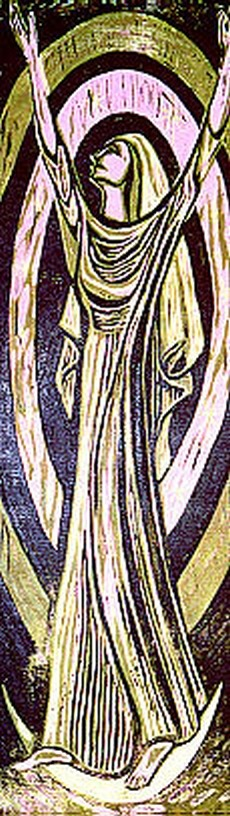
Madonna of the Magnificat by Sr. Mary Grace Thul

And Mary said,

“My soul magnifies the Lord,
    and my spirit rejoices in God my Savior,
for he has looked with favor on the lowly state of his servant.
    Surely from now on all generations will call me blessed,
for the Mighty One has done great things for me,
    and holy is his name;
indeed, his mercy is for those who fear him
    from generation to generation.
He has shown strength with his arm;
    he has scattered the proud in the imagination of their hearts.
He has brought down the powerful from their thrones
    and lifted up the lowly;
he has filled the hungry with good things
    and sent the rich away empty.
He has come to the aid of his child Israel,
    in remembrance of his mercy,
according to the promise he made to our ancestors,
    to Abraham and to his descendants forever.” (New Revised Standard Version)

Mary’s great song of praise, her “Magnificat” came from having grasped the reality of being pregnant with the Messiah. She affirmed that the all-powerful God “has done great things for me.” 

Indeed, the Lord shows mercy to everyone who worships and adores such mighty acts. It strikes me that Mary, instead of being full of worry and afraid of the future, and as an unmarried teen with child, is full of the Spirit and faith. 

Mary, the mother of Jesus, neither complained nor fretted for the nine months of her pregnancy; she praised God and had clear-headed faith about the grace shown to her. Mary’s canticle gives us insight into the mystery of the Christ’s incarnation: God chooses the weak, those of low esteem, and the powerless.

Mary was quite ordinary for her day. She had no wealth. There was nothing which caused anyone to pick her out of a crowd. Yet, she is the one chosen by God.

Her wonderful response to God’s grace demonstrated that there is so much more to any person than what we can see with our eyes and perceive through our earthly glasses of high positions and strength of personalities.

What’s more, Mary had the wisdom to discern that her situation typified the Lord’s egalitarian work of leveling the field so that all persons have what they need.

Her son, the Messiah, would carry this into his own life and ministry – declaring good news to the poor, comforting the brokenhearted, proclaiming freedom for captives, telling those who mourn that the time of the Lord’s favor has come.

Statue of Mary, Stella Maris Chapel, St. Joseph, Minnesota

God is full of grace, mercy, and strength to those who are powerless and in need of help. The Lord has our back. Perhaps if we all, both individually and corporately, continually used our words to identify and declare the great things God has done, then we would realize and have awareness of the Lord’s abiding blessing. 

One good way of gaining a greater awareness and appreciation of God’s gravity of grace is by journaling.

I encourage you to take some time today and write out some of the ways God has been good to you in the past days, weeks, or months.

Perhaps you might even craft your own song of praise, like Mary, and poetically and/or musically express your gratitude. Or maybe, instead of using words, a sketch or a painting may better communicate the great things God has done for you.

However you choose to do it, like Mary, offer praise for each act of mercy which comes to your memory. 

An outsider, looking in, might judge Mary to be helpless and weak, not the sort of a person who could carry a Messiah. Yet, we get a view from the inside, a glimpse into Mary’s heart. All along, she had her heart calibrated to detect the grace of God when it was present.

May we all follow her example of faith and confidence.

My Soul Magnifies The Lord ~ Chris Tomlin 

O Lord Jesus Christ, Son of God, Son of Humanity: Make me worthy to understand the profound mystery of your holy incarnation, which has happened for our sake and for our salvation.

Truly there is nothing so great and wonderful that you, my God, the Creator and Sustainer of all things, should become a creature, so that we might become children of God.

You have humbled yourself and made yourself small that we might be made mighty.

You have taken the form of a servant, so that you might confer upon us a royal and divine beauty.

You, who are beyond our understanding, have made yourself understandable to us in Jesus Christ.

You, who are the uncreated God, have made yourself a creature for us.

You, who are the untouchable One, have made yourself touchable to us.

You, who are Most High, make us capable of understanding your amazing love and the wonderful things you have done for us.

Make us able to understand the mystery of your incarnation, the mystery of your life, example, and doctrine, the mystery of your cross and passion, the mystery of your resurrection and ascension. Blessed are you, O Lord, for coming to earth as a man.

You have done great things for me!

Amen, and amen.

John 1:14-18 – This Is the One

The Word became flesh and blood,
    and moved into the neighborhood.
We saw the glory with our own eyes,
    the one-of-a-kind glory,
    like Father, like Son,
Generous inside and out,
    true from start to finish.

John pointed him out and called, “This is the One! The One I told you was coming after me but in fact was ahead of me. He has always been ahead of me, has always had the first word.”

We all live off his generous abundance,
    gift after gift after gift.
We got the basics from Moses,
    and then this exuberant giving and receiving,
This endless knowing and understanding—
    all this came through Jesus, the Messiah.
No one has ever seen God,
    not so much as a glimpse.
This one-of-a-kind God-Expression,
    who exists at the very heart of the Father,
    has made him plain as day. (The Message)

This is an astounding passage of Holy Scripture! These are verses to savor and not quickly read through. The Apostle John’s opening comments to his Gospel are theologically rich, lovingly beautiful, and missionally sensitive. 

The high and holy God has chosen to come and show himself to us in the person of Jesus. We know God through Christ. We learn about what God is like through Jesus. God has condescended to us, bent down and communicated to us through means we can understand and discern, through the Lord Jesus. 

In the biggest cities of the world, like Mexico City, Mexico and Manilla, Philippines, there are huge garbage dumps that cover several square miles. On top of these heaps of waste there live thousands of families who have made this their home. 

Each day they send their kids out to forage for scraps so they can have something to eat and survive. Few others tread where these families are. Yet, there are believers who make the journey and try to bring the love of God to such a place.

As incredible and sad a situation this is, the journey from heaven to earth that Jesus made has no comparison.  Christ came to the sin-soaked dump of this world, to us who were living on a heap of garbage and entered into our lives to save us from our wretched condition.

“The Self-revealing of the Word is in every dimension – above, in creation; below, in the Incarnation; in the depth, in Hades; in the breadth, throughout the world. All things have been filled with the knowledge of God.”

St. Athanasius, On the Incarnation

Jesus did not just appear to be human. He actually became one of us. Christ, the rightful King of the universe, chose to live with all the same things we face from day to day.  He “tabernacled” with us, using the imagery of God’s presence with the ancient Israelites through their desert journey.

John and the other Gospel writers were evangelists; they wrote so that people might believe in Jesus and clearly see what God is doing for them amidst the grinding spiritual and physical poverty of this fallen world.

The Apostle John saw and experienced first-hand Jesus interacting with families in the dump. John knew what was happening; God was coming to save the people. 

The way to reach people, who are so concerned for scurrying about their business and trying to survive apart from God, is through the incarnation. Christ’s descent to this earth – his earthly ministry, his crucifixion, death, resurrection and subsequent ascension back to heaven – demonstrated how we, as his followers, are to live our lives.

Believers in Jesus testify to what God has done in Christ. They do so through being little incarnations, entering fully into people’s lives with the grace and compassion given them by their Lord. Christians are to be like the moon, not we ourselves producing light, but in the middle of darkness, reflecting the light of the sun (Son) so that the earth may know that Jesus cares and can deliver them.

The sort of God that Christians worship and serve is an over-the-top gracious and generous God who has gone to the most incredible lengths possible to restore lost humanity. 

Since God has bridged the great chasm between heaven and earth, the very least we can do is walk across the street, or across the room, and develop a new relationship with someone who needs the sort of deliverance Jesus can expertly provide. 

This is the One, Jesus, who shows us the glory of God.

God’s loving initiative can become our own motivation. Sit and soak with this wonderful passage of the New Testament today. Let it seep deep into your soul. Allow it to shape how you live your life.

Almighty God, whose blessed Son, our Savior Jesus Christ, ascended far above all heavens that he might fill all things: Mercifully give us faith to perceive that, according to his promise, he abides with his Church on earth, even to the end of the ages; through Jesus Christ our Lord, who lives and reigns with you and the Holy Spirit, one God, in glory everlasting. Amen.