Luke 9:1-6 – On Power, Authority, and Mission

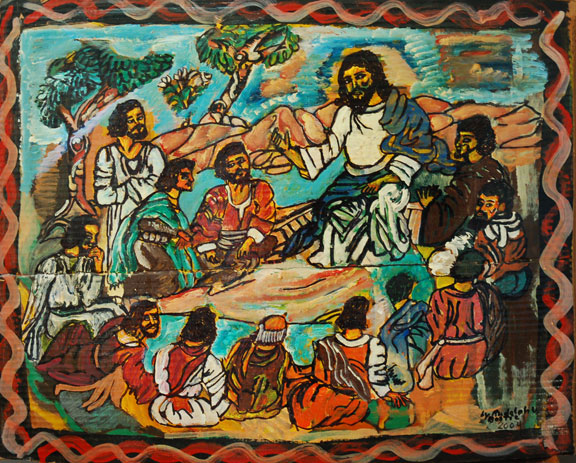
Jesus and the Disciples by Rudolph Bostic (1941-2021)

Jesus called the Twelve together and he gave them power and authority over all demons and to heal sicknesses. He sent them out to proclaim God’s kingdom and to heal the sick. He told them, “Take nothing for the journey—no walking stick, no bag, no bread, no money, not even an extra shirt. Whatever house you enter, remain there until you leave that place. Wherever they don’t welcome you, as you leave that city, shake the dust off your feet as a witness against them.” They departed and went through the villages proclaiming the good news and healing people everywhere. (Common English Bible)

You have likely heard the old nineteenth century adage from a member of the British Parliament, Lord Acton: “Power tends to corrupt, and absolute power corrupts absolutely.” The rest of the quote, which we seldom hear is this: “Great men are almost always bad men, even when they exercise influence and not authority.”

It’s almost as if Jesus knew this well before Lord Acton uttered it nearly two millennia later. Jesus Christ, in a truly wise and generous display of leadership, shared his power and authority with others. Rather than hoarding power and using authority to gain more authority, the Lord Jesus, rightful Ruler of the universe, delegated power and enabled those who ministered with him to share in carrying out his mission.

The only real Christian ministry is a bestowed ministry, granted to us by the delegation of Jesus. What this means for us, practically, is that believers minister as servants of God and stewards of the power and authority given to us. Grasping this basic accountability helps us to truly serve others with sensitivity and care – knowing we must give an account for the privilege of ministering in Christ’s name.

“There is no stronger test of a person’s character than power and authority, exciting as they do every passion, and discovering every latent vice.”

Plutarch (46-119, C.E.)

This has tremendous implications for us in all areas of life. Within the family, this means that parental authority can and ought to be delegated in wise increments, over time, as children grow and mature. The concept that a dad should be some sort of supreme leader who barks orders and demands fealty from mom and the kids is downright misguided, not to mention incredibly weird.

It also means that in the church and in faith communities, the wise use of power and authority will seek to identify and mentor younger disciples who will be given appropriate authority for expected ministry. Church leadership will listen to and equip those who have passions for particular service with the requisite authority to engage in effective ministry.

At the workplace, this involves forsaking a top-down approach of authority in favor of distributing power equitably amongst the workers with the greatest responsibilities.

In the political arena, this means Christians won’t tie their hopes in gaining power but rather in giving it away. They will seek equity and the common good of all citizens. And if that means deferring to a voice which isn’t being heard, then that is precisely what we do. Perhaps we see so little civility and concern for the other because Christians are much too enamored with dramatic miracles fueled by power.

Mosaic in the Papal Basilica, Rome, of Jesus and Disciples

Let’s not lose sight of the reality that healing sicknesses and suppressing the demonic is solely derived from Christ’s own authority, not ours. To press this reality home, Jesus instructed his disciples to take nothing with them. No staff, bread, bag, or money. Live among the locals, with them, on their turf and with their activities. Use the power and authority given to improve their lives and in so doing, lead them to greater spiritual truths.

If they don’t accept this gracious ministry, move on. No arm-twisting. No manipulation. No guilt-tripping. And definitely no using your given authority for grandstanding. A simple warning with shaking the dust off the feet is sufficient.

Every detail of the mission Christ gave to the disciples was a lesson in sheer and total dependence on God. Humble ministry and modest lifestyle will set the best table for a proper focus on benevolent and compassionate ministry. Just as increased knowledge ought to be used to love better and show us how much we actually don’t know, so increased authority ought to be used to serve others better and show us how much power we don’t have so that we might continually seek after the God who possesses all power and authority.

The good news is that God’s infinite and supreme power is given and focused in the person of Jesus Christ, who in turn, graciously bestows the authority to his followers so that they may proclaim forgiveness and new life. It’s a big message requiring large authority. And Jesus freely gives it:

And Jesus came and said to them, “All authority in heaven and on earth has been given to me. Go therefore and make disciples of all nations, baptizing them in the name of the Father and of the Son and of the Holy Spirit, and teaching them to obey everything that I have commanded you. And remember, I am with you always, to the end of the age.” (Matthew 28:18-20, NRSV)

It’s enough to make old Lord Acton smile in his grave.

Eternal God, you call us to live with faith in a world filled with so many challenges. Help us remember our mandate and our mission to use our given authority properly, lovingly, and confidently with obedience to our Lord.

Teach us by your Word, through our brothers and sisters in Christ, and in our prayers to learn and understand what you would have us to be and to do, so that we may fulfil our calling as Christ’s Body here on earth.

Draw your church together into one great company of disciples, together following our Lord Jesus Christ into every walk of life, together serving him in his mission to the world, and together witnessing to his love, in the strength of your Holy Spirit. Amen.


John 13:1-17 – Stinky Feet Love

Jesus washing the feet of the disciples, by Leszek Forczek

Now before the festival of the Passover, Jesus knew that his hour had come to depart from this world and go to the Father. Having loved his own who were in the world, he loved them to the end. The devil had already put it into the heart of Judas son of Simon Iscariot to betray him. And during supper Jesus, knowing that the Father had given all things into his hands, and that he had come from God and was going to God, got up from the table, took off his outer robe, and tied a towel around himself. Then he poured water into a basin and began to wash the disciples’ feet and to wipe them with the towel that was tied around him. He came to Simon Peter, who said to him, “Lord, are you going to wash my feet?” Jesus answered, “You do not know now what I am doing, but later you will understand.” Peter said to him, “You will never wash my feet.” Jesus answered, “Unless I wash you, you have no share with me.” Simon Peter said to him, “Lord, not my feet only but also my hands and my head!” Jesus said to him, “One who has bathed does not need to wash, except for the feet, but is entirely clean. And you are clean, though not all of you.” For he knew who was to betray him; for this reason, he said, “Not all of you are clean.”

After he had washed their feet, had put on his robe, and had returned to the table, he said to them, “Do you know what I have done to you? You call me Teacher and Lord—and you are right, for that is what I am. So, if I, your Lord and Teacher, have washed your feet, you also ought to wash one another’s feet. For I have set you an example, that you also should do as I have done to you. Very truly, I tell you, servants are not greater than their master, nor are messengers greater than the one who sent them. If you know these things, you are blessed if you do them. (New Revised Standard Version)

One of the reasons I like Jesus so much is that he loves me as I am, and not as I should be. Jesus loves me even with my dirty stinky feet, my herky-jerky commitment to him, and my pre-meditated sin. Jesus loved even Judas and washed his feet. Jesus serves people because they need his love, and not so that they will love him back.

I read about a man who lives in Paris. His wife has Alzheimer’s. He was an important businessman, and his life was filled with busyness. Yet, he said when his wife fell sick, “I just couldn’t put her into an institution, so I kept her. I fed her. I bathed her. Through the experience of serving my wife every day, I have changed. I have become more human. The other night, in the middle of the night, my wife woke me up. She came out of the fog for a moment, and she said, ‘Darling, I just want to say thank you for all you are doing for me.’ Then she fell back into the fog. I wept for hours to know this grace.”

Sometimes Christ calls me to love people who either cannot or will not love me in return. They live in the fog of some sort of disability, depression, poverty, or common spiritual blindness. As I serve them, I may only receive brief glimpses of gratitude. Just as Jesus loves me within my own spiritual confusion, so I desire to continue loving others as they walk through whatever fog they are in.

Lord willing, my life will be useful through my words and my witness. If God desires, my life will bear fruit through my prayers, my service, and my love. Yet, the usefulness of my life is God’s concern, not mine; it would be indecent of me to worry about that. I simply desire follow my Lord’s example.

Neither many Christians nor churches wash feet anymore. So, the following is today’s Gospel lesson put in a slightly different context:

It was just before the biggest and most important feast of the year, Passover. Jesus knew that it was finally the time for him to face the cross and die for the world’s sins. Having spent the past three years loving his followers, he now wanted to leave them with a clear demonstration of his love that they would never forget.

The evening meal was being served, and the devil had already gotten a hold of Judas Iscariot to betray Jesus to those who wanted him dead and gone. But it was all according to plan. Jesus knew that his heavenly Father had given him all authority because he was his Son, and he was ready to do what needed to be done to secure salvation and return to his rightful place at his Father’s right hand.  So, Jesus got up from the meal, rolled up his sleeves, put an apron on, and ran a sink full of hot water.  Jesus told the servants to take the night off, and he began taking the dishes from the dinner table and started washing them, taking care to do all that waiters and dishwashers would do.

When Jesus came to take care of Simon Peter’s dishes and serve him dessert and coffee, Peter said to him, “Lord, are you going to serve me?” Jesus replied, “I know you do not understand why I am doing this since it seems like something that is beneath me to do, but later you will look back on this night and understand completely what I am doing.”

“No,” said Peter, “this is not right – you are the Master, and this is not what a well-respected rabbi does – you are only disrespecting yourself and making us all look foolish. You are not going to take my dishes and wash them.”

Jesus answered, “Unless I wash these dishes and serve you, you are not going to be able to follow me anymore and you will have no part of what I am doing in this world.”

“Well, then, Lord,” Simon Peter replied, “if that is the way it really is, then don’t just wash the dishes – come on over to my place and clean out the fridge and scrub the kitchen floor!”

Jesus answered, “A person who has had a decent meal needs only to wash the dishes so that he can enjoy the freedom of hospitable relationships with me and those around him.  And all of you here have had a decent meal, though not every one of you.”  For Jesus knew that Judas was only picking at his food in anticipation of betraying him.

When Jesus was all done washing the dishes and serving his disciples, he took his apron off, rolled his sleeves back down, and returned to the table.  He looked them all squarely in the eye and said, “Do you understand what I just did for you?  You call me ‘Teacher’ and ‘Master,’ and rightly so, for that is exactly what I am.  So, now that I, your Master, and your Teacher have washed your dishes, you also should wash one another’s dishes.  I have set you an example that you should do as I have done for you.  I am telling you the plain truth that no follower is greater than the one he follows, nor is a preacher greater than the one he preaches about.  Now that you know that it is your task in this life to provide humble loving service, you will have God’s stamp of approval on your life if you quit thinking about how to possess and use power for your own purposes and start thinking about how to use the authority I am giving you to love other people into the kingdom of God.

Loving Lord Jesus, how shocking it was for your disciples to be served by you in such a humble manner.  But I cannot be spiritually cleansed unless I allow you to love me in an almost embarrassing fashion.  Help me not to be so proud that I neither refuse your humble loving service toward me, nor neglect to offer that same kind of service to others.  May love be the word, the idea, and the action that governs my every motivation and movement in your most gracious Name, I pray.  Amen.

Matthew 15:21-31 – Sense the Urgency

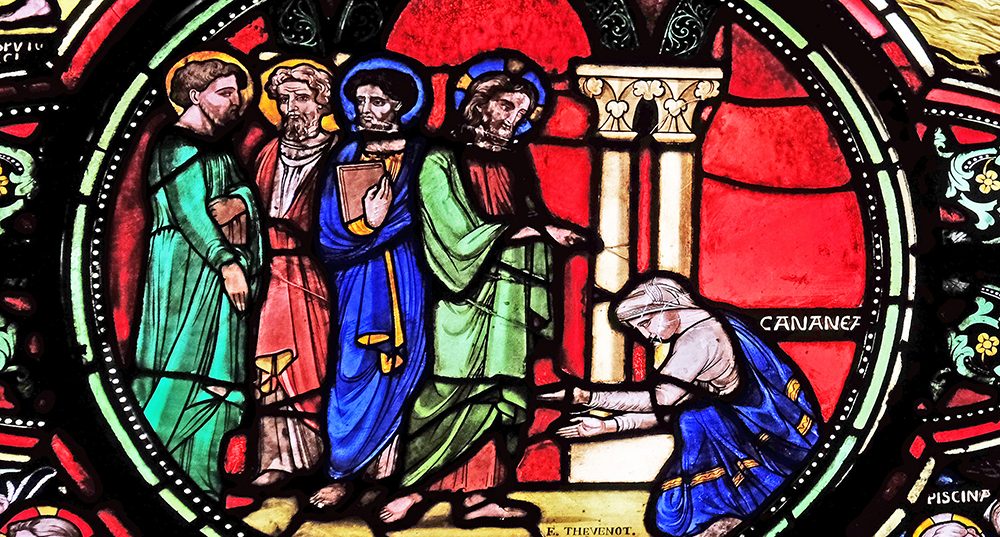
Woman of Canaan by Sadao Watanabe, 1965

Leaving that place, Jesus withdrew to the region of Tyre and Sidon. A Canaanite woman from that vicinity came to him, crying out, “Lord, Son of David, have mercy on me! My daughter is demon-possessed and suffering terribly.”

Jesus did not answer a word. So, his disciples came to him and urged him, “Send her away, for she keeps crying out after us.”

He answered, “I was sent only to the lost sheep of Israel.”

The woman came and knelt before him. “Lord, help me!” she said.

He replied, “It is not right to take the children’s bread and toss it to the dogs.”

“Yes it is, Lord,” she said. “Even the dogs eat the crumbs that fall from their master’s table.”

Then Jesus said to her, “Woman, you have great faith! Your request is granted.” And her daughter was healed at that moment.

Jesus left there and went along the Sea of Galilee. Then he went up on a mountainside and sat down. Great crowds came to him, bringing the lame, the blind, the crippled, the mute and many others, and laid them at his feet; and he healed them. The people were amazed when they saw the mute speaking, the crippled made well, the lame walking and the blind seeing. And they praised the God of Israel. (New International Version)

Not much happens until something becomes urgent.

A doctor, a financial planner, or a preacher can tell us something until they are blue in the face, but it usually doesn’t mean much without a sense of urgency that a change must occur – that the way things are isn’t going to cut it any longer. 

We can say eating healthy is of value, yet unless there is a sense of urgency to it, it is difficult to do. Someone can proclaim that retirement savings is important, yet unless there is a sense of desperate action, it likely won’t happen. 

Christians say prayer is important, lost people matter to God, and ministry to youth is the hope of the world. Yet without a sense of urgency, there is procrastination and talking, resulting in zero change.

It’s the difference between law and gospel, or between duty and grace. The law and duty are important elements of the Christian life. The law shows us our sin and gives us direction how to live. However, law and duty can only take us so far – it cannot effect real and lasting change. Only the gospel of grace can do that. 

Law and duty alone won’t do it. And when we figure out it doesn’t work, we try and hide our struggle by keeping up the appearance of being a good Christian. Then, we boil down the rules of the Christian life to merely being nice and attending church (law). Our deep hurts and damaged emotions are handled by burying them in layers of law in order to protect ourselves from any more disappointment.

Nothing could be further from today’s Gospel lesson. We have a Gentile Canaanite woman, who is as far from God as one can get in the ancient world. She is neither concerned about appearances nor hiding to mask her pain. The woman cares about her daughter’s terrible suffering from demonization. She recognizes Jesus as the Promised One and seeks him out.

Only grace, not law-keeping, will save, deliver, or heal anyone.

Grace is bestowed to the humble who recognize the great urgency of needing Jesus – in God’s good timing, not ours. Faith is exemplified by a willingness to beg. It’s demonstrated with dogged persistence in the face of the slimmest of odds.

The Canaanite woman screams for help.

Her daughter is suffering. The region of Tyre and Sidon is demon territory – the home region of the Old Testament character, Jezebel – a place far from the covenant people of Israel’s ways. 

The woman has no leverage, no ground of appeal, and no spiritual pedigree. There is no way to approach Jesus by any other means than crying out to him with her deeply felt need. In her sense of urgency, noise and humility is all she has.

Jesus is silent.

Have you ever felt like God is silent, as though your prayers were doing nothing but bouncing off the ceiling? 

God is often silent. Yet, let’s not misinterpret this lack of response as thinking God didn’t hear, or doesn’t care, or something is wrong with me. Silence from God is just that – agonizing divine silence….

A superficial reading of the story may lead us to believe Jesus is aloof, or elitist, that maybe he isn’t interested in certain people. It seems to me, a better way of interpreting the silence is through the lens of our patience and perseverance, a sort of faith testing.

There is some mystery to this story we may never fully grasp. However, the story lets us know Jesus is not a coin machine where we can slip in a dollar and get immediate change. Jesus is a person, not a mechanism to figure out, to get what we want from him. This is not the way of grace.

The disciples want Jesus speaking to get rid of the screaming obnoxious woman.

“Holy cow, Jesus, just give her what she wants so she’ll go away!”  They wanted a healing, but it wasn’t out of a sense of compassion or grace. “After all, we’ve got important Jesus-work to do here, and we don’t need this woman upsetting the peace, rocking the boat, challenging the status quo, making waves, and ruining our sanctified party.” 

The disciples labeled the woman as loud and undeserving. Frankly, they may have been right. But they were operating out of law, not grace.

Jesus and the Canaanite woman, from Saint Germain-l’Auxerrois church in Paris, France

Sometimes the most compassionate thing we can do is not give everybody what they want, right away. 

Jesus did not come to this earth to ensure everybody gets their way and stays happy so that no one is upset. In fact, Christ did quite the opposite. Jesus sought to do his father’s will by establishing the kingdom of God on this earth – teaching values that weren’t part of the religious culture, telling the most “godly” people of the time they were a brood of vipers, and generally offending a lot of people who claimed to know God.

Jesus cared enough about the woman to not immediately give her what she wanted. She had to go hard after Jesus, to keep going after him, to exercise her faith muscle. 

Jesus doesn’t give the disciples what they want, either.

Two different petitions were given to Jesus, and his response doesn’t really address either one of those asking’s.  He just says he was sent to the lost sheep of Israel. Yet the woman responds as if she doesn’t even hear what Jesus just said.

The chosen nation of Israel was meant by God to be a missionary people. All nations on earth are blessed through Abraham, through the Jewish people. It has always been God’s design to have the Gentiles come to faith, and the way that was to happen was through Israel being a great missionary people proclaiming God and being a light to the nations. 

I tell you that Christ became a servant of the Jews to show that God has done what he promised their great ancestors. Christ also did this so that the non-Jewish people could praise God for the mercy he gives to them. The Scriptures say,

“So, I will give thanks to you among the people of other nations;
    I will sing praise to your name.” (Romans 15:8-9, ERV)

And that is exactly what happened. I am a Gentile Christian today because a small group of Jewish persons took the gospel of grace given them by Jesus and fulfilled their role as a missionary people.

The woman worships and tries Jesus again.

Jesus never said “no” to the woman. This was the basis for her asking again. She reasons much like an infatuated teenager who asks the girl of his affections, “so, what kind of chance do I have going out with you?”  The girl responds to the teenage boy, “a million to one.”  And the boy responds to her, “so, what you’re saying to me is that there’s a chance!”

Slim as the woman’s chances seem, she saw an opening where others might not. This is precisely the nature of true faith – it sees possibilities where none seem to exist.

This is raw, real, and persistent faith. If we don’t resonate with this kind of faith and persistence, there is not a sufficient level of urgency in our lives. The bald fact is: If we don’t pray, it’s because there is no desperation. We are still more fixed on law than gospel. Duty only goes so far.

Jesus still doesn’t answer the woman’s request, but gives her a metaphor about dogs, instead.

Jesus is restating what he said about the Jews: Salvation is through the Jews, not around them. We cannot ignore or get rid of the Old Testament because the gospel comes through it.

The woman still doesn’t give up but works with the metaphor.

She doesn’t argue with Jesus about being a dog; doesn’t insist she ought to be an exception; doesn’t say she has a right to be like the Jews; and doesn’t claim Jesus is being unfair or uncaring.

The woman simply accepts Christ’s words. Then, replies that even as a dog she would be allowed to receive a few crumbs from the table of the children. She might be a dog, but she’s still in the house, even if it’s under the highchair. The woman is looking for mercy as expectantly as my own dog looks at me with those sad brown eyes while I’m eating.

Jesus honors her faith.

Why? Because she humbly looked for grace. We need not write an essay to God about why our requests should be answered, as if Jesus needs convincing. We just need to seek the mercy of God.

Faith, coupled with urgency, doggedly persists. It believes Jesus will deliver. Great faith overcomes discouragement, despite the odds. It doesn’t listen to naysayers who want us to shut up and quit bothering them.  Urgent prayers are an unabashed begging before Jesus because only he can help. Begging isn’t sexy. It isn’t comfortable. But it’s needed.

So, pray. Pray like it’s the only thing that will make a difference. Pray with a sense of urgency. 

Matthew 16:5-12 – Beware of Bad Teaching

Later, after they crossed to the other side of the lake, the disciples discovered they had forgotten to bring any bread. “Watch out!” Jesus warned them. “Beware of the yeast of the Pharisees and Sadducees.”

At this they began to argue with each other because they hadn’t brought any bread. Jesus knew what they were saying, so he said, “You have so little faith! Why are you arguing with each other about having no bread? Don’t you understand even yet? Don’t you remember the 5,000 I fed with five loaves, and the baskets of leftovers you picked up? Or the 4,000 I fed with seven loaves, and the large baskets of leftovers you picked up? Why can’t you understand that I’m not talking about bread? So again, I say, ‘Beware of the yeast of the Pharisees and Sadducees.’”

Then at last they understood that he wasn’t speaking about the yeast in bread, but about the deceptive teaching of the Pharisees and Sadducees. (New Living Translation)

I tend to think in metaphors, which is probably one reason I like the teaching of Jesus so much. While on this earth, he used a range of metaphors from common everyday life to communicate his point. Seems as though the disciples were more concrete thinkers.

Yeast was a common symbol for evil, which is why the Jews ate unleavened bread. Jesus was trying to get the point across to his disciples that, like yeast, even just a little bit of unhealthy teaching can have far-reaching effects. Partaking of bad teaching works through the whole batch of dough and ruins the spiritual life.

We might think that after seeing Jesus heal the sick, raise a paralyzed man, cure the blind, restore the demon-possessed, walk on water, and feed the masses with only a few loaves of bread that his disciples would be clamoring with praise and responding with a big “Wow! Look at what Jesus did!  Tell us what to do next!”  Instead, they stood around mumbling about how to interpret the great feeding of the four thousand.

The math lesson Jesus explained to the disciples about the basketfuls of food that they had gathered was that the less the disciples had and the bigger their problem, the more Jesus did. 

Jesus Math adds up to grace.  And grace means that who we are, or are not, and what we have, or do not have, is immaterial; what matters is that we have Jesus. We give him what little we have, along with ourselves, and let him do the work.

We must avoid the trap and the temptation of thinking, “If only I had ___; If only I were ___.”  This is unsound doctrine because it denigrates the image of God within us and the good gifts God has already given to us, as if we ourselves are not enough. Yet, even if we have next to nothing, with few abilities, when offering it to Jesus, he turns it into a miraculous bounty of blessing for the world.

Seeing ourselves, our relationships, our stuff, and our world through the person and work of Jesus Christ is our task.  It does not take great powers of interpretation to see that the times are evil and bad information gets disseminated and spread.  What is more difficult for us is discerning that there is a great opportunity for mission and service amid this decaying world. 

We will miss that wonderful opportunity if we partake of bad teaching.

It is imperative that we feed upon sound teaching and be very discerning about who we listen to and what they are really saying to us. Words which are heavy with judgment and light on grace are to be suspect because such teaching is antithetical to the gospel.

Instruction which sets apart and demonizes groups of people or characterizes certain individuals as monstrous or animalistic is completely out of step with the way of Jesus Christ.

We are to be on our guard against any teaching which places an unrealistic and dispassionate heavy load of guilt and shame upon people. We must be vigilant to not accept teaching that plays upon people’s fear and twists reality, making groundless and unsubstantiated claims without evidence. In short, the Holy Scriptures are not to be used as a club to beat people into submission toward our way of thinking and acting.

The spiritual abuse and objectification of others by using the Bible is a terrible condition which unfortunately exists in today’s world. The sad reality is that there are people who engage in harassing others by using God’s Holy Word.

People have been created in the image and likeness of God, and therefore deserve to be treated with respect and civility, regardless of their creed, color, or condition.

So, let me be clear and deliberate about the use and abuse of God’s revelation to us:

I do not condone any use of the Bible which seeks to intimidate, bully, impede, or affect any person’s ability: to work effectively at their jobs, to worship joyfully at their church, or to live without fear of being blacklisted or redlined to the periphery of society.

I do not condone any use of the Bible which intends to control either by threat or by use of physical force any person, their family, and/or their property through inducing fear.

I do not condone any use of the Bible which justifies touching any person without their consent, or coerces, or physically forces another person to engage in a sexual act against their will.

I reject any use of the Bible which encourages any sort of hate crime, act of violence, or hate speech against any person regardless of their gender, sexual orientation, race, ethnicity, class, or religion.

I reject any use of the Bible by any clergy and/or church leadership which demeans and marginalizes women in their basic humanity, role, function, or leadership.

I reject any use of the Bible by any church member and/or attender which demeans and discounts the worldwide Christian community.

I uphold any use of the Bible which seeks to communicate its theology and message gently, carefully, graciously, and lovingly for the spiritual edification and healing of all people.

I uphold any use of the Bible which intends to cultivate one’s own soul and develop a teachable spirit.

I uphold any use of the Bible which looks for truth, wisdom, beauty, and humility.

I champion use of the Bible for both personal and corporate encouragement.

I champion use of the Bible for critical inquiry, scrutiny, and learning.

I champion use of the Bible for all people, regardless of age, including genuine seekers and spiritual misfits, as well as the hurt, abused, lonely, lost, confused, and concerned.