Mark 6:35-44 – You Want Us To Do What?

Late in the afternoon his disciples came to him and said, “This is a remote place, and it’s already getting late. Send the crowds away so they can go to the nearby farms and villages and buy something to eat.”

But Jesus said, “You feed them.”

“With what?” they asked. “We’d have to work for months to earn enough money to buy food for all these people!”

“How much bread do you have?” he asked. “Go and find out.”

They came back and reported, “We have five loaves of bread and two fish.”

Then Jesus told the disciples to have the people sit down in groups on the green grass. So, they sat down in groups of fifty or a hundred.

Jesus took the five loaves and two fish, looked up toward heaven, and blessed them. Then, breaking the loaves into pieces, he kept giving the bread to the disciples so they could distribute it to the people. He also divided the fish for everyone to share. They all ate as much as they wanted, and afterward, the disciples picked up twelve baskets of leftover bread and fish. A total of 5,000 men and their families were fed. (New Living Translation)

I once knew a dear church lady who made a pan of lasagna for a local soup kitchen. When she showed up, it turned out, other church ladies didn’t. Hers was to be one pan amongst many. Instead, it was the only one. When a long line formed of hungry impoverished people, she felt both compassion and heartsick. Her immediate thought was to go and buy several pans of lasagna. But she knew it would take too long, and she wasn’t even sure she could find enough to feed everyone.

So, rather than turning the people away, the dear woman looked up to heaven, uttered a prayer of thanksgiving to God for what little she had, and began serving. She said, “I just kept sticking my spatula into the pan, and lasagna kept coming out. By the time the last person in line came, I served the last of it. I can’t explain it. It just happened.”

No one left hungry.

Today’s Gospel lesson of Jesus feeding the five thousand men and their families is not just a nice account of something that happened a long time ago. Jesus is still doing miracles. The Lord is still expanding his benevolent reach all across God’s big world.

Jesus takes our meager resources and turns them into something with a large impact on a lot of people. For this to happen, all we need to do is follow our Lord’s simple instructions: “You feed them.” 

“But Jesus! I don’t have much money. I’m not a good organizer. I can’t do what you’re asking!”

“I don’t…” “I’m not…” “I can’t…” Jesus hears it every day.

Jesus really doesn’t want to hear about our “buts.” Maybe we ought to take the word “but” out of our language altogether. That’s because it’s not about us, at all.

Jesus can multiply whatever little we have to accomplish his benevolent work through us. 

Jesus could clearly do miracles without us having any involvement. Yet, he deliberately chooses to use us and our drop-in-the-bucket resources to participate in his work. Jesus wants to use our minds, our mouths, and the very marrow of our being to effect a miracle.

Our work is to bring Jesus our five small loaves and two fish. He’ll do the rest.
It is the compassion of Jesus which motivates him to miracles.

The crowd did not leave him alone. Rather than being annoyed by the situation because it was not on his agenda to deal with any people, Jesus looked at the large group of people and had compassion on them.  His heart went out to them.

God does not begrudgingly deal with us, as if we are an interruption to his day.

All these hungry people. What to do about it? “You feed them,” Jesus says. I perhaps detect a hint of sarcasm in the tone of the disciples reply: “We have only five loaves of bread and two fish.”  Their math was way off because they did not count Jesus. 

Through simple prayer and active obedience, we must give Jesus what we have, no matter how little or insignificant.

In this contemporary era, much of what we do is concerned to be reasonable and rational with a strong scientific or proven base for engaging ministry. Although I don’t have much of a stomach for believers who incessantly want a miracle for everything and see devils under every rock, I equally have no stomach for doing ministry as if it were an Enlightenment project, completely drained of all faith and the possibility of seeing God work in ways that are incomprehensible to our modern sensibilities.

Indeed, looking out at all the vast Western resources have accomplished with money and buildings and programs, it makes me want to explain, “This is amazing! It is incredible what we know-how American Christians can do without God!” 

I am curious what Christ’s Church would look like if we were to have an underlying presupposition and assumption that God is still in the business of doing miracles? I wonder: Would it impact the way we pray, and the way we act? 
What if we altogether forsook shame and had the boldness to say, “This might sound crazy, but what if we…”

  • “Found everyone in our city who needs food and go love on them and feed them” (instead of just going the rational route of only supplying the food pantry).
  • “Used our property to create a community garden and seek to help people grow their own food.” (instead of just giving out some food cards).
  • “Built a smart robot to plant the fields of disabled farmers and gave them the rights to the tech we developed.” (am I getting too crazy yet!?). 

In the kingdom of God, there are no boundaries – only unlimited opportunities to give our small ideas, little bits of strength, and puny resources to Jesus so that he can take it and feed the world.

Jesus is perfectly able to do his work without us and without what we have. However, he wants to use us and our meager resources to accomplish the miraculous meeting of needs far beyond what we could ever imagine. 

We too often do nothing. That’s because we mistakenly believe God either cannot or does not want to use me or what I have.

It just won’t do to stand afar off and expect God to work without us giving what we have, whether that something is time, money, conversation, food, hospitality, or whatever. Our excuses won’t do for Jesus – my home is too small, it is not clean enough, I don’t have enough money, I am not smart enough, my schedule won’t allow it, I don’t have enough resources…. All you need is something, no matter how seemingly insignificant it is.

You want me to do what? Feed thousands? The real pre-miracle work for many people is to be open, real, and transparent enough to believe Christ can do a miracle through confessing sin, participating in a ministry, having a spiritual conversation with somebody different than me, or just saying what I actually think and feel.  

The question is never, “Can God use me?” The real question is, “What miracle does Jesus want to do through me and through his Church?”

It was no accident when Jesus distributed the bread that it sounds a lot like communion.

The Lord’s Supper may seem to be irrelevant to some – as if it is only a way to remember Jesus, a mere regular ritual. Yet, God’s design is much bigger. Jesus wants to do a miracle through the distribution and ingestion of the common elements of bread and wine – a miracle of healing, a miracle of bringing true satisfaction the world can never give. 

It isn’t realistic to expect that Jesus can use the Table to feed and reach thousands. However, we don’t serve a God who is limited to work through rational means by only using our five senses. 

We serve a God who does unexpected miracles within the life of the community.

Lord, I believe. Help me in my unbelief! I open my mind and heart believing in your infinite power and possibility. I believe in your constant expression of perfect good in and through me. I know that with you all things are possible. All that I am, all I was, and all I hope to be I give to you. I am yours. Amen.

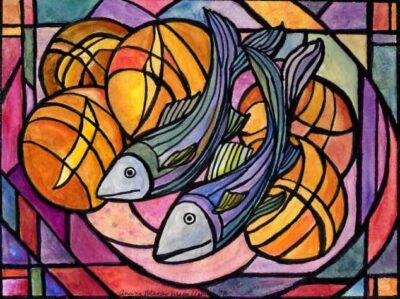
*Above painting: Feeding of the 5,000 by Laura James

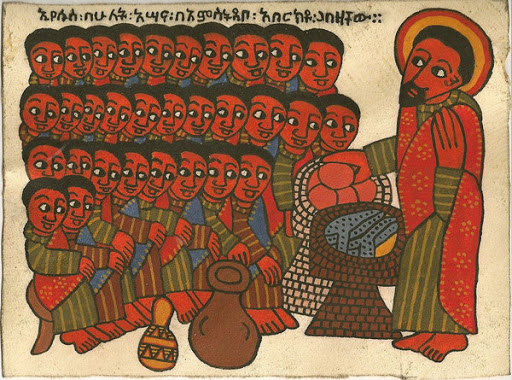
**Above: Ethiopian Orthodox Church depiction of Christ feeding the 5,000

John 4:31-38 – Real Food

Meanwhile his disciples urged him, “Rabbi, eat something.”

But he said to them, “I have food to eat that you know nothing about.”

Then his disciples said to each other, “Could someone have brought him food?”

“My food,” said Jesus, “is to do the will of him who sent me and to finish his work. Don’t you have a saying, ‘It’s still four months until harvest’? I tell you, open your eyes and look at the fields! They are ripe for harvest. Even now the one who reaps draws a wage and harvests a crop for eternal life, so that the sower and the reaper may be glad together. Thus, the saying ‘One sows, and another reaps’ is true. I sent you to reap what you have not worked for. Others have done the hard work, and you have reaped the benefits of their labor.” (New International Version)

Today’s Gospel narrative reads something like the stereotypical mother concerned for her son saying, “Sit down and eat some of Mama’s pasta. You need some food!” As if preparing and serving a meal will make everything better.

Food has both the power to bring us together, as well as separate us. A meal can create the conditions for fellowship, acceptance, and enjoyment. Eating can bond people together through hospitable love. On the other hand, sitting down to eat can also be a way to avoid painful emotions. In this manner, eating becomes an obstacle to giving and receiving love.

It seems Christ’s disciples were doing the latter. They were uncomfortable and perhaps a bit stressed. Looking to fill up with food instead of with God, the disciples’ sense of unfulfillment was coming out sideways by opening the refrigerator, poking through the meager leftovers, and putting the emphasis on feeling better.

I know we can be hard on the disciples in the Gospels. Their ups and downs from faith to fear and back to faith again can be weird. Yet, through it all, I believe their hearts (excepting Judas Iscariot) were in the right place.

Jesus could see through the entire scenario and put the focus off eating. He addressed the disciples’ soul hunger through putting the spotlight on doing the will of God. Deep within they were hungering and thirsting for righteousness.

Paying attention to our vocation and discovering our humble work in the service of God, rather than a vacation to the pantry to cover our unwanted feelings, is the essence of Christ’s interaction with his disciples.

People are much more ready for the gospel of Jesus than we think. There are times we can become so insular, and lost within our own heads, that we are then unable to see the world as ripe for a harvest of people who are actually eager to be gathered into the community of the redeemed.

Jesus just had a significant interaction with the Samaritan woman. Back in that day, you just didn’t have dialogues with half-breed Samaritans – an unholy mix of Jewish and hated ancient Assyrian Gentile blood – let alone a man talking with a woman of disrepute who experienced several failed marriages.

Christ had a way of doing the will of God, despite conventional thinking of the time. And a lot of people got their undies in a bundle from it. The disciples, having a front seat to most of Christ’s shenanigans, did a few too many palms to the forehead, believing their Rabbi’s un-orthopraxis was going to make him unpopular. They feared no one would follow him.

Looks like the disciples didn’t quite get that one right.

The Samaritan woman received Jesus as Living Water, having her ultimate needs met by the penultimate Lord of all. The disciples hadn’t quite caught up to this, so fell back on their old ways of physical food and drink to assuage the weirdness happening inside them.

The woman was gushing over with Living Water, becoming a wellspring of good news to her community. Whereas the disciples (eventually becoming an incredible fountain of the gospel after Christ’s death and resurrection) are here nothing but an annoying drip from the kitchen faucet.

A non-descript ethnically suspect woman of dubious character coming to faith was meant by Jesus to open the disciples’ eyes to a new reality: The good news of Christ is meant for the world, not just Jewish men.

The disciples were given the opportunity to participate in the world’s takeover – a mission of bringing the love of God where love wasn’t present, of helping all kinds of people awaken to the deep spirituality within them, of lifting their downcast faces of guilt and shame to see the Living God wanting to bless the world with the body and blood of Jesus.

For this is real food and real drink.

Many believers in Jesus today think they are working hard for the Lord by seeking people for their churches. Yet, the real work is being done by the triune God – the heavenly Father who scans the world and seeks spiritual misfits to bless; the gracious and truthful Son who put hands and feet to that blessing; and the wild Holy Spirit who moves in unpredictable ways – are working infinitely harder for our churches, our families, our neighborhoods, and our world.

All of our work, no matter how big or small, is made possible by the pre-work of the Holy Trinity. The great Three-in-One has done all the preparations of chopping the onions, mincing the garlic, slicing the carrots, and peeling the potatoes so that we, his followers, can make a savory stew of diverse people sharing a common pot of God’s love and hospitality.

This is the food we know nothing about, and that God knows intimately.

O God, you made us in your own image, and you have redeemed us through your Son Jesus Christ: Look with compassion on the whole human family; take away the arrogance and hatred which infect our hearts; break down the walls that separate us; unite us in bonds of love; and work through our struggle and confusion to accomplish your purposes on earth; that, in your good time, all nations and races may serve you in harmony around your heavenly throne; through Jesus Christ our Lord. Amen.

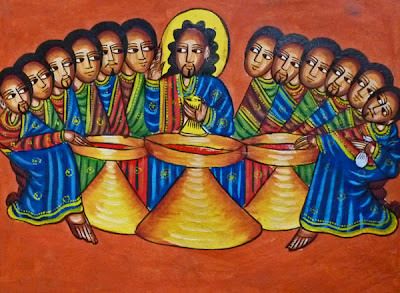
*Above painting: Ethiopian Orthodox Church depiction of the Last Supper

John 13:1-17, 31-35 – Maundy Thursday

Jesus Washes Peter’s Feet

It was before Passover, and Jesus knew that the time had come for him to leave this world and to return to the Father. He had always loved his followers in this world, and he loved them to the very end.

Even before the evening meal started, the devil had made Judas, the son of Simon Iscariot, decide to betray Jesus.

Jesus knew that he had come from God and would go back to God. He also knew that the Father had given him complete power. So, during the meal Jesus got up, removed his outer garment, and wrapped a towel around his waist. He put some water into a large bowl. Then he began washing his disciples’ feet and drying them with the towel he was wearing.

But when he came to Simon Peter, that disciple asked, “Lord, are you going to wash my feet?”

Jesus answered, “You don’t really know what I am doing, but later you will understand.”

“You will never wash my feet!” Peter replied.

“If I don’t wash you,” Jesus told him, “you don’t really belong to me.”

Peter said, “Lord, don’t wash just my feet. Wash my hands and my head.”

Jesus answered, “People who have bathed and are clean all over need to wash just their feet. And you, my disciples, are clean, except for one of you.” Jesus knew who would betray him. That is why he said, “except for one of you.”

After Jesus had washed his disciples’ feet and had put his outer garment back on, he sat down again. Then he said:

Do you understand what I have done? You call me your teacher and Lord, and you should, because that is who I am. And if your Lord and teacher has washed your feet, you should do the same for each other. I have set the example, and you should do for each other exactly what I have done for you. I tell you for certain that servants are not greater than their master, and messengers are not greater than the one who sent them. You know these things, and God will bless you, if you do them….

Now the Son of Man will be given glory, and he will bring glory to God. Then, after God is given glory because of him, God will bring glory to him, and God will do it very soon.

My children, I will be with you for a little while longer. Then you will look for me, but you won’t find me. I tell you just as I told the people, “You cannot go where I am going.” But I am giving you a new command. You must love each other, just as I have loved you. If you love each other, everyone will know that you are my disciples. (CEV)

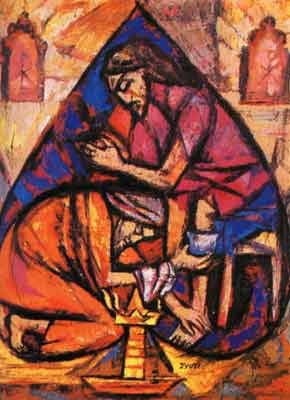
Jesus Washing the Feet of His Disciple by Japanese artist Sadao Watanabe (1913-1996)

We all need to receive love and to give love. Without love, there is little to live for. Apart from love, relationships devolve into silent standoffs and destructive triangles. Indeed, with an absence of love the world ceases to spin on its axis.

Yet, where love is present all things are beautiful. Personal relations have meaning and joy. All seems right and just in the world.

Love, however, comes at a cost. Because we live in a broken world full of pride and hubris, greed, and avarice, hate and envy, we are victims of loveless systems and unjust actions. We need love to rescue us, to redeem us from the sheer muck of existence. It’s as if we are constantly walking knee deep through sludge so thick, we can barely get anywhere. We need saving. We need Jesus.

Christians everywhere around the world are journeying through Holy Week, the most sacred time of the year for followers of Christ. When we think about Holy Week, we are familiar with Good Friday and certainly Easter, but Maundy Thursday? 

On this day, the Church remembers the final evening Jesus shared with his disciples in the upper room before his arrest and crucifixion. The experiences in the upper room were highly significant because this was the last teaching, modeling, and instruction Jesus gave before facing the cross. Jesus was careful and deliberate to communicate exactly what was important to him: to love one another.

Maundy Thursday marks three important events in Christ’s Last Supper with his disciples: 

  • The washing of the disciples’ feet (the action of loving service)
  • The instituting of the Lord’s Supper (the remembrance of loving sacrifice)
  • The giving of a “new” commandment to love one another (the mandate of a loving lifestyle). 

For Jesus, his last night with the disciples was all about love, God’s love. On that fateful night, having loved his disciples for the past three years, Jesus showed them the full extent of his love by taking the posture of a servant and washing each one of the disciples’ feet, including Judas. After demonstrating for them humble service, Jesus said,

“I have set you an example that you should do as I have done for you” (John 13:15, NIV). 

This was an incredible act of love. Jesus Christ loves me just as I am, and not as I should be. He loves me even with my dirty stinky feet, my herky-jerky commitment to him, and my pre-meditated sin. 

The Last Supper by Indian artist Francis Newton Souza (1924-2002)

Not only did Jesus wash the disciples’ feet, but he lifted the cup of wine and boldly asserted: 

“Take this and divide it among you.  For I tell you I will not drink again of the fruit of the vine until the kingdom of God comes.”  And he took the bread, gave thanks, and broke it, and gave it to them, saying, “This is my body given for you, do this in remembrance of me.”  In the same way, after the supper he took the cup saying, “This cup is the new covenant in my blood, which is poured out for you” (Luke 22:17-20, NIV). 

Because of these words, the church throughout the world, for two millennia, have practiced this communion so that we might have the redemptive events of Jesus pressed firmly into our minds and our hearts by means of the visceral and common elements of bread and wine. We are to not just know about Jesus; we are to experience being united with him.

Having washed the disciples’ feet, and proclaiming to them the meaning of his impending death, Jesus gave them a clear commandment: 

“A new command I give you: Love one another. As I have loved you, so you must love one another.  By this everyone will know that you are my disciples, if you love one another.” (John 13:34-35, NIV)

Love one another, insisted Jesus, by imitating his humble service. We represent Christ on this earth when we carefully, diligently, and persistently practice love. Although love was not a new concept for the disciples, in the form and teaching of Jesus love was shown with four distinctions: 

  1. Jesus is the new model of love.
  2. A new motive of love, that Christ first loved me.
  3. A new motivator to help us love, the Holy Spirit.
  4. A new mission, the evangelization of the world, utilizing the power of Christ’s love to accomplish it.

Maundy Thursday is a highly significant day on the Church Calendar – one which deserves to be observed, and an opportunity to remember the important words and actions of Jesus on our behalf.  Through Jesus Christ we are to live always in love, modeling our life and church ministry after him. 

In Christ, love is to characterize our life together as we proclaim God’s love in both word and deed. A watching world will only take notice and desire to be a part of our fellowship if we are deeply and profoundly centered in the love of God in Christ. This is the reality Maundy Thursday brings to us.

Mark 9:2-9 – The Transfiguration of Jesus

Welcome, friends! On this Transfiguration Sunday for Christians everywhere around the world, let us celebrate the good changes which come from our Lord Jesus Christ, who is our ultimate Deliverer and Revivalist to new hope and new life. Click the videos below to worship Christ and listen to Jesus…

Mark 9:2-9, Pastor Tim Ehrhardt
“Transfiguration” by Hillsong Worship. From the album “Open Heaven / River Wild”. Written by Scott Ligertwood, Aodhan King, Brooke Ligertwood, and Taya Smith. Worship leader is Taya Smith.

Not all is as it seems. There is glory hidden in everything, waiting to be revealed to the eyes of those who believe, beyond what seems inevitable, who do not want to live in the status quo but in the promises of God.

Hold onto this vision as we turn towards Lent and walk the more difficult path. There is yet a greater glory still to be revealed. Go in peace. Go in hope. Go in love, to serve the Lord Jesus, who is love incarnate. Amen.