Hebrews 9:23-28 – Once for All

Ethiopian Orthodox Church icon of Christ’s crucifixion

It was necessary for the sketches of the heavenly things to be purified with these rites, but the heavenly things themselves need better sacrifices than these. For Christ did not enter a sanctuary made by human hands, a mere copy of the true one, but he entered heaven itself, now to appear in the presence of God on our behalf. Nor was it to offer himself again and again, as the high priest enters the Holy Place year after year with blood that is not his own; for then he would have had to suffer again and again since the foundation of the world.

But as it is, he has appeared once for all at the end of the age to remove sin by the sacrifice of himself. And just as it is appointed for mortals to die once, and after that the judgment, so Christ, having been offered once to bear the sins of many, will appear a second time, not to deal with sin, but to save those who are eagerly waiting for him. (NRSV)

Once for all. Those few words are some of the most gruesome and beautiful in the entirety of Holy Scripture.  The sacrifices of bulls and goats in the Old Testament had its place. Yet, those were mere shadows pointing to the reality of the Messiah – the one whose sacrifice is so potent as to do away with sacrifice forever.

The cross of Christ was the once for all sacrifice that has settled the sin issue forever.

This is the heart of New Testament good news. Forgiveness of sins comes through the sheer grace of God in Christ. Through faith, we have the privilege of entering new life. Jesus has paved the way for eternal life, everlasting salvation, and complete remission of sins.

If it has not yet become self-apparent as to why Christ’s once for all sacrifice is such a game changer, then let’s perceive the cross from this angle: guilt is done away with, forever. Do you believe your life would change forever if you never had guilt hanging over your head?  What if all your past indiscretions, unhealthy life decisions, failures to speak or act when needed, overt things done which you cannot take back, or even the little things said or done in anger or hate were all washed away, forever?

Just as Jesus was nailed to a cruel cross, so guilt and shame was nailed there – once for all. There are three options of dealing with a guilty conscience when it happens…

Rationalize

First, you can rationalize it away, as if you have no responsibility or no culpability. One simply ignores their conscience. This is a one-way path to hardness of heart. Whenever we sin in speech or in action, and do not acknowledge it as our fault, then there is a little piece of us which hardens. The next time it happens, it’s a bit easier to respond with callousness. If you’ve ever encountered someone who seems utterly unfeeling to your situation, then there has likely been a pattern in that person’s life of keeping distance from pain. It only leads to hardness of heart.

Punish

A second way of facing guilt is just the opposite of rationalization. It is to punish and beat yourself for your faults and sins. Heaping abuse on ourselves for our sins takes two different tracks with either: discouragement, defeat, and depression resulting in inaction; or, working like crazy to try and earn God’s favor with hyper-activity. Both ways are a kind of self-imposed penance to try and atone for one’s sins or failures.

Confess

Fortunately, there is a better way to face and deal with our guilt. When there is true guilt for things done or undone, said, or unsaid, we must confess it, repent of it, and believe God has taken care of it. Unlike dealing with guilt in unhealthy ways resulting in callousness, discouragement, and hyperactivity, the path of confession and repentance allows the person to have a clear conscience, resulting in freedom. Christ’s once for all sacrifice is completely able to clear the conscience of the worshiper so that they may live into the grace and freedom of an enjoyable daily life. 

Nothing needs to hang over the believer’s head because Jesus Christ, the pioneer of our salvation, has accomplished deliverance from and forgiveness of sin, once and for all. Jesus didn’t just put a nice-looking veneer over sin; he took care of it, thoroughly and completely. Jesus didn’t whitewash things so that we looked okay; the salvation he offers is permanent.

The cross which held Christ’s naked and tortured body exposed the true violence and injustice of sin. The cross revealed what kind of world we have and what kind of God we have: a world of gross unfairness and sin, and, a God of extreme sacrificial love and grace.

What I believe this world, including you and me, need more than anything else is forgiveness – not a cheap sentimental forgiving, but a real forgiveness which lasts forever.

To justify or to judge is God’s business. Our business is to believe in the once-for-all sacrifice of Jesus that brings permanent and lasting forgiveness; and, to share that life-giving message with others so that they, too, might experience deliverance from sin and its horrible effects.

“For he delivered us from the domain of darkness and transferred us to the kingdom of his beloved Son, in whom we have redemption, the forgiveness of sins.” (Colossians 1:13-14, NIV)

May you know the freedom and joy today which comes from knowing Christ as Savior.

Acts 2:36-42 – From Sorrow to Salvation

Baptism by American artist Ivey Hayes (1948-2012)

“Therefore, let all Israel be assured of this: God has made this Jesus, whom you crucified, both Lord and Messiah.”

When the people heard this, they were cut to the heart and said to Peter and the other apostles, “Brothers, what shall we do?”

Peter replied, “Repent and be baptized, every one of you, in the name of Jesus Christ for the forgiveness of your sins. And you will receive the gift of the Holy Spirit. The promise is for you and your children and for all who are far off—for all whom the Lord our God will call.”

With many other words he warned them; and he pleaded with them, “Save yourselves from this corrupt generation.” Those who accepted his message were baptized, and about three thousand were added to their number that day.

They devoted themselves to the apostles’ teaching and to fellowship, to the breaking of bread and to prayer. (NIV)

Imagine we are all standing around in a huge modern-day lobby, ready to listen to Peter. We understand big events like this must be well-organized, so everyone is getting a name tag.  But the name tags are given to us with not only our first names; they also include our hidden guilt and shame.  People walk up to the registration table. “Name?” “Bob.”  “What are you ashamed of, Bob?”  “I stole some money from my boss once, and he never found out.” The person takes a marker and writes, Bill: Embezzler. 

Next person: “Name?” “Jill.” “Jill, what are you guilty of?” “I deliberately slandered a group of people. I said things that were not true about them because I did not like them.” So, the person writes on Jill’s nametag, Jill: Slanderer. “Name?” “George.” “What kind of guilt and shame are you carrying?” “I’ve been coveting my neighbor’s Corvette… and his wife.” George: Coveter. Person after person comes. 

Then, up to the table comes Jesus. “What is your shame, Jesus?” Well, in truth, none. So, Jesus starts walking down the line. He comes to Bob and says, “Bob, give me your name tag,” and puts it on himself. “Jill, give me your name tag.” He puts it on himself. “George, give me your name tag.” It goes on himself.

Soon Jesus is covered with name tags and a bunch of icky shame and awful guilt. Apart from Jesus, we cannot take the name tags off because we cannot shed the labels of who we really are. Christ bore the cross covered with all our guilt and shame attached to him. It was all crucified with him.

When the people of the Apostle Peter’s day understood who Jesus was and what he had done for them, they were deeply troubled in their spirits and their souls were horribly upset. They were cut to the heart with the things they had done which sent Christ to the cross. The crowd’s remorse was so deep and profound that they were beside themselves with spiritual pain and asked Peter,

“What shall we do!?”

Peter called them to “repent and be baptized.” To repent is to have a complete change of mind and heart; it is to express a courageous naming of shame, guilt, and sin. Repentance, then, leads to a 180 degree turn of direction to our lives. Repentance is realizing what we have become, and seeing it is not a good place to be.

Sometimes we lack awareness of how serious our situation really is and how at risk we really are. It may be hard to imagine our offense is bad enough to crucify Jesus. Perhaps we have self-justified our morsels of gossip or our lack of attention to the poor, only choosing to see our hard work and sincere efforts to do good.

For others, the problem with repentance runs deeper, having been raised in a legalistic environment. These folks lug around a guilt-laden backpack that would bend the knees of a mule. And most of the guilt, they realize, is neurotic—not based on any real transgression.  Every bad thought and each failure of faith is obsessed over to the point that they cannot shake the pangs of constant shame.

The good news is that the kingdom of God is near. In the name of Jesus Christ there is forgiveness, healing, and new life. If today there is a realization of being in a bad place in your life, whatever that place is, the cross of Christ addresses the deepest needs of your life. What shall we do?  Repent and be baptized.

Repentance, baptism, forgiveness of sins, and receiving the Spirit are all linked together in today’s New Testament lesson. Baptism is the sign and seal of God’s promise of forgiveness in Jesus; it visually shows us that God washes away our guilt and shame in the name of Jesus.

Baptism is a different kind of nametag, identifying that we belong to God. One who repents and embraces new life in Jesus Christ de-thrones all other competing lords and identifies as a beloved child of God.

The result of that ancient mass repentance and baptism was that three-thousand people were added to a small church of one-hundred-twenty persons! Since repentance leads to action, the new believers went to work devoting themselves to the apostles’ teaching and orienting their lives completely around Jesus through their constant fellowship together.

Allow me to be a bit more specific about what repentance looks like and does not look like. The prayers of the mildly repentant sound something like this:

“Easy-going God: We have occasionally had some minor errors of judgment, but they’re not really our fault. Due to forces beyond our control, we have sometimes failed to act in accordance with our own best interests. Under the circumstances, we did the best we could. We are glad to say that we’re doing okay, perhaps even slightly above average. Be your own sweet Self with those who know they are not perfect. Grant us that we may continue to live a harmless and happy life and keep our self-respect. And we ask all these things according to the unlimited tolerances which we have a right to expect from you. Amen.”

I like eggs.  I eat them nearly every day.  Fresh eggs are the best.  Sometimes I make an omelet, with, of course, bacon, green pepper, and cheese.  When I am making my omelet, if I crack open a rotten egg, I do not go ahead and mix it in with the others in the hope that the other good eggs will overwhelm the rotten one.

Grace can only be grace when we have a true realization of our guilt and shame. Grace is radical. It throws out the rotten omelet altogether and makes a new one so incredibly delicious that we never want to go back to the old way of making them. And it is for everyone who calls on the name of the Lord.

Godly sorrow, like the kind in today’s story, leads to repentance. In the Apostle Paul’s first letter to the Corinthian church, he called them out and insisted they turn from their old way of life.  In his second letter, he followed up with this: 

I know I distressed you greatly with my letter. Although I felt awful at the time, I don’t feel at all bad now that I see how it turned out. The letter upset you, but only for a while. Now I’m glad—not that you were upset, but that you were jarred into turning things around. You let the distress bring you to God, not drive you from him. The result was all gain, no loss.

Distress that drives us to God does that. It turns us around. It gets us back in the way of salvation. We never regret that kind of pain. But those who let distress drive them away from God are full of regrets, end up on a deathbed of regrets.

And now, isn’t it wonderful all the ways in which this distress has goaded you closer to God? You’re more alive, more concerned, more sensitive, more reverent, more human, more passionate, more responsible. Looked at from any angle, you’ve come out of this with purity of heart. And that is what I was hoping for in the first place when I wrote the letter. (2 Corinthians 7:8-11, MSG)

There are (many) times we need to feel awful before we feel wonderful – awful concerning how much we have hidden our shame and never let it see the purifying light of the gospel – but wonderful of how over-the-top good grace really is, once we have exposed the guilt and let Jesus replace it with God’s mercy.

O merciful God, we bring long-held grudges and recent grievances, and we chew them over, even at the foot of your cross. We tiptoe around chasms of misunderstanding, we pick our way anxiously among stumbling-blocks of language and culture, and blame each other for every misstep, even while singing of your Spirit. We tremble to name the troubles we see in the Church and the world, for fear of our own sins finding us out, for fear that we will become easy targets for everyone’s hostility. Have pity on us, for our hands are not strong enough and our hearts are not big enough to hold all together in love. We beg you to come to us, foolish as we are, downcast and despairing. We beg you to send us a breath of your Spirit with the perfume of resurrection and hope, through Jesus Christ, the Light of the world. Amen.

Isaiah 52:13-53:12 – Good Friday

CrossChrist
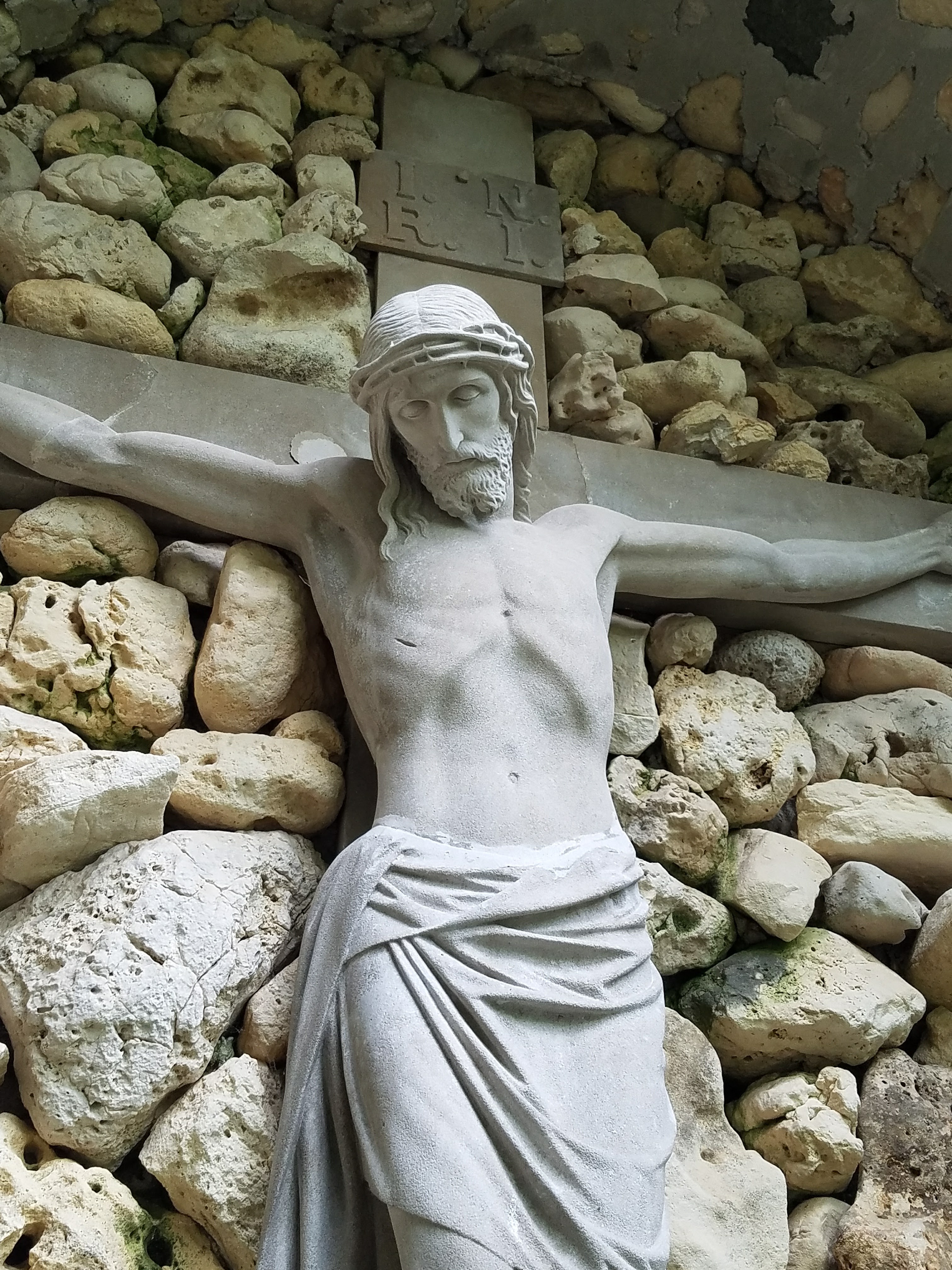
Depiction of Christ on the Cross at Holy Hill in Hubertus, Wisconsin

The Lord says, “See, my servant will act wisely.
People will greatly honor and respect him.
Many people were shocked when they saw him.
His appearance was so damaged he did not look like a man;
his form was so changed they could barely tell he was human.
But now he will surprise many nations.
Kings will be amazed and shut their mouths.
They will see things they had not been told about him,
and they will understand things they had not heard.”

Who would have believed what we heard?
Who saw the Lord’s power in this?
He grew up like a small plant before the Lord,
like a root growing in a dry land.
He had no special beauty or form to make us notice him;
there was nothing in his appearance to make us desire him.
He was hated and rejected by people.
He had much pain and suffering.
People would not even look at him.
He was hated, and we didn’t even notice him.

But he took our suffering on him
and felt our pain for us.
We saw his suffering
and thought God was punishing him.
But he was wounded for the wrong we did;
he was crushed for the evil we did.
The punishment, which made us well, was given to him,
and we are healed because of his wounds.
We all have wandered away like sheep;
each of us has gone his own way.
But the Lord has put on him the punishment
for all the evil we have done.

He was beaten down and punished,
but he didn’t say a word.
He was like a lamb being led to be killed.
He was quiet, as a sheep is quiet while its wool is being cut;
he never opened his mouth.
Men took him away roughly and unfairly.
He died without children to continue his family.
He was put to death;
he was punished for the sins of my people.
He was buried with wicked men,
and he died with the rich.
He had done nothing wrong,
and he had never lied.

But it was the Lord who decided
to crush him and make him suffer.
The Lord made his life a penalty offering,
but he will still see his descendants and live a long life.
He will complete the things the Lord wants him to do.
“After his soul suffers many things,
he will see life and be satisfied.
My good servant will make many people right with God;
he will carry away their sins.
For this reason I will make him a great man among people,
and he will share in all things with those who are strong.
He willingly gave his life
and was treated like a criminal.
But he carried away the sins of many people
and asked forgiveness for those who sinned.” (NCV)

We all suffer.  In some way, whether a chronic physical condition, emotional or moral distress, mental illness, or spiritual oppression, everyone faces living in a fallen world with its pain and heartache.  Presently, the entire world is suffering the scourge of the COVID-19 virus.  Every person in my neighborhood, city, state, and nation is impacted and affected.  Not only do many suffer because of disease and death itself, all are enduring either lost wages, limitations, loneliness or more.  Suffering that seems to have no reason, the senseless kind, the type where nothing good appears to be going on at all can be very troubling to our souls.

Perhaps it seems ironic, maybe even cruel, that Christians would observe a day called “Good” Friday.  Considering the hard circumstances of so many people, to call today “good” appears awkward, as if Christ’s followers have their heads in the sand.  Even for Christians, at first glance, “Good Friday” might seem a oxymoronic for a day observing the torture and death of an innocent man.  Some would argue that Christ is no longer on the cross and we need to give all our focus on the resurrected Jesus and the victory he achieved.  No need for all this suffering stuff.  Yet, the Resurrection only has meaning because of this very day, Good Friday.  Without the Suffering Servant of Isaiah, there is no King Jesus.  For Christians everywhere, this day is very good in the sense that the crucifixion of Jesus Christ means the redemption of the world.  On this day we remember and commemorate the events that led up to the cross; unpack those events and interpret them with profound meaning and significance; and, worship Jesus with heartfelt gratitude because of his redeeming work of the cross.

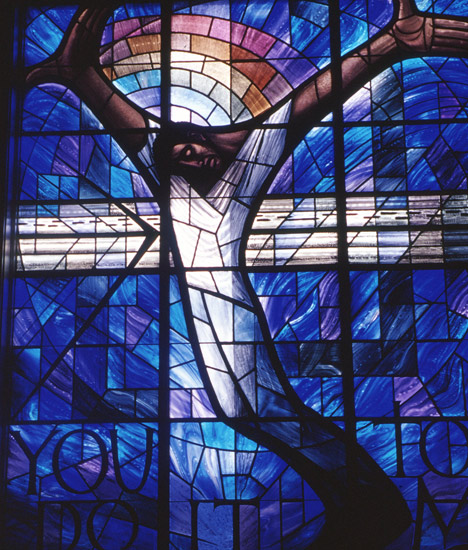
16th St Baptist Church Crucifixion Stained Glass Window
This stained-glass window was donated to the Sixteenth Street Baptist Church of Birmingham, Alabama by the people of Wales after the church was bombed in 1963.

The bulk of the New Testament Gospels of Matthew, Mark, Luke, and John are given over to the final week of Christ’s life, especially leading to the cross.  Good Friday observances often take a somber form due to the brevity of Christ’s experience on the cross.  Christians remember the last words of Christ, and recognize the significant impact his death had on the immediate persons around him.  Believers also contemplate the lasting results of that singular death as an atoning sacrifice; perfect love; reconciliation between God and humanity; victory over evil; and, redeeming all creation.

Sadness, then, is far from the only emotive expression on this day.  It is appropriate to feel wonder, gratitude, and deep satisfaction for the accomplishment of deliverance from the power of sin.  There is the recognition that something profound and meaningful has truly happened in the egregious suffering of Jesus.  Thus, we not only remember the anguish of Christ, but what that horrible torment accomplished.  In fact, the cross of Jesus is so significant that an eternity of considering its import and impact could never plumb the depths of its far-reaching effects.

With all that has been said, one would think that Good Friday is a hugely observed day on the Christian Calendar.  Yet, for a chunk of churches and Christians, it’s not.  The bottom line is that the cross is not popular.  Maybe it’s because neither Christian nor non-Christian wants to ponder something that appears so icky and bloody.

Episcopal priest Fleming Rutledge has adroitly put her finger on the issue: “Religious people want visionary experiences and spiritual uplift; secular people want proofs, arguments, demonstrations, philosophy, and science.  The striking fact is that neither one of these groups wants to hear about the cross.”  Indeed, as the Apostle Paul has said, the cross of Christ is “a stumbling block to Jews and folly to Gentiles” (1 Corinthians 1:23).

A personalized religion which leaves the cross out of the picture (too much blood and violence) might seem appealing yet will only leave us bereft of the communion of the saints both past and present.  Consider the ancient witness of the Church:

“I believe in Jesus Christ, his only Son, our Lord… he suffered under Pontius Pilate, was crucified, died, and was buried; he descended to hell.” –Apostles’ Creed

“For our sake he [Christ] was crucified under Pontius Pilate; he suffered death and was buried.” –Nicene Creed

Christ suffered “in both body and soul – in such a way that when he sensed the horrible punishment required by our sins ‘his sweat became like great drops of blood falling down on the ground.’  He cried, ‘My God, my God, why have you forsaken me?’  And he endured all this for the forgiveness of our sins.  Therefore, we rightly say with the Apostle Paul that we know nothing ‘except Jesus Christ, and him crucified;’ we ‘regard everything as loss because of the surpassing value of knowing Christ Jesus our Lord.’ We find all comforts in his wounds and have no need to seek or invent any other means than this one and only sacrifice, once made, which renders believers perfect forever.” –Belgic Confession, Article 21

And let us consider further the New Testament witness:

“Jesus suffered outside the gate in order to sanctify the people through his own blood.  Therefore, let us go forth to him outside the camp, and bear the abuse he endured.” (Hebrews 13:12-13, NIV)

“May I never boast of anything except the cross of our Lord Jesus Christ, by which the world has been crucified to me, and I to the world.” (Galatians 6:14, NRSV)

6a7f0-thecross

The extent of Good Friday goes far beyond just a day on the calendar; it is the fulcrum upon which all of Christianity hinges.  Because Christ suffered, our suffering has meaning.  Each situation of trauma; every case of disease; all adversity and wholesale hard circumstances make sense, in the Christian tradition, when they are viewed in solidarity with Jesus Christ crucified. So, today, let Christians everywhere contemplate the cross, observe the salvation accomplished through Christ’s death, and offer prayers and petitions for those who need deliverance from the power of evil.  In short, let us worship God in Jesus Christ because of the suffering on the cross.

Along with all believers everywhere we pray:

Jesus, Lamb of God, have mercy on us.

Jesus, Bearer of our sins, have mercy on us.

Jesus, Redeemer of the world, grant us your peace.  Amen.

Click Were You There performed by The Vigil Project as we station ourselves near the cross.

Job 13:13-19 – Contending with God

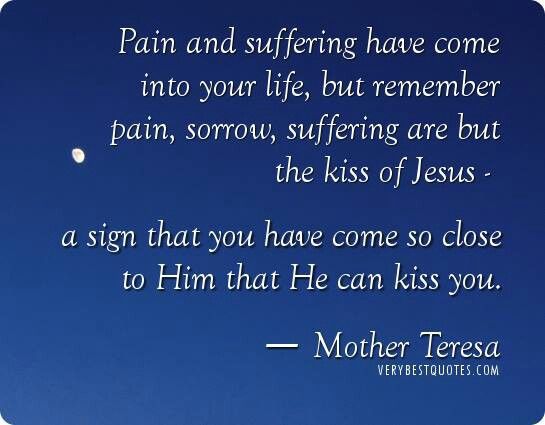
Mother Teresa suffering quote

“Keep silent and let me speak;
then let come to me what may.
Why do I put myself in jeopardy
and take my life in my hands?
Though he slay me, yet will I hope in him;
I will surely defend my ways to his face.
 Indeed, this will turn out for my deliverance,
for no godless person would dare come before him!
Listen carefully to what I say;
let my words ring in your ears.
Now that I have prepared my case,
I know I will be vindicated.
Can anyone bring charges against me?
If so, I will be silent and die. (NIV)

The story of the biblical character, Job, is both famous and infamous.  It’s famous among most bible readers because we are privy to why Job endured such terrible suffering and how the story ends.  Conversely, the story is infamous because Job’s “friends” and most everyone else in his day believed that the extremely hard circumstances were proof positive of sin.  Job had the misfortune of being misunderstood and misinterpreted with an evil, infamous, reputation.

Job was understandably desperate.  He hadn’t a clue why he lost his every earthly possession and relationship, not to mention his health.  Job was hurt, angry, and lonely.  In today’s Old Testament text, we observe Job getting ready to have-it-out with God.  It is interesting to me that in such grinding physical, emotional, and spiritual pain as Job experienced, he held to both his own integrity and of confidence in God.

If this story strikes a familiar chord, it may be because this was also Christ’s experience.  Jesus did nothing unethical or immoral to deserve being whipped, beaten, and tortured.  Our Lord, like Job, felt the awful sting of silence stating, “My God, my God, why have you forsaken me?” (Matthew 27:46).  As we fast approach Holy Week, the Lectionary reminds us that there must be suffering before glory, crucifixion before resurrection, agony before victory.

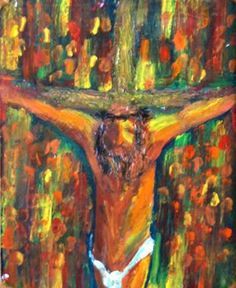
Christ on the Cross
Painting by Hans Mertens

I wonder what humanity would be like if we stopped fighting so hard against suffering and instead leaned into it as a teacher and a means of awareness.  For the Christian, I am curious what the Church everywhere would be like if she embraced suffering as the path of solidarity with Jesus. I wonder what human interactions on the personal, corporate, and global level would look like if people throughout the earth would stare this current pandemic through their spiritual eyes and imagine as Old Testament scholar Walter Brueggemann does:

“We may imagine God doing a new thing among us. Perhaps we are arriving at a new neighborly normal:

  • Imagine, we are treating prisoners differently, even releasing some who constitute no threat
  • Imagine, we are mobilizing generous financing for needy neighbors who must have resources in order to survive.
  • Imagine, we are finding generous provisions for students and their debts.

The new thing God is making possible is a world of generous, neighborly compassion.”

When we are stripped of wealth, cut-off from others, and do not know how to make sense of the suffering around us and in our own lives – it is in such a time that we are invited to consider a few observations from the story of Job:

  1. Much, if not most, of life is a mystery – including God. We are neither all-knowing nor all powerful.  Our nation’s perceived power and intellectual savvy expose deep fissures of pride and hubris.  Events like pandemics reveal that there is so much we don’t know and must learn.  We will likely never get all the answers we want when tragedy hits and lives are turned upside-down.
  2. Confronting and contending with God is okay, perhaps even encouraged. Unlike the human creature, the Creator God is big enough to take and absorb whatever anger, rage, disappointment, discouragement, depression, fist-shaking, and expletives we throw at him.
  3. Suffering does not mean that God has forgotten us. We may not understand why or even what we go through.  We will, however, never go through it alone.  God is often silent; yet, never aloof.  God maintains both his transcendence high above us and his immanence close to us at the same time, all the time.  In the Christian tradition, this is why the Holy Spirit was given – to be the continuing presence of Jesus on this earth.

My prayer for you today is that your suffering will not be wasted – that God will bend each adverse situation toward your good and the good of others.

Soli Deo Gloria

Click How Deep the Father’s Love for Us sung and mixed by David Wesley as we anticipate the suffering of Christ on our behalf in this next Holy Week.