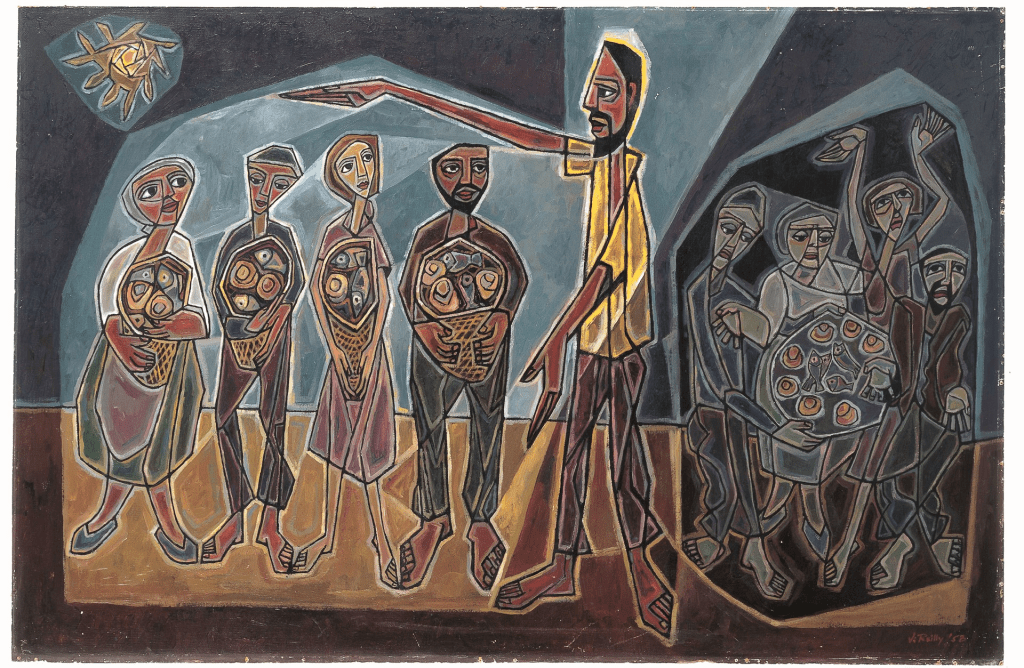
Jesus Feeds the Five Thousand (Matthew 14:13-21)

The Feeding of the Five Thousand, by John Reilly (1928-2010)

When Jesus heard what had happened, he withdrew by boat privately to a solitary place. Hearing of this, the crowds followed him on foot from the towns. When Jesus landed and saw a large crowd, he had compassion on them and healed their sick.

As evening approached, the disciples came to him and said, “This is a remote place, and it’s already getting late. Send the crowds away, so they can go to the villages and buy themselves some food.”

Jesus replied, “They do not need to go away. You give them something to eat.”

“We have here only five loaves of bread and two fish,” they answered.

“Bring them here to me,” he said. And he directed the people to sit down on the grass. Taking the five loaves and the two fish and looking up to heaven, he gave thanks and broke the loaves. Then he gave them to the disciples, and the disciples gave them to the people. They all ate and were satisfied, and the disciples picked up twelve basketfuls of broken pieces that were left over. The number of those who ate was about five thousand men, besides women and children. (New International Version)

Miracles still happen

I know of a woman who once brought a pan of lasagna to a community meal at her church, thinking that only 25-30 people would be fed. However, 70 people showed up. Her immediate thought was to go buy more, but she didn’t have the time.

So, here is what the dear woman did: She looked up to heaven, gave thanks, and started dishing out the lasagna – until every last person was fed. She confided in me that “every time I put my spatula down there was food to put on it!”

The story of Jesus feeding thousands of people is not just a nice account that happened a long time ago; Jesus is still in the miracle business. Christ can take our meager resources and turn them into something with a large impact on a lot of people. 

For this to happen, all we need to do is follow our Lord’s simple instructions: “You give them something to eat,” and, “Bring them here to me.” Jesus, using a simple act of obedience by the disciples, did one of the most famous miracles in history.

The message of the story is simple, but profound: Jesus can multiply whatever little we have, to accomplish his kingdom work, through us. Jesus could do miracles without us, but he wants us to participate in the work. We only need to bring our few loaves and fish to him.

The compassion of Jesus is the motivation for miracles

Jesus withdrew to a solitary place. But the crowd did not leave him alone. Rather than be annoyed by the situation, Jesus looked at the large group of people and his heart went out to them. So, he went about the work of healing the sick. Please know that God does not begrudgingly deal with you, as if you were an interruption to his day; he has compassion.

The desire of Jesus is for us to participate in the miracles

After a full day of healing, Christ’s disciples came to him as if he was unaware of the people’s need for food. They gave a very rational and realistic answer to the problem of hunger: Dismiss them so they can go out to eat. But Jesus said, “They don’t need to go away; you give them something to eat.” 

I detect maybe a hint of sarcasm in the tone of the disciples reply: “We have only five loaves of bread and two fish.” But their math was way off because they did not count Jesus.  “Bring them here to me,” Christ replied. If we have ears to hear, Jesus is still saying this today: bring them here to me. Through simple prayer and active obedience, we give Jesus what we have, no matter how little or insignificant it seems to us.

Much of what we do in the American church is a reasonable and rational ministry; it has little to do with the impossibility of faith and seeing God work in ways that are incomprehensible to our modern sensibilities.

A Chinese pastor once visited the United States. After seeing our vast resources of money, buildings, and ministries. He said, “This is amazing! It’s incredible what you American Christians can do without God!” 

In reality, we need God – who is in the business of taking our simple obedience and humble participation, and doing the miraculous. And it has always been this way. For example….

Elisha Multiplies the Widow’s Oil, from  L’histoire dv Vieux et dv Nouveau Testament, 1670

The wife of a man from the company of the prophets cried out to Elisha, “Your servant my husband is dead, and you know that he revered the Lord. But now his creditor is coming to take my two boys as his slaves.”

Elisha replied to her, “How can I help you? Tell me, what do you have in your house?”

“Your servant has nothing there at all,” she said, “except a small jar of olive oil.”

Elisha said, “Go around and ask all your neighbors for empty jars. Don’t ask for just a few. Then go inside and shut the door behind you and your sons. Pour oil into all the jars, and as each is filled, put it to one side.”

She left him and shut the door behind her and her sons. They brought the jars to her and she kept pouring. When all the jars were full, she said to her son, “Bring me another one.”

But he replied, “There is not a jar left.” Then the oil stopped flowing.

She went and told the man of God, and he said, “Go, sell the oil and pay your debts. You and your sons can live on what is left.” (2 Kings 4:1-7, NIV)

You want me to do what?

What if we were to operate as if God were truly in the business of doing miracles?  Would it impact the way we pray, and the way we act?  What if we understood just enough of Jesus and what he can and wants to do that we would be bold to say: “This might sound crazy, but what if we….”

  • found out everyone who needs food in this community, go love on them, and feed them…
  • used our property to create a community garden and seek to help people grow their own food…
  • came up with a God-sized plan to reach our community…
  • prayed to see a hundred people come to Christ through this church… 

Most of our plans don’t require us to do anything impossible, so we simply settle for the possible.

We too often do nothing out of a sense that God either cannot or does not want to use me or what I have. But it just won’t do to stand afar off and expect God to work without us giving what we have – whether that something is time, money, conversation, food, hospitality, or whatever. 

Our limitations mean nothing to Jesus, so he doesn’t hear us when we say:

  • my home is too small, and it’s not clean enough
  • I don’t have enough money,
  • I’m not smart enough
  • my schedule won’t allow it
  • I don’t have enough resources

You don’t need much – only the willingness to be part of the miracle Jesus is doing.

Conclusion

You want me to do what? Feed thousands? Lead someone to Jesus? Pray in front of others? Work for justice?

Sometimes, the greatest miracle is for people to be open, real, and transparent enough to believe that Christ can do a miracle through confessing my sin, participating in a ministry, or having a spiritual conversation with an unbeliever. 

The question is never, “Can God use me?” It is, “What miracle does God want to do through me and through this church?”

It is no accident that when Jesus distributed the bread that it sounds a lot like communion. The Lord’s Supper may seem irrelevant, as if it is merely remembering Jesus. However, God’s design is much bigger: The Lord wants to do a miracle. 

God wants the practice of our communion together to bring healing and wholeness that the world cannot give. It might be unrealistic to expect that Jesus can use a Table to feed and reach thousands, but we don’t serve a God who is limited to work through rational means.

Blessed are you, O Lord God, King of the Universe, for you give us food to sustain our lives and make our hearts glad. We thank you for your countless blessings, especially for the gift of your Son, for the Church, for our faith, and now for this meal we are about to participate in, through Christ our Lord. Amen.

A Life of Compassion (Matthew 9:35-10:23)

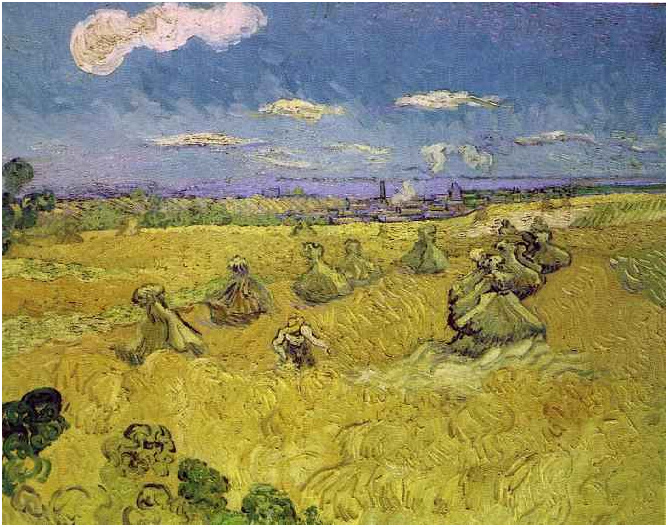
Wheat Stacks with Reaper, by Vincent Van Gogh, 1888

Jesus went through all the towns and villages, teaching in their synagogues, proclaiming the good news of the kingdom and healing every disease and sickness. When he saw the crowds, he had compassion on them, because they were harassed and helpless, like sheep without a shepherd. Then he said to his disciples, “The harvest is plentiful but the workers are few. Ask the Lord of the harvest, therefore, to send out workers into his harvest field.”

Jesus called his twelve disciples to him and gave them authority to drive out impure spirits and to heal every disease and sickness.

These are the names of the twelve apostles: first, Simon (who is called Peter) and his brother Andrew; James son of Zebedee, and his brother John; Philip and Bartholomew; Thomas and Matthew the tax collector; James son of Alphaeus, and Thaddaeus; Simon the Zealot and Judas Iscariot, who betrayed him.

These twelve Jesus sent out with the following instructions: “Do not go among the Gentiles or enter any town of the Samaritans. Go rather to the lost sheep of Israel. As you go, proclaim this message: ‘The kingdom of heaven has come near.’ Heal the sick, raise the dead, cleanse those who have leprosy, drive out demons. Freely you have received; freely give.

“Do not get any gold or silver or copper to take with you in your belts—no bag for the journey or extra shirt or sandals or a staff, for the worker is worth his keep. Whatever town or village you enter, search there for some worthy person and stay at their house until you leave. As you enter the home, give it your greeting. If the home is deserving, let your peace rest on it; if it is not, let your peace return to you. If anyone will not welcome you or listen to your words, leave that home or town and shake the dust off your feet. Truly I tell you, it will be more bearable for Sodom and Gomorrah on the day of judgment than for that town.

“I am sending you out like sheep among wolves. Therefore be as shrewd as snakes and as innocent as doves. Be on your guard; you will be handed over to the local councils and be flogged in the synagogues. On my account you will be brought before governors and kings as witnesses to them and to the Gentiles. But when they arrest you, do not worry about what to say or how to say it. At that time you will be given what to say, for it will not be you speaking, but the Spirit of your Father speaking through you.

“Brother will betray brother to death, and a father his child; children will rebel against their parents and have them put to death. You will be hated by everyone because of me, but the one who stands firm to the end will be saved. When you are persecuted in one place, flee to another. Truly I tell you, you will not finish going through the towns of Israel before the Son of Man comes. (New International Version)

Use your voice for kindness, your ears for compassion, your hands for charity, your mind for truth, and your heart for love.

We need compassion; humanity cannot survive without it.

Compassion is…

  • a concern for the well-being of others
  • the basis for altruism and the most virtuous motive one can possess
  • activated within the human heart when witnessing another person’s suffering
  • helping other people feel seen, heard, and known
  • the bridge that connects us with another in need
  • life

While on this earth, I believe Jesus was the very embodiment of compassion. To reflect on Christ’s compassion helps us to raise our own compassion quotient, and thus, avoid succumbing to the whims of indifference concerning human need.

Compassion responds to human need

In his earthly ministry of preaching, teaching, and healing, Jesus went through all the towns and villages. He neither waited for people to come to him nor wanted anyone to fall through the cracks. Doing this compassionate work, Jesus was moved by the depth of people’s needs.

The word for “compassion” in the Bible means “to be moved in the pit of your gut.” It is to be filled with pity and heartbroken over the unmet needs of people.

So, what moves and stirs compassion deep down in your gut?

Jesus went into towns and was broken-hearted over people who were harassed and helpless, locked into patterns of life that were harmful and damaging. 

Jesus came to this earth to seek and save people, offering forgiveness and a new life. Jesus willingly brought compassion – and his motivation for doing so was neither from duty nor guilt. Compassion is the proper motivation for all things.

Just as Jesus went out and ministered, then was moved by what he saw, so our compassion is aroused whenever we go out and enter people’s lives, seeing first-hand the depth of human need.

Compassion results in prayer

Christ saw the masses of people and told his disciples to ask God to send workers because the harvest is plentiful. Jesus knows there are large numbers of people waiting to hear good news. So, he said to pray earnestly and compassionately.

Compassion brings us to prayer and impels us to pray that workers be sent to people who are ripe for hearing good news. We must not listen to the hellish lie: That certain people don’t really want the good news of the kingdom of God; that my neighbor, or co-worker, or family member is not spiritual and doesn’t care about forgiveness or grace – that there is nothing within them to respond to compassion.

The devil does not want us to have merciful compassion for them, to be moved to intercede for them in prayer, nor to become a harvester in the field of people. Jesus said the harvest is plentiful; and it is through compassionate prayer that the work will be done.

Compassion sends us out

The call to prayer is central, but it’s not everything. As faith without works is dead, so prayer without mission is empty.

The people Jesus authorized for ministry were a collection of twelve motley disciples who thought differently about a great many things. Yet, the compassion of Jesus changes lives and brings people together from diverse backgrounds and viewpoints.

The disciples were told, in their initial mission as followers of Jesus, to go only to the house of Israel. Israel’s house needed to be put in order first before they could ever think of going to Gentiles. We begin by reaching out to people in our own backyard.

“You will be my witnesses in Jerusalem, and in all Judea and Samaria, and to the ends of the earth.” Jesus (Acts 1:8, NIV)

Jesus told the disciples to do exactly what he had been doing: preaching and healing, proclaiming the message that “the kingdom of God is near.” 

The kingdom is not only something in the future; the kingdom of God has already broken into the present time, and the evidence of it is the transformation of people’s lives now. The blessings and promises of kingdom life are presently available.

Jesus sent the disciples out and told them not to take anything with them. They were to leave all their baggage behind. The disciples were to be stripped of everything so that they had the ability to see people and their needs and be moved with compassion as Jesus was.

The kingdom of God was near to them, so they did not need to add anything for the mission. Jesus did not want his disciples assuming they already knew what people needed. Instead, they must be present to people and discover their needs without bias. As compassion is freely received, it is to be freely given.

Cultivating Compassion

Compassion is the appropriate response to human need. Yet, we do not always react with compassion. The following are a few approaches which prevent us from becoming compassionate, along with some ways of cultivating a compassionate life:

  1. A defeating and discouraging environment. Contempt, anger, hatred, and abuse drives out compassion. The environment around us makes a difference. If we find we must check our hearts at the door and avoid compassion to just make it, then we need a change of environment. Life is too short, and the world too compassion-starved, to maintain a situation that drags us down and hinders the kingdom of God within us.
  2. An unhealthy pace of life.  A person cannot have a compassionate heart if they are running too fast to see other people’s needs. When spare moments are used to try and figure out how to keep all the balls in the air and all the plates spinning, there’s no way to dole out compassion to others. So, slow down. No one comes to the end of life and wishes they had logged more hours of work at their job. Develop a plan on how to slow down enough to tune into the needs of others and have emotional energy for them.
  3. Excessive caregiving. Compassion fatigue is a real thing. Resentment can build toward the very people we care for because of constant giving without receiving. When the emotional gas tank is empty, it is possible to become cold-hearted. Yet, some keep going anyway – and ruin their engine. Caring for others must be meticulously balanced with caring for self. There is a time for everything, including rest and recuperation. Jesus regularly practiced the disciplines of solitude and silence. If he needed those restorative practices, so do we.
  4. Objectifying people. Whenever we put adjectives in front of people, compassion is lacking. Referring to “those” people, “lesbian” neighbors, “black” folks at work, my “obnoxious” relative, or, the “poor” family down the street, are all examples of objectifying people and putting them at a distance from ourselves. Your neighbors are your neighbors, your family is your family, and the people in your life are just people, period. Compassion arises as we look for what is common among us, not different. Compassion brings solidarity with others, not separation and division.

May you allow God the time to form a compassionate heart within through being with Jesus. May compassion toward others be the defining characteristic of your life.

On Mercy and Against Condemnation (John 7:53-8:11)

The woman caught in adultery, by Chinese artist He Qi

[The earliest manuscripts and many other ancient witnesses do not have John 7:53—8:11. A few manuscripts include these verses, wholly or in part, after John 7:36, John 21:25, Luke 21:38 or Luke 24:53.]

Then they all went home, but Jesus went to the Mount of Olives.

At dawn he appeared again in the temple courts, where all the people gathered around him, and he sat down to teach them. The teachers of the law and the Pharisees brought in a woman caught in adultery. They made her stand before the group and said to Jesus, “Teacher, this woman was caught in the act of adultery. In the Law Moses commanded us to stone such women. Now what do you say?” They were using this question as a trap, in order to have a basis for accusing him.

But Jesus bent down and started to write on the ground with his finger. When they kept on questioning him, he straightened up and said to them, “Let any one of you who is without sin be the first to throw a stone at her.” Again he stooped down and wrote on the ground.

At this, those who heard began to go away one at a time, the older ones first, until only Jesus was left, with the woman still standing there. Jesus straightened up and asked her, “Woman, where are they? Has no one condemned you?”

“No one, sir,” she said.

“Then neither do I condemn you,” Jesus declared. “Go now and leave your life of sin.” (New International Version)

“Do you ever wonder what the greatest gift is that has ever been given? It is this: mercy. If you wonder what this means, practice mercy and your questions will fade. Live into mercy and you will become what you love. For love unites us in our loving, not in our being. So give yourself to love and love yourself in giving. The rest will follow of its own.”

Meister Eckhart (1260–1328, C.E.)

Mercy is scandalous. I wish it weren’t. It seems crazy that this is the case. But here we are, living in an unmerciful world. And even more absurd is that many religious leaders want nothing to do with mercy. The leaders in Christ’s day were trying to get Jesus to depart from his normal routines of grace so that he would appear fickle, unsteady, and weak.

The religious leaders got together and decided to put a woman forward who was clearly a sinner, caught in the act. What to do with her? they asked Jesus. They were, of course, trying to trap him. On the one hand, if Jesus didn’t condemn her, the leaders could say Christ was not upholding the Law. And, on the other hand, if Christ acquiesced in killing the adulterous woman, then the leaders could say that Jesus was inconsistent and unreliable.

The response of Jesus was to stoop down and say nothing. I believe Christ was demonstrating how utterly unworthy the religious leaders were to be heard on the subject. I don’t think there’s anything to conjecture about writing in the sand. It was like taking the physical posture of turning his back on them or putting up a hand, as if he isn’t going to watch the silly circus scene that’s happening.

Jesus wasn’t about to be deterred from his ministry of mercy, from preaching grace, and from hobnobbing with “sinners.” But, since the religious leaders kept up their questioning like a pack of obnoxious yippee dogs, Jesus straightened up and decided to deal with this unmerciful display happening in front of him.

He simply stated that if they want judgment, not mercy, then the one who is without any sin ought to throw the first stone to kill the woman and execute judgment upon her. If innocence is so all-fired important, then it will take an innocent person to punish the guilty.

Whoever accuses another person ought to first look in the mirror to see if there is any innocence reflecting back. And the stark truth is that any old Tom, Dick, or Harry is not qualified to level judgment on another and condemn them. Christ is unmasking the hypocrite who flatter themselves with the supposed high ground of their innocence.

In reality, they are excessively severe and harsh, spiritual felons who have no right to censure others. There is a place for loving correction and appropriate judgment. However, there is never a place in the kingdom of God for eliminating mercy and punishing others with either our hands or our tongues.

Although the wicked and hypocritical religious leaders intended to entrap Jesus by their unholy shenanigans, the tables were quickly turned and their true shame was exposed for what it is – being so darned unmerciful and unloving. Their own guilt is proved by walking away from the scene.

No one has the right to be a jerk. And it is definitely not okay for any person, of all things, to tempt Jesus Christ! And yet, too many religious folk through the centuries have done just that.

None of this means that sin is okay and we can do whatever we want. No, Christ calls us to go and sin no more. Mercy frees us to do just that. Mercy is the key which unlocks the door of freedom and allows us to leave one room for another, to arise from the dark basement of disobedience and despair and enter the bright living room of forgiveness, grace, and life.

Let us then imbibe mercy as the elixir of life – because it is. The world cannot survive without mercy.

We are not the arbiters of who can or cannot have mercy. God said:

“I will have mercy on whom I will have mercy, and I will have compassion on whom I will have compassion.” (Exodus 33:19, NIV)

The Lord has always been characterized as merciful:

Remember, Lord, your great mercy and love,
    for they are from of old.
Do not remember the sins of my youth
    and my rebellious ways;
according to your love remember me,
    for you, Lord, are good. (Psalm 25:6-7, NIV)

Mercy is of high value to God, who said:

“For I desire mercy, not sacrifice, and acknowledgment of God rather than burnt offerings.”

Hosea 6:6, NIV

Because God is merciful, the Lord calls people to show mercy, as well:

He has shown you, O mortal, what is good. And what does the Lord require of you? To act justly and to love mercy and to walk humbly with your God. (Micah 6:8, NIV)

“Then the master called the servant in. ‘You wicked servant,’ he said, ‘I canceled all that debt of yours because you begged me to. Shouldn’t you have had mercy on your fellow servant just as I had on you?’” (Matthew 18:32-33, NIV)

Speak and act as those who are going to be judged by the law that gives freedom, because judgment without mercy will be shown to anyone who has not been merciful. Mercy triumphs over judgment. (James 2:12-13, NIV)

May the gracious and almighty God have mercy on you and forgive you all your sins through our Lord Jesus Christ. Amen.

Luke 13:10-17 – Healing on the Sabbath

Jesus Healing the Bent-Over Woman by Glenda Skinner-Noble

On a Sabbath Jesus was teaching in one of the synagogues, and a woman was there who had been crippled by a spirit for eighteen years. She was bent over and could not straighten up at all. When Jesus saw her, he called her forward and said to her, “Woman, you are set free from your infirmity.” Then he put his hands on her, and immediately she straightened up and praised God.

Indignant because Jesus had healed on the Sabbath, the synagogue leader said to the people, “There are six days for work. So come and be healed on those days, not on the Sabbath.”

The Lord answered him, “You hypocrites! Doesn’t each of you on the Sabbath untie your ox or donkey from the stall and lead it out to give it water? Then should not this woman, a daughter of Abraham, whom Satan has kept bound for eighteen long years, be set free on the Sabbath day from what bound her?”

When he said this, all his opponents were humiliated, but the people were delighted with all the wonderful things he was doing. (New International Version)

The way in which we interpret events says a lot about who we are and what we need. The story sounds different, depending upon which person(s) are viewing it….

The Crippled Woman

She had gotten used to looking at people out of the corner of her eye, by looking up and sideways.

After eighteen years, she could hardly remember any other way of seeing the world. On this particular Sabbath, there was a special excitement at the synagogue, where she regularly went to worship. A Galilean preacher and prophet, Jesus of Nazareth, had arrived in town and would be teaching there.

She and the others in town had heard reports about Jesus–how he talked about God’s reign arriving soon and how he healed sick people. She was not sure how many of the rumors to believe, but she was trying not to get her hopes up. Her life already had too many disappointments to count.

When she entered the synagogue, the place was abuzz. As Jesus began to teach, however, the room was hushed. Moments later, his words turned from teaching to invitation. He had caught her eye–no mean feat, given that he had to lean over and incline his head to do so. “Come here,” he said to her. She slowly made her way to the front of the assembly.

Jesus and the Bent-Over Woman by Marg Mowczko

What happened next amazed the whole congregation. “Woman, you are set free from your ailment.” When this man, Jesus, spoke those words and put his hands on her broken, bent body, she felt power surge through her. Without hesitation, she straightened her once crooked back. She stood tall and praised her God . . .

The Synagogue Leader

He has come to the synagogue every Saturday. Each Sabbath day the synagogue leader stands and faithfully reads the Torah. On this particular Sabbath, a Galilean preacher is coming. Some say his is a prophet, even Messiah. The leader has seen his share of would-be messiahs come and go, claiming to speak for God. He doubts anything will come of this. Just another man.

But what is this? A synagogue full of people! And just as the leader thought this may just be good for the people, getting them to pay attention to the law and the prophets, this preacher calls a woman forward, and of all things, heals her!? This is not good. This is not how things are to be done!

In the Torah, the seventh day was set aside by God for Israel’s rest. Work is prohibited. Non-life-threatening illnesses and conditions can be treated on the other six days. The synagogue leader is not opposed to healing. In fact, he welcomes it. But at an appropriate time, on the right day. He says to himself, “This all must be done decently and in order. Who does Jesus think he is? We cannot have such insubordination amongst the people, and in the synagogue, of all places!”

And so, the synagogue leader is beside himself with both anger and fear that the Law will not be properly upheld, and that God will be displeased and take away their place of worship.

Coptic Church depiction of Jesus healing the crippled woman, 12th century

Jesus

Jesus comes, looking forward to being with the people in the synagogue on the Sabbath. He understands that since the Sabbath law commemorates and celebrates Israel’s liberation, it ought to be a day for enacting — not inhibiting — the present-day liberation of Israelites. Yes, it is a good day for a healing. Every day is a good day for healing.

As Jesus enters the synagogue, it is full of people, charged with the atmosphere of anticipation. During the service, Jesus sees a woman. Although he rightly discerns that the synagogue leader and some of the congregants will not be happy about this, he calls her forward, intent on freeing her from her satanic bondage. And also knowing that placing his hands upon this woman will appear scandalous, he does it anyway.

Sure enough, the synagogue leader is livid. The leader feels the need to correct Jesus. Yet, Jesus unmoved by this, calmly retorts, without budging an inch, that given the custom of providing water for thirsty livestock on the Sabbath, it is surely appropriate to heal a long-suffering Israelite on the Sabbath.

In none of this does Jesus abolish the Sabbath commandment. Rather he follows it faithfully. Jesus enters an ongoing Jewish debate about how to interpret the Sabbath law, locating himself at the less stringent end of the opinion spectrum.

Jesus is determined to uphold the spirit of the Law, to practice compassion, to do what leads to human betterment. He is doing God’s will. He is allowing the Sabbath to serve this old woman, rather than letting the woman serve the Sabbath as a bent over crippled person.

The People

They come, as they do each Sabbath, to gather and listen to Torah read, to pray to God, and to strengthen one another in their common faith. Yes, the synagogue leader can be a bit tedious. The synagogue service can be a bit boring. But he is a good man doing good work.

Today, however, is different. Jesus, the one they have heard so much about, is there. And what a synagogue service it is! Jesus teaches us, and with authority! But, to our astonishment, he calls one of our women forward. And he touches her! Then heals her! This is the woman who has been tortured with such crippling pain and bent over all the time!

Oh, my, the synagogue leader is upset! We are so full of joy for our healed sister, yet also confused. This is a good thing that Jesus did – God’s kingdom breaking into this world. Yet, here is the synagogue leader and Jesus debating Torah. Does freedom from Satan only come on six days, not seven? Surely, God is especially honored on such a holy day as the Sabbath to do such important work. But work, it is. And Jesus did it. Is this really a good thing, or not?

Syrian Church depiction of Jesus and the crippled woman, 6th century

Conclusion

This is a story about the role and function of our religious traditions, our claims about what could and should be practiced, when and where it ought to take place, and who is allowed within the walls of our faith communities. Special religious practices may become hindrances to including folks. We must be diligent to recognize what theological ideas we hold dear that disallow full participation from others.

Jesus was no Sabbath breaker. He operated well within Jewish tradition of the day. At the same time Christ is also not one to allow the tradition to exclude people from access to the community and the potential for their healing. Even though the synagogue leader and some others disagreed, many in the crowd agreed.

Today’s story is about the community and addresses questions such as, “What kind of community do we want to be?” “Do our religious traditions help us to become that kind of community or do they hinder it?” “If we want to be a healing community, how can we make that happen?”

O God the Father, whose will for us and for all your people is health and salvation, O God the Son, who came that we might have life and have it in abundance, O God the Holy Spirit, whose indwelling makes our bodies the temples of your presence, have mercy on us.

O Triune God, we pray you to hear us, and that you will grant your grace to all who stand in need of healing of both of body and spirit, and lead them to look with confidence in you;

That you will grant patience and perseverance to all who are disabled by injury or illness, and increase their courage;

That you will grant peace to all who are troubled by confusion or pain, and set their minds at rest;

That you will grant relief from suffering to all sick children, and give them a sure sense of your tender love and care;

That you will grant rest to all whose increasing years bring weariness, distress, or loneliness, and give them the abiding comfort of your presence;

That you will grant confidence to all about to undergo surgery or difficult procedures, and keep them free from fear;

That you will grant purpose to the church as it seeks to carry on Christ’s ministry of healing to suffering humanity, and keep it always true to the gospel of Christ;

That you will grant skill and compassion to doctors, nurses, technicians, aides, and all who are called to  practice medical arts, and make strong their dedication to help others;

That you will grant to all people the peace of quiet sleep and the joy of resting in your everlasting arms, that we may rejoice in your care while we are on earth, and in the world to come, have eternal life.

O God, who in Jesus Christ called us out of darkness into your marvelous light; enable us always to declare your wonderful deeds, thank you for your steadfast love, and praise your with heart, soul, mind, and strength, now and forever. Amen.