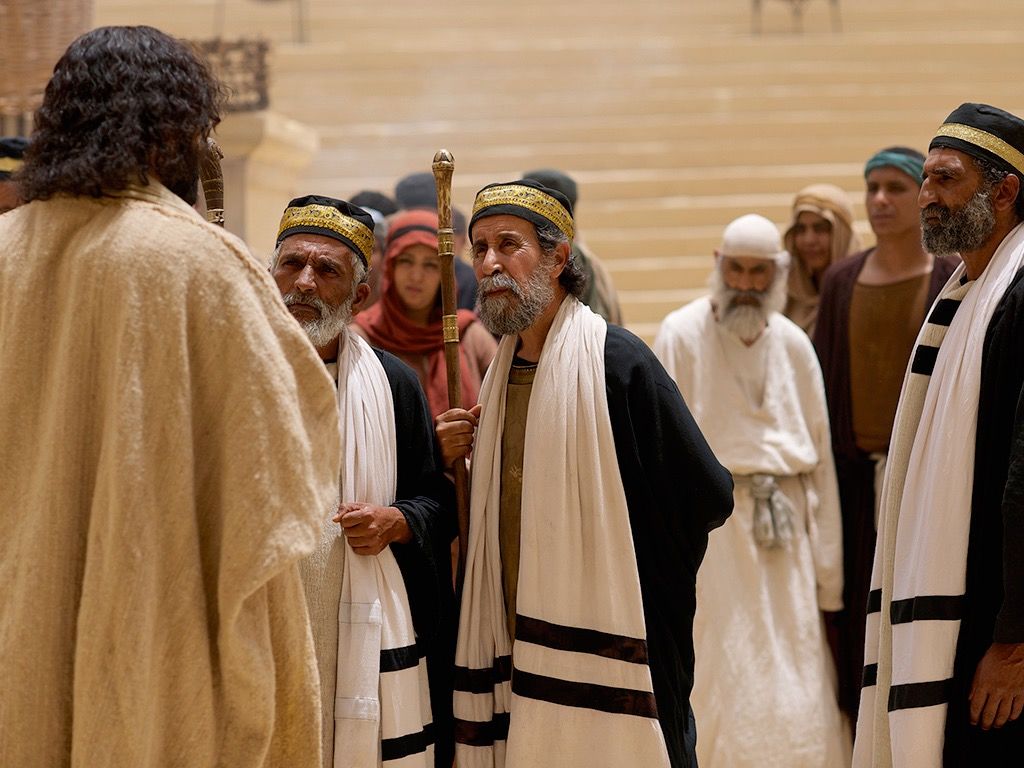
They arrived again in Jerusalem, and while Jesus was walking in the temple courts, the chief priests, the teachers of the law and the elders came to him. “By what authority are you doing these things?” they asked. “And who gave you authority to do this?”
Jesus replied, “I will ask you one question. Answer me, and I will tell you by what authority I am doing these things. John’s baptism—was it from heaven, or of human origin? Tell me!”
They discussed it among themselves and said, “If we say, ‘From heaven,’ he will ask, ‘Then why didn’t you believe him?’ But if we say, ‘Of human origin’ …” (They feared the people, for everyone held that John really was a prophet.)
So, they answered Jesus, “We don’t know.”
Jesus said, “Neither will I tell you by what authority I am doing these things.” (NIV)
Because Christ is Lord, we might overlook that Jesus, in his earthly ministry, was an outsider. Although a teacher, a rabbi, Jesus was neither a priest nor a member of any Jewish religious sect. He walked around as if he owned the place (which he did) and this gave no end of consternation from the established status quo religious leadership.
Jesus made significant inroads into people’s lives, especially with outsiders like himself, and this created anger and jealousy with many of the religious ruling class. Since Jesus was not a card-carrying member, the leaders wanted to hear from him why he kept acting confidently and deliberately on their religious turf, as if he had authority to do so.
The established authorities are depicted in today’s Gospel lesson as a craven bunch who did not want to alienate the crowds yet were eager to get the upstart Jesus out the way. This appears to be an age-old situation of leaders putting their fingers to the wind to go with whatever will keep them popular and in power. Since Jesus consistently refused to play such games, the authorities believed he needed to go. They, however, had no intention of risking an outright confrontation and showing their shadow motives.
Jesus clearly connected himself with John the Baptist, both coming from the same authority. John was yet another figure for whom the established leaders could not control. We ought never to underestimate that threats to status quo leadership who have no inkling of being public servants when true moral authority comes along. The lack of conformity from both John and Jesus would cost them their very lives.
Speaking truth to power while not becoming defensive is a tricky art. Yet, Jesus did it. Continual challenges to his authority left him unfazed as to his mission and purpose on this earth. Christ was assertive without becoming despotic; forward without taking the bait of useless arguments; confident with no hint of arrogance.
For me, the contrast between Jesus and the religious authorities is trenchant. The confident, wise, and calm authority of Christ is in direct opposition to the fear, anxiety, and worry of the ruling leaders. Whereas they kept anxiously ruminating about what to do about this threat to their established authority, Jesus exhibited a non-anxious presence which maintained a steadfast focus on God’s righteous, holy, and benevolent rule and reign.
Sometimes, continual fear is a clue that one is so worried about losing the person, place, or position they possess that the divine gets pushed aside.
Questioning Christ’s credentials was the giveaway that the existing religious authorities were concerned about their power and privilege, and not the people. The wise person will see such queries for what they are.
Wherever we observe those who refuse to share power, have a xenophobic bent toward outsiders, and will seem to do just about anything to maintain the status quo, there we will find the abuse of authority. Conversely, where we observe a deep concern for equity, justice, and the common good of all persons, there we see compassionate leadership who will champion ethical leadership and espouse moral authority.
In any democratic society, we must choose our leaders wisely.
Great God of hope, in these times of change and uncertainty, unite your people and guide our leaders with your wisdom. Give us courage to overcome our fears and help us to build a future in which all may prosper and share together through Jesus Christ our Lord in the strength of your Holy Spirit. Amen.
Christ’s Church is not so much made up of saints or sinners as it is made up of saintly sinners and sinning saints. The Church is at the same time both beautiful and ugly, holy, and wicked, full of faith and full of fear. The Body of Christ is the place of spiritual sensitivity as well as a den of depravity. So, anyone searching for a squeaky-clean church on a nice upward path of success with everything done to perfection and where no one ever gets hurt or unhappy… it does not exist; and, it never did.
Jesus stands alongside his imperfect people, despite their faults and egotism. Jesus intimately knows our damaged emotions and our open putrid spiritual abscesses. Yet, he treats us with mercy because he never tires of rehabilitating and reforming his Church.
Christ’s disciple, Peter, is the poster child for all the mixed motives and imperfect following of God we experience. For example, Peter stepped out of the boat in great faith and walked on the water, only to begin sinking because of his great fear. It was Peter who made a bold and right confession of faith, and then turned around here in our story for today and bought into Satan’s agenda. And Jesus was right there next to Peter all the way. Christ both rebukes and loves, all the while never abandoning us, but always working in and through us to accomplish his kingdom purposes.
Here is what we need to know or be reminded of today: Following Jesus involves pain and sacrifice because we live in a broken mixed-up world, and, on top of it, Christ’s Church is still imperfect and in the process of becoming holy. If we will admit it, we are all like Peter – a little devil who needs to get in line behind Jesus. (Matthew 16:21-28)
Peter Admonishes Jesus by Unknown artist
We all, at times, get frustrated and/or disgusted with the whole church thing. We can whine and complain and even avoid it. Or, we can commit to taking up our cross, and give our lives for Jesus Christ. We can choose to put love into the church where love is not, even when we do not feel loved. Priest and professor, Ron Rollheiser, once gave the following analogy about staying together around Jesus:
Imagine that the family is home for Christmas, but your spouse is sulking, you are fighting being tired and angry, your seventeen year old son is restless and doesn’t want to be there, your aging mother isn’t well and you are anxious about her, your uncle Charlie is batty as an owl… and everyone is too lazy or selfish to help you prepare the dinner. You are ready to celebrate but your family is anything but a Hallmark card. All their hurts and hang-ups are not far from the surface, but you are celebrating Christmas and, underneath it all, there is joy present. A human version of the messianic banquet is taking place and a human family is meeting around Christ’s birth….
In the same way, here we are, the community of the redeemed. We gather in our imperfect way, a crazy mix of sinner and saint. But we gather in and around Jesus – and that makes all the difference. There is a reason we are here on this earth, a reason much bigger than all our dysfunctional ways and dyspeptic attitudes. Jesus Christ is building-up the people of God and he will keep doing it until the end of the age. In other words, Jesus is not quite finished with us yet; we still have some things to learn about the need for sacrifice.
The need for sacrifice by Jesus. (Matthew 16:21-23)
Jesus stated openly and in detail what must happen. It was necessary for Christ to suffer deeply and die a cruel death; it was God’s will and plan. Yet, good ol’ Peter was not down for this plan, at all. He took Jesus aside and rebuked him, believing him to be off his rocker for even suggesting such a terrible scenario. Jesus, however, turned the tables on Peter and rebuked him right back. Essentially, what Jesus said is that being Christ-centered without being cross-centered is satanic.
The error of Peter was that he presumed to know what was best for Jesus. He believed the suffering of the cross would “never” happen. Peter’s perceptions were dim and limited; he did not clearly see how broken the world really is and how much it would take to heal it. Jesus needed to offer himself as a sacrifice for the sins of the entire planet.
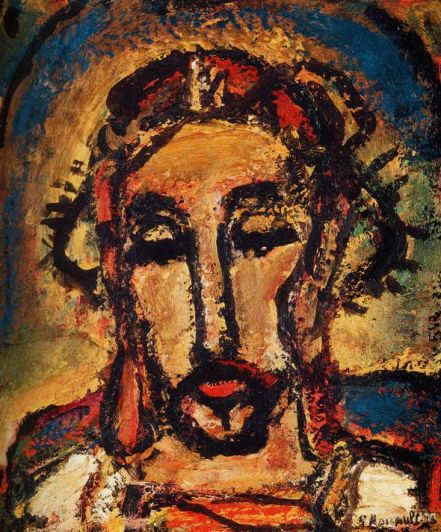
Crucifixion of Christ by Georges Rouault, 1936
Sometimes, like Peter, we might think that the way I see and the way I perceive is the way things really are, or, at least, how they should be. Peter had been walking with Jesus for a few years, watching and enjoying his ministry of teaching, healing, and extending compassion. It was all good for Peter, and, therefore in his mind, it should not change. Peter wanted to hold this moment forever. After all, why try and fix something that is not broken? Oh, but broken the world is – so much so that it required the ultimate sacrifice.
Just because it was good for Peter did not mean it was good for everybody or should always be this way. If Peter were to have his way, we would all be in hell right now; it would not have been good for us. We, like Peter, are finite humans with limited understanding and perceptions. We can easily slip into a satanic mode of believing that because something is going fine for me that everyone else is doing okay, too. I like it, I want it, so what is the problem?
The problem is that we too easily look at life through narrowly selfish lenses, and then cannot see other people’s needs; cannot perceive the lost world around us with any sense of reality; cannot see that Jesus has an agenda very different from our own. Our limited perceptions come out in saying things like, “Oh, she is just depressed because she is avoiding responsibility.” “People on government welfare are lazy.” “He’s addicted because he doesn’t want to help himself.” “They’re demonstrating on the streets because they are a bunch of malcontents.” These, and a legion of statements like it, betray a satanic worldview devoid of grace and a compulsive need to find blame, believing that if there is personal suffering there must be personal sin.
In truth, we are all part of one human family, and we are all in this together; one person’s joys are our joys; one person’s struggles are our struggles. We really are our brother’s keeper. The detachment we can have toward other human beings is completely foreign to the words of Jesus. The Christian life involves suffering, and Jesus invites us to follow him in his way of sacrifice.
The need for sacrifice by the followers of Jesus. (Matthew 16:24-28)
There is a way to reverse demonic thinking. Jesus issues an invitation to practice self-denial, to fall in line behind him, and walk with him in his suffering. Self-denial is not so much doing something like giving up sweets for Lent as it is giving up on ourselves as our own masters. It is the decision to make the words and ways of Jesus the guiding direction for our lives. It is the choice to quit holding onto the way I think things ought to be, and to take the time to listen to Jesus.
The logic of Jesus is relentless. Life comes through death, so, we must give up our lives to find them. It does us no good to adulterate our lives by serving the gods of success and perfectionism. Jesus invites us to quit our moonlighting job with the world and go all in with him. Only in this way will we truly find life.
Jesus was saying more than just submitting to suffering – we are to embrace it. In doing so, we will find reward and joy. For those familiar with this path, they can tell you that suffering is a blessing because they have found the true purpose and meaning of life.
Crucifixion with Lamp by New Zealand artist Colin McCahon, 1947
Few people have suffered as much as the nineteenth-century missionary medical doctor to Africa, David Livingstone. He was a pioneer explorer who opened the interior of Africa to the outside world. He had two reasons for doing so: To be able to take the good news of Christ’s suffering to the African people; and, to open Africa to legitimate trade so that the illicit slave trade would end.
Dr. Livingstone’s hand was once bitten and maimed by a lion; his wife died while on the mission field; he was most often alone on his travels; the one house he built was destroyed in a fire; he was typically wracked with dysentery and fever, or some other illness in the jungle. Someone once commented to him that he had sacrificed a lot for going in the way of Jesus. Livingstone’s response was, “Sacrifice? The only sacrifice is to live outside the will of God.” When asked what helped him get through so much hardship, he said that the words of Jesus to take up his cross were always ringing in his ears.
We may believe we must watch out for ourselves; that we need to push for our personal preferences; that if I accept this invitation to follow Jesus in the way of self-denial I will be miserable and people will walk all over me. Such thoughts are demonic whispers in our ears.
There are two ways of thinking and approaching the Christian life: There is the way which believes success, perfection, and a pain-free life is the evidence of God’s working; while the other way believes that suffering is right and necessary to connect with God and to be in solidarity with those who suffer.
Suffering, rejection, and execution did not fit into Peter’s church growth plan or factor into his view of Messiah. So, I will say it plainly: We do not exist only for ourselves. We do not exist to be a spiritual country club. We do exist to follow Jesus in his path of sacrifice and suffering for a world of people who desperately need to know the grace of forgiveness and the mercy of Christ. Jesus died. We are to die to ourselves. Christ lives; so, we are to live a new life. In God’s upside-down kingdom, joy comes through suffering. We are to follow Jesus as the mix of sinners and saints that we are.
Peter eventually learned his lesson from Jesus. After Christ’s resurrection and ascension, Peter caught fire with courage and boldness – which landed him in hot water with the Jewish ruling council. As a result, he was severely whipped and flogged and told to keep in line. Peter’s response demonstrates how far he had come. He left the experience rejoicing that he had been counted worthy of suffering disgrace for the Name of Jesus Christ. (Acts 5:41)
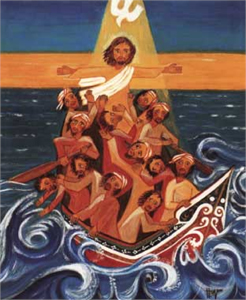
Then he [Jesus] got into the boat and his disciples followed him. Suddenly a furious storm came up on the lake, so that the waves swept over the boat. But Jesus was sleeping. The disciples went and woke him, saying, “Lord, save us! We’re going to drown!”
He replied, “You of little faith, why are you so afraid?” Then he got up and rebuked the winds and the waves, and it was completely calm.
The men were amazed and asked, “What kind of man is this? Even the winds and the waves obey him!” (NIV)
When I was a kid, every evening after supper and the news, I watched a show called To Tell the Truth. The show featured a panel of four celebrities attempting to correctly identify a described contestant who has an unusual occupation or experience. This central character was accompanied by two impostors who pretended to be the central character. The celebrity panelists questioned the three contestants; and, the impostors could lie but the central character was sworn “to tell the truth.” After questioning, the panel then attempted to identify which of the three challengers was telling the truth. The host would conclude the show by saying the famous line, “Will the real ______ please stand up!” The four panelists on the show often missed the real person, mainly because they had certain expectations of what the real person’s occupation or experience would be like. And their expectations did not match the real thing.
People in the first century had expectations of what the Messiah would be like. Their assumptions centered mostly in a manly Savior who would enter history and beat up the Romans, establishing the kingdom of God on earth with strong leadership over everyone. And that was why they missed the Messiah because their expectations did not fit the real Jesus.
It is imperative we do not miss Jesus because we have certain expectations of who he is, and what he should do, based on our own experience, or on what we want, rather than what God is doing.
God is at work bringing all things under Christ’s authority. The kingdom of God expands and develops when people follow Jesus through genuine humility, confession of sin, and reception of grace. Satan and his demons are quite displeased when this happens because they do not want Jesus on the scene to bring deliverance.
The devil had his own aspiration to do away with Jesus so that Christ could not accomplish the mission of redeeming the world back to God. Wiley old Satan wanted the violent storm to kill Jesus. However, Christ’s authority and power overwhelmed the “natural” act.
The real Jesus is, in truth, beyond our expectations. The emphasis in the story of deliverance from the storm is on the person of Christ. The people were surprised that even the wind and the waves obey him! They were afraid because of the furious storm. But Jesus was sleeping, not the least bit fearful. The disciples woke him, and the original text of the story has just three short staccato-breathed words expressing their abject fear: “Lord! Save! Dying!” Jesus seemed to lazily awake and chided them for little faith, for their inability to recognize who he really was. The disciples’ expectations of Jesus were way too low!
Many people believe that God hears and answers prayer. Yet, sometimes our faith can be so small that, when God answers those prayers in ways far superior to our expectations, we are slack-jawed astonished by it. Matthew’s Gospel records several instances of people being surprised by the real Jesus:
When Jesus had thrown out the demon, the man who couldn’t speak began to talk. The crowds were amazed and said, “Nothing like this has ever been seen in Israel.” (Matthew 9:33, CEB)
Everyone was amazed at what they saw and heard. People who had never spoken could now speak. The lame were healed, the crippled could walk, and the blind were able to see. (Matthew 15:31, CEV)
When the followers saw this [Jesus withering a fig tree] they were very surprised. They asked, “How did the fig tree dry up and die so quickly?” (Matthew 21:20, ERV)
They were surprised to hear this [how insightful Jesus is to the human condition]. Then they left him alone and went away. (Matthew 22:22, GW)
But Jesus said nothing in answer to Pilate, and Pilate was very surprised at this. (Matthew 27:14, NCV)
The real Jesus is more marvelous, wonderful, powerful, and awesome than we know. Jesus will take care of us; he will not let his people be destroyed. When we truly grasp the real Jesus, and how much he loves us, there is no room for fear, only faith.
Even though the disciples’ faith was small, Jesus still responded to it with grace because even small faith is faith. Grace is undeserved help. Our Lord helps anyone who approaches him, whether with little faith or big. Our small faith is no obstacle for Jesus in delivering us from the storms of life.
I am wondering if you are presently experiencing a violent storm in your life. Please know that Jesus can bring peace.
Perhaps you have a besetting sin that dogs you every day. Jesus can deliver you.
It could be that depression follows you like a lost kitten wherever you go. Jesus can bring new life and fresh joy to your life.
Maybe there is a relationship you have lost hope over. Jesus can restore it.
Perchance you think your neighbor, co-worker, or family member is too far from God to ever know Jesus. By now you know the response. Our expectations of Jesus are much too small! We can pray big prayers because we serve a big and powerful God who has the authority to command even the wind and the waves!
When the real Jesus confronts the world, he confronts injustice and the darkness within human hearts. Some people are crushed by their awareness of sin, disobedience, and guilt. Therefore, they respond by hungering and thirsting after true righteousness. Others respond by trying to domesticate Jesus in serving their own ends.
The Gospel of Matthew portrays Jesus as both a powerful and compassionate God. Christ has authority over all things, and uses that authority to bestow grace, even in the face of the smallest of faith in his followers. Jesus cares about people and seeks to deliver them from the dominion of evil.
So, may we participate with Jesus in his agenda for this world. May we submit to his rule and authority. May we exhibit the same care, compassion, and concern for people as Jesus does. May we identify the real Jesus to stand up.
Lord Jesus, Son of God, I believe all things are possible through you; help my unbelief! Take my small and seemingly insignificant faith and use it to calm the storms in my life and demonstrate your authority even over the wind and the waves. Amen.
The Sinking of the Apostle Peter by Julia Stankova, 2006
The New Testament Gospels of Matthew, Mark, Luke, and John allow us to see Jesus for who he really is: The Son of God, the true King of the universe who seeks to reconcile people to God through his life, miracles, and teaching. The Gospels also allow us to see the disciples of Jesus for who they really are: A rag-tag bunch who express both belief and doubt, and experience both faith and failure.
The reality of the Christian life is that it is often a herky-jerky three-steps-forward and two-steps-backward kind of experience. An expectation that we will “succeed” and have everything go well every time we try something by stepping out in faith is way out of step with how things work in both this world and in the kingdom of God. It would be a bit like a basketball player expecting to make every free throw attempt – and if they cannot do it, they refuse to even try.
Doubt and failure are important experiences for the believer in Jesus Christ. Without failure, there is no Christian life. Never failing means we have not tried – we are still in the boat, having never left the safety of established routines and responded to God’s command to come, leave your comfort zone, and enter the scary world of kingdom living.
Our failures may sometimes, like the disciple Peter, be colossal belly-flops. Yet, the story of Peter getting out of the boat and walking on the water and becoming overcome with the waves is just as much or more about Jesus (Matthew 14:22-33). Christ extended grace to Peter and helped him, even in his failure of faith. Therefore, our failures do not need to define us. Jesus is Lord over the water, the storms, and of everything – including our own hardship and trouble.
Yes, there are a lot of scary things in life. Learning to ride a bike is scary. Driving for the first time on an icy road is scary. Getting married and having kids is scary. Admitting an addiction or unethical behavior is scary. Sharing the innermost thoughts with a friend is scary. It is scary just to be in this world. It can even be scary to be at church! It is all scary because we might fail, and the failure, we reason and worry about, might crush us.
However, the fear of failure need not control our lives because grace overcomes everything. We all find ourselves, at times, caught midway between faith and doubt. Yet, to know this situation is to experience grace. If the worst scenario you worry about in your head would actually come to pass, it will still never change the reality that God loves you! And it will not stop Jesus from extending his hand to you in a life-saving grip of grace.
Jesus Saving Peter by Bertram Poole, 2012
Fear only melts away when we keep our eyes on Jesus. Christ is the polestar whom we must center our lives, instead of focusing on the waves around us. The truth sets us free, so, take note of the following truths about Jesus that will help us overcome the fear of failure and embrace a life of faith.
Jesus is a person of prayer (Matthew 14:22-24).
Jesus, the Son of God, was deeply dependent on his heavenly Father. His life exhibited the necessities of simple prayer and obedience. If Jesus found the need for solitude and prayer in his life and ministry, how much more to we need it!?
Jesus made the disciples get into the boat and go out on the lake. As Lord of the elements, he knew very well they were about to face a storm. Sure enough, the storm clouds gathered, and the boat got thrown around by the waves. Even though the disciples were doing God’s will by going out on the lake, they were not spared from the adversity. In fact, Jesus wanted them to experience the storm because it is through the storm that we really learn faith.
Faith is a muscle which requires continual use. Through stressful and vigorous exercise, there is a breaking down of muscle tissue and tearing of muscle fibers which leaves the body in need of rest and recuperation. It is through this process of healing that the muscles grow and are strengthened. Muscles which do not experience this type of stress become useless and eventually atrophy. Show me a person of great faith, and I’ll show you a person who has gone through a boat load of adversity and hurt, having allowed Jesus to grace them with healing.
There is no shame in either being hurt and/or admitting failure. Where there is shame, our instinct is to run away much like our ancestors Adam and Eve. We can try and hide from the shame, but we will end up hiding ourselves from the grace that could be ours through the Body of Christ. Grace is free, not cheap – it is accessed by the humility of confession.
Jesus is present with us, bringing an end to fear (Matthew 14:25-27).
Although on the middle of a lake during a storm, Jesus was still present with the disciples. Adverse weather was no problem for Jesus – he just walked on the water to be with them. Even though the disciples had just seen and participated in the miracle of Jesus feeding the five thousand, they were not looking for another miracle. Maybe that is why they did not recognize Jesus and were afraid when they saw him.
The disciples’ expectations of Jesus were far too low! Sometimes when we are afraid, we fail to see Jesus, even when he is right in front of our faces. We just do not expect him to be there. When the disciples cried out in fear, Jesus responded. I used to work at a factory where I trained people in their jobs. When the training was finished, I had the trainees evaluate our time together. The top response I received from most of them is that it was my presence that helped them to learn their job – the ability to fail time and time again. And having me there to rescue them when things got overwhelming eventually built faith that they could do it on their own.
Jesus wants those who follow him to imitate him (Matthew 14:28-31).
Jesus walked on water. Jesus invited Peter to walk on water. We are to do what Jesus did. Notice that Peter is not chided by Jesus for getting out of the boat but for doubting that he could continue in the miracle that was happening. Jesus wants more than a regurgitation or parroting of his teaching; he wants us to exercise that learning through actual deeds of faith. Once the command of Jesus was given to “come” then walking on water became nothing more than a matter of trust. Christianity is more than a set of doctrines to believe; it is a powerful reality to be live into.
“Christianity has not been tried and found wanting. It has been found difficult and left untried.” –G.K. Chesterton
We understandably get nervous when a crazy Jesus and an unpredictable Holy Spirit call us to get out of the friendly confines of the boat. After all, we might fail. However, it is in such times we bank on the Word of God and the promises of God.
The Apostle James said that if we find ourselves lacking wisdom to deal with the unpredictable and unknowable that we are to ask God who gives generously to all without finding fault and will be given to them (James 1:5).
Peter responded to his sinking situation by crying out to Jesus, “Lord, save me!” Jesus immediately reached out and saved Peter from his own doubt and lack of faith. Jesus called Peter a “little-faith.” Many people have lived too long with the notion that God is some stern angry deity who is constantly displeased with his sinful people, and that only through perfection will he ever be happy with us. The truth is that Jesus wants us to imitate him; and, when we fail, he is there to pick us up.
Jesus has the authority to settle the storm when he is good and ready to do it (Matthew 14:32).
Jesus is the King of the universe and the Sovereign of the world. He will bring the crisis to an end according to his own good pleasure and in his own good timing. Rather than spending all our emotional capital by worrying or conniving to get out of a situation, we need to trust God and keep our eyes on Jesus. Our job is trust; God’s job is everything else.
Jesus’ power led the disciples to acknowledge who he is (Matthew 14:33).
Worship happens when we see Jesus as he really is, the Son of God. Flat, dull, boring worship comes from flat, dull, boring Christians who are unable to see the power of Jesus in their lives. And the way we know the power of God is when we are in a situation which requires God’s strength to deliver us. Grasping Jesus as the Son of God is more than a verbal confession of faith; it is being able to trust him, like getting out of a boat in the middle of a lake.
We are to live by faith in the Son of God who loved us and gave himself for us (Galatians 2:20). It does not require much faith to pray that Aunt Mable’s bunions will feel better. It only requires a little faith to give a dollar when you have ten dollars. It takes no faith to discuss the weather and steer clear of hard conversations.
However, it does require faith to pray for a miraculous healing every day without giving up for a little boy who is racked by epilepsy, and trust God to spare his life. It does require faith to write a check for $100 to someone in need when you have exactly $100 in your checking account, and you must trust God to provide for you own necessities. It does require faith to deviate from the routine schedule to have a difficult discussion about race. It does require faith to act on Christ’s teachings. It does require faith to live as though the mission of God in this world is the most important thing we could ever do.
It would be nice for me say that if you live by faith in the Son of God that you will never fail, but that would be lying. The only way of not failing is not living life, and not exercising faith. It would be great if we could pray and act without ever doubting, yet the only way to avoid doubt is to not believe.
So, may we embrace the life that is truly life by stepping out of the boat. May Jesus define our lives instead of letting failure define us. May we accept the grace that is ours in Jesus Christ our Lord.










 Rev. Tim Ehrhardt