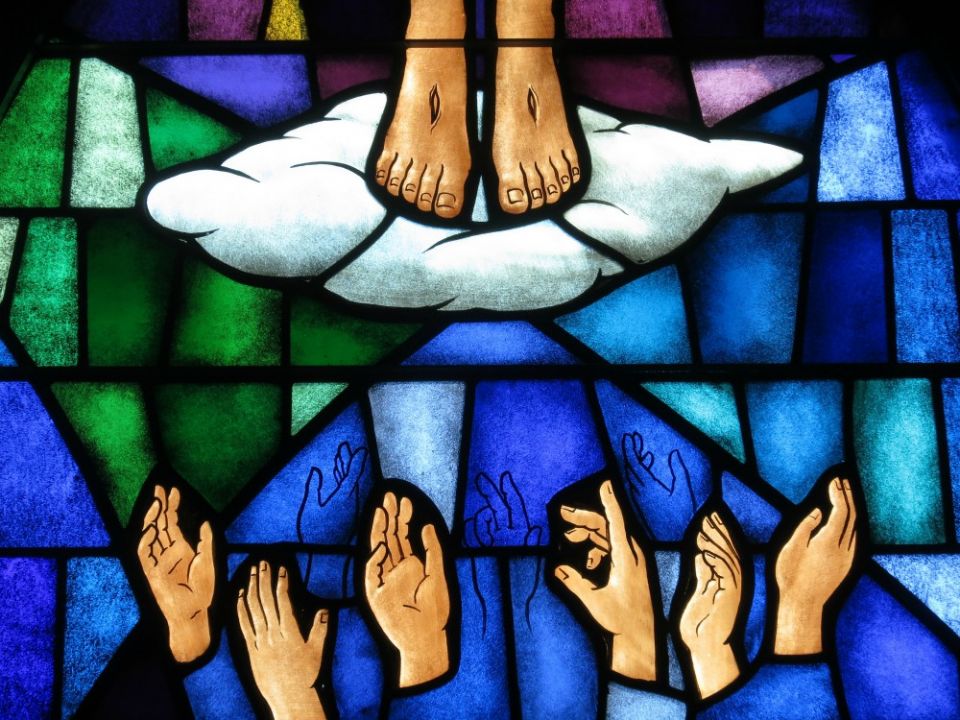
Ascension of the Lord (Acts 1:1-11)

The Ascension of Christ, by Pacino di Bonaguida, c.1340

Theophilus, the first scroll I wrote concerned everything Jesus did and taught from the beginning, right up to the day when he was taken up into heaven. Before he was taken up, working in the power of the Holy Spirit, Jesus instructed the apostles he had chosen. After his suffering, he showed them that he was alive with many convincing proofs. He appeared to them over a period of forty days, speaking to them about God’s kingdom. While they were eating together, he ordered them not to leave Jerusalem but to wait for what the Father had promised. He said, “This is what you heard from me: John baptized with water, but in only a few days you will be baptized with the Holy Spirit.”

As a result, those who had gathered together asked Jesus, “Lord, are you going to restore the kingdom to Israel now?”

Jesus replied, “It isn’t for you to know the times or seasons that the Father has set by his own authority. Rather, you will receive power when the Holy Spirit has come upon you, and you will be my witnesses in Jerusalem, in all Judea and Samaria, and to the end of the earth.”

After Jesus said these things, as they were watching, he was lifted up and a cloud took him out of their sight. While he was going away and as they were staring toward heaven, suddenly two men in white robes stood next to them. They said, “Galileans, why are you standing here, looking toward heaven? This Jesus, who was taken up from you into heaven, will come in the same way that you saw him go into heaven.” (Common English Bible)

It’s been two-millennia since Jesus Christ ascended to heaven. Since then, a lot has changed.

Yet, on the other hand, we’re still in the same situation as the early church: Jesus is still up there; and we are still down here. That means, because we are still awaiting Christ’s return, the original call and practice of the church is still in effect.

As far as experiences go, it’s hard to top being one of the original disciples and seeing Jesus ascend into the clouds to heaven. Now what? How do you go about your life after that?

In the spiritual life, we move back and forth between moments of genuine inspiration and the sheer routine of our daily mundane lives. The uplifting mountain-top experience and the hard slog of walking through the valley are both important. The trick is to channel the energy from one into the other. For that to happen, we need to work out rhythms of grace that connect expectant prayer with the action of being witnesses.

Prayer and witness – both are necessary for the church; and they are closely tied to the risen and ascended Christ. The ascension of the Lord Jesus means Christ is exalted above everything; he’s in charge. By his authority he has made us prayerful witnesses and given us the means of carrying out that job.

Jesus and the disciples, even after forty days together, post-resurrection, were not on the same page. The disciples were anticipating a restoration of David’s kingdom. Their vision for the future was a great apocalypse in which Jesus, as the ultimate mixed martial arts champion, would beat up all their enemies. Then, set up a political kingdom just like King David of old. 

But Jesus had a different agenda. Instead of creating an immediate utopia, where the disciples would be in charge and in control, Jesus bluntly told them that knowing God’s timetable is not in their pay grade. Instead, the disciples were commissioned for a job, which didn’t include gawking at the sky and trying to figure out when the end of the world was happening.

Christ’s Ascension, by Scott Rayl

Although we (understandably and deservedly) want peace and justice now, Jesus avoided handing out prophecy charts detailing when that would happen. He essentially said to quit thinking about that stuff because it’s really none of our business.

Rather, our business is being witnesses of Jesus. The angels came along immediately after Jesus ascended and said to the disciples to stop standing there slack jawed. Jesus is coming back and, meanwhile, there is a job to do – to be witnesses of Christ’s redemptive events. And, the strength of that witness will come from the Holy Spirit. So, hang tight in prayer.

So, what does it mean to be a “witness?” A few years back, I was called to the bedside of an actively dying patient. The patient’s spouse and parents were present. In the space of two hours I watched them in the throes of grief. And I provided all the spiritual support I could. 

The situation had similarities to many emergencies I have attended, with one exception: I noticed that I was different. I did not “do” or “say” a lot. Mostly, I was present. I remember, at times during my encounter, feeling helpless. In some ways I was. I certainly couldn’t fix a thing. Yet, this time, I saw my role in a new way. 

I distinctly remember the sense of bearing witness to this sacred event. There was an entire world outside the patient room that knew nothing of this family’s intense grief. But I knew. I watched the whole thing. I was present for all the struggles of the medical team, the tears of the husband, the grief of a Dad, the angry questions of a mother toward a God that she didn’t know how to approach – who seemed aloof and capricious.  I was there for it all. Even now, I still carry those folks and their story in my heart.

And it was enough. 

Yes, it was enough. This was the first time I ever said that after such a situation. I had a settled sense that the role of witnessing the events in front of me was a blessed and sacred responsibility. Billions of people on planet earth didn’t know the grief of these people. I did. Because I was there. 

There is something both mystical and necessary about this understanding of being a witness with active prayerful observation.

I wonder if that’s how the disciples felt after Christ’s ascension. Perhaps my experience is what Jesus meant when he said, “You shall be my witnesses.” Maybe a witness is one who has the special role of observing the suffering of Christ, his resurrection of the dead, and the ongoing work of the Spirit. 

God is, I believe, the ultimate witness. When no one else sees, God sees. Where there is grief, God is present. Wherever pain, hurt, and brokenness exists, God is there bearing witness to it all. 

And, once in a while, the Lord is gracious to invite me into the scene to witness it along with him. Jesus is our Immanuel – God with us. And that is enough for me. 

In the book of Acts, praying and witnessing was a consistent pattern that the early church practiced. They prayed about whom to choose as leaders and bore witness to the Spirit setting individuals apart for the work of gospel proclamation and service to the church. They prayed for the Holy Spirit to come on people and bore witness to miraculous signs of the Spirit’s work. They prayed for the courage to preach and heal and bore witness to the saving work of God.

As the book of Acts unfolds, we see Peter imprisoned for being a witness. So, the church went to prayer. Peter was released, and when he showed up at the prayer meeting, the believers at first did not believe it was him.  Even with their little faith they were able to witness God answer their prayers. (Acts 12:1-18)

It was at a prayer meeting where Paul and Barnabas were set apart by the Spirit to bear witness in other locations. (Acts 13:1-3)

While traveling from city to city, Paul constantly devoted himself to prayer and listened to the Spirit. (Acts 16:1-35)

People came to Christ because of prayerfully listening to the Spirit and the obedient action that followed by Peter, Paul, and the other believers giving witness to how the risen Christ saved their lives. This was possible because of the risen and ascended Christ.

There is not one square inch of this earth that Jesus is not Lord. This means we can be alive with devotion to prayer and to being witnesses in this world for Jesus. Just as a cup of coffee needs a warm-up, so our prayers need to be refreshed so that God’s purposes will be accomplished. And his purposes are that all of creation comes, in a real and practical way, under Christ’s lordship.

What does the ascension of Jesus Christ mean for us today? That we belong to God and have the wondrous privilege of prayer and witness in a world that so desperately needs to connect with the transcendent and divine.

John 1:14-18 – This Is the One

The Word became flesh and blood,
    and moved into the neighborhood.
We saw the glory with our own eyes,
    the one-of-a-kind glory,
    like Father, like Son,
Generous inside and out,
    true from start to finish.

John pointed him out and called, “This is the One! The One I told you was coming after me but in fact was ahead of me. He has always been ahead of me, has always had the first word.”

We all live off his generous abundance,
    gift after gift after gift.
We got the basics from Moses,
    and then this exuberant giving and receiving,
This endless knowing and understanding—
    all this came through Jesus, the Messiah.
No one has ever seen God,
    not so much as a glimpse.
This one-of-a-kind God-Expression,
    who exists at the very heart of the Father,
    has made him plain as day. (The Message)

This is an astounding passage of Holy Scripture! These are verses to savor and not quickly read through. The Apostle John’s opening comments to his Gospel are theologically rich, lovingly beautiful, and missionally sensitive. 

The high and holy God has chosen to come and show himself to us in the person of Jesus. We know God through Christ. We learn about what God is like through Jesus. God has condescended to us, bent down and communicated to us through means we can understand and discern, through the Lord Jesus. 

In the biggest cities of the world, like Mexico City, Mexico and Manilla, Philippines, there are huge garbage dumps that cover several square miles. On top of these heaps of waste there live thousands of families who have made this their home. 

Each day they send their kids out to forage for scraps so they can have something to eat and survive. Few others tread where these families are. Yet, there are believers who make the journey and try to bring the love of God to such a place.

As incredible and sad a situation this is, the journey from heaven to earth that Jesus made has no comparison.  Christ came to the sin-soaked dump of this world, to us who were living on a heap of garbage and entered into our lives to save us from our wretched condition.

“The Self-revealing of the Word is in every dimension – above, in creation; below, in the Incarnation; in the depth, in Hades; in the breadth, throughout the world. All things have been filled with the knowledge of God.”

St. Athanasius, On the Incarnation

Jesus did not just appear to be human. He actually became one of us. Christ, the rightful King of the universe, chose to live with all the same things we face from day to day.  He “tabernacled” with us, using the imagery of God’s presence with the ancient Israelites through their desert journey.

John and the other Gospel writers were evangelists; they wrote so that people might believe in Jesus and clearly see what God is doing for them amidst the grinding spiritual and physical poverty of this fallen world.

The Apostle John saw and experienced first-hand Jesus interacting with families in the dump. John knew what was happening; God was coming to save the people. 

The way to reach people, who are so concerned for scurrying about their business and trying to survive apart from God, is through the incarnation. Christ’s descent to this earth – his earthly ministry, his crucifixion, death, resurrection and subsequent ascension back to heaven – demonstrated how we, as his followers, are to live our lives.

Believers in Jesus testify to what God has done in Christ. They do so through being little incarnations, entering fully into people’s lives with the grace and compassion given them by their Lord. Christians are to be like the moon, not we ourselves producing light, but in the middle of darkness, reflecting the light of the sun (Son) so that the earth may know that Jesus cares and can deliver them.

The sort of God that Christians worship and serve is an over-the-top gracious and generous God who has gone to the most incredible lengths possible to restore lost humanity. 

Since God has bridged the great chasm between heaven and earth, the very least we can do is walk across the street, or across the room, and develop a new relationship with someone who needs the sort of deliverance Jesus can expertly provide. 

This is the One, Jesus, who shows us the glory of God.

God’s loving initiative can become our own motivation. Sit and soak with this wonderful passage of the New Testament today. Let it seep deep into your soul. Allow it to shape how you live your life.

Almighty God, whose blessed Son, our Savior Jesus Christ, ascended far above all heavens that he might fill all things: Mercifully give us faith to perceive that, according to his promise, he abides with his Church on earth, even to the end of the ages; through Jesus Christ our Lord, who lives and reigns with you and the Holy Spirit, one God, in glory everlasting. Amen.

Acts 1:1-11 – Ascension of the Lord

In my first book I told you, Theophilus, about everything Jesus began to do and teach until the day he was taken up to heaven after giving his chosen apostles further instructions through the Holy Spirit. During the forty days after he suffered and died, he appeared to the apostles from time to time, and he proved to them in many ways that he was actually alive. And he talked to them about the Kingdom of God.

Once when he was eating with them, he commanded them, “Do not leave Jerusalem until the Father sends you the gift he promised, as I told you before. John baptized with water, but in just a few days you will be baptized with the Holy Spirit.”

So, when the apostles were with Jesus, they kept asking him, “Lord, has the time come for you to free Israel and restore our kingdom?”

He replied, “The Father alone has the authority to set those dates and times, and they are not for you to know. But you will receive power when the Holy Spirit comes upon you. And you will be my witnesses, telling people about me everywhere—in Jerusalem, throughout Judea, in Samaria, and to the ends of the earth.”

After saying this, he was taken up into a cloud while they were watching, and they could no longer see him. As they strained to see him rising into heaven, two white-robed men suddenly stood among them. “Men of Galilee,” they said, “why are you standing here staring into heaven? Jesus has been taken from you into heaven, but someday he will return from heaven in the same way you saw him go!” (New Living Translation)

“At his Ascension, our Lord entered Heaven, and he keeps the door open for humanity to enter.”

Oswald Chambers

Jesus was taken up to heaven in what Christians celebrate as the “Ascension of the Lord.” This is a hugely important event for followers of Jesus.

The Ascension means that Christ is now presently sitting at God’s right hand, offering continual prayers on our behalf to the Father. We have an advocate, a champion, who has gone before us and secured deliverance from sin, death, and hell.

On top of it all, Christ’s ascension means that Jesus is the universal ruler; he commands a kingdom that will never end. Yes, the Ascension of the Lord is a big deal.

So, why does a day set aside on the Christian Calendar celebrating the Lord’s mighty and redemptive ascension over all creation garner such scant attention from many churches?

Maybe the church has A.D.D. (Ascension Deficit Disorder).

Our clue to the inability to focus on such a grand redemptive event is the disciples’ response when Jesus ascended.

The picture St. Luke paints for us in the account of our Lord’s ascension, is a group of guys looking up into the sky slack-jawed and shoulders hunched.

It took a couple of angels to come along and ask them what in the world they were doing just standing there. Now is not the time to stand and gawk at the clouds, the angels insisted. Jesus will come back when he comes back. You aren’t going to know when. So, now is the time to get busy with what Jesus just told you to do two minutes ago: Tell everyone about me.

Christ’s ascension to heaven is a deeply theological event. It’s freighted with major implications for our prayer lives. And it means Christ is the King to whom we must obey.

Jesus is coming again. In the meantime, there’s to be no cloud-gawking. Instead, there is to be a well-developed and well-cultivated connection with Jesus which proclaims the good news that Christ died, rose from death, and ascended to heaven for mine and your forgiveness of sins and a new clean slate on life.

Trying to peer into the future about how the end of history will shake-out is, frankly, not the job we are called to do. Believers in Jesus aren’t supposed to stand and gawk at the clouds waiting for the Lord’s return, as if we are in some earthly holding tank until heaven. 

Rather, we are to bear witness about the person and work of Jesus. The Ascension of the Lord means we are God’s people blessed with deliverance from the realm of sin, and the hope of Christ’s coming again. The Church everywhere recognizes together the rule and reign of the Lord Jesus.

The world, as we know it, shall eventually come to an end. Until that time, Christians since the time of the ascension have been proclaiming Christ crucified, died, risen, ascended, and coming again.

This is a day of joy and celebration for us. Jesus is our ascended and glorified king! The fate of the earth is with the benevolent and mighty Ruler of all. Jesus is Lord, and no other human leader is. Thank you, Jesus.

The great Reformed Confession, the Heidelberg Catechism, question and answer 49, states:

Q: How does Christ’s ascension to heaven benefit us?

A: First, he is our advocate

            in heaven

            in the presence of his Father.

Second, we have our own flesh in heaven

            as a sure pledge that Christ our head

            will also take us, his members,

            up to himself.

Third, he sends his Spirit to us on earth

            as a corresponding pledge.

            By the Spirit’s power

                        we seek not earthly things

                        but the things above, where Christ is,

                                    sitting at God’s right hand.

Amen.

Acts 1:1-11 – When Will We Engage in Our Ministry?

In my former book, Theophilus, I wrote about all that Jesus began to do and to teach until the day he was taken up to heaven, after giving instructions through the Holy Spirit to the apostles he had chosen. After his suffering, he presented himself to them and gave many convincing proofs that he was alive. He appeared to them over a period of forty days and spoke about the kingdom of God. On one occasion, while he was eating with them, he gave them this command: “Do not leave Jerusalem, but wait for the gift my Father promised, which you have heard me speak about. For John baptized with water, but in a few days you will be baptized with the Holy Spirit.”

Then they gathered around him and asked him, “Lord, are you at this time going to restore the kingdom to Israel?”

He said to them: “It is not for you to know the times or dates the Father has set by his own authority. But you will receive power when the Holy Spirit comes on you; and you will be my witnesses in Jerusalem, and in all Judea and Samaria, and to the ends of the earth.”

After he said this, he was taken up before their very eyes, and a cloud hid him from their sight.

They were looking intently up into the sky as he was going, when suddenly two men dressed in white stood beside them. “Men of Galilee,” they said, “why do you stand here looking into the sky? This same Jesus, who has been taken from you into heaven, will come back in the same way you have seen him go into heaven.”

When will we engage in our ministry? The short answer: Now.

The angels in this story sound a lot like my mom when I was a kid: “Why are you just standing there looking into an empty sky?  You need to quit your gawking and get to work!”

But sometimes we can be confused about what it is we are supposed to be about or when we are supposed to do it. Jesus was quite clear about what the mission of his followers is to be: witnesses.  And the angels essentially tell the disciples to quite their gawking and get to work on being witnesses.

Being a Witness Now

The mission is not simply to do some sort of evangelical job of witnessing, but to be a witness. What we do flows from who we are and what we have seen. If we have seen and experienced the risen Lord, we are witnesses. We then tell of what we have seen and heard, not necessarily because it’s our job, but because we just cannot help it.

A mom nurtures her kids because she is a mom; it isn’t just a job – it’s who she is. To be a witness involves the kind of people we are. The word “witness” is literally the term “martyr.”  A martyr, as the term has been used throughout church history, is:

  • One who chooses to suffer death rather than deny the person and work of Jesus Christ.
  • One who bears testimony to the truth of what they have seen or have experienced with God.
  • One who sacrifices all things to further God’s kingdom.
  • One who is willing to endure anything from anyone to maintain their Christian witness. 

A martyr is someone we are, not a task that gets checked off a to do list.

There is a clear mandate and mission given by Jesus, the Head of the Church: We are witnesses. We are participants in service to Christ the King, and not fans of Jesus only cheering in the bleachers. It’s a very different experience being a fan in the stands than a player on the field.

In baseball, some fans think they know what all the right calls are, then graciously let the umpire know when he is wrong. Being a spectator is significant. Yet, for us here on this earth, it is not yet our time for that. Those who have gone before us, lived in faith, and were martyrs, are testifying to us….

Some faced jeers and flogging, and even chains and imprisonment. They were put to death by stoning; they were sawed in two; they were killed by the sword. They went about in sheepskins and goatskins, destitute, persecuted and mistreated—the world was not worthy of them. They wandered in deserts and mountains, living in caves and in holes in the ground. These were all commended for their faith, yet none of them received what had been promised, since God had planned something better for us so that only together with us would they be made perfect….

Therefore, since we are surrounded by such a great cloud of witnesses [martyrs], let us throw off everything that hinders and the sin that so easily entangles. And let us run with perseverance the race marked out for us, (Hebrews 11:36-40, 12:1, NIV)

The Christian fans in the heavenly stands are witnessing that they have participated in God’s mission. And they are not unruly – spilling their beer on people and getting kicked out of the stadium. Instead, they are encouraging us who are here, right now, on this earth, seeking to fulfill Christ’s mandate.

Those who have gone before us are passing the baton of leadership and the message of good news to us – and they expect us to run with it – not to try and sit in the stands as spectators because it is not yet our time.  They are cheering us on, letting us know it’s all worth it.

Now is the time to be witnesses of what God in Christ has done and is doing. God created a perfect world. Man and woman fell into disobedience and sin. Now, God is in the business of restoring and renewing all creation. So, we are to witness to what God has done, and is doing, because our identity is thoroughly in Jesus Christ. It is our heritage and our privilege.

“Let God be the Judge. Your job today is to be a witness.”

Warren Wiersbe

In the 1990s a Christian prisoner in Cuba was asked to sign a statement containing charges against fellow Christians that would lead to their arrest. He said, “The chain keeps me from signing this.” The communist officer protested, “But you are not in chains!” “I am,” said the Christian. “I am bound by the chain of witnesses who throughout the centuries gave their lives for Jesus Christ. I am a link in this chain. I will not break it.”

Christ’s words are directed to us: “You will be my witnesses,” you and me. If we look at this as merely a task, we will likely give up and whine, saying, “This is too hard. It takes too much time. There’s too much suffering. This isn’t for me!” 

If we understand our identity as being a witness, then we will love God with all our heart, soul, mind, and strength. We willingly abandon our own personal agendas and adopt the will of God for our lives. And the will of God is that we embrace our identity as witnesses to the redemptive events of Jesus – Christ’s incarnation, holy life, compassionate ministry, suffering and death, rising from the grave, and ascending to heaven.

What do you have to witness to? Here is a teenage girl’s witness when he stood glaring at her, his weapon before her face, asking, “Do you believe in God?” She paused because it was a life or death question. “Yes, I believe in God.” “Why?” asked her executioner. But he never gave her the chance to respond. The 17-year-old girl lay dead at his feet. 

This scene could have happened in the Roman coliseum, in the Middle Ages, or in any number of countries around the world today. People are still being imprisoned, tortured, and killed every day because they refuse to deny the name of Jesus. This particular story, though, did not happen in ancient times or in another country. It happened at Columbine High School in Littleton, Colorado on April 20, 1999.

Being a Witness Everywhere to Everyone Now

The original witnesses of Jesus Christ embraced the mandate of being witnesses. Not far into the New Testament book of Acts, 3,000 people in Jerusalem were converted to Christianity through one sermon from Peter’s witness. Philip broke all kinds of taboos by going to Samaria and being a witness to the half-breed Samaritans. Peter broke all convention by going into a Gentile’s house and seeing the Spirit come on them. Saul, who became Paul, was dramatically converted and went on three separate missionary journeys so that he could take the good news of Jesus Christ to the ends of the earth.

We are to be witnesses wherever we go with whomever we encounter. We will be witnesses in Jerusalem (our families); in Judea (our community); in Samaria (other races and people different from ourselves); and, to the ends of the earth (overseas).

Being a Witness Through the Spirit’s Empowerment Now

Only after giving the mission to his followers did Jesus ascend to heaven. The ascended Lord is to be our confidence and our hope. We are not alone. We possess Christ’s authority and the Spirit’s help. The power to be a witness is not generated from within us but comes from God’s Spirit.

Jesus will return. Until then, we are to be his witnesses. It’s not the time to sit in the bleachers. We have been given power to accomplish the mission before the end of this world comes, and before Jesus comes again to judge the living and the dead.

Being a witness is not a one-time, one-size-fits-all work. Our own witness is just that: ours. We all have our own stories of faith and experiences of the risen and ascended Christ. There’s really nothing flashy or sexy about being a witness. Rather, it mostly entails a consistent and patient witness of love. It’s a lifestyle and a way of life in which our love for God pours out of our heart and soul and is expressed with all our mind and strength.

Every Christian can witness to what God is doing in their life – to tell our story of what God has done and is doing with us.

Holy God, you are making all things new through your gracious reconciling and restorative work. Grant us, your people, the vision to see you at work in our world healing our brokenness and making us new. Grant us the wisdom to hear your voice through the noise that surrounds us. And grant us the courage to bring to fruition the world you are creating, through Jesus Christ our Lord, in the power of your Holy Spirit. Amen.