Taste That the Lord is Good


            Throughout the past thirty-one years of Thanksgivings that my wife and I have celebrated together, many of them have included college students, co-workers, and church members – all with no family in the area.  On one particular Thanksgiving we had a young woman from India over to eat with us.  She was a Hindu from the highest caste in Indian society.  She looked like a real live Indian Barbie doll and carried herself like royalty.  She had never observed Thanksgiving and been with an American family to celebrate it.  It is always our tradition to go around the table during the meal and describe one thing we are thankful for in the past year.  I purposely made sure she was the last one to share, and let her know that she was not obligated to do so.  But she wanted to speak and said this:  “I never knew that there could be love like this amongst a family.  You see, in my culture we are always concerned about how we are displeasing one of our many gods and what we can do to appease them and solicit their help.  Love is not something we think much about.  I do have a question, if I might ask:  Why do you eat this food, and why so much?”  Yeah, good question!  Why dowe do that?  And why do we do what we do at Christmas?  Why do we hold to certain traditions and do particular things in the holiday season?
 
            I said something to her like this:  “The food reminds us that the God we serve is a good God who provides us not only with what we need, but graciously gives us beyond what we even ask or deserve.  This is what we call “grace.”  And the fellowship we share around the table reinforces the story of God – how we were once spiritually hungry – and God sent his Son, Jesus, to give us what we could gain for ourselves.  He satisfied us with the spiritual food of forgiveness and freedom to become the people we were intended to be from the beginning.  The food is symbolic and the celebration is a ritual that reinforces God’s grace to us in Christ.”  She left that day with many questions and lots to think about.
 
            God uses symbols to reveal himself to us.  For example, when he wanted to show us the ugliness of sin and the cost of forgiveness, he told his people, the Israelites, to kill an animal and sprinkle its blood on their clothing and on the altar.  It sounds awful.  But no worshiper ever walked away from that experience scratching his head and wondering what in the heck it was all about.  That’s because he encountered and tasted the drama of sin and redemption.  His senses saw it, felt it, smelled it, and tasted the meat from it. 
 
            Symbols have power.  God wants us to know him, and we cannot know him with only our minds.  We are not just brains on a stick.  We need more – we need ordinary events, like shared meals, that include symbols and rituals.  We need both words and sacraments.  That’s why holidays like Thanksgiving and Christmas involve both verbal expressions of gratitude and love, and particular actions of love in giving gifts and sharing food.  Together, it all connects us to God, to one another, and to a history of God’s people.  Jesus met his disciples in the Upper Room to celebrate Passover together.  Jesus energized their time together by filling it with words and symbols of love and redemption.  Jesus did not just tell them about his upcoming death.  He spoke and acted symbolically.  “Take and eat – this is my body….  Take this cup – this is my blood – drink from it, all of you.”  The disciples did not sit around and analyze the bread and discuss the wine’s vintage.  They ate and drank.  They tasted real food and drink, but they also tasted real spiritual food.  It is one thing to speak of God’s presence, and it is another to experience that presence through an ordinary shared ritual of bread and cup.


The taste of bread reminds us of:  the life of Jesus who humbled himself and became a baby; the incarnation of Christ; Christ’s humiliation and death.  The taste of drinking the cup reminds us of:  the blood of Christ; the sacrifice of Christ; the drops of blood which Jesus sweated in Gethsemane; and, the beatings, floggings, nails, and crown of thorns that resulted in Christ’s bleeding.  Tasting the bread and cup when we celebrate the Lord’s Supper reminds us that:  our sins are forgiven; we are united to Christ; and, we are united together.  We are encouraged through word and sacrament to proclaim the gospel of Jesus Christ until he comes again.  Respond to God’s wooing invitation through his church to eat and drink, to taste and see that the Lord is good through repentance and faith in Jesus.

How Has Jesus Touched You?


Touch is one of those things that we likely take for granted.  Yet, touch is very important to everyday life.  Several years ago, Philip Yancey and Dr. Paul Brand wrote a book entitled “Pain: The Gift Nobody Wants.”  It is largely a biography of Dr. Brand who pioneered both the diagnosis and prognosis of leprosy.  He discovered that leprosy occurs because of a lack of feeling – an inability to sense touch.  The delicate nerve endings we all have in our fingers and toes are numb to the leper.  The lack of sensing pain in the extremities leads to small cuts or injuries, which would be immediately treated by someone who feels pain, becoming gangrene with the losing of fingers and toes.
 
            When it comes to the spiritual and the emotional, the ability to feel is vitally important.  A calloused unfeeling heart and soul does not realize the damage that is being done to it.  One of the greatest gifts we have as people is the ability to feel guilt, sorrow, disappointment, and pain – it is actually a gift.  It brings about attention to prayer and addressing the situation.  In Luke’s Gospel account, Elizabeth was a godly woman who was sensitive to God.  She was the wife of Zechariah the priest, and came from a family of priests.  Elizabeth was also old and childless.  She believed her opportunity to be a mother was gone forever, and it pained her (Luke 1:5-25, 39-45).
 
            But God specializes in the impossible, and Elizabeth became pregnant with John the Baptist.  My wife and I are definitely past the child bearing years.  If my wife became pregnant right now it would really be a miracle.  But, when I think about it, the real miracle might not be a conception but in having the strength and energy to raise a newborn, a toddler, and make it through the tweener and teen-age years!
 
            Mary, the mother of Jesus, was the niece of Elizabeth.  As soon as Mary approached Elizabeth, the baby within Elizabeth did not just move but leaped in her womb (Luke 1:41).  Elizabeth was filled with the Holy Spirit – she felt the touch of Jesus.  Jesus touched Elizabeth’s life in ways she could never have dreamed.  Jesus changed her life.  Elizabeth was never the same after encountering this miraculous touch.  She knew great joy because she first knew great pain and sorrow.
 
            How has the touch of Jesus impacted your life?  As great as Elizabeth’s story is, and your story and my story, it really only points to a much larger and even more significant story:  the birth of Jesus and its significance.  All of our stories have meaning because of Jesus Christ.  Jesus is what made Elizabeth’s story such a great one.  Elizabeth’s response to being touched by Jesus was joy, thanksgiving, and blessing.  She blessed the whole thing.  To be “blessed” is to have God’s stamp of approval on your life.  There is an emotional component to the word.  It is to be happy.  In other words, to recognize God’s grace and goodness through his merciful approval results in the response of being happy and joyous.


            How has Jesus touched you?  What is your story?  How has that touch changed your life?  How, in response, have you touched Jesus and blessed his heart?  All of our stories are still being written.  Our lives aren’t over yet.  We still have the opportunity of using our lives in a way that will bless the heart of Jesus.  Having the courage and boldness to share our story with another, even in a church setting, has the possibility of not only affirming your own faith, but impacting someone else’s faith, as well.  May we believe that what the Lord has said will be accomplished in us.

Psalm 148


             The Church Calendar tells us that we are in the fourth day of the twelve days of Christmas.  The time between Christmas Day and Epiphany each year is twelve days.  Whereas during Advent the church anticipates the coming of Christ, the season of Christmas is a grand celebration of the Christ Child.  While those who keep secular time are experiencing a worldly hangover of fickle disappointment with presents and a gnawing in the gut that a single day of celebration is over, the church lingers in her joy over God’s grace in Christ.
             Praise is the currency of the divine economy.  Believers in Jesus deal in it just as a broker immerses himself in the stock market.  But it isn’t only Christians who celebrate; all of creation praises the God of heaven who has wonderfully given us Jesus.  All of creation is summoned to praise the Lord.  Yet, not everything has breath in it to do so.  Therefore God has raised his people to speak on behalf of the creation to do the job of praise.
             Here is an exercise to try the next time you take the dog for a walk or are spending time outdoors:  look at the trees, the rocks, and the elements of creation around you and imagine what they would say to God in praise if they had the breath to do it.  Speak for the creation.  Give it a voice.  Then, later imagine what you can say to God on behalf of people who do not or cannot praise him; be their voice.  Picturing all creation and every creature praising God can give a new and fresh form to how we relate to God, others in need of Jesus, and creation which needs proper care.
             Mighty God, I give you thanks for the gift of your Son, the Lord Jesus.  I, along with all creation, praise your glorious name for extending the grace of salvation to us in Christ.  May I open the gift given me every day throughout the year so that praise continually arises from my soul to the glory of Jesus Christ.  Amen.

Luke 2:1-20


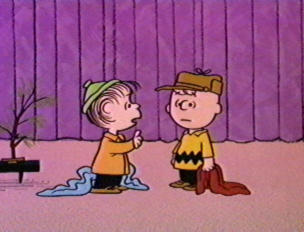
            There are a several holiday classics that my family and I enjoy watching every year at Christmas.  My clear favorite is Charlie Brown’s Christmas.  Since I am something of a cartoon connoisseur it would surprise no one that I would pick Charlie Brown.  But the real reason I watch this one over and over again is the story of Charlie Brown’s search for the meaning of Christmas.  He talks to people, looks to acquire a tree, directs a Christmas play, and tries to find in things, activities, and people the end to his search.  Just when he throws up his hands and believes he will never find its true meaning, Linus humbly and unassumingly declares that he can tell Charlie Brown what Christmas is all about.  And he proceeds to quote the birth narrative of Jesus from this account of Luke.

 
            Worshiping the Christ Child exposes the folly of searching for meaning in certain activities, other people, and the acquisition of stuff.  When approaching the manger we find that our quest for purpose and our place in this world becomes satisfied in God becoming a baby.  Doubt begins to melt into faith; despair starts to give way to unbounded joy; and, solidarity with the angels erupts in joining the heavenly chorus: “Glory to God in the highest, and on earth peace among those with whom he is pleased!”
 
            Indeed, we have found the pleasure of God through our pilgrimage to Bethlehem.  Too many people will be disappointed this season because family has let them down, their Christmas presents only satisfy for a moment, and all the food preparation and its consumption was so temporary.  But the true meaning of Christmas, with its lasting effects of peace and joy not only last for a season – they remain through the year and lead to eternal life.  Praise the name of Jesus.  Thank you, Lord.


            Gracious God, you have sent your Son into the world to redeem all the earth.  I not only focus on Jesus today, but choose to remember him all the year through.  May the true meaning of Christmas be renewed in my life today so that I might join the angelic chorus of adoration to you, and know Jesus.  Amen.